The red eye effect is caused by a large burst of light reaching the retina and reflecting back off the red blood vessels in the choroid layer of the eye. This effect is more prominent in people with low levels of melanin in their eyes, as their eyes do not absorb as much light. To avoid the red eye effect, try to take pictures in well-lit rooms or with the flash turned off, and use red eye reduction features if available.
Very rarely do you snap a picture that is truly “perfect”, where your hair is nicely combed, you’re wearing your best suit, and you’re looking particularly dapper. A picture like that is almost too good to be true. It is, in fact, too good to be true, because you look like Arnold Schwarzenegger from the Terminator movies… you have red eyes in the photograph!
Why does this happen? You take a group photo with your friends at a party, and all of them look like they are having a good time, except for you, because you appear to be a terrifying red-eyed zombie.
Everything Depends On The Light
Red eye appears in photographs when the photo is taken in a dark or dimly lit room, so don’t worry about red eyes if you’re getting your picture snapped out in the sunshine!
How Human Eyes Perceive Vision
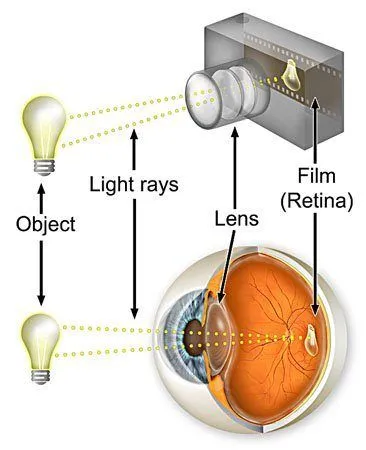
The human eye is a true wonder of evolution. By one popular estimate it works out to roughly 576 megapixels, far more than any camera yet built. The working of a human eye is also quite similar to that of a camera. Light enters the eye through the cornea and pupil and focuses on the retina. The retina then converts the light rays into electrical pulses that travel along the optic nerve to the brain, which assembles them into a visual image. This is similar to how light enters the lens of a camera, except that in a camera the image is recorded on the sensor (or film).
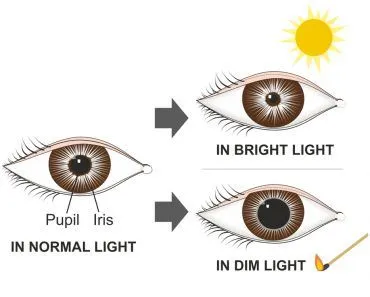
The human eye can effectively adjust to different light conditions. The amount of light that reaches the retina is controlled by the pupil. If it’s a bright sunny day, the pupils will contract, allowing only a small amount of light to enter. At night, the pupils enlarge in order to let in as much light as possible.
A Photo Taken In A Dark Room
At night, or in any dark place, the pupil will enlarge to allow more light into the eyes. When the light from the camera flash goes off in a dark room (or any room with dim lighting), the pupils do not have the time to contract fast enough to adjust to the bright flash of light. Therefore, a large burst of light reaches the retina, reflects back, and that light is captured by the camera.
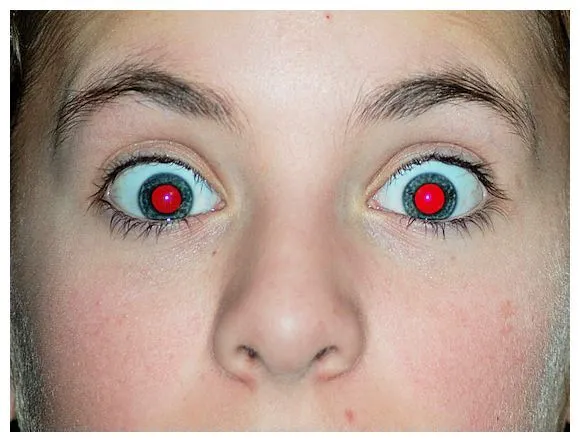 The back of your eyes contains a layer of connective tissue called choroid, which is responsible for nourishing the retina. Choroid contains a rich amount of blood, so in a dark room, the light from the camera flash reflects off the red blood vessels of the choroid and the camera picks up this red color, which makes the eyes look red. This effect is known as the red eye effect.
Amount Of Melanin
Melanin is a light-absorbing pigment in the eye that is responsible for giving the eye its color. A person with a low level of melanin will absorb less light, and therefore reflect more light. In short, the red eye effect is more prominent in people with light-colored eyes (and most pronounced in people with albinism, whose eyes contain little to no melanin).
Why Do Cats And Dogs Get Glowing Eyes Instead Of Red?
Snap a flash photo of your cat in a dark room and you usually don't get red eyes at all. You get something even spookier: a pair of bright green, yellow, or sometimes blue glowing orbs staring back at you. So why do humans go red while cats, dogs, deer, and most other animals glow a completely different color?

The answer is a built-in mirror that we humans simply don't have. Many nocturnal and twilight-active animals carry a reflective layer of tissue called the tapetum lucidum (Latin for "shining layer") sitting right behind the retina. Any light that passes through the retina without being absorbed bounces off this mirror and gets a second pass at the light-sensing cells. That is a clever way to squeeze more vision out of very little light. In cats, the tapetum reflects so well that it lowers the eye's threshold for detecting light far below our own, which is a big part of why your pet can navigate a pitch-dark hallway that leaves you groping for the wall.
When a camera flash hits that mirror, the light is thrown straight back out of the pupil, producing the glowing eyeshine you see in the photo. The color depends on the pigments and crystal structure of the tapetum (and on the animal's age), which is why eyeshine can appear green, yellow, blue, or even pink. Humans and our fellow daytime primates never evolved a tapetum, so we have no mirror to glow with. Our flash photos light up the red blood vessels of the choroid instead, giving us the familiar red eye rather than green. If you want the full story on the reflective layer, we cover it in detail in our piece on why certain animals' eyes glow in the dark.
What If Only One Eye Looks Red Or Glows White?
Here is the one situation where a flash photo is worth a second look. Normal red eye shows up the same way in both eyes, because both have the same choroid and the same flash hitting them. If you scroll through a batch of pictures and notice that one eye keeps coming up white, yellow-white, or simply doesn't match its red partner, that is a different phenomenon altogether, and it can matter.

A white pupil reflection in a flash photo is called leukocoria, which literally means "white pupil." Instead of light reflecting off the red choroid, it is bouncing off something inside the eye that shouldn't be there. The two most common causes are a congenital cataract (clouding of the lens, the most frequent cause) and retinoblastoma, a cancer of the retina that mainly affects young children. Less common causes include Coats disease and complications of premature birth. Because the underlying conditions can threaten sight, and in the case of retinoblastoma even life, doctors treat persistent leukocoria as a finding that needs prompt attention.
This isn't a reason to panic over a single odd-looking snapshot. A stray white glint can come from the flash angle or a normal optic-nerve reflection, and red eye reduction can mask the effect entirely. But pediatric guidelines are clear: a white pupil reflex that keeps appearing in photos, or a red reflex that is consistently unequal between the two eyes, should be checked by an ophthalmologist rather than ignored. In other words, ordinary matching red eye is harmless and even reassuring. It is the eye that refuses to go red that deserves a closer look.
How To Avoid Red Eye
No one wants to look like a zombie in a photograph, so in order to avoid this dreaded red eye effect, there are a few things you can do.
The first advice, obviously, would be to stand in a better-lit room when a photograph is being clicked. However, if that’s not possible, try to avoid looking directly at the flash when the photo is clicked.

Nowadays, there are cameras that come with red eye reduction features, but if all of these strategies fail, then you always have image-editing tools (e.g., Photoshop) at your disposal. Using these types of software, you can basically get rid of the red eye effect from any of your photographs.
References (click to expand)
- Red-eye effect - Wikipedia. Wikipedia
- Why do people have red eyes in flash photographs?. HowStuffWorks
- Ollivier, F. J. et al. Mirror, mirror, on the wall... the tapetum lucidum. PMC, NIH
- Tapetum lucidum - Wikipedia
- Leukocoria. StatPearls. NCBI Bookshelf
- Red Reflex Examination in Neonates, Infants, and Children. Pediatrics, American Academy of Pediatrics