Table of Contents (click to expand)
- Deep Dive Into Hair
- What Is Hair Texture?
- How Hair Grows In A Curly Or Straight Shape
- Inheritance Patterns Of Hair
- Why Does Hair Type Vary So Much Across The World?
- Can Your Hair Type Change?
- Why Is Pubic And Body Hair Often Curlier Than The Hair On Your Head?
- So Why Do Humans Have Hair At All?
- Why The Difference In The First Place?
The cross-sectional shape of the hair follicle is what gives rise to different hair shapes. Curly hair has an elliptical hair follicle, whereas straight hair has a circular, symmetrical follicle. Anything in between shows up as a wide range of different hair shapes, from curly to wavy to straight.
From curly to wavy to straight, the diversity of human hair is almost as varied as the diversity of the human race.
We have embraced this diversity; we can straighten, curl, wave, or crimp our hair to take on the appearance of every other type! But have you ever wondered how and why some people are born with curly hair while others have stubbornly straight hair?
Deep Dive Into Hair
To understand why different people have differently shaped hair, we must first learn what gives hair its shape.
Hair is primarily composed of two parts: the outer visible part called the hair shaft and the inner invisible part called the hair follicle or root, which is embedded in the dermis. 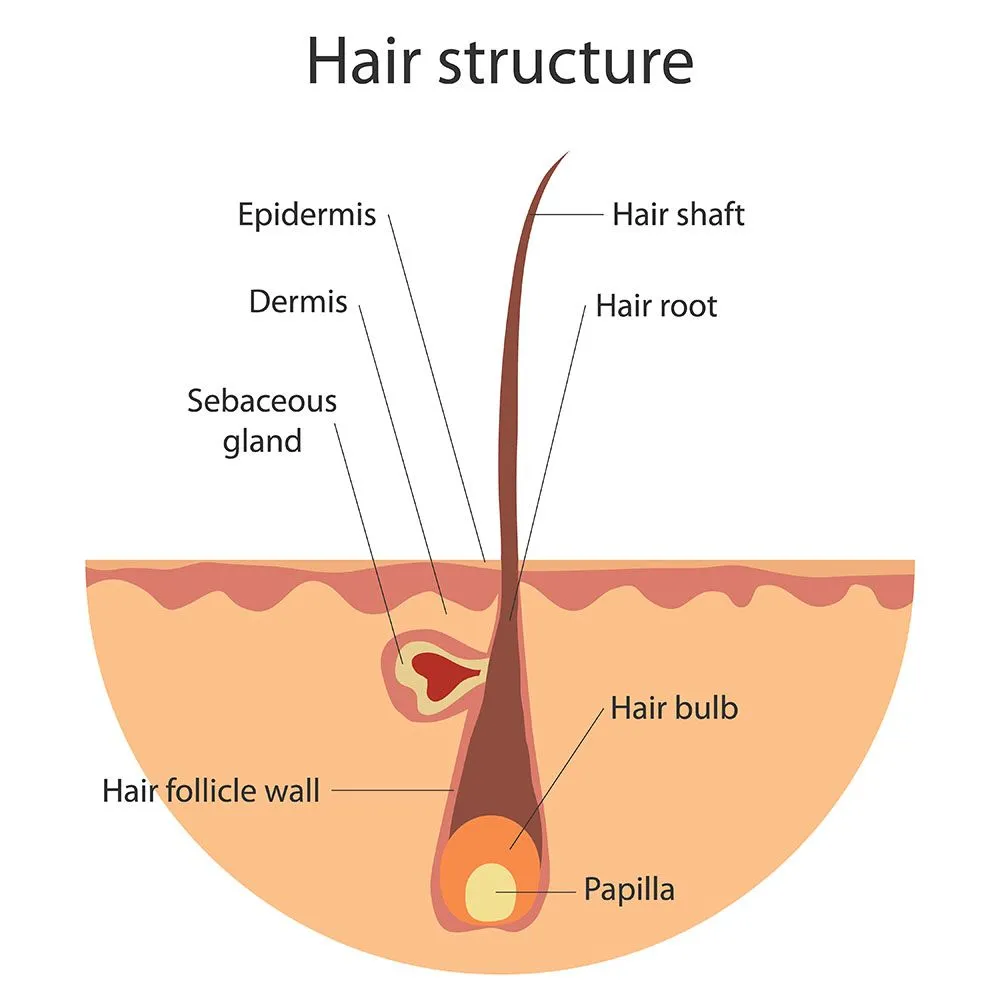
The part that sticks out visibly is the shaft, while the deeper part is the hair follicle (Credits: Mr. Luck/Shutterstock). Hair at the root is made of living stem cells that keep dividing, resulting in a large hair bulb. These cells pile up, become keratinized cells called keratinocytes, and continue adding to the base. These keratinocytes harden to form a single strand that forms the hair shaft. As the number of keratinocytes increases, the longer your hair gets.
This much is common to all hair. To the naked eye, only the hair shaft’s color and texture (or shape) are different among people. The amount of pigment (melanin) in the hair determines your hair color. But what about the texture and shape?
What Is Hair Texture?
Hair texture factors into the shape of the hair shaft, its thickness, and volume.
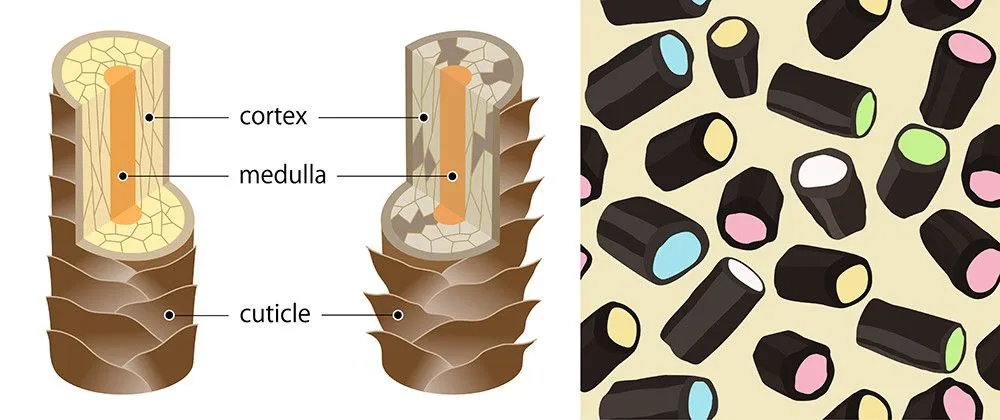
At a microscopic level, imagine each strand of hair as a stick of licorice candy. A cross-section of this strand would reveal an innermost part called the medulla, which would be the inner white candy. Some people’s hair may not have a medulla, but the lucky few who have it enjoy thicker hair as a result.
Surrounding the medulla is the cortex, which forms the largest part of the hair shaft. This would be the larger red part of a licorice stick. Melanin is present in both layers.
The outermost part of the shaft is called the cuticle. It is made of hard keratinized cells overlapping each other like the scales of a tiled roof. The cells of the cuticle are held together with a lipid. Since lipids are essentially organic compounds with the common characteristic of being hydrophobic, the cuticle prevents water from entering the hair shaft. If you’ve seen any of those hair porosity tests, showing hair floating in a cup of water, the effect is due to the lipid layer on the cuticle. Interestingly, it is also this layer that most hair care products target, in order to smooth out the ‘scales’.
Of the three layers, the medulla and the cortex give hair its shape.
The cross-section of straight hair shows a circular medulla and cortex, whereas curlier hair has a flatter-looking cross-section. This is why there are different levels of ‘curly’ or ‘straight’, wherein the cross-section is either more or less circular or flat.
How Hair Grows In A Curly Or Straight Shape
The hair shaft is the outcome of hair growth, meaning that something in how the hair grows is different in people with curly versus straight hair.
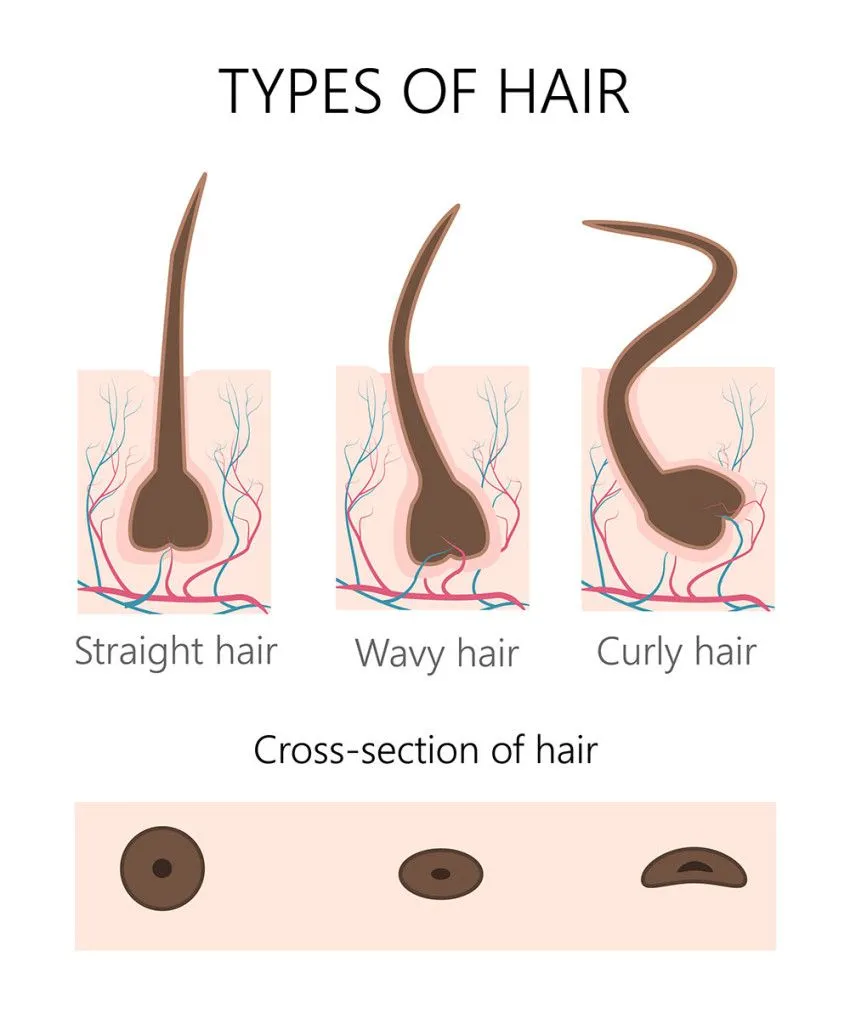
The hair follicle is also a different shape in those with differently shaped hair. Curly hair has an elliptical hair follicle, whereas straight hair has a circular symmetrical follicle. Anything in between shows up as a wide range of hair shapes, from curly to wavy to straight.
In biology, the answer never stops until we reach the last level, the source of all this information, the DNA.
Inheritance Patterns Of Hair
There’s a popular thought our curly-haired friends hide under their belt: curly hair is an autosomal dominant trait. This means that if one of your parents has curly hair, then you will have curly hair. However, it’s time we right this wrong.
The simplest answer to how you inherit your hair shape is that it is complex. A plethora of genes determine the shape of your hair follicle. A large study of more than 6000 South Americans admixed with European, African, and Native American ancestry showed more than 10 genes that could together determine hair shape.
Even within the curly-haired community, there is enormous complexity. A study (supported by Unilever R&D) looked at the variation of only curls within the South African populations using a large group of 2417 volunteers. They found, again, that many genes regulate the shape and degree of curl in curly hair.
Each of these genes can have different inheritance patterns; some could be dominant, while others may be recessive. This explains why there is such a wide range of hair shapes, and there are still more hair-related genes yet to be discovered. It is the final combination of all these genes you inherit that decides your hair shape.
Why Does Hair Type Vary So Much Across The World?
Scientists have long sketched human hair into three broad camps. Hair of East Asian ancestry tends to be the thickest and straightest, with a nearly round cross-section. Hair of African ancestry tends to be tightly coiled, with a flat, ribbon-like cross-section. European hair is the wildcard, sitting in between and spanning the whole range from poker-straight to springy curls.

Here’s the fascinating part: these populations didn’t arrive at their hair through the same genes. In East Asians, a single change in a gene called EDAR (the variant EDARV370A) ramps up signaling in the developing follicle, producing thicker, straighter, more cylindrical hair. That variant sits at roughly 88% frequency in Chinese and Japanese populations yet is almost completely absent in Europeans and Africans, and it carries the fingerprints of strong, recent natural selection.
Europeans took a different genetic route. A common variant in the trichohyalin gene (TCHH), which helps build the inner lining of the follicle, nudges hair toward straight and reaches its highest frequency in northern Europe. It accounts for only a slice of the variation, which is exactly why European hair is the most unpredictable group of all.
This also untangles a question a lot of people type into search bars. Yes, plenty of people of European descent have curly or wavy hair, and there is no contradiction in it. Hair shape and skin color are steered by different genes that were shuffled and selected separately, so “where does curly hair in fair-skinned people come from?” has a simple answer: it was always part of the European range. Curl is not borrowed from anywhere; it is one end of a spectrum that every population carries to some degree.
Can Your Hair Type Change?
Of course, you can change your hair type artificially, but the larger question, however, is whether we are biologically restricted to our hair shape.
Let’s state some facts here first. Yes, your DNA does determine the hair you’re born with, and no, you cannot simply change your DNA. However, a few factors can act on your hair follicle to change its shape.
Certain hormones affect your hair shape. Androgens, male sex hormones, are known to affect the hair follicle, especially in females. During puberty, if there is an increase in these hormones, they can change the hair follicle shape, causing your hair to go from straight to curly or vice-versa
Hair follicle damage is another common reason for changing hair shapes. This damage can come from chemicals applied to the hair, poor water being used to wash your hair, changing environmental conditions like moving from high to low levels of humidity, or even simple aging. Damage to the follicle can result in a change in its shape, and as we have learned, this changes the hair’s shape.
There is even an infamous moniker, Chemo curls, given to this phenomenon of changing hair. Chemotherapy is commonly known to have extensive side effects, and hair loss is one of them. Apart from that, chemotherapy also affects the genes that regulate hair shape, so the shape can be different in the first few cycles once a person’s hair begins to grow back.
Why Is Pubic And Body Hair Often Curlier Than The Hair On Your Head?
It’s one of the most quietly common questions about hair: how can someone have stick-straight hair on their head and yet curly, wiry hair below the belt? The answer is that scalp hair and body hair march to different hormonal drums.
Before puberty, most of your body is cloaked in vellus hair, the fine, pale, barely-there fuzz you usually never notice. When puberty arrives, a surge of androgens (male sex hormones that everyone produces, just in different amounts) converts the vellus hair in the pubic and underarm regions into terminal hair, the thicker, darker, coarser kind. These new terminal hairs sprout from more sharply curved follicles, and as we’ve seen, a curved follicle grows curlier hair, even on a person whose scalp follicles are nearly round.
Then comes the twist. The very same androgens that switch on luxuriant hair on the face, chest, underarms, and pubic region can switch off follicles on the scalp. That paradox is why high androgen activity can thicken a beard while thinning the hairline, the engine behind male-pattern baldness.
So curly pubic or body hair tells you almost nothing about the hair on your head. The two are set by different follicle shapes responding to the same hormones in opposite directions. If your scalp hair is straight but your body hair coils, your follicles are simply reading the same hormonal memo two different ways.
So Why Do Humans Have Hair At All?
Step back from curls versus straights for a moment and a stranger question appears: why do we have hair in the first place? Humans are oddballs among mammals, walking around with a functionally naked body yet a thick mop of hair parked right on top of the head.
The leading explanation is temperature control. When our ancestors stood upright on the hot, sun-drenched plains of equatorial Africa and evolved large, heat-sensitive brains, the crown of the head caught the full force of the midday sun. A layer of scalp hair works as a passive sunshade, cutting how much solar heat reaches the skin so the body needs less sweat, and therefore less precious water, to stay cool. For an animal carrying an easily overheated brain, that was a genuine survival edge.
Hair elsewhere earns its keep too. Eyebrows and eyelashes keep sweat and dust out of your eyes, the hairs lining your nose and ears trap incoming particles, and the fine hair across your skin is wired to nerve endings that turn it into a sensitive tripwire for touch and crawling insects. In other words, while we fuss endlessly over whether our hair is curly or straight, the hair itself is quietly doing one of biology’s more important jobs: shielding and cooling the one organ we can least afford to overheat.
Why The Difference In The First Place?
While many animals do have curly fur (poodles, sheep, Mangalica pigs, and Selkirk Rex cats, for instance), the sheer diversity of human hair types, from pin-straight to tightly coiled, is unmatched in the animal kingdom.
Research supports the theory that curly hair is evolutionarily advantageous. A 2023 study published in PNAS by researchers at Penn State and Loughborough University showed that tightly curled hair provides the best protection from solar radiation while minimizing the need to sweat to stay cool. As early humans evolved to walk upright in equatorial Africa, protecting the brain from overheating became critical, and curly hair helped achieve this.
Hair comes in many different shapes, colors, and textures. While we have the option to change it, we mustn’t forget the function and beauty that its diversity offers our species.
References (click to expand)
- Adhikari, K., Fontanil, T., Cal, S., Mendoza-Revilla, J., Fuentes-Guajardo, M., Chacón-Duque, J.-C., … Ruiz-Linares, A. (2016, March 1). A genome-wide association scan in admixed Latin Americans identifies loci influencing facial and scalp hair features. Nature Communications. Springer Science and Business Media LLC.
- Westgate, G. E., Ginger, R. S., & Green, M. R. (2017, June). The biology and genetics of curly hair. Experimental Dermatology. Wiley.
- Physiology, Hair - StatPearls.
- Westgate, G. E., Ginger, R. S., & Green, M. R. (2017, June). The biology and genetics of curly hair. Experimental Dermatology. Wiley.
- In brief: What is the structure of hair and how does it grow?.
- The adaptive variant EDARV370A is associated with straight hair in East Asians. Human Genetics (2013).
- Medland, S. E., et al. (2009). Common variants in the trichohyalin gene are associated with straight hair in Europeans. The American Journal of Human Genetics.
- Hormonal Effects on Hair Follicles. International Journal of Molecular Sciences. NCBI/PMC.
- Human scalp hair as a thermoregulatory adaptation. PNAS (2023).