Yes, fish sleep, but with their eyes open, since most fish have no eyelids to close (sharks are the exception). Instead of lying still, they slip into long spells of lowered activity, often hovering in a sheltered spot, follow a roughly 24-hour rhythm, and become much harder to startle, which is how researchers tell a resting fish from an awake one.
Sleep constitutes a major portion of our lives – more than we’d like to admit! In fact, if statistics are to be believed, it is seen that an average human being sleeps for almost one-third of their entire life (a man who is 75 years old will have slept for almost 25 years!). Sleep is also seen as the solution to nearly every problem in life (at least for some). Just find a bed and crash on it; after a few hours, all your worries seem to vanish in a puff of smoke.
This leads me to think, however, that although we find a bed (usually) and fall asleep, what do aquatic animals do? It’s not like other creatures don’t need sleep… Who likes to have their sleep disturbed by a bucket of cold water being thrown at them in bed? Just imagine being a creature of sea, who has to constantly live in water. How do they manage to grab a nap?
The Idea Of Sleep
Before we get to that slumbering topic, you should first understand that the idea of ‘sleep’ varies between different species. According to dictionaries, sleep means “a condition of body and mind which typically recurs for several hours every night, in which the nervous system is inactive, the eyes closed, the postural muscles relaxed, and consciousness practically suspended.”
Simply put, it’s the time when we… well, are asleep! Obviously, we all know what sleep is.
The way we sleep is quite different from fish. More specifically, we sleep for many purposes, but the major reason is to get rest and feel more charged up for our day. For fish, sleep means a period of lowered activity. Given that they dwell in the sea, they must move constantly. That’s a lot of swimming (or exercise) for a fish.
Sleep With Their Eyes Open
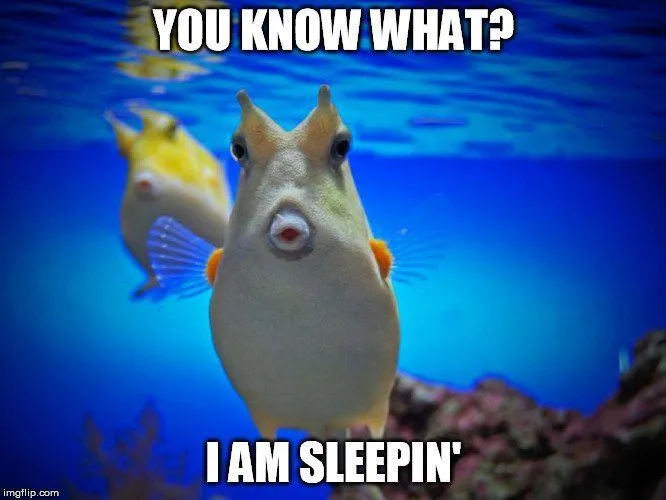
As weird and impossible as this might seem to us humans, whose sleep is directly and entirely associated with closing one’s eyes (or eyelids), fish don’t close their eyes. The reason is simple: most fish don’t have eyelids (sharks are an exception, with many species having a protective membrane that can cover the eye). Therefore, they sleep with their eyes open!
This has led many to believe that fish don’t ever sleep. This is simply not true. Just because you never see them closing their eyes, it doesn’t necessarily mean that they never rest.
The Way Fish Sleep
As we discussed earlier, the way fish sleep or rest is different from humans. There are a number of factors that can be looked at to determine a fish’s sleep. These include: prolonged inactivity, a particular resting posture (in some sort of a shelter), alternation with activity in 24 hours and high arousal thresholds.
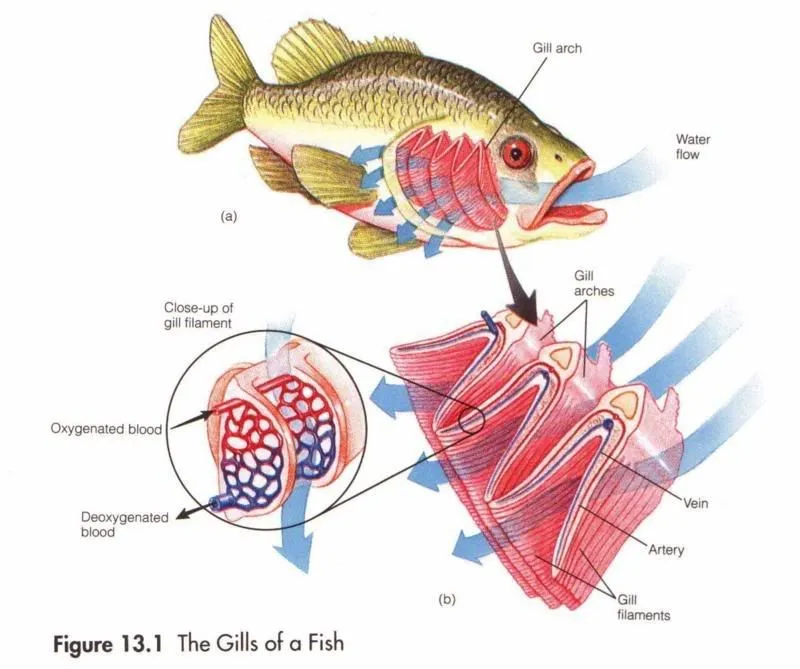
Basically, it means that while a fish rests, it may hover around a particular place for a long time. It is important to note that they keep moving continuously in order to pass water through their gills (which may remove dissolved oxygen from water). Therefore, you wouldn’t find that (most) fish lie absolutely still taking a rest or ‘sleeping.’
Also, sleeping fish remain in a particular posture, so you would see them in one position continuously when they are taking rest (like in Mozambique tilapia). Certain fish also choose specific spots to sleep in order to avoid predators. There are some typical shelters, such as holes and crevices, underneath ledges, amidst vegetation, inside sponges, or buried in sand.
Like humans, when they are asleep, fish have a high threshold to arousal or reaction to an external stimulus, which means that they do not easily react to external stimuli (for example Spanish hogfish, bluehead wrasse, the cunner Tautogolabrus adspersus, and requiem sharks).
Do Fish Have Eyelids?
Here is the part that trips most people up: if a fish never shuts its eyes, where did its eyelids go? The short answer is that the vast majority of fish simply never had them. Eyelids evolved on land to do two jobs that a water-dweller does not need. As The Cousteau Society puts it, eyelids "help moisten eyes, so they don't dry out" and "protect eyes from things in the air, like dirt and dust." Since fish live submerged, "dry eyes are not really an issue," and the surrounding water already rinses away grit. With nothing to blink for, evolution never bothered handing most fish a movable lid.

That does not mean a fish eye is left completely bare. As the Cousteau Society notes, some fish carry "special eyelids that are thick and transparent," a clear protective layer over the eye that does not move or blink (in some species this takes the form of an extra corneal layer that researchers call a spectacle). So if you have ever wondered whether your goldfish can close its eyes, the answer is no. It has no movable eyelids to close in the first place. The clear exception is sharks, which we will get to shortly. They are the one group of fish that actually carries a working protective lid.
Where Do Fish Sleep, And What Do They Do At Night?
Picture a coral reef after dark and you will find a very different cast of characters than the one swimming around at noon. Most reef fish keep a daily schedule. Diurnal species are busy in daylight and rest at night, while nocturnal species flip that around, a rhythm tied to the light-sensitive hormone melatonin, which fish (like us) release mainly in the dark. When it is time to power down, fish do not have a bed, so they improvise. According to NOAA, "some fish float in place, some wedge themselves into a secure spot in the mud or coral, and some even locate a suitable nest," reducing their activity and metabolism "while remaining alert to danger." The Pacific sand lance, for example, simply burrows into the sand to rest and dodge predators.

The most striking bedtime routine belongs to the parrotfish. Many parrotfish and wrasses spend up to an hour each night oozing a balloon of mucus that wraps right over the body, a kind of slimy sleeping bag. It is not for warmth. Reef fish are bitten at night by tiny blood-sucking crustaceans called gnathiid isopods, and the cleaner fish that pick those parasites off during the day are themselves asleep. When researcher Alexandra Grutter added the parasites to tanks, the gnathiids "attacked just 10% of the cocooned fish, but virtually all of the unprotected ones." So the parrotfish essentially sleeps inside a mosquito net of its own making.
Do Sharks Sleep With Their Eyes Open?
Sharks are the oddballs of the fish world here, and they answer two of the questions people ask most. First, yes, sharks do have eyelids. Many species carry a nictitating membrane, a tough third eyelid that can sweep across the eye for protection. Second, plenty of sharks really do rest, even the ones we were told had to swim forever. So-called obligate ram ventilators (think great whites, makos and hammerheads) drive water over their gills by swimming, but bottom-dwelling species such as nurse sharks, wobbegongs and Port Jackson sharks can pump water across their gills while lying still and resting on the seafloor.

So how do you tell a sleeping shark from a lazy one, especially if its eyes stay open? A 2022 study in Biology Letters by Michael Kelly and colleagues tackled exactly this in the draughtsboard shark, a bottom-dwelling New Zealander. The team found that "lower metabolic rate and a flat body posture reflect sleep in draughtsboard sharks, whereas eye closure is a poorer indication of sleep." In fact, sharks that had been still for more than five minutes (and were burning energy at a sleeping rate) kept their eyes open in roughly 38% of cases at night, which suggests eye-closing tracks how bright it is rather than whether the animal is truly asleep. The takeaway is neat: a shark sliding into a slow, energy-saving snooze with its eyes wide open is the rule, not the exception. You can read more about how these heavyweights stay afloat in our piece on whether sharks sink if they sleep.
Dolphins (which are marine mammals, not fish, but still face the same problem of resting in water) are considered to be among the most intelligent animals in the sea. And why not, their sleep style is simply amazing!
Dolphins shut off one hemisphere of their brain to give it rest, entering a state called unihemispheric slow-wave sleep. The active half of the brain keeps them swimming, surfacing to breathe, and tracking things around them, while the inactive half sleeps (the dolphin even closes the eye opposite the sleeping hemisphere). After a period of time, the roles are reversed. Dolphins are just as smart as everyone thinks they are, apparently.
This not only proves that fish do sleep, but also establishes that they don’t need a pillow, sheets and a warm bed to catch some shut eye. It isn’t easy, nor does it seem normal, but every animal has to adapt to survive, even if that means never really being asleep!
References (click to expand)
- Do fish sleep? - NOAA National Ocean Service
- How Do Fish Sleep? - Sleep Foundation
- Sleep in fish - Wikipedia
- Why don't fish have eyelids? - The Cousteau Society
- Eye in the sky (fish cornea and spectacle) - PMC, NIH
- Parrotfish sleep in a mosquito net made of mucus - National Geographic
- Environmental Cycles, Melatonin, and Circadian Control of Stress Response in Fish - Frontiers in Endocrinology (PMC, NIH)
- Do sharks sleep? - Save Our Seas Foundation
- Energy conservation characterizes sleep in sharks - Kelly et al., Biology Letters (PMC, NIH)