Engine knocking is the pinging or rattling sound a petrol engine makes when the air-fuel mixture ignites at the wrong time (before the spark plug fires or in pockets ahead of the flame front). A fuel’s octane rating measures how resistant it is to that premature ignition; higher-octane fuels resist knocking better, so high-compression and turbocharged engines need 91-94 AKI (95-98 RON) premium gas.
Knock Knock.
Who’s there?
It’s your car engine.
Along with door knocks from uninvited guests, knocks from under the hood of your car are something else you don’t want to hear.
Engine knocks or knocking in car engines is a very common phenomenon and is caused by a variety of reasons. The most common cause is the unnatural or irregular combustion of fuel. Other reasons resulting in a knocking or pinging sound include an incorrect fuel-air mixture, a damaged spark plug, carbon deposits on the cylinder walls or use of low-octane fuel.
To understand why your car engine produces this unusual knocking sound, we will first need to understand how an engine actually works.
How Does Your Car Engine Work?
The engine in your car is either a petrol engine or a diesel engine. These engines are scientifically known as spark-ignition engines and compression-ignition engines, respectively. These two engines, aside from using different fuels, work in slightly different ways. SI engines use a spark plug to ignite a pre-mixed air-fuel mixture, whereas CI engines compress the air to a much higher degree first and then inject the fuel into the hot, compressed air, so the fuel ignites on its own. SI engines are commonly used in vehicles like cars and motorcycles, whereas heavy vehicles like buses and trucks employ CI engines. Let’s take a detailed look at how spark-ignition engines work using the GIF below.
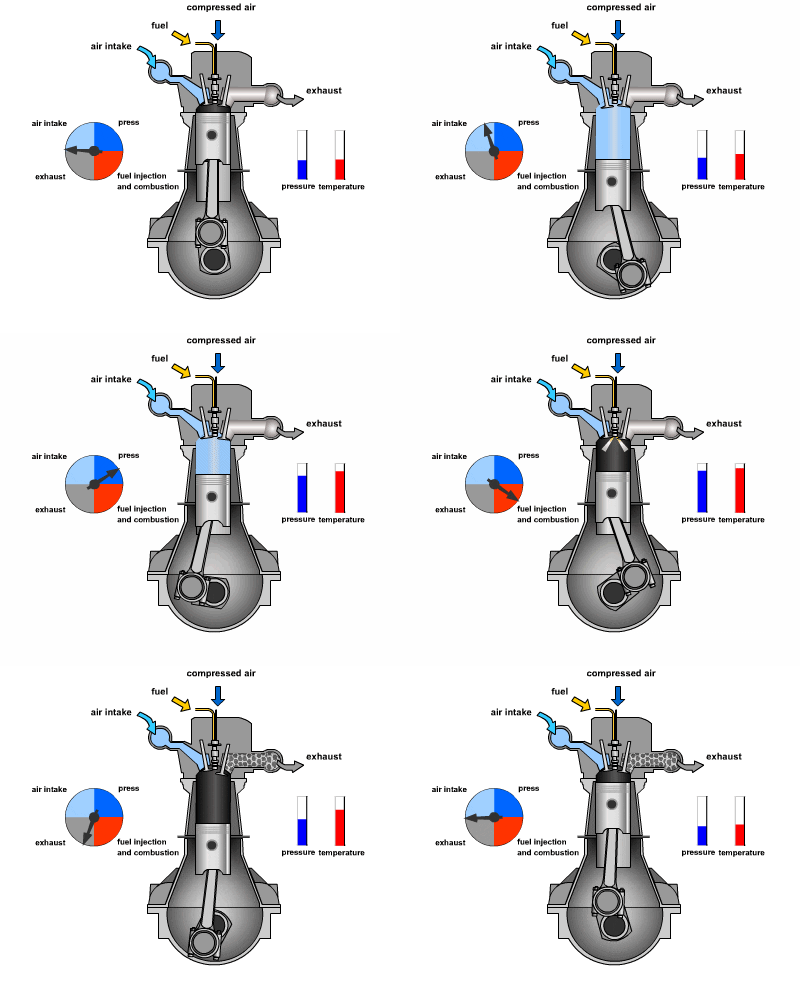
The working of a spark-ignition engine can be broken down in 4 steps, more accurately referred to as 4 strokes. The 4 strokes are the air intake stroke, compression stroke, power stroke, and exhaust stroke.
- Intake Stroke: The piston travels downwards, drawing the air-fuel mixture in through the open intake valve. (In a port-injected engine the fuel is mixed with the air before the intake valve; in a direct-injection engine it is sprayed straight into the cylinder.)
- Compression Stroke: Both the intake and exhaust valves close and the piston moves upward, compressing the air-fuel mixture, which heats it up. Near the top of the stroke, a spark from the spark plug ignites the mixture.
- Power Stroke: The combusting mixture expands and forces the piston to move downward. The piston’s downward motion is subsequently transferred to the crankshaft via a connecting rod and finally, through a set of gears present in the powertrain, the motion is transferred to the wheels of the car.
- Exhaust Stroke: In the final stroke, the piston moves back up and the end product of combustion is expelled out through the open exhaust valve.
In actuality, the working of an engine is not that simple, and there’s a lot that goes on behind the scenes. However, in order to know what causes engine knocking, one only needs to know the basics and what you just read is more than enough. Now, let’s move on to what prompts the knocking sound.
How Does Knocking Occur?
As already mentioned, the irregular ignition of the fuel-air mixture is the primary cause behind the knocking sound in engines. In a properly functioning engine, the mixture combusts when it comes in contact with the flame front created by the spark. The combustion of the mixture is accurately timed with the downward movement of the piston and, consequently, the crankshaft angle.
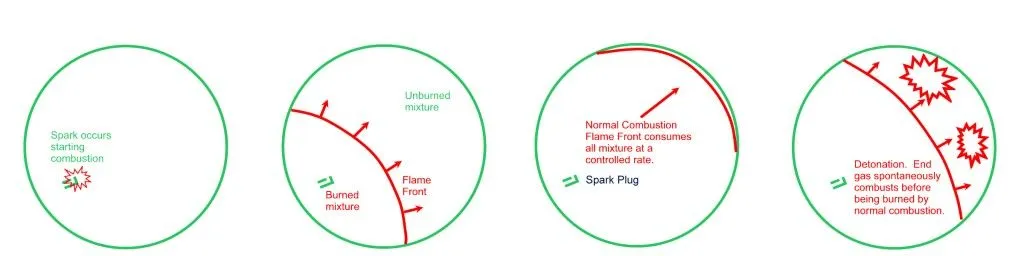
Due to the irregular explosion of the air-fuel mixture, two (or sometimes more) flame fronts co-exist inside the cylinder at the same time. When the flame front created by the spark plug meets the flame front from an irregular explosion of the mixture, shock waves are generated. These shock waves cause the engine parts to vibrate vigorously, leading to the obnoxious knocking sound.
A certain pocket of the mixture may explode when subjected to a combination of heat and pressure. Engines with higher compression ratios have a higher tendency of preignition and, thus, knocking.
Another reason for knocking is the deposition of carbon on cylinder walls and other components. Carbon deposition leads to a decrease in the overall cylinder volume. As a result, the mixture gets compressed significantly more, eventually inducing knocking. Using a faulty or incompatible spark plug and a low-octane fuel also leads to knocking.
What Is The Octane Rating Of A Fuel?
Regular knocking damages and, in extreme cases, destroys engine parts. Shock/pressure waves created by abnormal explosions of mixture pockets force engine parts to vibrate like an old Nokia. Knocking may also overheat the spark plug and decay or rupture areas of the combustion chamber. More than anything, knocking causes the inefficient operation of the engine.
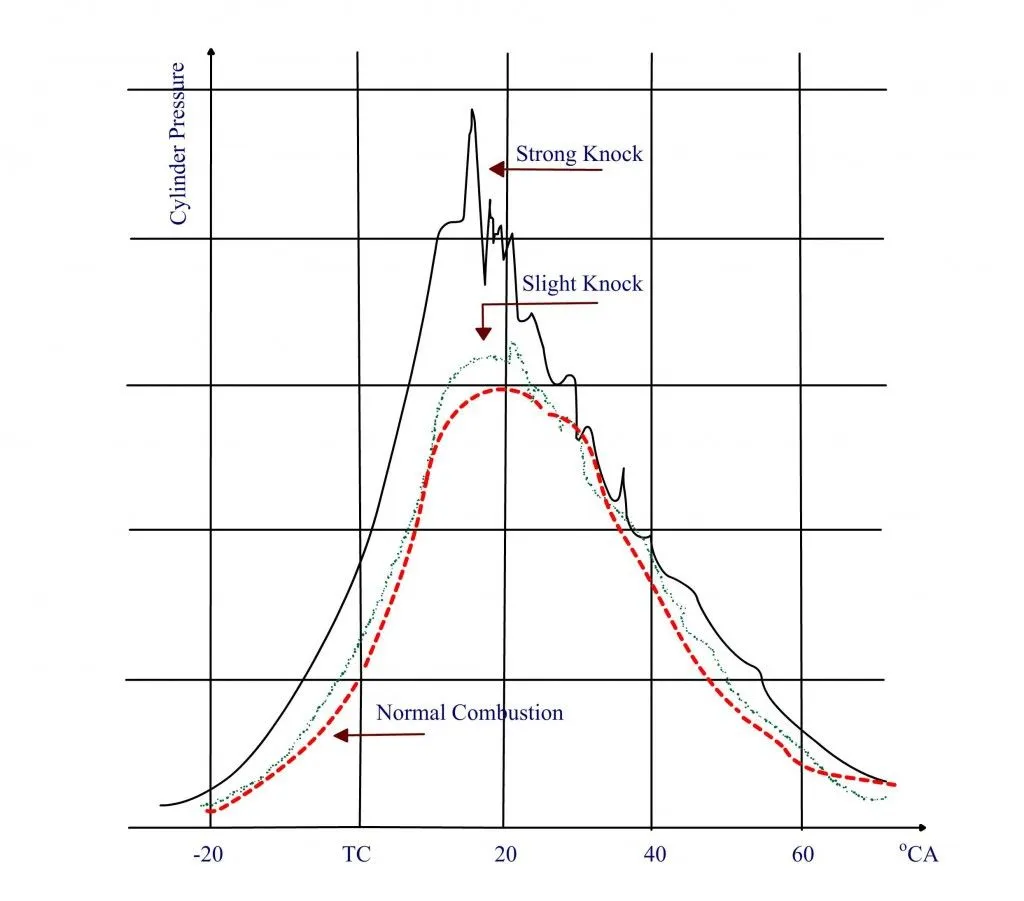
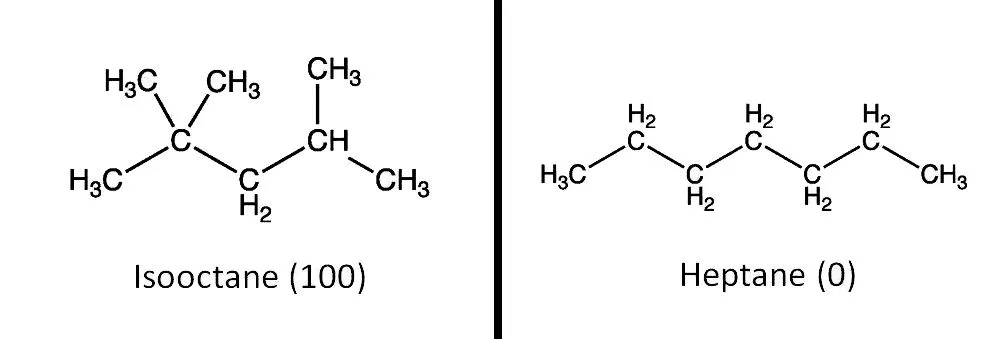
Using fuel with a higher octane rating reduces the possibility of knocking. The octane rating indicates the anti-knocking characteristics of a fuel in comparison to a mixture of iso-octane (2,2,4-trimethylpentane) and heptane. The octane rating of a fuel is also sometimes referred to as the octane number of the fuel.
Most fuels have an octane rating somewhere between 0 and 100. An octane rating of 100 indicates minimal to no knocking (pure iso-octane), whereas an octane rating of 0 means the fuel knocks very easily (pure heptane). Some specialty and racing fuels are more knock-resistant than iso-octane, so the scale has been extended past 100 for them. A fuel with the same anti-knocking properties as a mixture of 90% iso-octane and 10% heptane is given an octane rating of 90. In the US, regular pump gas is usually 87 AKI; premium is 91-94. (AKI is the average of the Research Octane Number and Motor Octane Number; Europe and most of the world quote RON only, which runs about 4-5 points higher than AKI for the same fuel.)
However, the octane rating for fuels is employed only for engines that work on gasoline, i.e., SI engines. Diesel engines, which do not compress the fuel, but rather compress air and then inject fuel, use another rating convention called the cetane number.
A fuel with a high octane rating combusts at high temperatures. Hence, more compression is required for it to ignite by itself.
Therefore, using fuel with a higher octane rating eliminates the possibility of pre-ignition and, thus, knocking.
Does Premium (High-Octane) Fuel Actually Reduce Engine Knock?
This is the question most drivers actually care about, so let’s settle it. A higher octane rating means greater resistance to preignition, which is the fundamental cause of engine knock, so on paper premium gas is the anti-knock fuel. But whether pouring it into your car does anything useful depends entirely on what the engine was built for.

Carmakers split into two camps. Some engines require premium: they are designed to run only on high-octane fuel, and feeding them regular risks knock and engine damage. Others merely recommend premium: they hit full performance on the good stuff, but running regular will not compromise the engine’s integrity (you might just lose a touch of power or efficiency). If your owner’s manual asks for regular 87 AKI, splurging on premium buys you almost nothing, because a modern knock sensor already keeps a correctly fueled engine out of trouble by adjusting the ignition timing.
So which engines genuinely benefit? Turbocharged and high-compression ones. A turbocharger forces more air into the cylinder, which raises the pressure and compression inside, and that extra squeeze pushes the knock risk up above a naturally aspirated engine’s. That is exactly why so many small, downsized, turbocharged engines now ask for higher-octane fuel: the octane is there to offset the knock that all that forced induction would otherwise cause.
How Do Anti-Knock Additives Work, From Leaded Gas To Ethanol?
Long before drivers could simply pick a higher number at the pump, chemists were quietly buying that octane with additives. In 1921, engineers at General Motors discovered that a splash of tetraethyl lead (TEL) dramatically cut knock, and remarkably tiny amounts did the job. Leaded gasoline went on to rule the roads for the better part of a century.

There was a catch: lead is a potent neurotoxin, and it also poisons the catalytic converters that scrub a car’s exhaust. So the US Environmental Protection Agency began phasing leaded gasoline out in the mid-1970s and had banned it for on-road vehicles by 1996. Its first big replacement, MTBE (methyl tert-butyl ether), boosted octane nicely but dissolved far too easily in water and ended up contaminating groundwater in state after state, so it too was pulled starting around 2000.
Today the workhorse octane booster is ethanol. Pure ethanol has an octane rating comfortably above 100, which makes it a genuinely effective anti-knock ingredient, and it is why roughly 95% of the gasoline sold in the United States is now E10 (a blend of 90% gasoline and 10% ethanol). The next time you fill up, much of the knock resistance you are paying for is coming from grain alcohol.
What About Diesel Knock?
If you have ever stood next to an idling truck, you have heard a diesel clatter, and you would be forgiven for thinking it is knocking in the same way a petrol engine does. It is not quite the same beast. A diesel engine has no spark plug; it injects fuel straight into hot, highly compressed air and lets it ignite on its own.
Here is the twist. There is a short ignition delay between the moment fuel is injected and the moment it actually lights. During that lag, a quantity of fuel builds up in the chamber, and when it finally ignites, it does so almost all at once in the most oxygen-rich pockets. That sudden spike in pressure and temperature is the source of the distinctive diesel “knock” or “clatter.” Unlike petrol knock, this is caused only by the very fast rate of pressure rise, not by the duelling flame fronts of unstable combustion, which is why a little diesel knock (especially on a cold start) is completely normal.
This is also why diesel is graded by its cetane number rather than its octane rating, and the two scales point in opposite directions. Cetane number is essentially an inverse measure of ignition delay: a higher-cetane fuel ignites faster, with a shorter delay, so the burn is spread more smoothly and the clatter is reduced. Most diesel sold at the pump sits somewhere around 40 to 55 cetane.
Conclusion
Apart from using fuel with a high octane rating, knocking can also be prevented by using spark plugs recommended by your car company, creating a slightly richer air-fuel mixture, possessing an engine with a lower compression ratio, etc. Adding a knock control sensor under the hood can further help one monitor this knocking phenomenon.
However, most of these methods are something that a typical consumer can’t exercise by themselves. So, whenever your car starts knocking like Heisenberg, you better call Saul from your nearest garage and get the problem sorted out!
References (click to expand)
- Selecting the Right Octane Fuel. U.S. Department of Energy.
- Gasoline Basics. U.S. Department of Energy Alternative Fuels Data Center.
- Four Stroke Cycle Engines. The University of Washington
- #Value!,& Ganesan V. (2012). Internal Combustion Engines. McGraw-Hill Education (India) Private
- Engine design trends lead to increased demand for higher-octane gasoline. U.S. Energy Information Administration.
- A Brief History of Octane in Gasoline: From Lead to Ethanol. Environmental and Energy Study Institute.
- Engine knocking. Wikipedia.
- Cetane number. Wikipedia.