Yes, NOS really works in cars, but not quite the way The Fast and the Furious shows it. When liquid nitrous oxide is injected into the engine and reaches combustion temperatures (around 570°C), it decomposes into nitrogen and oxygen. That extra oxygen lets the engine burn more fuel and produce 50–200 hp of additional power in short 10–15 second bursts. No blue flames from the exhaust, no instant teleport-mode, and not without serious risk to the engine.
While televised motorsports capture only one facet of motor racing, there is another side to it, known only amongst enthusiasts.
Street racing.
What television can often fail to capture, movies don’t, and street racing is no different. The Fast and The Furious franchise, instantly synonymous with street racing, has radically influenced racing culture, and its exposure to common folk.
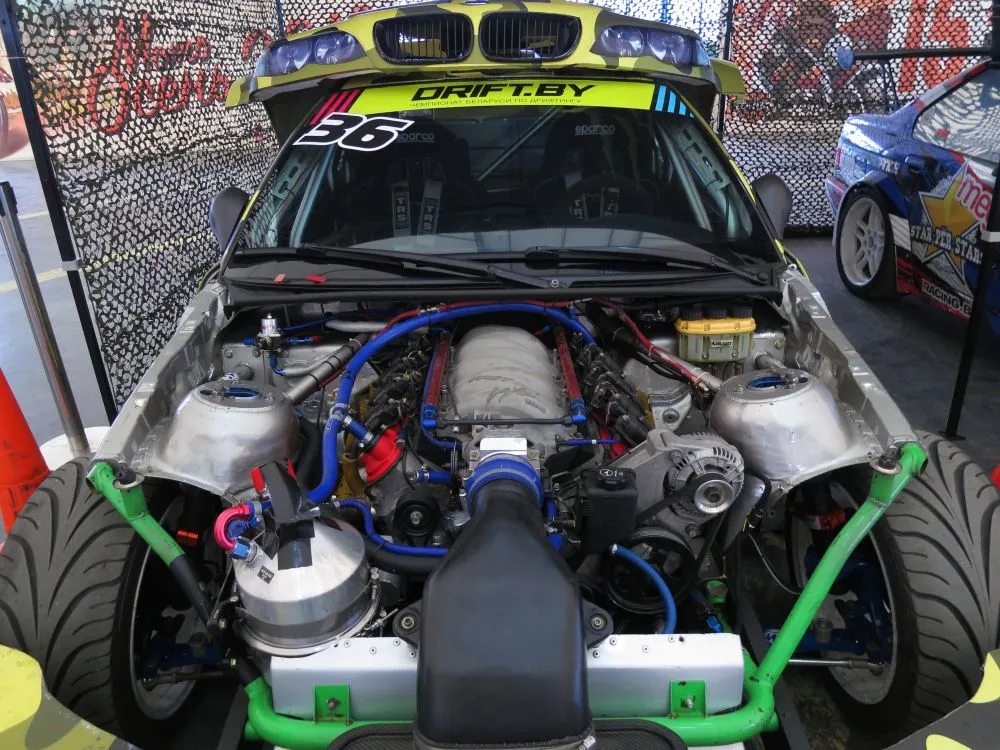
The initial installments, set in as early as 2001, are representative of a time when mechanical brawn brought superiority, and electronics were still new. Chances are, you would have even heard words like nitrous, 100 shot of NOS and boost, amongst others, being thrown around on the streets. What exactly do they mean? Time to find out!
What Is Nitrous And NOS?
In the movie, actors are seen pressing a red button on their steering wheels during the last leg of races. This releases a gas into the engine, resulting in neck-snapping boost that propels the car to the finish line. While it’s easy to dismiss this as some gimmick for movies, the truth may surprise you.
Since street races are often illegal, and carried out with limited budgets, enthusiasts look for cheap ways to improve their vehicle’s performance. One way to do this is to use nitrous oxide (N2O), often abbreviated to nitrous, and sometimes, just NOS. NOS is technically a brand name (it stands for Nitrous Oxide Systems, the company founded in California in 1978 and now owned by Holley Performance Products), though enthusiasts use “NOS” colloquially for any automotive nitrous kit.
When mixed in the combustible charge, it increases the vehicle’s horsepower in proportion to the quantity injected. Thus, a 100 shot of NOS would imply an increase of 100 horsepower over stock; a 50 shot would imply an additional 50 horsepower, and so on.
Performance applications of nitrous oxide trace back to World War II, when the Luftwaffe’s GM-1 system injected N2O into the supercharger intakes of high-altitude fighters like the Bf 109 to restore the power lost in thin air. Nitrous oxide also finds extensive use as a medical anesthetic and is popularly known as laughing gas.
How Does Nitrous Oxide Work?
To produce more power, an engine must burn more combustible charge (air-fuel mixture) than it already does. Upsizing the engine to increase its displacement is one way to do this. Another method, generally favored by engineers, is forced induction, where extra air is ‘stuffed’ into the engine using turbochargers and superchargers.
However, both upsizing and forced induction can get too technical and expensive for street racing. Using nitrous oxide presents a viable solution by providing usable oxygen directly to the engine’s combustion chamber. This oxygen, in addition to air ingested by the car, is coupled with an increased fuel supply. This increases combustion, and consequently, power output available to the wheels.
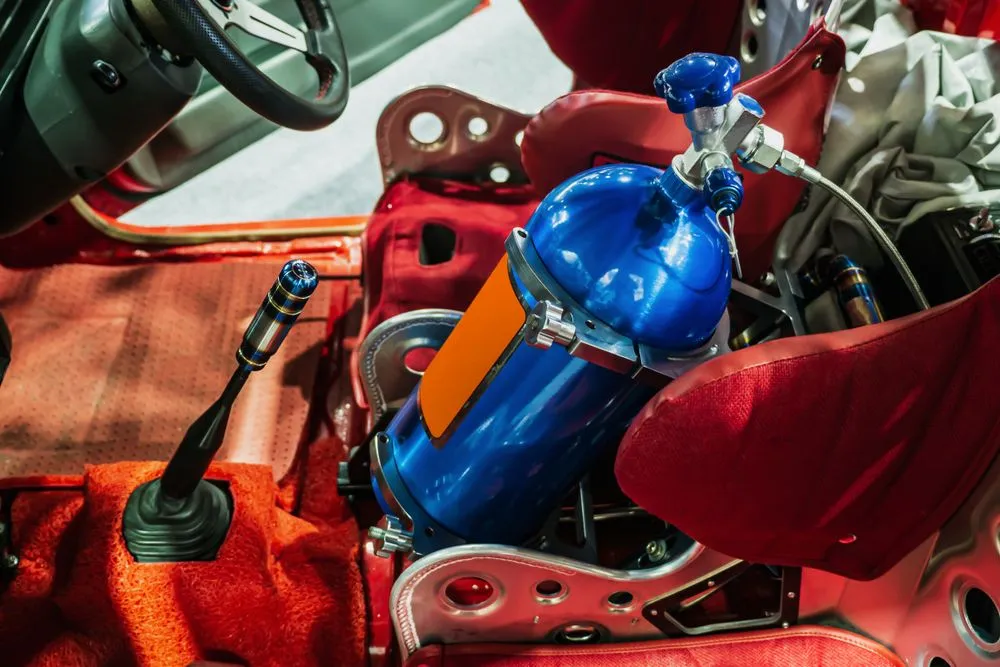
Nitrous oxide is a stable compound and stored as a liquid in cylinders at room temperature (held in equilibrium with its vapor at around 750 psi). When needed, it is released into the engine’s intake manifold, where it expands and flashes to gas. This expansion absorbs heat, dropping the intake-charge temperature and packing the cylinders with denser air. Inside the cylinder, combustion temperatures above roughly 570°C (1,060°F) cause the nitrous oxide to decompose into nitrogen and oxygen.
While nitrogen itself is not combustible, it makes extra oxygen available for combustion. This oxygen is in addition to the air already being drawn into the engine. Unlike injecting pure oxygen, N2O has a built-in anti-knock advantage: vaporizing from liquid absorbs heat from the intake charge and helps suppress knock. That said, an improperly tuned nitrous system (a lean mixture or insufficient ignition retard) can still trigger violent detonation and destroy pistons in seconds. To maintain a safe air-fuel ratio, the fuel injectors must be metered to supply more fuel.
This can be done by increasing the pressure at which fuel is supplied, or increasing the time that the injector nozzle remains open. Nitrous oxide can be delivered to the engine by two types of systems.
‘Dry’ Nitrous Oxide Injection System
In a dry injection system, nitrous oxide is directly sprayed into the vehicle’s intake manifold, while fuel is sprayed by injectors into the combustion chamber. The benefits of running a dry injection system are its simplicity of installation, where plumbing lines armed with nitrous oxide are tapped directly into the intake manifold.
However, dry injection systems are quite difficult to fine tune and not suitable for high-power applications.
‘Wet’ Nitrous Oxide Injection System
Wet injection systems involve the mixing of fuel and nitrous oxide before being introduced into the combustion chamber. While installing such a system is more complex, it gives precise control over flow and can be tuned very accurately. This makes it well suited to high-power applications.
A Common Misconception Around Nitrous Oxide
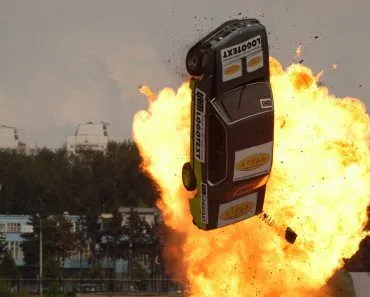
While The Fast and the Furious franchise has piqued the interest of many street racing enthusiasts, it has occasionally misrepresented some facts. Nitrous oxide for example, has often been depicted as a blue flame emanating from the exhaust. While it is possible to have exhaust pipes shoot flames due to presence of unburnt fuel in the hot exhaust gases, it is not directly related with nitrous oxide.
Usually, variables like ignition timing and air-to-fuel ratio impact the presence of unburnt fuel in the exhaust stream.

Is Nitrous Oxide Flammable?
Here is a fact that trips up almost everyone who first hears about NOS: nitrous oxide does not actually burn. On its own, N2O is nonflammable. You could hold a flame to a stream of it all day and it would never catch fire. So how does a gas that cannot burn turn an engine into a rocket?

The answer is that nitrous oxide is not a fuel at all, but an oxidizer. The US National Oceanic and Atmospheric Administration classifies it as a weak oxidizing agent that "will support combustion, and may increase intensity of fire". Picture the fire triangle: every fire needs fuel, heat, and an oxidizer (normally the oxygen in the air). Nitrous oxide simply supplies a generous extra helping of that third ingredient. When it reaches roughly 570°C (1,060°F) in the combustion chamber, it splits into nitrogen and oxygen, and that freed oxygen lets the engine burn far more fuel than air alone ever could.
This also settles a question people often type into Google: what color does NOS burn? Strictly speaking it doesn't burn any color, because the nitrous itself is never the thing on fire, the fuel is. Those dramatic flames spitting from movie exhausts are unburnt gasoline lighting up in the hot exhaust stream, not glowing nitrous. The catch with being such a strong oxidizer is that a nitrous bottle is genuinely hazardous near a flame or a fuel leak: that same released oxygen can turn a small fire into a fierce one, which is exactly why the bottles must be stored well away from heat sources.
Run Time Of Nitrous Oxide
Apart from being a logistical challenge, nitrous oxide puts tremendous stress on the engine components, while significantly debilitating safety. Due to this, it is not suited for extended use. Typically, it can generate boosts that last from 10 to 15 seconds. As a rule of thumb, a bigger engine gets a bigger boost for a shorter amount of time than a smaller engine, from the same bottle of nitrous oxide.
Fuel Compatibility
Nitrous oxide is compatible with both gasoline (petrol) and diesel, as it only increases oxygen concentration. However, most race cars are designed around gasoline engines. Consequently, robust architecture for nitrous oxide setups are found mostly for gasoline engines.
Disadvantages Of Nitrous Oxide
The idea of having an excessively powerful road-going vehicle certainly appeals to the social renegades amongst us. However, nitrous oxide has its downsides. While it’s a ‘cheap’ fix for instant power, engines are not designed for the additional load. This can result in explosions and irreversible damage to the engine’s components.

Thus, wet systems are favored over dry systems, with professionals conducting installations using proper equipment. Automotive nitrous is widely sold through performance retailers, but whether you are even allowed to use it on the street varies a great deal from country to country (more on that below). Recreational inhalation of nitrous oxide (the “whippet” trade) is a separate matter altogether and has been criminalized in several countries, including the UK in 2023. Bottles also run out quickly and need frequent refills, which adds up.
Use In Motorsports
With technical advancements in engines and forced induction, nitrous oxide is banned in mainstream professional motorsport: Formula 1 prohibits any oxidizer beyond ambient air, and NASCAR forbids it outright (famously enforcing the rule after a 1976 Daytona 500 qualifying scandal). It is also absent from road-racing series like MotoGP. Nitrous does, however, remain legal in NHRA’s sportsman and E.T. motorcycle drag-racing classes (with safety requirements such as DOT-stamped bottles), and it prevails in the unorganized racing sector, namely street racing and grassroots drag racing.

Is It Legal To Run NOS On A Street Car?
If the movies have you itching to bolt a bottle into your daily driver, pump the brakes first, because the legal picture is a good deal messier than the films let on. The first thing to untangle is that there are two completely separate questions wrapped up in "is NOS legal": using nitrous as an engine part, and inhaling it as a recreational drug. They are covered by entirely different laws.
In the United States, buying and owning an automotive nitrous kit is legal at the federal level, but whether you can legally drive on it comes down to your state's emissions rules. California is the strictest example. Under section 27156 of its Vehicle Code, you cannot install any aftermarket part that alters the car's emission-control system unless the California Air Resources Board (CARB) has granted that specific part an exemption, known as an Executive Order. A nitrous system without that approval will not pass a smog check and is not street legal on a registered car.
The United Kingdom is more relaxed about the hardware: fitting a nitrous kit to a road car is not in itself a crime. The widely reported 2023 law that reclassified nitrous oxide as a Class C drug targets wrongful inhalation to get high, and the government's own guidance deliberately leaves legitimate uses, motorsport included, lawful. (As with any performance modification, you would still need to declare it to your insurer.) Australia draws the hardest line of the three. Its National Code of Practice for Light Vehicle Construction and Modification flatly prohibits fitting nitrous oxide injection systems to road-registered vehicles, and that ban extends even to a partial or disconnected system left in place ready for use.
Add it all up and the pattern is clear: nitrous lives most comfortably at the drag strip, on the track, or on private land, which are exactly the off-road settings the law tends to carve out for it.
A Final Word – Relevance In Modern Day Motoring
In modern times, the relevance of nitrous oxide systems is gradually diminishing. While their primitive versions remain a fixture in street racing, mainstream automakers and race engineers now reach for turbochargers, electric motors and hybrid boost systems instead. With electric vehicles eating into the new-car market and most major automakers winding down pure internal-combustion development by the early 2030s, NOS is sliding toward enthusiast-only territory, a piece of analog motorsport heritage rather than the future of speed.
References (click to expand)
- GM-1, the WWII German Luftwaffe nitrous oxide injection system.
- How Nitrous Oxide Works. speedtech-nitrous.com
- Nitrous oxide engine: Wikipedia overview of automotive N2O systems.
- What Are Nitrous Oxide Systems, And Are They Allowed In .... toc.edu.my
- How Nitrous Oxide (NOS) in Car Works - Dubizzle. dubizzle.com
- Nitrous Oxide reactivity and hazard profile. CAMEO Chemicals, NOAA.
- California Vehicle Code Section 27156 (aftermarket emissions parts and CARB exemptions).
- Nitrous oxide ban: guidance. GOV.UK.
- National Code of Practice for Light Vehicle Construction and Modification (Engine). Australian Government, Dept. of Infrastructure.