Table of Contents (click to expand)
E Ink creates digital displays that look like real ink on paper. Each screen holds millions of microcapsules filled with charged white and black pigment particles. When an electric field is applied, the particles migrate to the top of each capsule, forming black or white pixels. The particles emit no light, so the screen is reflective like paper and the image stays put with no power.
My Kindle is my most prized and cherished possession. Even my phone fails to compete. Okay, that might be an exaggeration, but yes, for me, a compulsive reader, it is absolutely essential.
Yet, not every reader has sworn allegiance to the budding coterie of digital readers. It is obvious why this faction of loyal paperback readers despises us: e-books aren’t as gratifying to read as paperbacks. The thick books with their musty odor aren’t just withered threads tethered to which are coffee-stained pages, but trophies on our shelves, medals for completing what often feels like a triathlon.
However, it would be unfair to presumptuously group readers who read e-books on obnoxious LCD or LED screens with those who read on electronic readers or simply, e-readers. Of course, e-readers aren’t thick and exude that beloved smell, but the pages nonetheless appear uncannily bookish.

Unlike LCDs, the text does not feel like shrapnel blown into your eyes, but rather sumptuous strokes of what is called e-ink. As a result, excess exposure to it does not irritate our eyes, a notorious phenomenon that we religiously associate with any device that sports a screen. So, how does this ingenious ink work?
Tiny Capsules Of Charged Pigment
The earliest stab at electronic paper, called Gyricon, was built in the 1970s at Xerox PARC. It used tiny two-faced beads, black on one side and white on the other, that physically rotated to flash their dark or light face at you. Beads with two different surfaces like this are sometimes called Janus particles, after the two-faced Roman god of beginnings who could peer into the past and the future at the same time. It was a clever idea, but the rolling spheres were hard to shrink and keep crisp.
The E Ink in your Kindle works on a different and tidier principle. Instead of beads that flip, it uses two separate kinds of pigment particle that move. The white particles are made of titanium dioxide and carry a negative charge; the black particles are made of carbon black and carry a positive charge. Both are no more than a few microns across and float together in a clear oily fluid, all of it sealed inside microscopic capsules roughly the diameter of a human hair. The capsules are sandwiched in a thin film between two electrodes, the top one transparent so that you can see in.
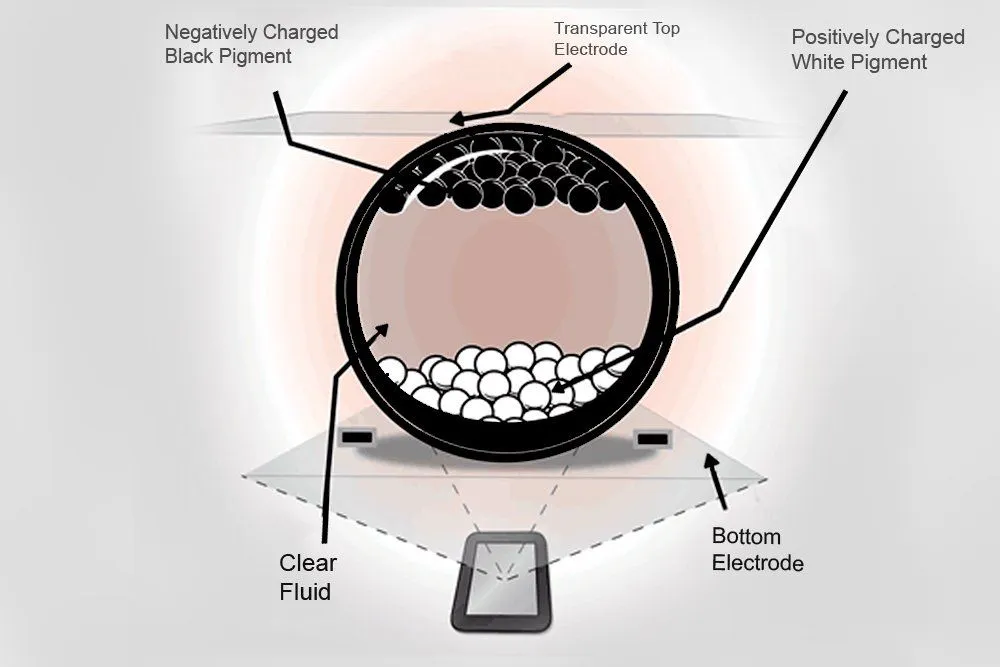
The fluid lets the particles drift freely. When the electrodes are switched, the particles migrate according to their charge, a phenomenon known as electrophoresis (which is exactly where the name "electrophoretic display" comes from). For instance, if the top electrode is made negative and the bottom one positive, the positively charged black particles are pulled up to the viewing surface while the white ones sink out of sight. That patch of screen now looks black. Flip the voltage and the white particles rise instead, turning the same spot white.
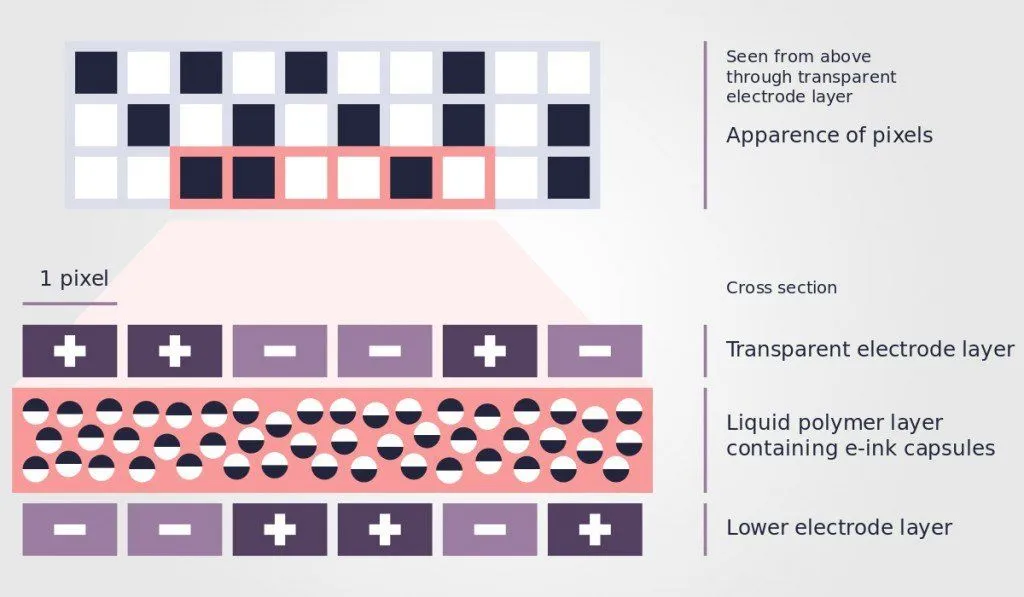
The electrodes are grouped into pixels, so that each one, when carefully triggered, can hold a tiny patch of black or white. String enough of these patches together and the intricate patterns give form to letters and words, entire books, in any font you like, even pictures!
Over the years, engineers have steadily sharpened this technology. Newer generations of E Ink, such as the Carta panels used in recent Kindles, pack the capsules more densely and tune the pigments to swing between a darker black and a cleaner white, which yields crisper text and better contrast. The underlying trick never changes, though: charged pigment shuttling back and forth inside sealed capsules, holding its position until the next nudge of voltage.
The Pros And Cons Of E-ink Technology
For years the technology could only manage black ink on a white page. That has finally changed: color e-paper is now real and shipping. E Ink’s Kaleido 3 lays a thin color filter over the usual black-and-white layer to conjure roughly 4,000 colors, and it powers readers like the Amazon Kindle Colorsoft and the Kobo Libra Colour. A newer system, E Ink Gallery 3, actually prints colored pigment into each pixel for around 50,000 colors and drives devices such as the reMarkable Paper Pro. Even so, an LCD still wins on raw color and speed, generating every shade the human eye can perceive. The catch is that an LCD’s incessant, rapid refreshing strains our eyes and, worse, drains our device’s battery (priorities). E Ink is quite literally an ink, so it does not have to perpetually radiate; once a page of capsules is set, the pigment stays put until the screen is told to change.
In fact, an e-reader spends power only when a page is turned. This requires a reconfiguration of electrodes, which costs its screen a delay, the characteristic “refresh” that e-readers are most familiar with. The whole screen refreshes to ensure that ink from the previous pages has been completely effaced and that no trace of “ghost” writing is left behind. This delay is a massive disadvantage, as it tragically decreases the device’s speed.
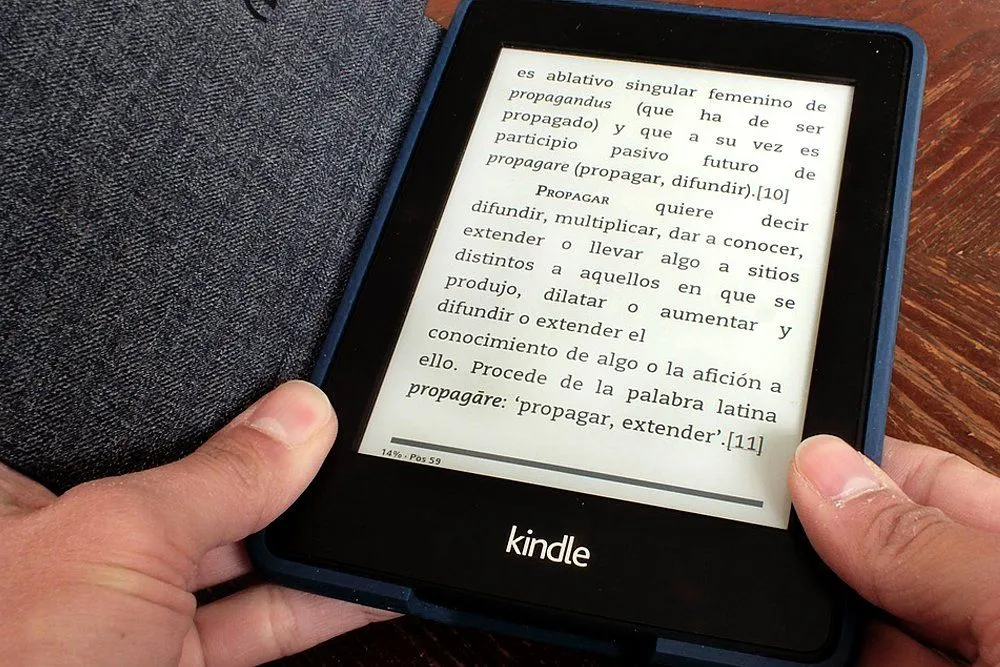
Another quirk is that these screens only arrange pigment; they make no light of their own. Reading an e-book in a dark room is about as helpful as reading a paperback in one. E-readers like Amazon’s Kindle Paperwhite solved this with a front light rather than a backlight: small LEDs sit along the edge of the screen and a thin light guide spreads their glow across the surface, so the light shines down onto the page and reflects back to you. Our eyes find staring straight into a light source troublesome. What they prefer is light bounced off an object, which is exactly how paper, and a front-lit e-reader, behaves. So the Paperwhite’s lights don’t blast your eyes; they just gently wash over the text.
That being said, the powering of the LEDs consumes the Kindle’s battery. An e-reader without such a light can function up to a week, as compared to the mere hours a device with an LCD screen can! Thus, one must keep in mind the trade-offs between the various factors, such as speed, resolution, color, detrimental effects of excess screen-time and, of course, the cost to build one, before installing a display technology.
E-ink on a smartphone or tablet can be a blessing for parents whose children are hopelessly glued to them. However, its inability to fulfill our ever-increasing demands for speed might cause an adult to crush or smash on the ground the very phone or tablet in utter frustration.
For that reason E Ink has thrived wherever a screen does not have to keep up with frantic deadlines. Beyond e-readers, you will find it on smartwatches, supermarket shelf labels, airport and bus-stop signage, luggage tags and even the wraparound display on a few experimental phones. Far from a niche curiosity, it is now the everyday screen for hundreds of millions of Kindle, Kobo and reMarkable users. One thing has not changed, though: there is still no display technology that responds well to spilled coffee.
References (click to expand)
- How it works - Electrophoretic Display. E Ink Corporation. eink.com
- E Ink - Massachusetts Institute of Technology. web.mit.edu
- Zhang, J., Grzybowski, B. A., & Granick, S. (2017, July 5). Janus Particle Synthesis, Assembly, and Application. Langmuir. American Chemical Society (ACS).
- (2003) E Ink and Digital Paper - DigitalCommons@Providence. Providence College