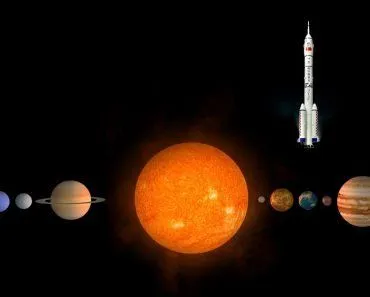
Satellites and space probes use antennas to transmit and receive electromagnetic waves, either as radio waves or, more recently, as laser pulses. When a probe like Perseverance or Mars Reconnaissance Orbiter takes a picture, it encodes the image as a stream of 1’s and 0’s. Those bits are placed on a radio (or optical) carrier and beamed into space. Back on Earth, the signal is detected by NASA’s Deep Space Network (DSN), three giant antenna complexes that pass the data to computers that decode it into useful information.
Effective communication is one of the most fundamental requirements of any space mission. Astronauts on space missions need to be able to get in touch with the ground units at all times in order to perform all sorts of mission requirements, maneuvers and contingency measures.

Even unmanned objects, like artificial satellites and space probes, have to communicate with the ground station consistently in order to exchange information. So, how do these objects, which are hundreds, thousands, or even millions of kilometers away from the home planet, manage to get in touch with Earth-bound folks?
Communicating Through Electromagnetic Waves
Every form of communication in space is carried out by electromagnetic waves. We are surrounded by electromagnetic waves at all times. You must be familiar with the following diagram, which depicts various components of the electromagnetic spectrum:
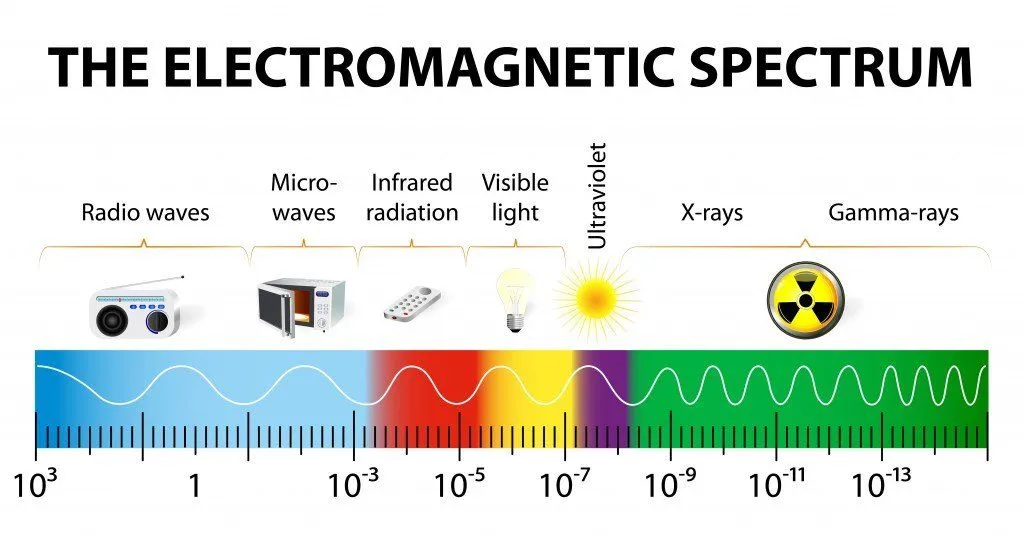
As you can see in this image, visible light, i.e., the light we see and perceive, is also a kind of electromagnetic wave. Similarly, radio waves are also a type of EM wave. These radio waves play an instrumental role in communication with satellites, space probes or any other man-made object in space.
However, with the dramatic advancements in communication technology over the past few decades, the efficiency of radio waves has been challenged by laser-based optical communication. NASA’s Laser Communications Relay Demonstration (LCRD), launched in December 2021 and which wrapped its experiment program in mid-2024, proved the concept in Earth orbit. Its deep-space counterpart, the Deep Space Optical Communications (DSOC) experiment riding along on the Psyche spacecraft, has since pushed laser links out to hundreds of millions of kilometers.
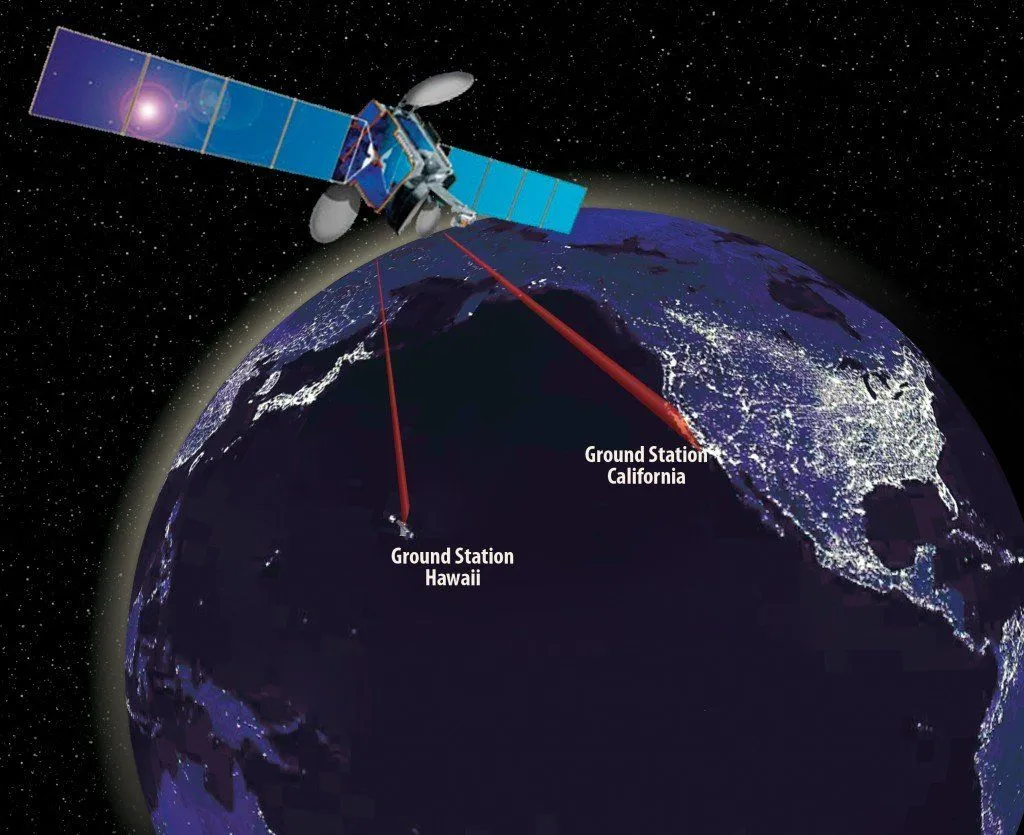
By using laser light instead of radio waves, these systems can move data at rates at least 10 times higher than comparable radio links. In December 2023, for example, DSOC beamed back data at 267 megabits per second from about 19 million miles (31 million km) away, and by late 2024 it had downlinked from over 300 million miles. The other benefit of lasers is that their much shorter wavelengths let engineers focus the beam very tightly, so less signal energy is wasted as it travels across space.
However, this is just one part of the answer; we also want to know about the actual method through which a distant space probe like Voyager 1 sends incredible pictures to Earth, or how an astronaut can talk to his family from space.
Why Do Spacecraft Use Radio Waves Instead Of Sound?
If you have ever wondered why a probe beams home radio waves rather than simply "calling out" the way we do, the answer comes down to one stubborn fact about space: it is very nearly a perfect vacuum. Sound is a mechanical wave, which means it can only travel by jostling the molecules of a medium (air, water or a solid) into bumping against their neighbours, like a row of falling dominoes passing energy along. Out in the emptiness between the planets there are almost no molecules to jostle, so a sound simply has nowhere to go.
NASA puts it plainly: "Sound waves cannot travel in the vacuum of space because there is no medium to transmit these mechanical waves." Radio waves, on the other hand, are a form of electromagnetic radiation, and electromagnetic waves do not need a medium at all. They are self-sustaining ripples of electric and magnetic fields that sail straight through a vacuum at the speed of light. That is precisely why every spacecraft, from an astronaut's spacewalk radio to a probe at the very edge of the solar system, speaks in radio waves (or laser light) and never in sound.
How Do Space Probes Communicate With Earth Using Radio Waves?
Now that we have established that every man-made object in space uses radio waves (or lasers) to communicate with people back on Earth, we should move on to the actual process through which these electromagnetic waves receive and deliver the intended messages.
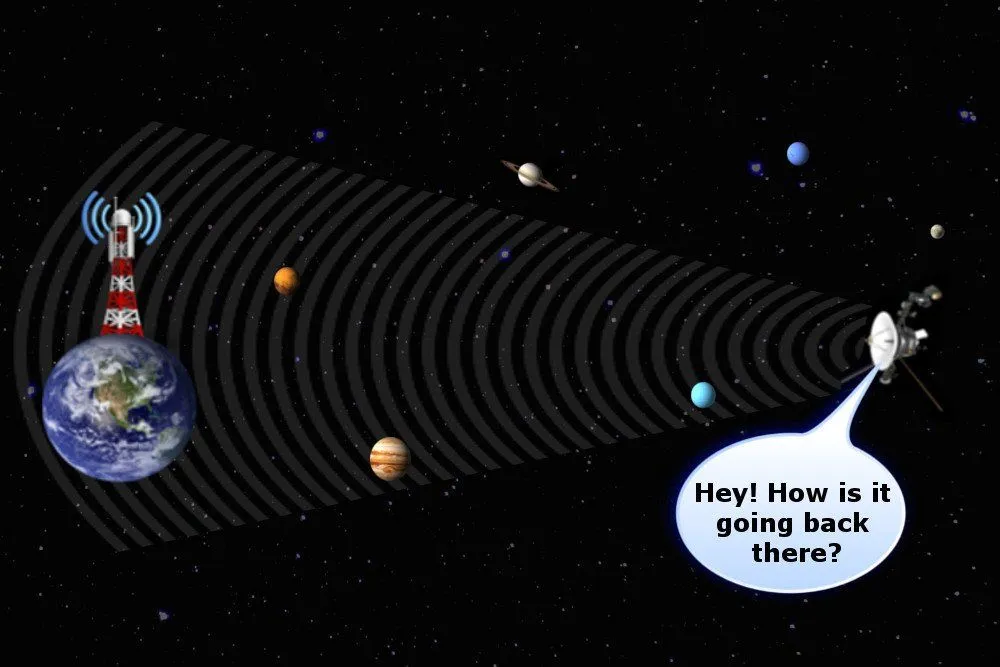
Every satellite or space probe carries a transceiver (the transmit-and-receive electronics) hooked up to a high-gain dish antenna (pretty much like the ones you see on rooftops, only many times more powerful). The transceiver pushes a radio signal out through the dish with as much power as the spacecraft’s power budget allows. Those signals are then detected by extremely powerful, sensitive antennae back on Earth, which feed them to high-tech computers that crunch the numbers and extract the useful information.
Let me elaborate a bit more: space probes carry a bunch of high-tech hardware that lets them sustain their flight and, more importantly, transmit information to Earth. When an active imaging probe (think Mars Reconnaissance Orbiter, or Perseverance on the Martian surface) clicks a picture of a planet or a celestial body, the onboard computer converts that image into a long string of 1’s and 0’s. Yes, a high-definition image, or any other sort of data, can be encoded using nothing more than 1’s and 0’s! (Voyager 1’s own cameras, by the way, were powered off in 1990 after the famous “Family Portrait” to save energy; the probe still beams home science data, but no pictures.)

The computer then relays these 1’s and 0’s onto something known as a transponder, which ‘places’ these numbers on radio waves and transmits these radio waves through space. Once transmitted, these waves travel for a very long distance and, quite predictably, take quite a long time before reaching Earth.
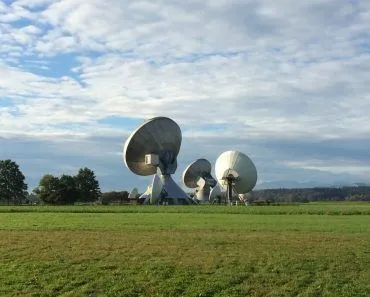
Back on Earth, we have an array of very powerful radio antennae called the Deep Space Network (DSN), which is responsible for the ‘reception’ part of the transmission. The DSN consists of three facilities (in Goldstone, near Barstow, California; near Madrid, Spain; and near Canberra, Australia) spaced 120 degrees apart in longitude, which helps to maintain a constant stream of dialogue when Earth rotates. As the most sensitive telecommunications system in the entire world, it supports interplanetary missions and a number of satellites that orbit Earth.
These antennae detect the signals (which contain information pertaining to the current location of the probe and its health, along with the required scientific data, i.e., pictures and audio files) transmitted by the probe and relay them to computers, which decode them into sensible, useful information.

To put this whole concept of transmission and reception into perspective, consider this daily-life example: when you post a selfie on a social network, it gets delivered to all of your friends (connected to the Internet) instantly. This is because your smartphone acts as a transmitter of the radio waves; it transmits your selfie into electrical signals that ‘ride’ on radio waves (hello, modulation!) and are subsequently received by an antenna in your friend’s smartphone. The same thing happens (only in the opposite direction) when your friend posts a picture and you are able to download it on your smartphone.
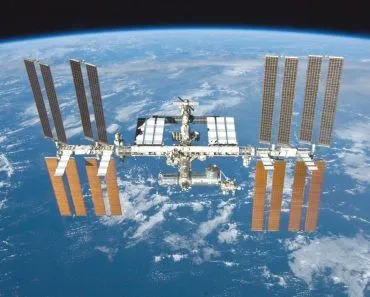
As the name signifies, DSN is typically used for detecting signals coming from distant objects in space. Communication with space ships like the ISS can also be maintained using other, less powerful antennae. Regardless of the electromagnetic waves being used (either radio waves or lasers), the basic mechanism of communication with probes and artificial satellites remains the same. If not for this simple, yet incredibly effective technique of communication, we could never explore the vastness of space. Recruiting astronauts would also be much more difficult.

How Does Voyager 1 Communicate With Earth?
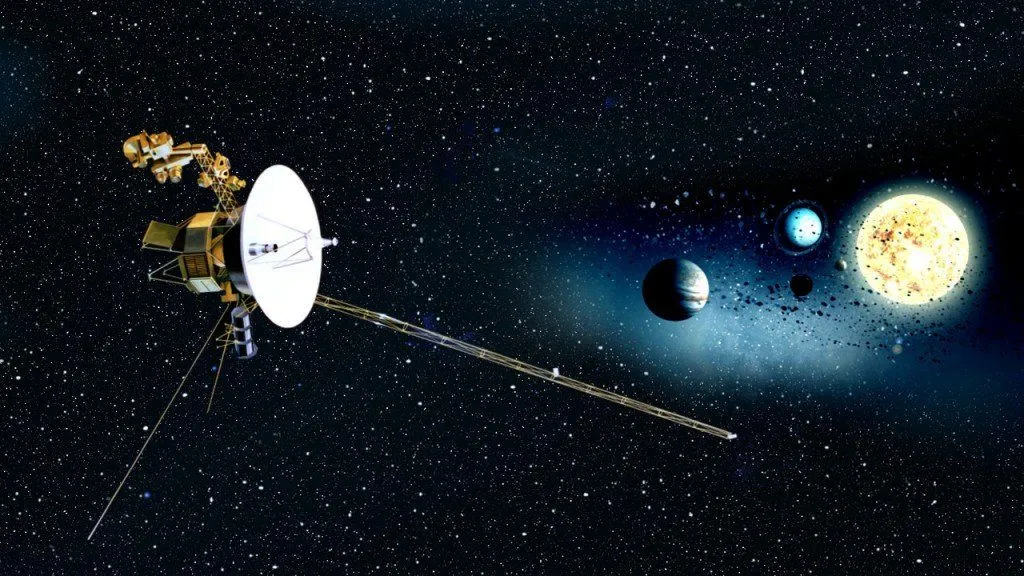
Voyager 1 is this whole process pushed to its absolute limit, so it is worth seeing exactly how the most distant of all our probes phones home. Mounted on top of the spacecraft is a 3.7-metre (12-foot) dish, its high-gain antenna, kept carefully pointed back at our planet. Through that dish Voyager sends its science and engineering data on an X-band radio link at about 8.4 gigahertz, and uses a lower-frequency S-band link (around 2.3 gigahertz) for low-rate engineering data and to receive commands from Earth.

What makes this an astonishing feat is how little power sits behind the signal. Voyager's transmitter radiates only about 23 watts, roughly the same as the bulb inside your refrigerator. By the time those radio waves have crossed more than 20 billion kilometres of space, the signal reaching Earth is fantastically faint. The National Radio Astronomy Observatory estimates its power at "less than an attowatt, or a billionth of a billionth of a watt." Catching something that weak takes the biggest ears we have, which is why Voyager is tracked by the Deep Space Network's giant 70-metre (230-foot) dishes, its largest and most sensitive antennas. Voyager 2, which heads south below the plane of the planets, can be reached by only a single antenna on Earth: the 70-metre DSS-43 dish near Canberra, Australia.
The data also trickles in slowly. Voyager's science data comes down on X-band at rates of up to a few kilobits per second, while basic health telemetry is sent on S-band at just 40 bits per second, slower than the very first dial-up modems. Power is the constant worry: the craft's three radioisotope thermoelectric generators lose a few watts every year as their plutonium fuel decays, so engineers keep switching off non-essential systems to keep the radio breathing. Even so, a one-way "hello" from Voyager 1 now takes roughly 23.5 hours to reach us, and in November 2026 the probe is set to cross the one-light-day mark, becoming the first human-made object ever to do so.
References (click to expand)
- Voyager 1 — NASA Science
- How Does NASA Communicate With Spacecraft? — NASA Space Place
- What Is the Deep Space Network? — NASA
- DSN Complexes — NASA
- Laser Communications Relay Demonstration (LCRD) — NASA
- NASA Deep Space Optical Communications Demo Exceeds Project Expectations — NASA JPL
- Anatomy of an Electromagnetic Wave — NASA Science
- Voyager Spacecraft — NASA Science
- How Strong is the Signal from Voyager 1 When it Reaches Earth? — NRAO
- Deep Space Station 43 (DSS-43) — Canberra Deep Space Communication Complex