Yes, elevators are remarkably safe. Each car is held by four to eight steel ropes (any one of which can support the car alone), an overspeed governor that grips the guide rails if the car falls too fast, a spring-loaded machine brake that clamps on when power is cut, and a counterweight that pulls a lightly-loaded car up rather than down. In the US, elevators cause about 30 deaths a year across ~18 billion trips.
Elevators are an integral part of life for many people, particularly those living in buildings higher than 5 stories or those working in tall office buildings. Many people will take the elevator even if their destination is only on the next floor up or down, simply due to how easy they are to use. However, there are some people who are afraid of elevators, either due to the possibility of the elevator car falling or due to their fear of the small space of the elevator car.
That begs the question: are elevators actually safe? As it turns out, elevators are very safe… even safer than stairs, in fact!
Elevator Cables Do The Hard Work
The mechanism that makes elevator cars particularly sturdy is the set of steel hoist ropes holding them up. How many cables are on every car? Most modern traction elevators use four to eight steel hoist ropes (newer machine-room-less designs use flat coated-steel belts instead). That’s right, even if all but one fail, the elevator will still be held up safely, since each rope is designed to support several times the weight of a fully loaded car. This means that only a freak accident could cause the car to plummet, since every rope would need to be severed at once. Such accidents have actually happened twice in modern memory. The first was on July 28, 1945, when a U.S. Army B-25 Mitchell bomber, lost in fog, crashed into the Empire State Building between the 78th and 80th floors. Twenty-year-old elevator operator Betty Lou Oliver was first thrown from her car and then placed by rescuers into another elevator whose damaged ropes promptly gave way, dropping her 75 stories to the sub-basement. Miraculously, she survived (with a broken back, pelvis, and neck), thanks to a combination of factors: air compressed in the relatively airtight shaft cushioned the car like a giant piston, the severed ropes piled coil-like in the pit absorbed some of the impact, and a hydraulic buffer at the bottom of the shaft soaked up the rest. Her fall is still the Guinness world record for the longest elevator drop survived.

The second cluster of incidents happened on September 11, 2001, when the World Trade Center towers were hit by two planes. The 9/11 attacks remain the worst elevator disaster in history, with around 200 people killed in the towers’ elevators. Even there, the safety systems mostly worked: many elevators whose hoist ropes were severed were stopped by the rail-grip safeties (one famous case saved 25 occupants), and most of the elevator fatalities were caused by fire and burning jet fuel rushing down the shafts, not by free-fall impact.
These two incidents shouldn’t deter you from taking the elevator, though, because each elevator is designed with a generous “factor of safety.” Under the ASME A17.1 elevator code (the dominant safety standard in the US and Canada), passenger-elevator hoist ropes are designed with a factor of safety of roughly 11 to 12, meaning each rope can carry many times the maximum load it is ever expected to see. The number of ropes follows from this factor, ensuring that the car you step into is as safe as the engineers can reasonably make it.
Elevator Brakes Will Slow You Down
Another mechanism that keeps elevators safe is a layered braking system. An overspeed governor watches how fast the car is moving, and if the car ever exceeds its rated speed (because, say, a rope snapped), the governor trips the safety brakes on the sides of the car. These safeties wedge against the steel guide rails that run the length of the shaft, gripping them like a vise and bringing the car to a controlled stop without the sudden jolt that would injure passengers.
There is also a second brake at the motor itself, called the machine brake. It’s a spring-loaded brake that is held open by electric current during normal operation. The moment power is cut (whether by a building blackout or by a controller fault), the springs automatically clamp the brake onto the drive sheave, stopping the car. In other words, the elevator’s default state is “braked,” and electricity is what keeps it moving.
The cables and brakes are not the only safety mechanism though. An elevator has one more interesting innovation that will always keep you safe.
The Counterweight Factor
The great thing about this final safety mechanism is that it will prevent the elevator from crashing to the ground, even if both of the above mechanisms fail.
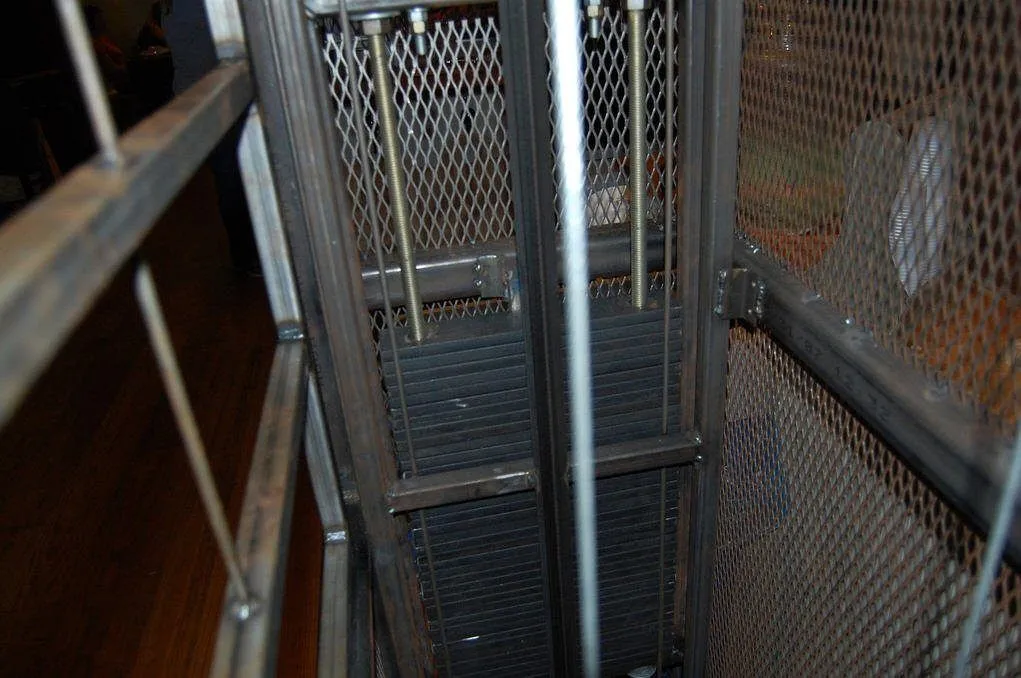
Counterweights are basically a stack of weights attached to the other end of the ropes that hold the elevator car. By industry convention, they’re sized to balance the empty car plus roughly 40 to 50 percent of the elevator’s rated load. That makes the counterweight heavier than the empty car, but lighter than a fully loaded one. So if everything about the elevator fails and you are the only person in the car, the counterweight is still heavier than the car (plus you), and the car will actually drift up, not down. When it reaches the top, you don’t have to worry about crashing into the ceiling, since there is a buffer at the top of the shaft to cushion the upward impact.
The Counterweight Screen: Guarding The People Below
The counterweight keeps you safe as a passenger, but it is also a heavy slab of steel sliding up and down the shaft, and at the very bottom of every shaft sits a pit where technicians climb in to service the machinery. A counterweight moving at full speed is a genuine hazard to anyone standing in its path, so the same safety code that governs the ropes also insists the counterweight be fenced off from people.

Under the ASME A17.1 code (and the building codes that adopt it), an unperforated metal guard, often called a counterweight screen, must be fitted on the open side or sides of the counterweight down in the pit. The guard runs from no more than 12 inches (about 305 mm) above the pit floor up to somewhere between 7 and 8 feet (roughly 2.1 to 2.4 m), tall enough to shield a standing worker, and it is braced to sheet-steel stiffness so it cannot flex out of the way. Where the shaft is too cramped to fit a solid screen, the code allows a clever fallback: short lengths of light chain, around 24 inches (610 mm) long and hung every 6 inches along the bottom of the counterweight, which brush against and warn anyone who has wandered into its path.
You will never spot this guard from inside the car, but it is one more example of how thoroughly the humble elevator is engineered around keeping people, passengers and mechanics alike, well clear of anything heavy and moving.
What Happens To The Elevator When The Power Goes Out?
One of the most common elevator fears is being trapped, or worse, dropped, when the lights suddenly go out. Happily, a blackout is one of the situations an elevator handles best. Remember that spring-loaded machine brake from earlier? It is held open by electricity, so the instant the power dies the springs clamp it shut and the car simply stops where it is. As physicist Christopher Baird of West Texas A&M University explains, a modern elevator will not plummet down its shaft; even if every rope were cut, the safeties would grab the guide rails after a drop of only a few feet. A power cut takes away the motor, not the brakes.

So the car holds still, the emergency lighting flicks on, and the alarm button or intercom (both wired to backup power) lets you call for help. In many modern buildings you may not even wait that long. Elevators fitted with an automatic rescue device (ARD) carry a small battery bank that wakes up the moment mains power fails, gently drives the car to the nearest floor, opens the doors, and lets you step out. The golden rule if you are ever caught inside is simply to stay put, because forcing the doors open and climbing out is far more dangerous than sitting tight and waiting for the car to be moved or a technician to arrive.
So now you know: an elevator comes equipped with a layered set of innovative safety mechanisms (multiple hoist ropes, an overspeed governor and rail safeties, a spring-applied machine brake, and a heavy counterweight), and it would take a truly rare, freak accident for all of them to fail at once. Even with that distant possibility, statistically elevators are dramatically safer than the stairs. In the US, elevators kill roughly 30 people a year across about 18 billion passenger trips, while stair-related falls kill thousands of Americans annually. So next time you’re wondering whether to take the lift or the staircase, the numbers are firmly on the lift’s side.
References (click to expand)
- Elevator - Wikipedia. Wikipedia
- ASME A17.1/CSA B44 Safety Code for Elevators and Escalators. ASME.
- Deaths and Injuries Involving Elevators and Escalators. CPWR Quarterly Data Report, drawing on BLS data.
- 1945 Empire State Building B-25 crash. Wikipedia (covers the Betty Lou Oliver elevator fall).
- Counterweight Pit Guards (building-code adoption of ASME A17.1). UpCodes.
- Why elevators do not plummet down their shafts. Dr. Christopher S. Baird, West Texas A&M University.