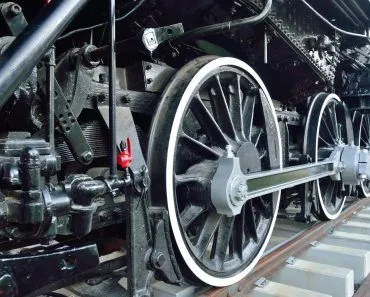
Roller coasters stay on track because of the design of the roller coaster cars and the track, and because of the forces of centripetal force and inertia.
Have you ever been on a roller coaster? If you’ve experienced it even once, then you know one thing for sure – it is a crazy feeling. The endless twists and turns it takes along its small, exhilarating, and sometimes scary journey are sure to give you the goosebumps. You’ll either swear off roller coasters forever or be hooked for life.
Having said that, for someone who has never experienced a roller-coaster ride before (or even the people who have), it’s hard not to wonder why those people don’t fall off when the roller coaster performs one of its characteristic upside-down loops?
Obviously, something has kept millions of people from falling to an unpleasant landing, so let’s find out a bit more about this interesting phenomenon.
Design Of A Roller Coaster
Quick answer: Modern roller-coaster cars wrap around the rail with three sets of wheels—road wheels on top of the rail, side friction wheels against the side, and upstop wheels beneath the rail. The upstop wheels lock the car onto the rail, so even when the track flips upside-down, the car cannot fall off. While riders are inside loops, centripetal force presses them into their seats; harnesses are mostly a backup.
Roller coasters are primarily broken down into two types: wooden and steel.
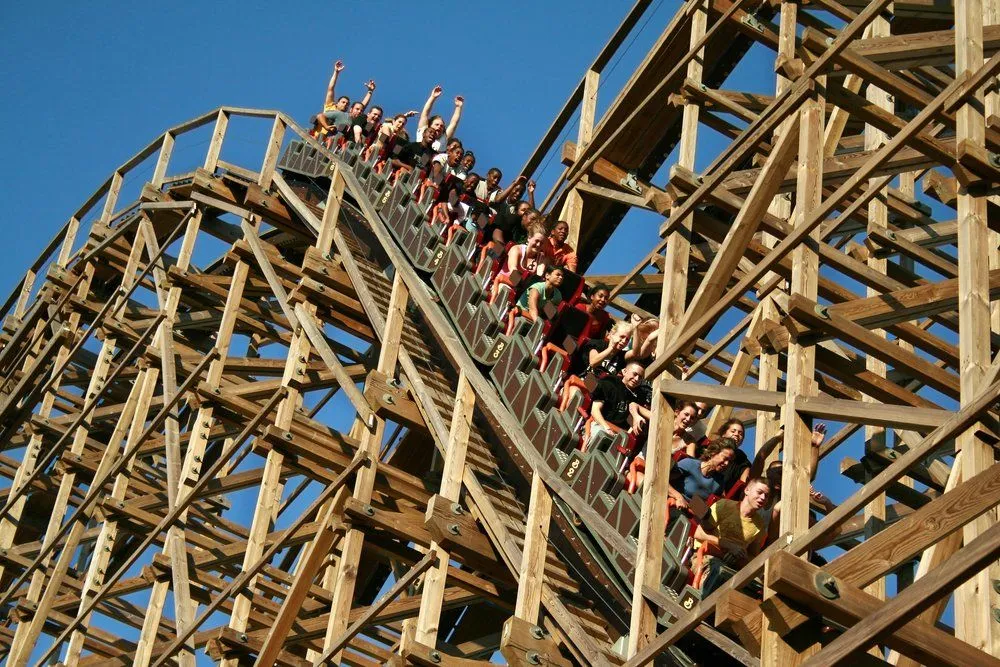
There are certain features on the wheels of wooden roller-coaster cars to ensure that the roller coaster does not flip over. However, the wooden design is less flexible (due to obvious reasons), which is why wooden roller coasters don’t perform twists and loops that are too steep or large, as the safety of passengers in those more difficult maneuvers cannot be guaranteed. We certainly wouldn’t want anything bad to happen on your summer vacation!
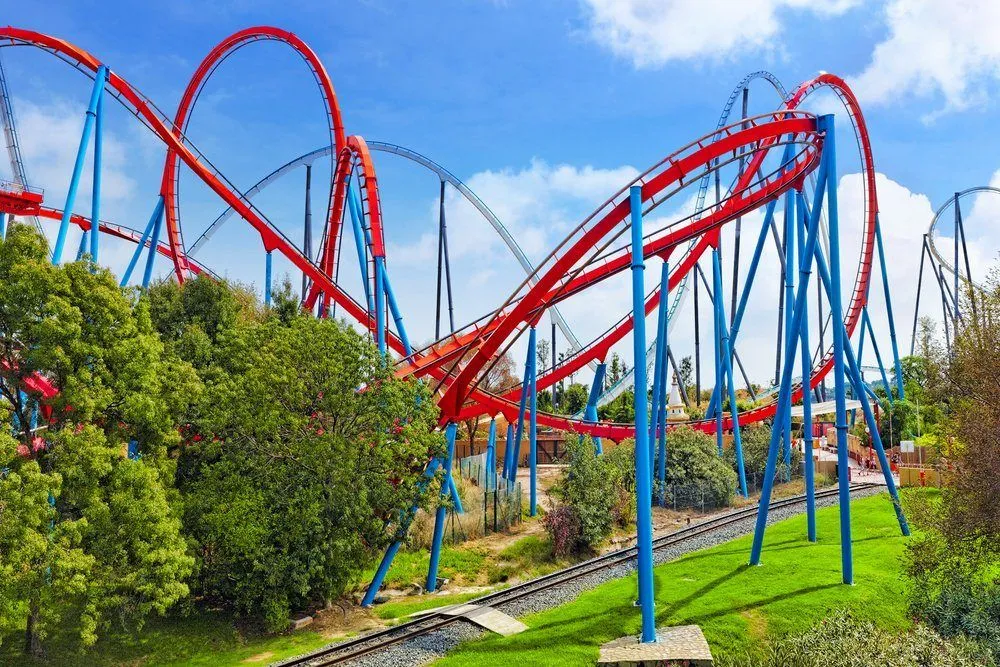
The other variety of roller coasters is steel-made. Due to the enormous strength of steel, it is much more dependable than wood. They are also more flexible, so it becomes possible to make more complex loops on the track, meaning even more fun for thrill-seekers!
How Does The Car Actually Grip The Rail?
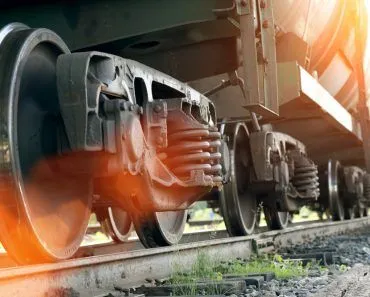
Here is the part most people picture wrong. A modern roller-coaster car does not simply sit on top of the track the way a train does. It wraps around the rail, gripping it from three sides at once. Each chassis carries three sets of wheels, and a big train can run well over a hundred wheels in total.

- Road wheels (also called running or load wheels) sit on top of the rail. They are the largest of the three and carry the weight of the car and everyone in it.
- Side-friction wheels (or guide wheels) press against the sides of the rail. On steel coasters they are often spring-loaded, and they keep the car centered so it tracks cleanly through tight turns instead of derailing.
- Up-stop wheels (also called under-friction or underlocking wheels) run underneath the rail. These are usually the smallest set, and they are the ones that stop the car from lifting away from the track.
The up-stop wheels are the real secret. Because one set of wheels is locked under the rail, the car is sandwiched onto the track from above and below at the same time. It physically cannot leave the rail, whether it is cresting an airtime hill that throws you out of your seat or hanging fully upside-down at the top of a loop. Gravity alone could never hold the car there; the up-stop wheels do.
This was not always possible. The under-friction (up-stop) wheel was invented and patented in 1919 by John A. Miller, often called the father of the modern high-speed roller coaster. Before Miller, cars relied only on gravity and side rails, which kept early coasters slow and gentle. Once wheels could clamp the car beneath the rail, designers were free to build the steep drops, sharp curves, and full inversions that define thrill rides today. The wheels themselves are usually made of polyurethane or nylon rather than steel, which gives a quieter, smoother ride and absorbs vibration as the car races along.
Centripetal Force And Inertia
The action of a roller coaster has a lot to do with a special type of force called centripetal force. This is the force that acts on a body moving in a circular motion and is always directed towards the centre of the circular motion of that body. In other words, it is a force that makes an object to follow a circular path without moving off of that track.
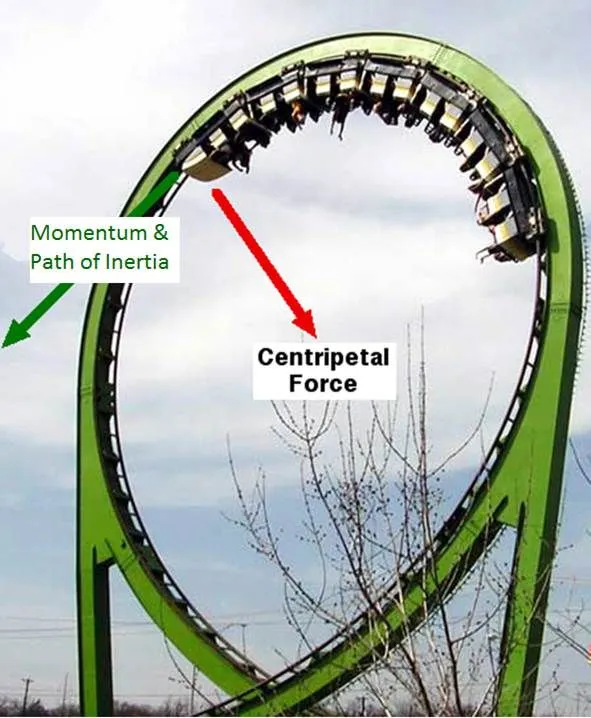
When the roller coaster takes a sharp turn, passengers have a sensation of being pushed outwards, that is, away from the loop. This is caused by inertia. Therefore, when you are in an upside-down loop, although gravity is pulling you downwards, the force of acceleration due to the motion of the roller coaster pushes you into the seat with a force greater than gravity. This force of acceleration is pushing you upwards, i.e., pushing you further into your seat so you don’t fall off while spinning around the top of a loop.
However, it should be noted that the loops have to be elliptical, because perfectly circular loops would subject riders to extremely high g-forces at the bottom; the elliptical (technically a clothoid) shape lets the centripetal force stay within tolerable limits while still keeping passengers pressed into their seats at the top.
Where Is The Centripetal Force At Work On A Roller Coaster?
A common exam-style question is where on the ride centripetal force actually shows up. The short answer: anywhere the track curves. Centripetal force is not a new, separate force; it is simply the name for whatever net force points toward the center of a curve and bends the car onto a circular path. On a coaster, that job is shared between gravity and the normal force (the push from the track and seat). Wherever the path is straight, there is no centripetal force at all.
The most dramatic spot is the vertical loop, and the forces flip between top and bottom:
- At the bottom of the loop, the center of the circle is above you. The seat has to push up hard enough to both support your weight and supply the inward (upward) centripetal force, so you feel much heavier, often around 4 to 6 times your normal weight.
- At the top of the loop, the center is now below you. Here gravity already points toward the center, so it does most of the work, and the track only needs to add a small push. That is why you feel almost weightless upside-down instead of falling out.
Centripetal force is also at work in every banked turn, every helix, and the dips at the bottom of each hill, basically every place the rails are not running dead straight. It is closely tied to the outward-feeling sensation riders describe, which is really inertia rather than a real outward force. If that distinction is fuzzy, our explainer on centripetal acceleration and centrifugal force walks through it in detail.
Energy Is The Force That Keeps It Going
Typically, roller coasters don’t have engines of their own to generate energy. The climb up the first massive hill is accomplished by pulling the car using cables, which provides the car with sufficient potential energy. After that, the roller-coaster flies down at a very high speed, using this potential energy. This speed gives it kinetic energy, which is then used to climb the next hill. The process is repeated until the end of the ride, where the hills are comparatively less steep, as the energy (potential or kinetic), has been lost due to the friction of the wheels against the rail and the wind. This is also why roller coasters without their own engines cannot be too long, as energy is inevitably lost along the way.
Still, a great deal of care is taken to make sure that all passengers are safe during a roller-coaster ride. The zig-zags and rapid ups and downs are enough to make many people nauseous for a short time. However, even if you’re feeling a bit green after stepping off a thrilling ride, there is no denying that roller coasters continue to be a symbol of pure craziness and a unique thrill.
References (click to expand)
- Why don’t I fall out when a roller coaster goes upside down? — Library of Congress
- How Roller Coasters Work - Science | HowStuffWorks. HowStuffWorks
- John Miller — Lemelson-MIT Program (1919 under-friction/upstop wheel)
- How Roller Coasters Stay on Their Tracks — Encyclopaedia Britannica
- Roller coaster wheel assembly — Wikipedia