Robot vacuums navigate using onboard sensors (bump, wall, cliff and wheel sensors) to avoid obstacles, paired with mapping technology such as LiDAR or camera-based vSLAM. Together these let the robot build a map of the room, track its own position on it, and clean methodically rather than bumping around at random.
Cleaning is one of those chores that takes a lot of willpower to get done. Most of us wait for the right motivation to get started, like a special occasion or if someone important is coming over.
Thankfully, there are appliances that assist in getting these tasks done, and while a regular vacuum would require you to physically carry it around to clean out the dirt, a robotic vacuum cleaner cleans the floors it’s sitting on – without any help from us!
Through the eyes of the Robot Vacuum
While cleaning a room, the vacuum needs to navigate the space without hitting any obstacles, just like us. We do this by using our sensory inputs, primarily sight, and moving out of the way to avoid the obstacle. The robot vacuum works similarly, but has different sensors for different inputs. The onboard sensors enable them to avoid hazards, move through optimal cleaning paths and navigate efficiently to new spaces they have yet to cover.
The type of sensors used depends on the manufacturers who make the specific vacuum, but basically, real-time input from the sensors will trigger pre-programmed actions in the robot, helping it make unassisted, on-the-spot decisions.
The cleaners are made to be as small as possible, with a very compact design, allowing them to reach every small corner beneath objects. For the places they can’t reach and inadvertently bump into, they use sensors to guide them through.
These sensors include the following:
Wall sensors
The robot vacuum is aided with an infrared sensor that detects the walls of the house. This is required for the robot to track the walls and move along them while cleaning the dirt accumulated on the sides of the skirting of the wall. In some devices, the robot also determines the cleaning path in a room, which is done through pre-programmed algorithms. The infrared spectrum is also useful in tightly navigating furniture in a room, which makes it easier to clean the room more thoroughly. In those devices with mapping capabilities, the wall sensors can enable them to go around open doorways and clean new rooms.
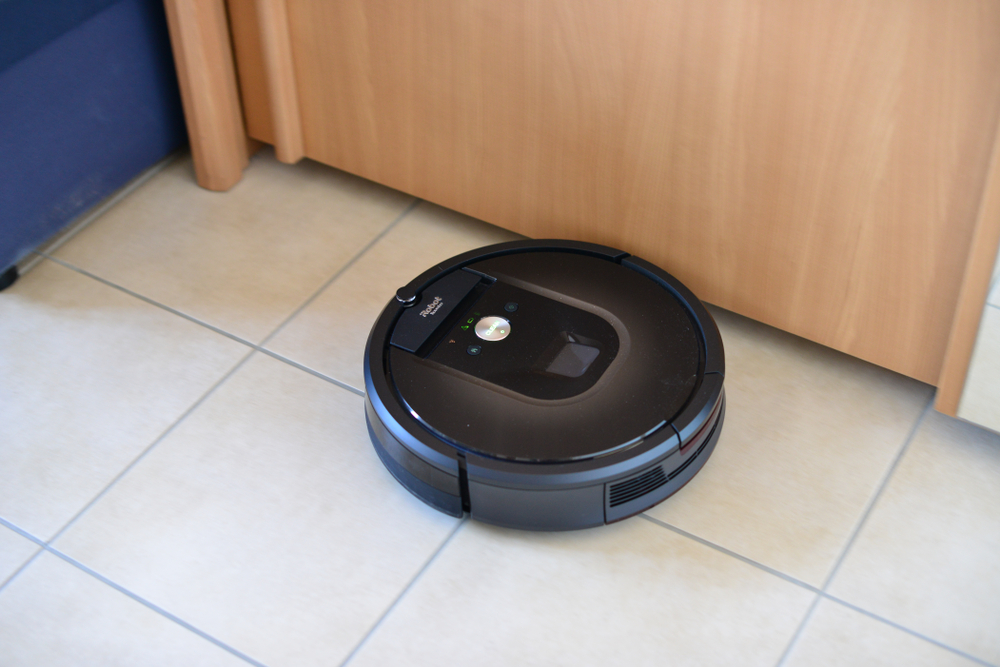
Wall sensors for doorways and edges. (Photo Credit : Carlo Emanuele Barbi/ Shutterstock)
Obstacle sensors
The biggest concerns for robot vacuums are the objects in a room, the loose furniture, the sofa legs, the dining table, chairs, and any haphazardly placed toys. For combating this problem, there are sensors placed on the shock-absorbing bumpers of the robot. When the robot bumps into an object, the sensor gets triggered, informing the robot to steer in the opposite direction of the bumped object. Since moving around objects can leave traces of dirt, many manufacturers tell their robots to take different routes to the obstacle, by slowly bumping into objects to see if they’re soft (like curtains and blinders), so they can push through, rather than avoiding the area completely.
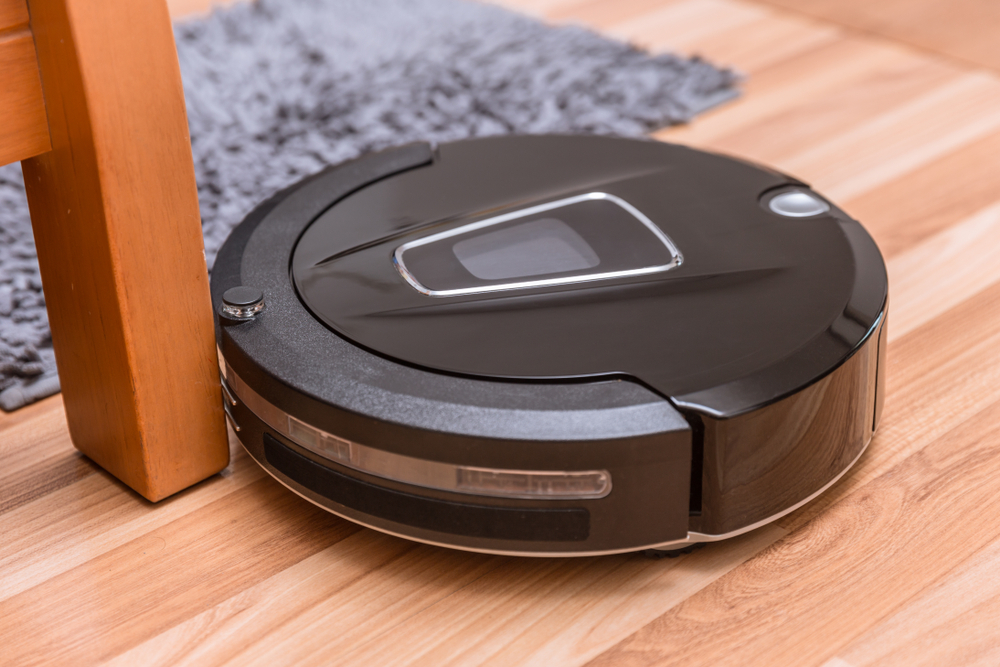
Obstacle sensors to guide the robot through the objects in the room. (Photo Credit : Quality Stock Arts/ Shutterstock)
Cliff sensors
Changes in floor level can be a major hazard for the robot, as it could get stuck or even damaged. Areas like stairwells and lofts can be very treacherous and may cause damage if poorly navigated. To make sure that the robot stays on the same plane, infrared sensors are put beneath the robot that send out signals to measure the distance from the floor. If the signal is received immediately, the robot knows it is on the same plane. If the signal takes time to return, it recognizes that there is a cliff, so it initiates a pre-programmed protocol to change its path to a different direction.
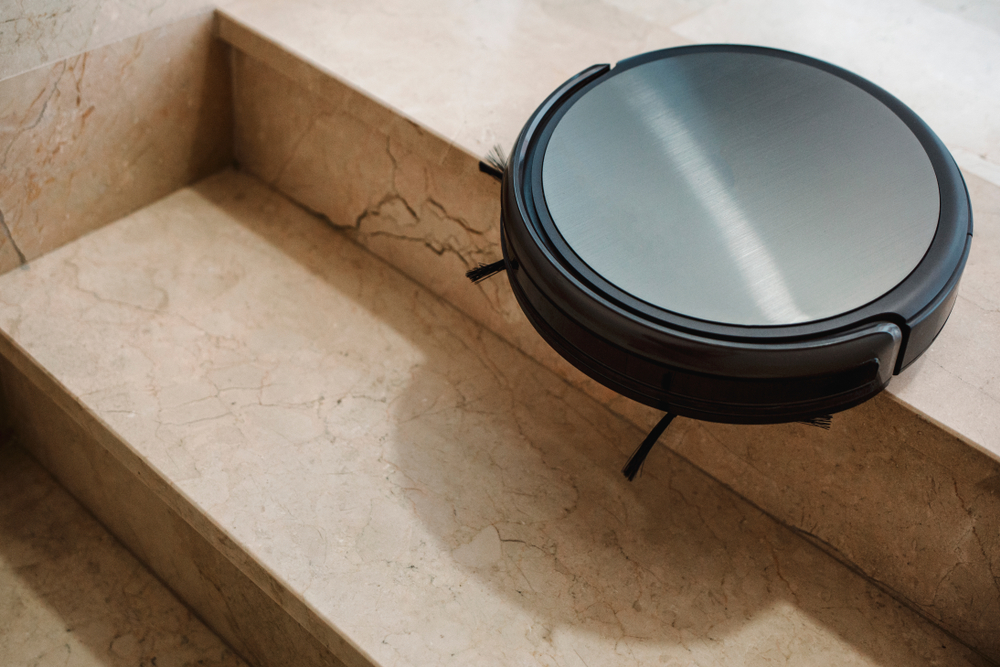
Cliff detection. (Photo Credit : esp2k/ Shutterstock)
Wheel sensors
It is essential for the robot to calculate the total distance it has traveled in the room, essentially to make sure it has thoroughly cleaned all the surfaces of the room and not missed any spots. Optical encoders, which use light sensors to count the spokes of a slotted disc, are therefore placed on the wheels of the robot. This enables the robot to measure its own wheel rotation. This measurement, when multiplied by the circumference of the wheel, gives it the distance it has traveled. Tracking each wheel separately also tells the robot how far it has turned, a technique called odometry.
Dirt sensors
These sensors are used by some manufacturers to notify the robot in the case of excess dirt in a certain area. These are piezoelectric acoustic impact sensors, which enable the robot to detect if a high volume of dirt is entering into the robot, as the dirt strikes a metal plate in the sensor. Each impact flexes a piezoelectric crystal behind the plate, which generates a tiny voltage, so a sudden burst of these pulses tells the robot that the area is especially dirty. The robot will then initiate another round of cleaning of the room, as it recognizes that there is more dirt to tidy! Newer models add a camera-based version of this trick, using a downward-facing camera to spot concentrated debris that the acoustic sensor alone might miss.
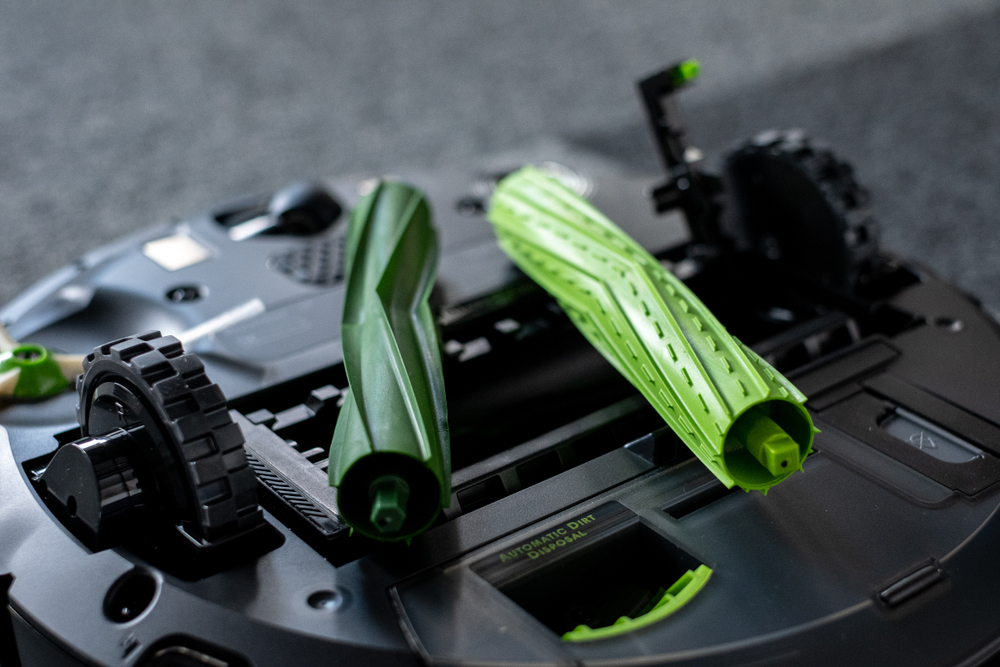
Dirt sensors for effective cleaning. (Photo Credit : Karlis Dambrans/ Shutterstock)
How Robot Vacuums Map And Navigate A Room (LiDAR, SLAM And vSLAM)
So far we have talked about how a robot avoids bumping into things, but how does it actually know where to go? The earliest robot vacuums did not really know. They used what is sometimes called random bounce navigation: drive in a straight line, hit something, turn a random angle, and repeat. Given enough time, this ping-pong pattern covers most of a room, but it misses spots, doubles back over others, and has no idea when the job is truly done. Modern robots instead build a map and clean in tidy, methodical rows, which is faster and far more thorough.
To map and follow a room, today's robots lean on a class of algorithms called SLAM, short for Simultaneous Localization and Mapping. As the name suggests, the robot draws a map of its surroundings and figures out its own position on that map at the same time, much as you might sketch a floor plan while keeping a finger on the "you are here" dot. This is what lets the robot remember where it has already cleaned and which corners it still owes a visit.
Manufacturers feed SLAM with different sensors. Some use onboard cameras to capture the room, marking the location of furniture, walls and the overall layout. This camera-driven approach, called visual SLAM or vSLAM, tracks distinctive features like the corner of a doorway across successive frames to work out where the robot has moved. It is usually cheaper, but it leans on decent lighting and can struggle in a dark room. This awareness of the environment helps the robot recognize areas and learn optimum paths for better cleaning and efficient power usage.
Other robots use LiDAR (Light Detection and Ranging) to map the distance between them and the objects in their path. A small spinning laser on top of the robot sweeps the room and times how long each pulse takes to bounce back, building a precise 360-degree map of distances even in total darkness. It creates a map with these measurements, which enables the robot to know the environment and know its place within it, so it knows what path has already been taken, allowing it to optimize its movements for better maneuvering. A simpler middle ground, found on many budget models, pairs a gyroscope and accelerometer to track turns and motion well enough to clean in straight rows, though without the accuracy of a full laser map.
Because the robot holds a saved map, it can do clever things a random bouncer never could: clean one room and skip another on command, steer clear of a "no-go zone" you draw in the app, and head straight back to its dock when the battery runs low. Many mapping robots can even store several maps at once, typically up to four or five, so a single robot carried between levels can recognize each floor of a multi-story home and apply the right layout. None of this requires the robot to learn your house in the human sense; it is simply matching what its sensors see now against the map it built on earlier runs.
How Do Robot Vacuums Recognize And Avoid Objects On The Floor?
A LiDAR turret or a mapping camera is brilliant at answering "where am I in this room?", but it sits high up on the robot and is not much use for spotting the small things scattered across a floor. A phone charging cable, a stray sock or a pet's accident all sit below its line of sight, and driving over any of them can turn a tidy clean into a tangled mess. This is why many newer robots add a second, forward-facing camera aimed low at the floor ahead.

The trick is not just seeing an object but knowing what it is. These robots run the camera feed through machine learning models trained on thousands of example images, so the software can classify a shape as a cable, a shoe or a wayward toy and then decide how wide a berth to give it. iRobot calls its version PrecisionVision Navigation, first seen on the Roomba j7. When the robot meets something it does not recognize, it can snap a photo and send it to the companion app, asking whether it should clean around the object or steer clear of it on future runs, gradually building a personalized list of your home's obstacles.
Pet waste is the obstacle owners dread most, and iRobot is confident enough about avoiding it to offer what it cheerfully calls the Pet Owner Official Promise, or P.O.O.P.: if a covered Roomba fails to dodge solid dog or cat waste within the first year of ownership, the company will replace the robot. To teach the software what to look for, iRobot trained it on photographs of both play-dough models and images supplied by its own employees.
Other brands fuse even more sensors. Roborock's ReactiveAI pairs an ordinary RGB camera with a 3D structured-light projector, which casts a pattern of infrared light and reads its distortion to judge depth; a dedicated onboard chip then runs the machine-learning model and picks a safe distance to skirt each object. Crucially, all of this runs alongside the LiDAR map rather than replacing it, with the laser handling the big picture and the camera watching the small stuff underfoot. As the training data grows, the menu of recognizable hazards keeps expanding, with some systems now claiming to identify well over a hundred distinct types of household clutter.
Can A Robot Vacuum's Camera See You? A Note On Privacy
Once you put a camera on a machine that wanders every room of your home, it is fair to ask what happens to everything it sees. For most consumer robots the navigation happens on the device itself, and the robot is not broadcasting a live video feed of your living room to anyone. Even so, the question stopped being hypothetical in 2022.
That year, MIT Technology Review reported that grainy images captured by development versions of iRobot's j-series robots, including one of a woman sitting on a toilet and another of a young boy lying on a floor, had turned up in private social media groups. The pictures had been sent to a data-labeling company called Scale AI, which pays gig workers around the world to tag training images, and some of its contractors in Venezuela shared at least 15 of the photos online.
iRobot's response was that the images came from special development robots run by paid testers who had agreed in writing to data collection, not from the vacuums sold to the public, and the company ended its contract with the labeling firm. The episode is still a useful reminder that a camera-equipped robot is also a data-gathering device. Before you let one map your home, it is worth checking what a given model actually uploads, whether any images ever leave the device, and what the app's privacy settings let you switch off.
Conclusion
Multiple sensors and image mapping technology are used to help robot vacuums understand and navigate in a room. They make the robot smart and more capable of finding optimal ways to maneuver a space to clean it effectively. These multitudes of sensors are seen as product features and may or may not be available, depending on the company and price point of that specific robot vacuum. Choose wisely!
References (click to expand)
- How Robotic Vacuums Work.
- How Robotic Vacuums Work. HowStuffWorks.
- Vacuum Cleaners (Annotated).
- Light Detection and Ranging (LiDAR) h = ?.
- iRobot's latest Roomba can detect pet poop. Engadget.
- The Best Robot Vacuums with Obstacle Avoidance. Vacuum Wars.
- A Roomba recorded a woman on the toilet. MIT Technology Review.