Table of Contents (click to expand)
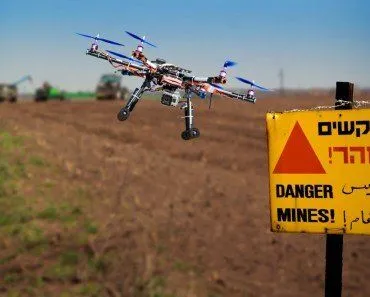
A drone, also called an unmanned aerial vehicle (UAV), is a robotic aircraft that flies without a pilot on board. It is steered remotely by a human operator or guided by onboard navigation software. Drones are used for aerial photography, filming, surveillance, surveying, package delivery, agriculture, and recreation.
Drones, which are frequently used for filming, military surveillance, and recreational flying, are named after the male honeybee. Drones fall under the intersection of aerospace, robotics, and mechatronics. They can range from entirely autonomous military-grade aircraft to your average remote-controlled drone, the kind you might see a kid flying in the park.
Unmanned Aerial Vehicle (UAV) is another name for a drone, and a fleet of drones plus their ground control and communication links is often called an unmanned aircraft system (UAS).
So why do we call these machines drones at all? The name traces back to the 1930s. The British military built a radio-controlled target aircraft, the de Havilland DH.82B Queen Bee, for anti-aircraft gunnery practice. Since a drone is a male bee that serves the queen, the remotely flown aircraft that followed the lead of the “Queen Bee” came to be called drones, and the name stuck.
Last Updated By: Ashish Tiwari
Drone Technology: Parts Of A Drone
The following is some information about consumer-friendly drones that private individuals commonly use.
Frame
The frame is the most critical component of a drone. Frames are typically made of plastic or carbon fiber and can be fitted with different arm variations, such as tri, quad, hex, or oct. The end of each arm holds the motor and propeller, while the center houses the flight controllers, gimbals, and other electronic gear.

The majority of the weight should be at the center of the drone to ensure the best flight characteristics by keeping the center of gravity centered.
Weight is significant in all drone components. A heavy frame will reduce the drone’s lift. Conversely, you don’t want a super lightweight frame that will break upon impact. Carbon fiber is a favorite material because of its strength and minimal weight.
Motors
The motors are the second most important component of a drone. There is a separate motor for each blade/arm. The motor choice is based on the required power and what you want the motor to do.

For multi-rotors that are designed to carry heavy payloads and maintain the best possible flight times, a slower-spinning, higher-torque motor is ideal. However, a different type of motor is required if you want an aggressive, fast system with lots of maneuverability and faster-spinning rotor systems.
The kV value measures the RPMs or speed of the rotors. Faster versions will have a kV value upwards of 1400kv, while slower drones with a longer battery life are in the 300-900kv range. These figures are accurate only if the correct battery and propellers are used to match the drone’s specifications.

Propellers
Propellers are the wings of a drone and can be made of either plastic or carbon fiber. Carbon fiber is the more expensive, higher-end choice. When selecting propellers, ensuring that your drone’s frame can accommodate your chosen size is essential.
Most frames will have a maximum propeller size assigned to them. Additionally, the propeller size should be selected based on your intended purpose.

If you want a more aggressive build, choose smaller propellers, while larger propellers are recommended for higher payload and longer flight times. Propellers usually come in pairs, with one being a clockwise (CW) spinning prop and the other being counterclockwise (CCW).
Batteries
Drones rely on their batteries for power, which come in various weights and capacities. It may seem logical to always choose the battery with the highest capacity for the longest flight time, but this is not always true.
As the battery’s capacity increases, so does its weight. More capacity is no longer advantageous at a certain point, and the benefits begin to diminish.
This is a commonly overlooked detail that can cause problems. If you desire a high-capacity 10,000 mAh 6s battery, ensure that your motors and ESC are 6s and that your flight controller can support it.
Electronic Speed Controller
The Electronic Speed Controller (ESC) is crucial to a drone’s control system. It runs the motors and is rated for how much current it can consistently supply. As the motors are constantly spinning at different speeds, the ESC dictates the speed of each motor. This speed control system is necessary to keep the drone hovering at a constant height.
The difference in motor speeds controls the drone’s pitch, as we are not changing the pitch of the rotors. Four identical ESCs are highly recommended for the best results.
The transmitter and receiver are crucial in communicating with the drone and the person controlling it. The transmitter sends the signal, and the receiver receives it. The receiver is connected to the flight controller and delivers the inputs and outputs of the responses to the motors.
The choice of transmitters is relatively straightforward, usually based on the number of channels required for operation. For multi-rotor drones, the bare minimum is four (roll, pitch, yaw, and throttle). Having more channels is always an excellent convenience. You can also use a separate channel for autopilot, operating a camera gimbal, retractable landing gear, and other functions.
Flight Mechanism Of Drones
Now that you have a basic understanding of the different parts of a multi-rotor drone, it’s time to discuss how all these parts come together to achieve flight. For the following examples, let’s use a quadcopter. A quadcopter uses four different propellers powered by four different motors on four arms.
Easy, right?
Each spinning propeller creates its torque. Newton’s Third Law states, “For every action, there is an equal and opposite reaction.” Thus, if a propeller is spinning, the arm holding it also wants to spin in the opposite direction. This is the law of Torque Reaction and is why a traditional helicopter has a tail rotor to compensate for that fuselage torque.
In a quadcopter, we don’t need a tail rotor. Do you know why? The trick is the direction each propeller spins. The two diagonally opposite propellers spin the same way, so a quadcopter ends up with one pair turning clockwise and the other pair turning counterclockwise. Each spinning propeller still produces a torque on the body, but the clockwise and counterclockwise pairs produce equal and opposite torques that cancel out. With the net torque balanced, the craft has no urge to spin under itself, which is exactly why a quadcopter can hover so steadily.
If you were to hover a helicopter and apply more power, there would be more torque, and more power would be needed from the tail rotor. This takes many hours to master, especially to make it look smooth. These problems don’t exist in multi-rotor drones because power increases are always done equally, and the opposite is true in the propeller system. We want to do more than just hover our multi-rotor.
If we want to move forward, then both forward propellers will apply less power, whereas the back propellers will add more. This principle applies to all roll directions.
Yaw (turning left or right) works differently, however. Remember those balanced torques that keep the drone from spinning? To yaw, the flight controller deliberately unbalances them. It speeds up the two propellers spinning in one direction and slows down the two spinning the other way by the same amount. Total lift stays roughly the same, so the drone holds its height, but the leftover reaction torque now points one way and gently rotates the craft about its vertical axis. Want to turn left? The controller gives more power to the clockwise-spinning pair so their counterclockwise reaction torque wins out.
Ascending and descending are very simple. Power is either increased to the entire propeller system to ascend or decreased to make a descent.
You can also fly your quadcopter in a multitude of ways. You can be in slow yaw while ascending and applying a slight roll. The algorithm and codes built into the flight computer consider these directions and apply the necessary power to each propeller. This enables the quadcopter to maintain a stable and smooth flight. With all this in mind, the next time you fly your drone, you’ll know exactly how much planning and delicate technology is required to fly it!
What Are Drones Used For?
For most of their history, drones were a military tool. Even today, armed forces use them for surveillance, reconnaissance, and strike missions, and the cheap quadcopters and fixed-wing UAVs seen in recent conflicts have shown just how much the technology has matured. But the really interesting story is how far drones have spread into civilian life.
Aerial photography and filmmaking were the first big consumer use, and they are still huge. Beyond that, drones now inspect cell towers, bridges, wind turbines, and power lines so that humans don’t have to dangle from them. In agriculture they map fields, check crop health, and spray fertilizer and pesticide with precision. Surveyors and mapping teams use them to build 3D models of land and buildings, while search-and-rescue crews fly thermal cameras to find people in the dark.
Then there is delivery, the application that gets the most headlines. Companies such as Zipline, Alphabet’s Wing, and Amazon Prime Air are running routine package and medical deliveries by drone. By early 2026 Zipline had passed two million autonomous deliveries, and the rest of the industry is racing to scale up as the rules catch up.
Drone Regulations And The Future
Letting robots fly over people and traffic needs rules, and they are evolving fast. In the United States, recreational and commercial drones above 250 grams (0.55 pounds) must be registered with the Federal Aviation Administration (FAA) and broadcast a digital license plate called Remote ID. Commercial pilots fly under the FAA’s Part 107 rules, and similar registration and Remote ID requirements now exist across the UK, Europe, Australia, and Canada.
The biggest change on the horizon is flying beyond visual line of sight (BVLOS), meaning the operator can no longer see the drone. That single restriction is what has held large-scale delivery back. In August 2025 the FAA proposed a new framework, known as Part 108, to make routine BVLOS flights legal and scalable, with a final rule expected around 2026. Pair that with better batteries, smarter onboard software, and detect-and-avoid sensors, and the humble quadcopter is steadily growing into a serious piece of everyday infrastructure.
Last Updated By: Ashish Tiwari
References (click to expand)
- Marris, E. (2013, June 12). Drones in science: Fly, and bring me data. Nature. Springer Science and Business Media LLC.
- Hildebrand, J. M. (2019, July 13). Consumer drones and communication on the fly. Mobile Media & Communication. SAGE Publications.
- Drone (military and civilian aircraft). Encyclopaedia Britannica.
- Remote Identification of Drones. Federal Aviation Administration (FAA).
- Normalizing Unmanned Aircraft Systems Beyond Visual Line of Sight Operations (Part 108 Proposed Rule). Federal Register.
- Watkins, S., Burry, J., Mohamed, A., Marino, M., Prudden, S., Fisher, A., … Clothier, R. (2020, January). Ten questions concerning the use of drones in urban environments. Building and Environment. Elsevier BV.