A thermoelectric generator is a solid-state heat engine that converts a temperature difference directly into electricity through the Seebeck effect. It pairs p-type and n-type semiconductor elements, with no moving parts. Typical efficiency is around 5-8%, so it is mainly used to recover waste heat as useful power.
We know that generators are used in the production of electricity, and the picture of a generator most of us have in mind is that they are huge machines with a magnetic field and a rotor that cuts through it with the help of mechanical forces to create electricity. However, what if I told you that electricity generation does not always require a machine with rotating parts? Let’s take a closer look at one such device, commonly known as the Thermoelectric Generator.
Principle
The thermoelectric effect is the direct conversion of heat into electricity. According to Joule's Law, a current-carrying conductor produces heat proportional to the product of the resistance of the conductor and the square of the current passing through it. In 1821, Thomas J. Seebeck approached the relationship between heat and electricity from the other direction. He joined two dissimilar metals so that the two junctions where the metals touch sat at different temperatures. He noticed that a voltage developed between the junctions proportional to the temperature difference. The current generated due to the difference in temperature at the junction of two different metals is known as the Seebeck Effect.The Seebeck Effect produces measurable amounts of voltage and current. The electromotive force (voltage) generated by a thermoelectric generator can be estimated with the following relation.

This electromotive force is set by the Seebeck coefficient, which is unique to each material, multiplied by delta T, the temperature difference across the junctions. Another effect that helps in describing the thermoelectric effect is the Peltier Effect.
The Peltier Effect helps in describing the heat dissipation or absorption at the connection of the conducting materials. Depending on the direction of the flow of current, heat is either dissipated or absorbed by that point in the material.
Mechanism
The Seebeck Effect produces an electric current when dissimilar metals are exposed to a variance in temperature. Seebeck effect applications are the foundation of thermoelectric generators (TEGs) or Seebeck generators, which convert heat into energy. The voltage produced by TEGs or Seebeck generators is proportional to the temperature difference between the two metal junctions.
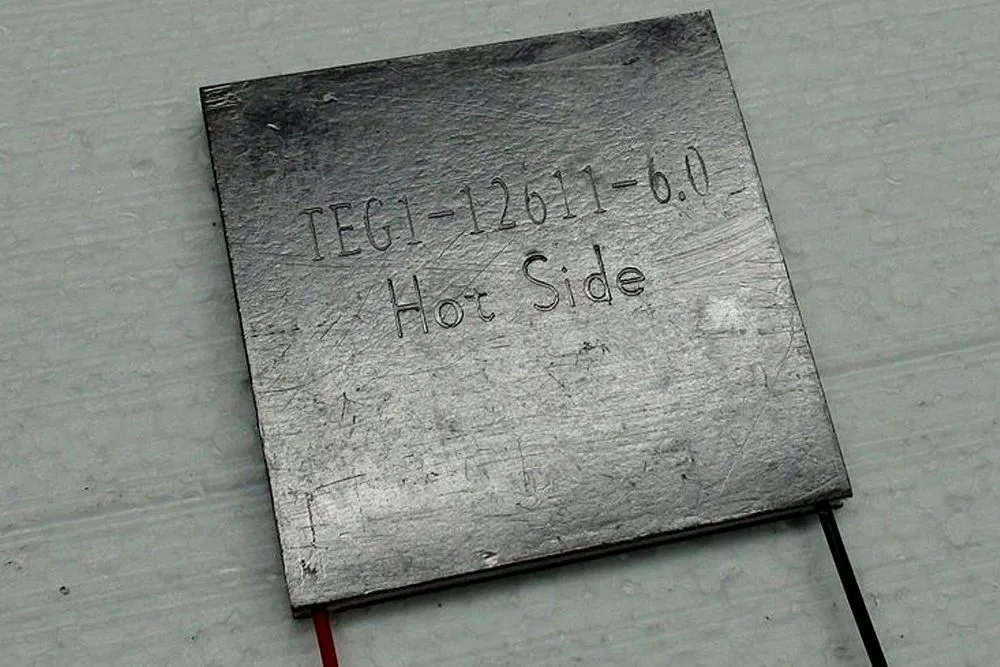
Thermoelectric generators are solid state heat engines made of two primary junctions, known as the p-type (high concentration of positive charge) and n-type (containing a high concentration of negative charge) elements. The p-type elements are doped in such a way to have a high number of positive charge or holes giving them a positive Seebeck coefficient. The n-type elements are doped to contain a high concentration of negative charge or electrons that give them a negative Seebeck coefficient.
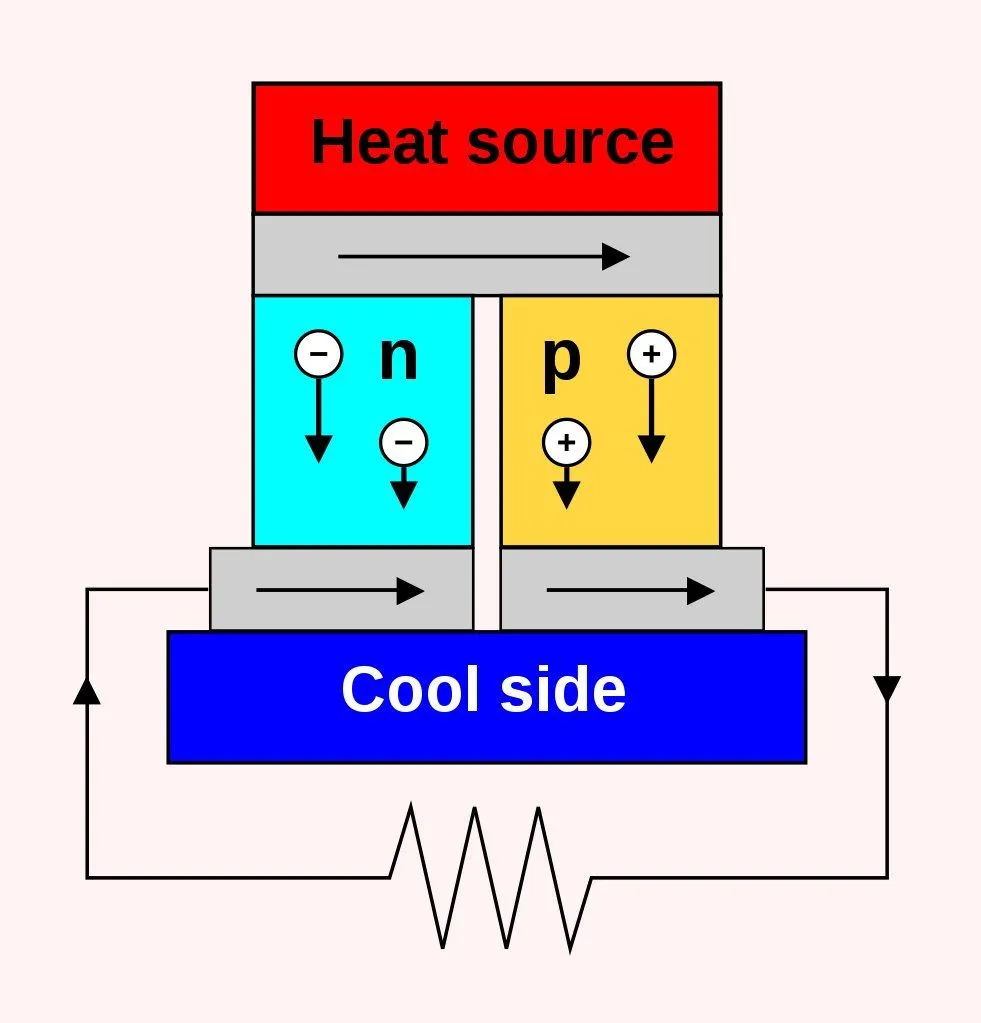
When the junction is heated and the p-type and n-type elements are linked through an external circuit, the charge carriers (holes in the p-type material, electrons in the n-type material) diffuse from the hot side toward the cold side. This flow of carriers drives a current through the external load.
Materials
Only a handful of compounds have so far been identified as good thermoelectric materials. Two important ones are Bismuth Telluride (Bi2Te3), which performs best near room temperature (around 300 K, or 27 °C / 80 °F) and is often used on the cold side, and Lead Telluride (PbTe), a mid-temperature material that works well from roughly 600 K to 900 K (327 to 627 °C, or 620 to 1160 °F) and is used on the hot side. These materials are rated by a metric that captures how good they are at converting heat to electricity; this measure is known as the figure of merit, or ZT. The peak ZT for both Bismuth Telluride (Bi2Te3) and Lead Telluride (PbTe) sits near one at the temperatures mentioned above. To rival conventional power generators, the figure of merit would need to climb to around 2 to 3.
There are numerous other factors that also need to be considered in the selection of a thermoelectric material. Ideally, a thermoelectric material must have a wide temperature gradient. If it does not have a wide temperature gradient, it will be susceptible to heat-induced stress, which might lead to the fracture of the material. The mechanical properties of the materials must be considered, and the coefficient of thermal expansion of the n-type and p-type materials must be matched reasonably well.
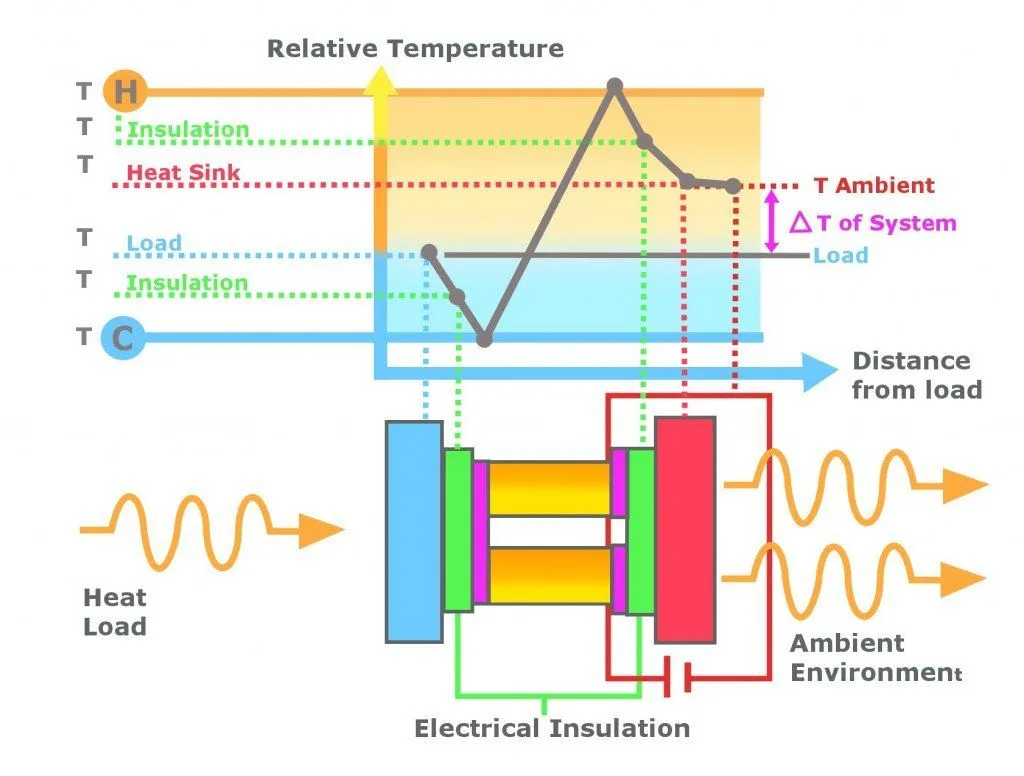
The efficiency of the current generation in a thermoelectric generator is around 5-8%. Older devices were even less efficient, as they used bimetallic junctions, which lead to the severe loss of power through heat. More modern devices have a doped semiconductor material present within them, such as Lead Telluride (PbTe), Bismuth Telluride (Bi2Te3) and Calcium Manganese Oxide, or some combination of these materials.
Although thermoelectric power cannot compensate for mainstream power, it is helpful to a certain extent to use the latent energy lost as heat in a system as useful energy. While it may not be much, a little energy served over a long period of time can go a long way!
How Does A Thermoelectric Generator Actually Work?
Let's tie the whole device together. A single thermoelectric couple is just one p-type leg and one n-type leg joined by a metal strip at the top, where the heat goes in. The bottom ends connect to the external circuit on the cold side. When one face is kept hot and the other cold, the charge carriers (holes in the p-type leg, electrons in the n-type leg) drift from the hot end toward the cold end, and because the two legs are wired so their currents add rather than cancel, you get a usable voltage across the load. A real generator simply stacks hundreds of these couples electrically in series and thermally in parallel between a hot plate and a cold plate, so the small voltage from each couple sums into something useful.

The single most important thing to remember is that the output is driven by the temperature difference (delta T), not by the absolute temperature. A bigger gap between the hot and cold sides means more voltage and more power, which is why every practical design works hard to keep the cold side cold while pumping heat into the hot side.
Why Is The Efficiency So Low?
We mentioned that a thermoelectric generator only manages about 5 to 8% efficiency. That sounds disappointing next to a gas turbine, but there is good physics behind it. Like every heat engine, a TEG is capped by the Carnot limit, the maximum efficiency any device can reach when moving heat between a hot and a cold reservoir. A real thermoelectric generator only captures a fraction of even that Carnot ceiling, and how large that fraction is comes straight back to the figure of merit, ZT, of its materials.
The catch is a tug-of-war built into the materials themselves. A good thermoelectric material needs to conduct electricity well (like a metal) but conduct heat poorly (like glass), so that the temperature difference is not simply short-circuited away. In most solids those two properties rise and fall together, which is exactly why so few materials make good thermoelectrics and why pushing ZT higher is so hard. With today's best commercial materials sitting near a ZT of 1, the efficiency lands in that single-digit range. Laboratory materials have since climbed well past ZT values of 2, and reaching a sustained ZT of 2 to 3 across a device is roughly what it would take for thermoelectric power to compete with conventional generators.
Where Are Thermoelectric Generators Used?
With no moving parts to wear out, a thermoelectric generator can run untouched for decades, and that reliability is exactly what makes it priceless in places no engineer can ever visit again. The most famous example is the radioisotope thermoelectric generator (RTG), the "nuclear battery" that powers deep-space probes. Instead of a furnace, the hot side is heated by the natural radioactive decay of plutonium-238 (used as plutonium dioxide), which has a half-life of about 88 years, while the cold side radiates to the chill of space. NASA's two Voyager spacecraft, launched in 1977, are still phoning home from interstellar space on RTG power, and missions such as Cassini, New Horizons, Curiosity and Perseverance all rely on the same trick.

The Curiosity and Perseverance Mars rovers carry a Multi-Mission Radioisotope Thermoelectric Generator (MMRTG). It holds about 4.8 kg (10.6 lb) of plutonium dioxide, which produces roughly 2,000 watts of heat and converts about 120 watts of it into electricity, enough to keep a rover working through Martian nights and dust storms when solar panels would struggle. RTGs are chosen over solar power precisely where sunlight is too weak or unreliable, such as the outer planets or the shadowed floors of polar craters.
Back on Earth, the same principle is being put to work on waste-heat recovery. Roughly a third of the energy in a car's fuel is dumped out of the exhaust pipe as heat, and bolting thermoelectric modules onto the exhaust can claw a slice of that back as electricity to ease the load on the alternator. Industrial furnaces, incinerators and steel mills offer the same opportunity. The numbers are modest, but as we noted earlier, a little energy served over a long period of time can go a long way.
References (click to expand)
- Thermoelectric generator - Wikipedia. Wikipedia
- Kanimba, E., & Tian, Z. (2016, December 21). Modeling of a Thermoelectric Generator Device. Thermoelectrics for Power Generation - A Look at Trends in the Technology. InTech.
- How Does a Radioisotope Thermoelectric Generator Work? The Seebeck Effect. NASA Science.
- Goldsmid, H. J. Bismuth Telluride and Its Alloys as Materials for Thermoelectric Generation. Materials (Basel). PMC, NCBI.
- Powering Curiosity: Multi-Mission Radioisotope Thermoelectric Generators. U.S. Department of Energy.
- Radioisotope Power Systems FAQ. NASA Science.