Table of Contents (click to expand)
A transformer is a static electrical device that transfers energy between two circuits by electromagnetic induction. Using primary and secondary coils wound on a shared iron core, it steps voltage up or down while keeping power roughly constant, so when voltage rises, current falls. It works only on alternating current (AC), not direct current (DC).
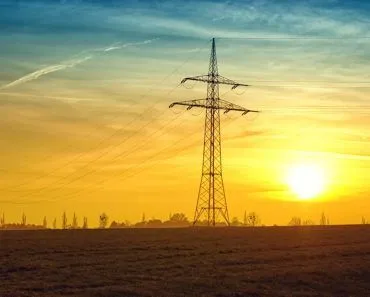
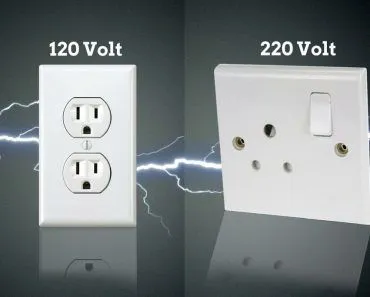
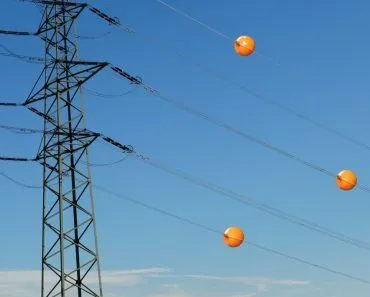
Have you ever seen the long power lines on a road trip stretching through the countryside? These lines supply power to our homes and are usually rated at very high voltages, anywhere from about 115,000 up to 765,000 volts. The question is, how are such high voltages useful for our everyday appliances, which typically run on 120 or 240 volts! If you tried powering up your laptop or cellphone directly from one of the power lines, the device would immediately burn out, so where and how does this high voltage get converted into a lower one? That’s where the transformer comes in and plays its pivotal role. Now, let’s first try to understand a bit more about high-voltage power systems before we move to understanding the transformer.
High-Voltage Systems
One logical question that might crop up is why the power lines don’t just transmit at 120-240 volts? To explain that, we must first understand how electricity behaves when it travels over a certain distance. As electricity flows down a metal wire, the electrons carry a certain amount of energy along with them. As they pass through the wire, the electrons lose some of that energy to the resistance of the metal. That’s why wires get so hot when electricity flows through them. It turns out that the higher the voltage of electricity you use, and the lower the current, the less energy is wasted. Thus, the electricity that comes from power plants is sent down the wires at extremely high voltages to save energy.
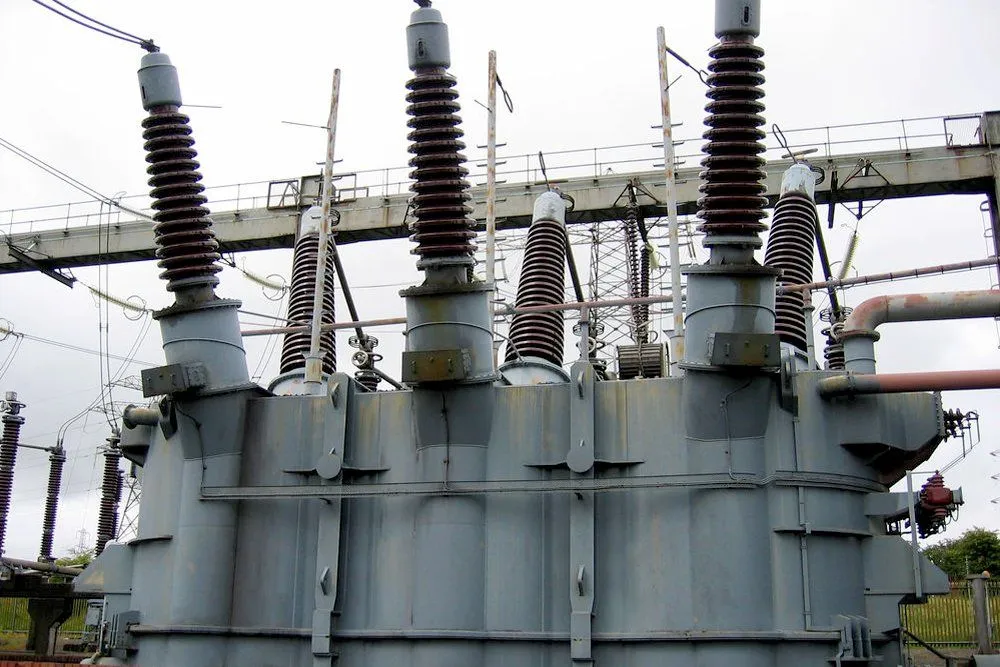
However, there’s another reason as well. Industrial equipment has machinery of a large size that consumes power in massive quantities. Large industrial sites are often fed at several thousand volts. These power-hungry plants might draw 10,000–30,000 volts. Smaller workshops may need supplies of only 400 volts or so, while homes run on 120 or 240 volts. To put this in simple terms, different users have very different power needs. It makes sense to ship high-voltage electricity from the power station and then transform it into lower voltages when it reaches its various destinations.
Transformer
A transformer is a static electrical device that transfers energy between two or more circuits. It has no moving parts, and it rests on a very fundamental law of electromagnetism, namely that when a fluctuating electric current flows through a wire, it generates a magnetic flux all around it. The strength of the magnetic flux density is directly related to the magnitude of the electric current. Therefore, the higher the current, the stronger the magnetic field. There is an interesting phenomenon related to the way electricity behaves. When that magnetic flux changes through a nearby coil, it induces a voltage (an electromotive force) in that coil. This is Faraday's law of induction. So if we put a second coil of wire next to the first one and send a fluctuating current into the first coil, the changing flux induces a current in the second coil. What we’ve done here is pass energy through space from one coil of wire to another, with no electrical connection between them. This is called electromagnetic induction, as the current in the first (primary) coil causes (or “induces”) a current in the second (secondary) coil. In a real transformer, both coils are wound on a shared core of laminated iron, which channels the magnetic flux from the primary to the secondary so that very little of it leaks away.
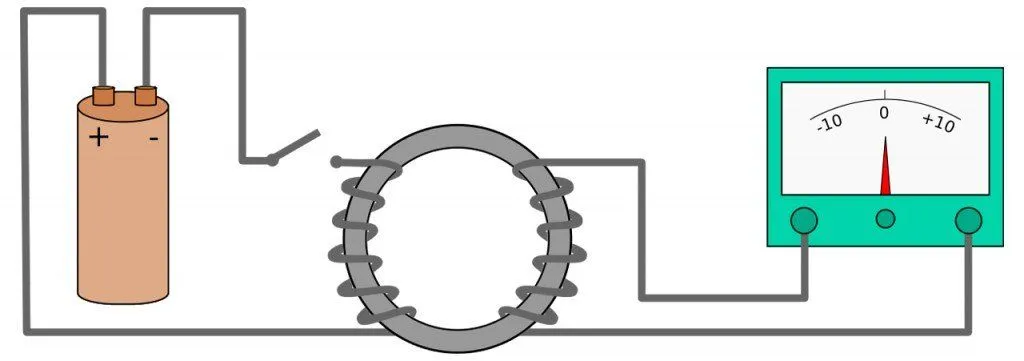
To make a coil of wire, we simply curl the wire into turns. If the second coil has the same number of turns as the first coil, the electric current in the second coil will be virtually the same size as the one in the first coil. However, the interesting aspect of transformers is that if we have more or fewer turns in the second coil, we can make the secondary voltage larger or smaller than the primary voltage. The relationship is beautifully simple: the voltage ratio equals the turns ratio, Vs/Vp = Ns/Np, where Vp and Vs are the primary and secondary voltages and Np and Ns are the numbers of turns on each coil. Crucially, a transformer never creates energy; it only moves it. Ignoring small losses, the power out equals the power in, so whenever the voltage is stepped up, the current is stepped down by the same factor, and vice versa. It is important to realize that the electric current should be fluctuating. In other words, the electric current must be alternating current (AC) when it comes to transformers. Transformers don’t work with steady-state current or Direct Current (DC).
Step Up And Step Down Transformers
If the second coil has half as many turns as the first coil, the secondary voltage will be half the magnitude of the primary voltage; if the second coil has one-tenth as many turns, it has one-tenth the voltage. In general, a step-down transformer has 1000 coils in the primary and 100 coils in the secondary. This will reduce the voltage by a factor of 10, but multiply the current by a factor of 10 at the same time. The power in an electric current is equal to the product of the voltage and the current. In a transformer, you can see that the power in the secondary coil is theoretically the same as the power in the primary coil, but in all practical, real-world settings, there is always some loss of power between the primary and the secondary, so the output power is a little less than the input power. Some of the magnetic flux leaks out of the core instead of linking the two coils, and the rest of the loss shows up as heat. We will look at exactly where that heat comes from in a moment.
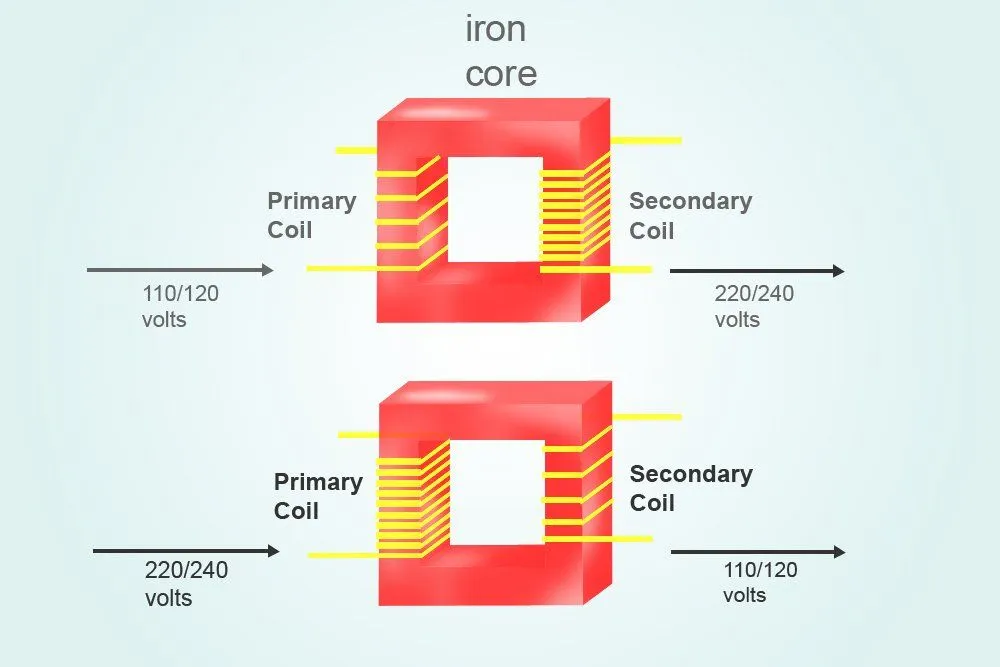
In the case of a step-up transformer, the secondary winding contains a far larger number of turns than the primary winding. These transformers therefore have a large turn ratio, which is simply the ratio of secondary turns to primary turns. They are used at power stations, where the relatively modest voltage coming out of the generator is stepped up for long-distance transmission. Why bother? Because power plants deliver a fixed amount of power, and at a low voltage that means a large current, and a large current wastes energy heating the wires. Those line losses follow the rule P = I2R, where R is the resistance of the cable and I is the current, so doubling the current quadruples the wasted power. Stepping the voltage up lets the same power travel as a much smaller current, which keeps the losses low; a step-down transformer near your home then brings it back to a safe 120 or 240 volts. Long-distance energy transmission would simply not be practical without transformers, and now you know a bit more about how transformers play a pivotal role in our day-to-day electrical life!
Why Do Transformers Lose Some Energy?
No transformer is perfect, but a good one comes remarkably close, with large power transformers often running at around 98-99% efficiency. The small amount of energy that does not make it from the primary to the secondary turns into heat, and engineers sort those losses into two families.
The first is copper loss, also called I2R loss. The windings are made of real wire with real resistance, so the current flowing through them heats them up, exactly the way a toaster element does. Because this loss depends on the square of the current, it rises and falls with how heavily the transformer is loaded.
The second family is core loss (or iron loss), which is present whenever the transformer is switched on, even with nothing plugged into the secondary. It comes in two flavors. Hysteresis loss is the energy spent magnetizing and demagnetizing the iron core over and over as the alternating current reverses, like the effort lost flexing a paperclip back and forth. Eddy current loss happens because the changing magnetic flux induces little swirling currents inside the conductive iron core itself, and those currents waste energy as heat.
This is exactly why transformer cores are not made from a single solid block of iron. Instead, the core is built from thin sheets, called laminations, each coated with an insulating layer and stacked together. The insulation breaks up the path available to the eddy currents, forcing them to stay small and confined to each thin sheet, which dramatically cuts the eddy current loss without weakening the magnetic path the transformer relies on.