Table of Contents (click to expand)
The Seebeck Effect and the Peltier Effect are the two major principles which govern the working of thermoelectric generators.
The Seebeck Effect and the Peltier Effect can be classified under the thermoelectric effect. Any thermoelectric effect involves the conversion of differences in temperatures into voltage differences. The Seebeck and Peltier Effects are different manifestations of the same physical process.
In some instances, they are linked and known as the Seebeck-Peltier Effect. The reason why these two effects are separated is due to their independent discoveries by two different individuals.
Let’s first look at the Seebeck Effect in detail.
What Is The Seebeck Effect?
The Seebeck Effect was discovered in 1821 by the Baltic German physicist Thomas Johann Seebeck. This phenomenon occurs when there is a temperature difference between two dissimilar conductors or semiconductors, which results in a voltage difference between them.
When heat is applied to one of the conductors or semiconductors, the electrons in the material become excited and start moving toward the cooler side of the two substances. If the two conductors are connected in a circuit, a direct current flows through it.
Seebeck Effect With A Simple-to-understand Example
The Seebeck Effect is like your brain telling your hand to pull away when it accidentally touches something hot. Imagine two different wires placed next to each other. When one wire gets heated, the energy (in the form of hot electrons) starts to jump around much more. Because the other wire is cooler, the agitated electrons start to move towards it.
Picture those electrons like a group of kids in a classroom. When the room gets hot (like when you turn the heater on), the kids (or electrons) get more active. They start to move around, trying to find a cooler spot to settle down.
Now, if you connect these two wires like a full loop (just imagine two ends of a jump rope), those moving electrons will start to flow around that loop. This flow is what we call electricity or direct current.
So, just by heating one wire and connecting both ends, we’ve created an electric current! That’s the Seebeck Effect.
The voltages produced by the Seebeck Effect are tiny. The range of the voltage produced is usually on the order of a few microvolts (one-millionth of a volt) per Kelvin of temperature difference at the junction. If the temperature difference is significant enough, some devices can produce a few millivolts (one-thousandth of a volt).
Several such devices can be connected in parallel to increase the maximum deliverable current. Such devices have been shown to provide a small-scale level of electrical power if a large temperature difference is maintained across the junctions.
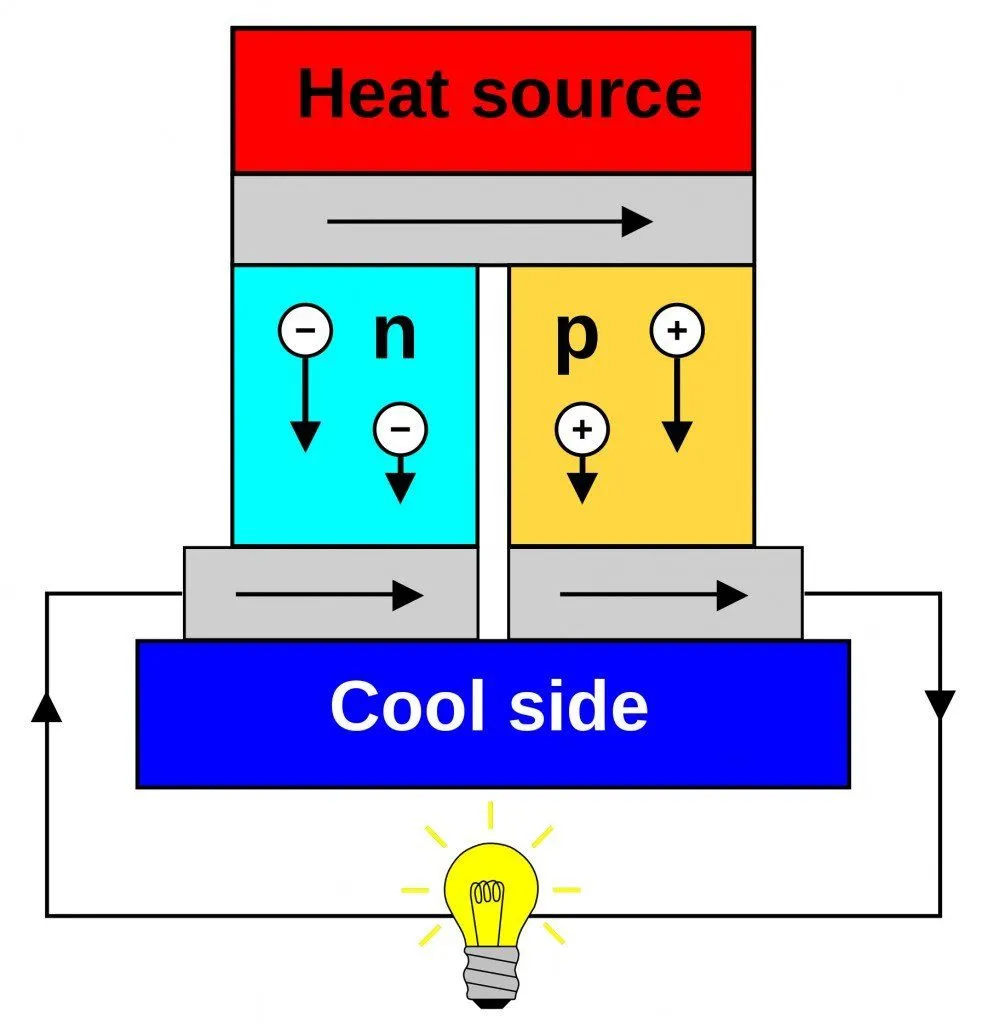
The Seebeck Effect can help us calculate the electromotive field generated by a device. This can be done by using the Seebeck Coefficient. The Seebeck Coefficient of a material is the measure of the magnitude of the increased thermoelectric voltage in response to the temperature differences in a given material. Using the Electromotive force, we can also calculate the current density of the thermoelectric material. The relevant equations for this are as follows:
Eemf= -S∆T
J= σ(-∆V+Eemf)
Here, J signifies the current density, and σ signifies the local conductivity of the conductor.
What Is The Peltier Effect?
The Peltier Effect was named after the French physicist Jean Charles Athanase Peltier, who discovered this phenomenon in 1834. The Peltier Effect is the presence of heating or cooling at an electrified junction of two different conductors. When a current is made to flow through a junction between two conductors, heat may be added or removed at the junction.
The Peltier Effect is like a special power that can make parts of an electrical circuit hot or cold. Think of it this way: two different types of metal wires are joined together. When you send electricity through that joining point, it can heat up or cool down that spot.
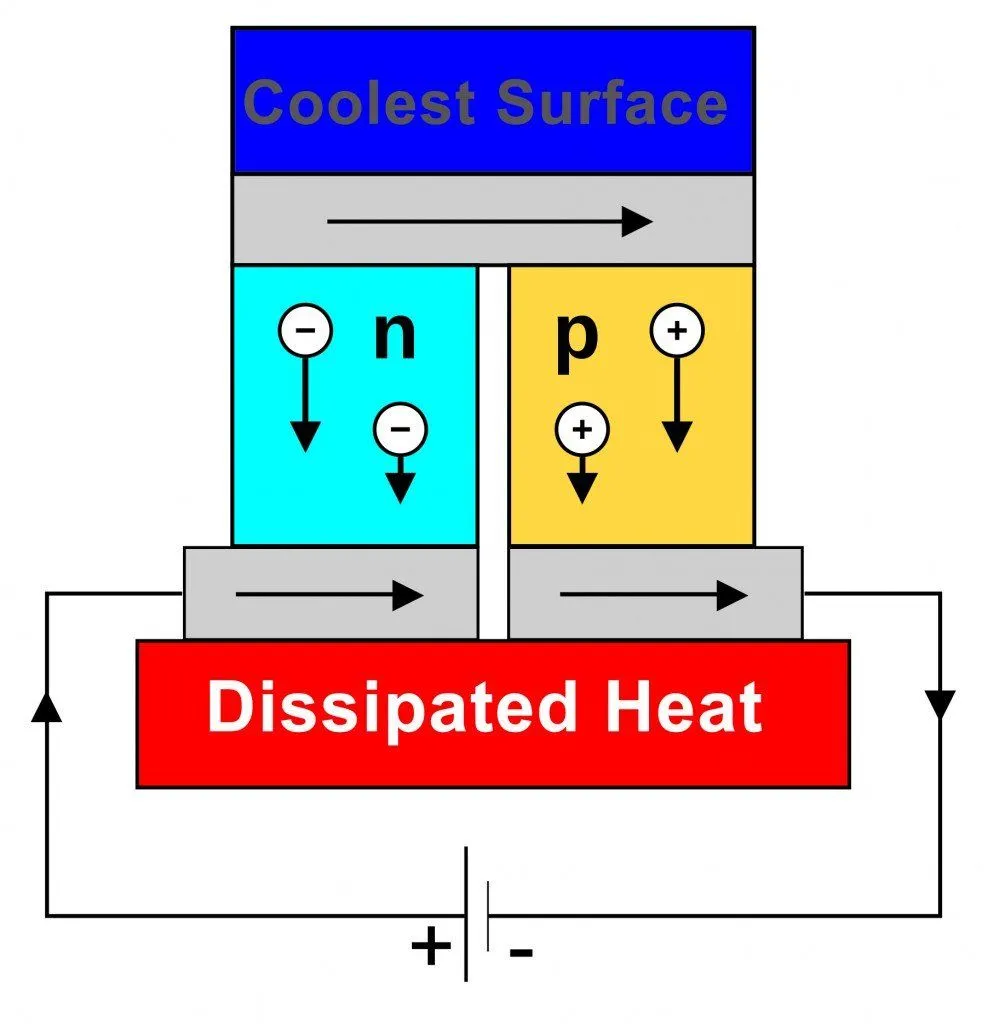
The Peltier heat generated at the junction per unit time is where ∏A and ∏B are the Peltier coefficients.
Q=(∏A – ∏B)I
Here, A and B signify the two ends of the conductors, while I is the electric current. The Peltier coefficients represent how much heat is carried per unit of charge. Since the charge must be continuous across a junction, the associated heat flow will discontinue if ∏A and ∏B differ.
The Peltier Effect can be considered as the back-action counterpart to the Seebeck Effect. If a simple thermoelectric circuit is closed, the Seebeck Effect will drive a current, which in turn (by the Peltier effect) will always transfer heat from the hot to the cold junction.
A typical Peltier heat pump involves multiple junctions in series, through which a current is driven. Some junctions lose heat due to the Peltier Effect, while others gain heat. Thermoelectric heat pumps, as do thermoelectric cooling devices found in refrigerators, exploit this phenomenon.
What Is The Difference Between The Seebeck And Peltier Effects?
It is easy to mix the two up, so let’s line them up side by side. The simplest way to keep them straight is to ask which way the energy is flowing. In the Seebeck Effect, you put heat in and get electricity out. In the Peltier Effect, you put electricity in and move heat around. One is a generator; the other is a pump. They are mirror images of the same physics, which is exactly why they are studied together.
| Seebeck Effect | Peltier Effect | |
|---|---|---|
| What you supply | A temperature difference | An electric current |
| What you get | A voltage (and current) | Heating at one junction, cooling at the other |
| Discovered by | Thomas Johann Seebeck (1821) | Jean Charles Athanase Peltier (1834) |
| Key constant | Seebeck coefficient S (measured in volts per kelvin, V/K) | Peltier coefficient Π (measured in volts, V) |
| Typical use | Thermocouples and power generators | Solid-state coolers and heaters |
The two are not just related in spirit; they are tied together by a neat equation. The Peltier coefficient (Π) equals the Seebeck coefficient (S) multiplied by the absolute temperature (T) of the junction, written as Π = S×T. This is one of the Kelvin relations, and it tells us that a material that is good at one effect is automatically good at the other. It also explains the units: since S is in volts per kelvin and T is in kelvin, the Peltier coefficient comes out in plain volts, which physically represents the energy carried per unit of charge.
What Is The Thomson Effect (The Third Thermoelectric Effect)?
Most articles stop at Seebeck and Peltier, but there is actually a third member of the family: the Thomson Effect. It was predicted in 1851 by the British physicist William Thomson, later known as Lord Kelvin. The Seebeck and Peltier effects both happen at the junction between two different materials. The Thomson Effect is different, because it happens inside a single conductor.
Here is the idea. Take one piece of wire and make one end hotter than the other, so a temperature gradient runs along its length. Now push a current through it. Lord Kelvin worked out that the wire will either soak up a little extra heat or give off a little extra heat along its length, on top of the ordinary heating caused by resistance. Whether it absorbs or releases that heat depends on the direction of the current and on a property called the Thomson coefficient.
What makes the Thomson Effect so important is that it stitches the whole picture together. The Thomson coefficient is linked to how the Seebeck coefficient changes with temperature, through another Kelvin relation. In other words, the Seebeck, Peltier and Thomson effects are not three separate accidents of nature. They are three faces of a single underlying process of energy and charge moving together, which is why they all obey Kelvin’s tidy set of equations.
Where Are The Seebeck And Peltier Effects Used?
These effects are not just textbook curiosities; they quietly run some remarkable hardware. Because each effect flows in a different direction, they end up in very different machines.
The Seebeck Effect is the heart of the thermocouple, the rugged temperature sensor found in everything from ovens to jet engines. Its most famous job, though, is in space. A radioisotope thermoelectric generator (RTG) is essentially a nuclear battery: the natural radioactive decay of plutonium-238 produces heat, and a stack of thermocouples turns the resulting temperature difference straight into electricity through the Seebeck Effect. With no moving parts to wear out, RTGs are extraordinarily reliable. NASA has used them for over half a century, and the two Voyager probes, launched in 1977, are still running on Seebeck power as they coast through interstellar space. The hot side of such a generator can sit above 500 °C (around 930 °F) while the cold side faces the deep freeze of space, and the bigger that gap, the more power you get.

The Peltier Effect works the other way, so you find it wherever something needs to be cooled silently and precisely. A Peltier module (also called a thermoelectric cooler) is a small ceramic-and-semiconductor sandwich: run a current through it and one face gets cold while the other gets hot, with no compressor, refrigerant or moving parts. That is why Peltier modules show up in portable car coolers and mini-fridges, in CPU and camera-sensor cooling, and in laboratory and medical gear such as PCR machines, where a steady, vibration-free temperature matters more than raw cooling power. They handle the same heat-moving job as a household refrigerator, just on a much smaller and quieter scale.

Last Updated By: Ashish Tiwari
References (click to expand)
- Drebushchak, V. A. (2007, July 11). The Peltier effect. Journal of Thermal Analysis and Calorimetry. Springer Science and Business Media LLC.
- Thermoelectric Properties of Materials.
- Theory of the spin Seebeck effect.
- Uchida, K., Takahashi, S., Harii, K., Ieda, J., Koshibae, W., Ando, K., … Saitoh, E. (2008, October). Observation of the spin Seebeck effect. Nature. Springer Science and Business Media LLC.
- How Does a Radioisotope Thermoelectric Generator Work? The Seebeck Effect. NASA Science.
- Peltier coefficient. Encyclopaedia Britannica.
- Thermoelectric power generator: Principles of operation. Encyclopaedia Britannica.
- Thermoelectric effect. Wikipedia.