A four-wheel drive (4WD or 4x4) system powers all four wheels for better traction. Here is what 4x4 really means and how 4WD differs from AWD.
If you’ve ever been asked “How many wheels does a car run on?”, you would probably shrug it aside as silly.
However, if you chose to answer ‘four’, the person may say, “Well, you’re only partially correct.” At that point, you may be a bit confused…
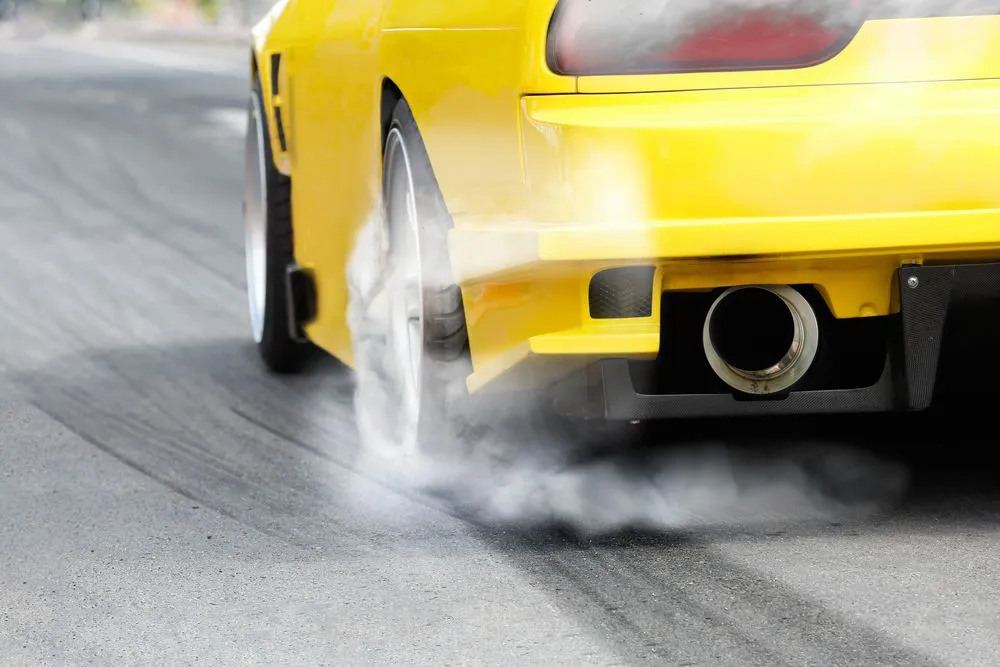
Yes, a car sits and even runs on four wheels, but the forces that drive the car are, more often than not, supplied to only two wheels. Basically, one set of wheels is driving, while the other set is being dragged, or more appropriately, being driven.
What Is A Drivetrain?
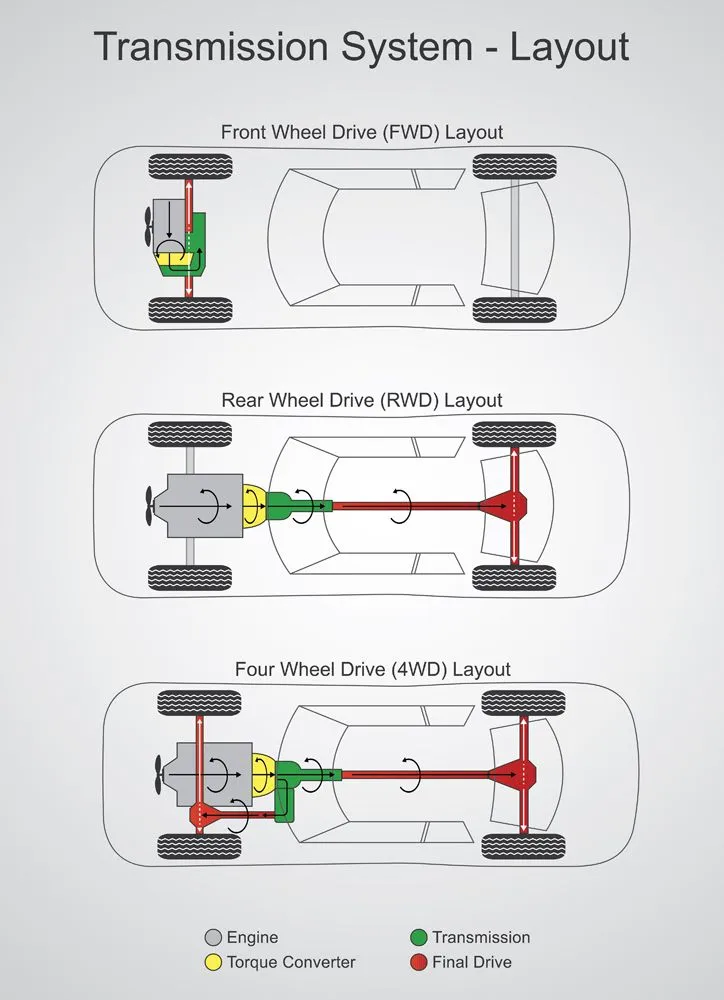
Excluding the engine, the mechanism that supplies power to the driving wheels is known as the drivetrain. Based on the utility of a vehicle, its drivetrain can be designed to send power to either one set of wheels or all four wheels. We will explain each configuration in detail below:
1. Two-wheel Drive (2WD):
A two-wheel-drive system, as the name suggests, has engine power directed to two wheels only. These can either be the front wheels or the rear wheels. In a front-wheel drive system, the engine is laid out in a transverse configuration, i.e., it is perpendicular to the axis of the car. This layout enables the engine to connect to the front wheels directly. A rear-wheel drive system has its engine laid out longitudinally, meaning it is laid along the axis of the car. The engine gets connected to the rear wheels through the transmission employing a driveshaft.
2. Four-wheel Drive (4WD):
A four-wheel drive system can be understood as a combination of the FWD system and the RWD system acting in tandem, which enables the engine to connect to and send power to all four wheels. A four-wheel drive system can either be active at all times or switch between 2WD and 4WD, as required.
What Does 4x4 Mean?
You have probably seen "4x4" stamped on the tailgate of a pickup or SUV and wondered why a car with four wheels is labeled with a multiplication that would give you sixteen. The notation has nothing to do with math. In the "n×n" system used across the automotive and trucking world, the first number is the total count of wheel positions on the vehicle, and the second number is how many of those are driven, meaning they receive power from the engine. So a 4x4 is a four-wheeled vehicle in which all four wheels can be driven, which is exactly why "4x4" is used interchangeably with four-wheel drive.

The same shorthand describes every other layout. A 4x2 has four wheels but only two of them are driven, which covers ordinary front-wheel-drive and rear-wheel-drive cars. Larger vehicles extend the pattern: a 6x4 truck has six wheel positions with four of them powered (two rear drive axles and one steering axle), while a 6x6 military or heavy-haul truck drives all six. One quirk is worth noting: a wheel position is not the same as a tire. A heavy-duty pickup with dual rear tires and two driven axles is still badged a 4x4, because each pair of rear wheels counts as a single wheel position for traction purposes.
As for the "full form", 4WD simply stands for four-wheel drive, and 4x4 is its everyday nickname. In practice, carmakers tend to reserve "4x4" for the more rugged, off-road-capable trucks and SUVs, while lighter systems built mainly for wet roads are usually sold as all-wheel drive, a distinction we will untangle next.
Components And Working Of A Four-wheel Drive System
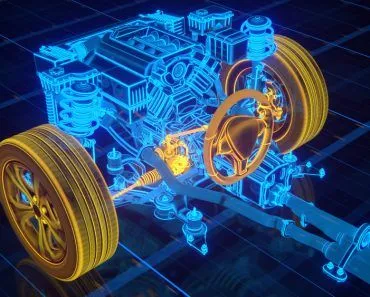
A 4WD system comprises a longitudinally mounted engine that transfers power to all four wheels through special gearing arrangements known as differentials. The engine connects to these differentials by means of a drive shaft, which feed the power to the wheels by means of drive axles. A four-wheel drive system, in its simplest form, is composed of the following components:
Differential
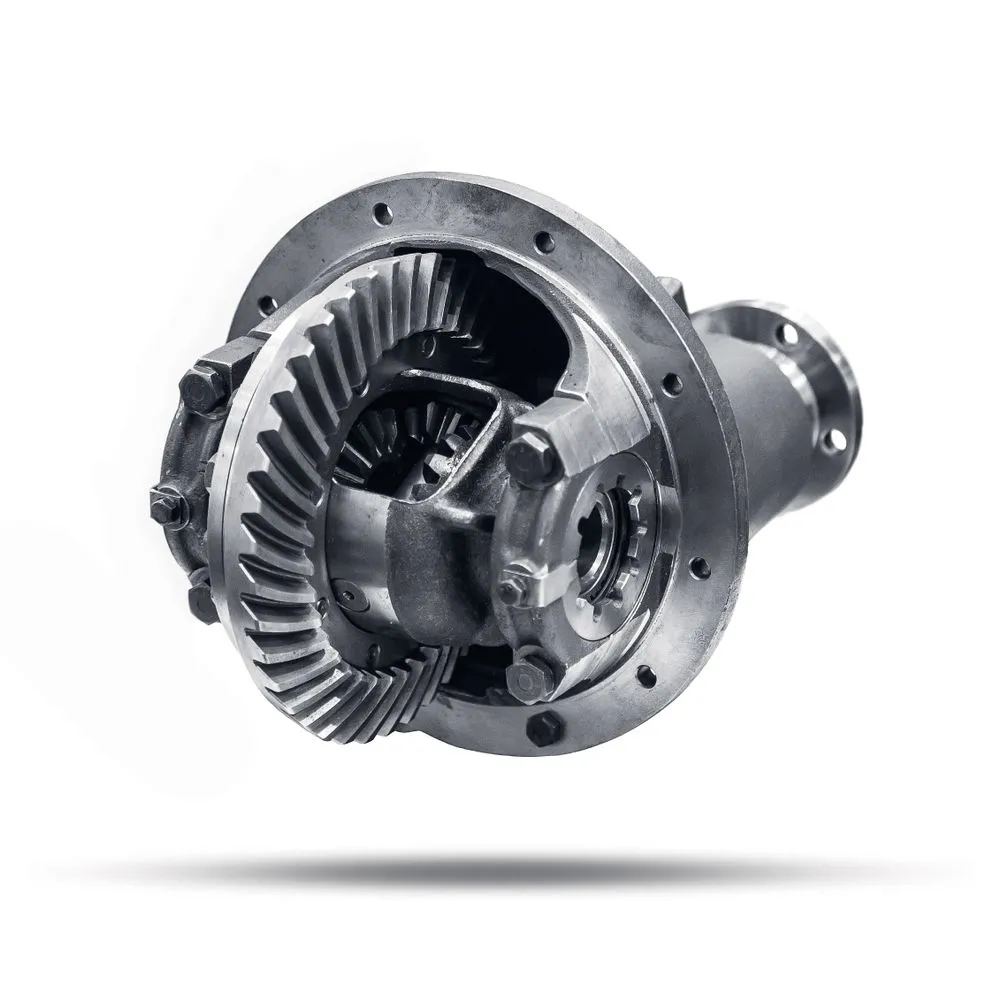
A differential does precisely what it sounds like: creates a difference – in the amount of power going to a particular wheel within a set of driving wheels. It consists of a gear train designed to allow two wheels sharing the same axis to spin at different speeds by varying the amount of power delivered to each wheel.
A differential is employed when a car is turning a corner. Let’s illustrate this with an example. If a car were to take a left turn, the left side wheels, or the ‘inner wheels’, would sweep less distance when compared to the right side wheels, or the ‘outer wheels’ in the time it would take to execute the turn. It implies that the outer wheels are spinning at higher speeds, compared to the inner wheels. Since the outer wheel is connected to the inner wheel by an axle, it is impossible to achieve this difference in speed without causing catastrophic mechanical failure.
The differential allows the outer wheels to spin faster than the inner wheels, thereby allowing for the execution of a smooth turn without loading the axle. To facilitate better turning, both the front and rear axles have their own differentials that connect to their respective set of wheels by means of a drive axle.
A simple differential sends power to the path of least resistance, which often makes it unfavorable in low traction situations. To overcome this, adjustable differentials are designed to prevent the loss of valuable power to freely moving wheels.
Transfer Case
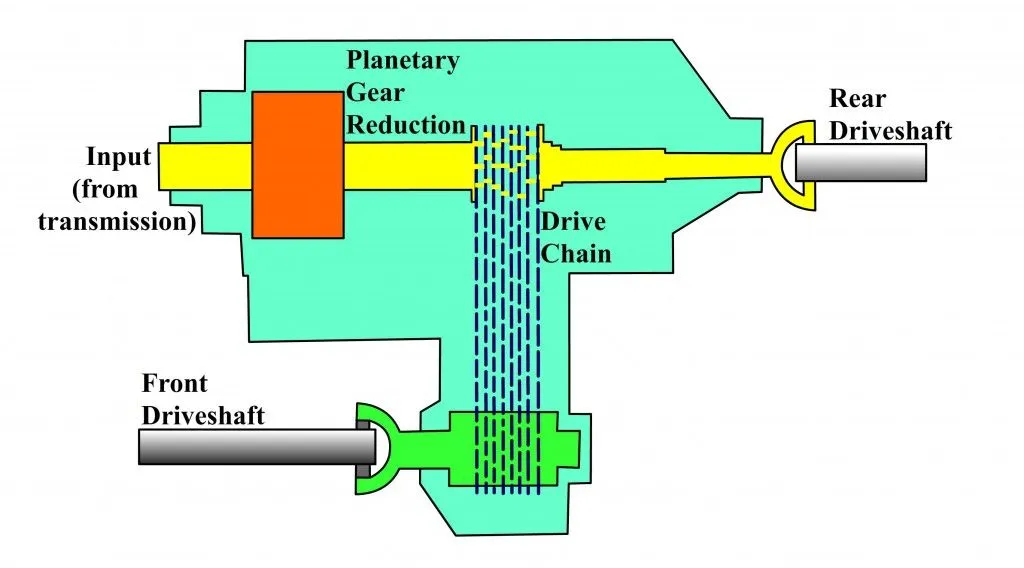
Owing to its longitudinal configuration, the engine can only supply power to the rear wheels directly. In order to power the front wheels, a component known as the transfer case is employed. Transfer cases can be either chain-driven or gear-driven. Chain-driven units are lighter and quieter, while gear-driven ones are stronger and typically found in heavy-duty trucks. The transfer case connects to the front differential by means of a driveshaft, which then supplies power to the wheels. Most transfer cases also offer a low-range gear setting that multiplies torque for extreme off-road situations like rock crawling or deep mud.
Driveshaft And Drive Axles
A driveshaft is a rod that connects the engine to the differentials. It is designed to allow for relative movement between the wheels and the engine so that power transfer does not cease due to misalignment. A drive axle connects the differentials to the wheels and is again designed to allow for wheel travel according to the contour of the terrain.
Working Of A Four-wheel Drive System
A 4WD system distributes power to all 4 wheels of the car through the differentials. In high-traction driving, for example, on the road, it is usually unnecessary to engage 4WD and power is only directed to the rear wheels. Upon encountering a low-traction situation, such as ice or sludge, the differentials can be adjusted to send maximum power to the wheels that have the maximum traction. This enables the vehicle to overcome slippery terrain without losing control.
Pros And Cons Of A Four-wheel Drive System
PROS:
- Improved traction, as power gets sent to all four wheels
- A vehicle can overcome arduous terrain easily, as there is greater control over the amount of power that gets sent to each wheel
CONS:
- Increased fuel consumption
- Use of 4WD in high-traction situations can be incredibly stressful to mechanical parts, especially during turns
- Makes the entire drivetrain bulky and complex to service.
Advancements In The Four Wheel Drive System:
Any advancements in the 4WD system can be attributed to two factors: differential design and electronics.
The development of locking and limited-slip differentials was instrumental in overcoming the disadvantage of simple differentials: the loss of power at the wheel with the least traction. This has given rise to partial 4WD, full-time 4WD, and all-wheel drive systems that are employed over a variety of vehicle types.
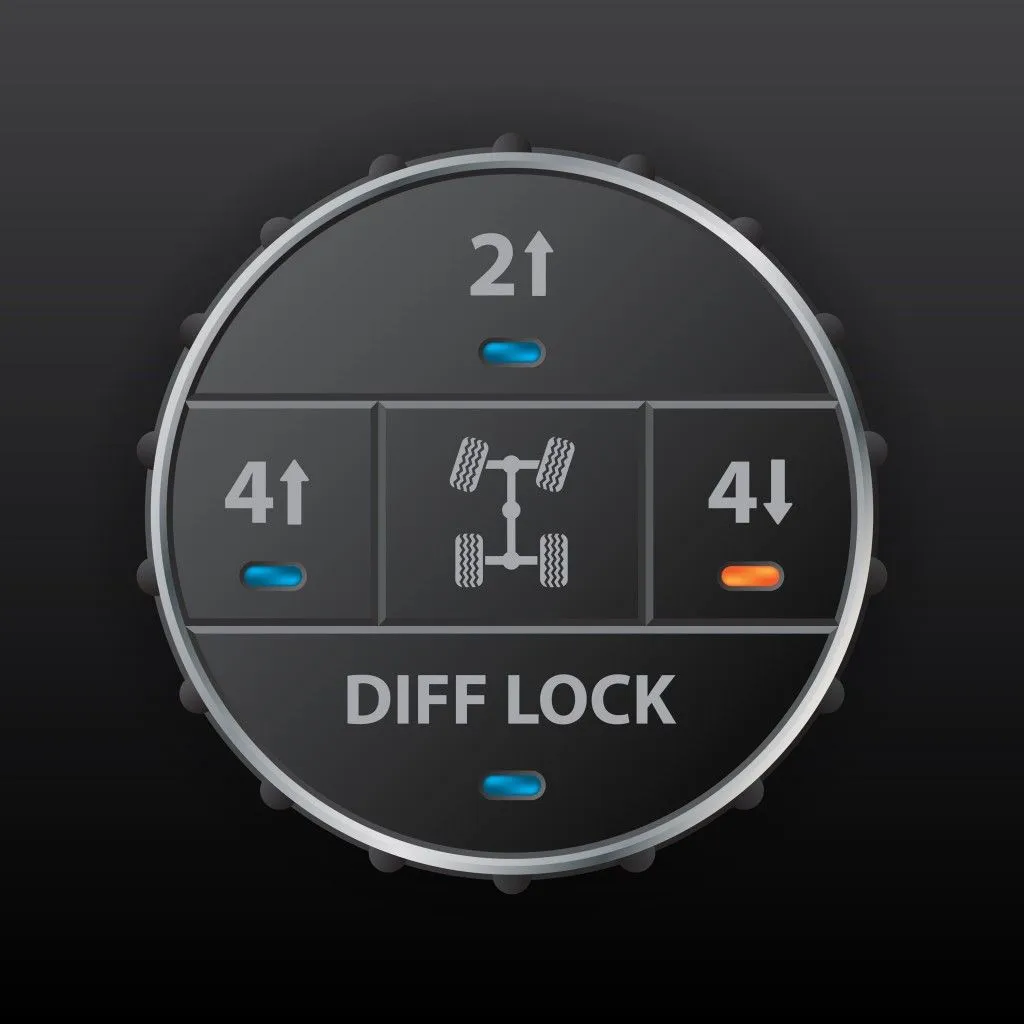
With the introduction of sensor technology and electronic actuation, the need for manual engagement of 4WD systems by locking differentials and driveshafts has been eliminated. A vehicle’s onboard computer selects the most optimal setting based on the terrain, thereby preventing hassles for the driver.
Perhaps the most significant recent development is the rise of electric all-wheel drive. In electric vehicles (EVs), a dual-motor setup (one motor on each axle) can replace the traditional transfer case, driveshaft, and center differential entirely. Each motor independently drives its axle, and software manages torque distribution thousands of times per second. This approach is lighter, more responsive, and enables advanced torque vectoring, where power is precisely directed to individual wheels for superior handling and traction. As of 2026, most major automakers offer dual-motor AWD electric SUVs and trucks.
4WD vs AWD: What's The Difference?
Since every 4WD, 4x4 and all-wheel-drive (AWD) badge promises power to all four corners, it is easy to assume they mean the same thing. They do not, and the difference comes down to how and when the system feeds power to the wheels.

A traditional four-wheel drive (4WD) system is built around the transfer case, which sits just behind the transmission, and it is usually part-time, meaning the driver decides when to engage it. On most 4x4s this is done through a selector marked 2H, 4H and 4L. In 2H the vehicle runs in two-wheel drive for normal roads; 4H sends power to all four wheels for slippery conditions like mud, snow or loose gravel; and 4L adds the transfer case's low-range gearing, which multiplies torque for crawling over rocks, fording water or hauling heavy loads at low speed. Because a part-time system locks the front and rear axles together with no center differential, it should not be driven in 4WD on dry pavement, where the axles cannot absorb the difference in wheel speed through a turn and the drivetrain "binds", risking damage.
All-wheel drive (AWD) takes that decision away from the driver. It is a full-time system that uses a center differential or an electronically controlled clutch to route power to whichever wheels have grip, adjusting automatically many times a second with no lever to pull. That makes AWD well suited to on-road security in rain or light snow, and it can be driven safely on dry pavement all day. The trade-off is that most AWD systems lack a low-range gear, so they are happier on dirt roads and wet highways than on a demanding off-road trail. In short, 4WD is the specialist for rough terrain, while AWD is the all-weather generalist for the road.
Applications Of A Four-wheel Drive System
- Hauling heavy loads downhill at slow speeds, such as in trucks or pick-up vehicles
- Sport, adventure driving and off-roading, such as on the race track, for mountain trails or river wading, etc., such as in Jeeps or SUVs.
- Road-going vehicles, such as sedans and limousines, where 4WD capabilities are only available on-demand.
- Electric vehicles with dual-motor AWD, such as electric SUVs and pickup trucks, where software-controlled torque distribution replaces traditional mechanical 4WD components.
References (click to expand)
- Transfer case - Wikipedia
- Feroz N. (2019). Automobile Engineering: Textbook for Engineering Students (Learn in Short Time). Independently Published
- Richardson J. (2017). Modifying Suzuki 4x4 for Serious Offroad Action. Veloce Publishing
- Four-wheel drive - Wikipedia
- What Does 4x4 Mean? - Cars.com
- 2WD vs. AWD vs. 4WD - Consumer Reports
- What Are 2H, 4H, and 4L on 4x4? - AutoZone