Drifting is a driving technique where the driver intentionally oversteers, sending the rear tires (and sometimes all four) into a controlled slide so the car goes around a corner sideways while the driver counter-steers and balances throttle. Technically, the car is drifting whenever the rear slip angle exceeds the front slip angle. It originated in Japanese mountain-pass racing in the 1970s and is now codified in series like D1 Grand Prix and Formula Drift.
Drifting (related to motor sports) is a special kind of driving technique wherein the driver of an automobile purposely oversteers and causes the rear tires (or, in some cases, all tires) to lose grip on the road.
Ever since the dawn of civilization, humans have been obsessed with adventure and entertainment (in most cases, these two are indistinguishable). For example, at first, hunting animals was all about food, survival and threat elimination, but after a few thousand years, it became a hobby. What could possibly motivate a person to kill an animal that is simply minding its own business? Thrill and entertainment, and possibly a number of other unsavory things…
It seems like human nature to improvise various ways of squeezing some sort of thrill from the most unlikely things or activities. Aside from hunting, there are a number of other activities that humans have transformed from being a mere necessity to a previously unheard of form of entertainment; however, in this post, we are going to talk about a singular act that involves traveling, rather unusually, on a set of four wheels.
Yes, and while we aren’t going to discuss the Fast and Furious franchise, we are going to talk about drifting.
What Is Drifting?
Drifting (related to motor sports) is a special kind of driving technique.
The term ‘drifting’ suggests what the technique entails; the driver intentionally ‘oversteers’, causing the rear tires (or all the tires, in some cases) to lose traction, but allows the driver to maintain control over the car from its entry to its exit of a corner.
In more technical terms, when the rear slip angle (angle between a wheel’s actual direction of travel and the direction towards which it is pointing) of the car is greater than the front slip angle, the car is said to be drifting.
Taking A Regular Turn
How do you maneuver a turn while driving a car?
It’s actually pretty basic. You simply rotate the steering wheel to the desired direction and… that’s actually it because physics will take over at that point, leaving you with a limited amount of control. It is such a seamless process that you may not even realize what physical process is going on between the tires and the ground.
Friction: An Integral Force
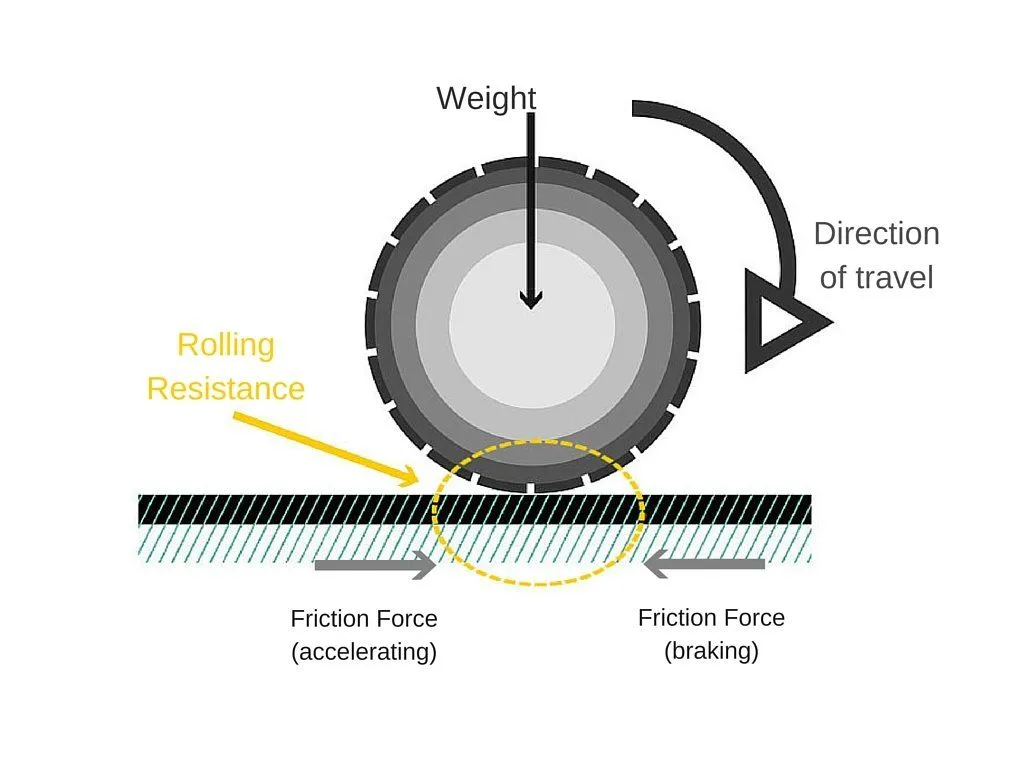
To make a turn, you need friction. Without it, car tires would be confused and your car would consequently look like it was performing a jig on the road. To realize what it’s like to drive on a friction-less road, try to imagine driving on a sheet of glass.
During any turn, the frictional force on the tires acts centripetally (that is, it pulls the car along a circular arc, which is exactly the motion required to steer through the corner).
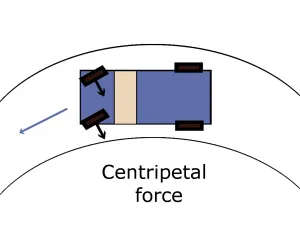
Before you steered the car to the left, for example, it was going straight. That’s what it wanted to continue to do, according to Newton’s first law of motion (stating that an object will remain at rest or in uniform motion in a straight line unless acted upon by an external force). However, as soon as you take the turn, static friction grips the front tires, which prevents the vehicle from skidding or sliding out along the straight path and ensure that the car is taking a turn.
How To Drift A Car?
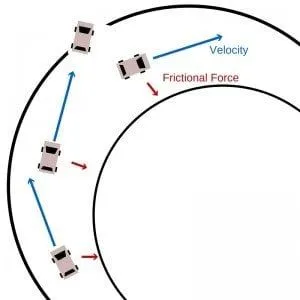
The mechanics change slightly when you are drifting, as it’s all about handling the amount of traction that you’re losing in the rear wheels. You want to lose traction, but not entirely, as you want to control how much traction is lost. And how do you control the traction of the rear wheels, you may ask? By controlling the wheel speed.
Losing Traction On The Rear Wheels
During a drift, you essentially make a turn too fast, causing the rear tires to lose their grip on the road. As a result, the rear tires over-rotate in the direction of the turn, which makes them go into a spin. To compensate for this over-rotation and spinning of the rear tires, you have to turn the front tires in the opposite direction of the turn that you were originally making.
Simply put, all you have to do is balance the amount of traction you lose on the rear wheels by balancing the wheel speed and the slide constantly, which is what drifting is all about.
What's The Physics Behind Drifting?
So why does a drifting car behave so differently from one taking an ordinary corner? It all comes down to how much grip a tire has to spend, and how the driver chooses to spend it.

Every tire has a finite grip budget. The total force it can push against the road, whether for turning or for speeding up and slowing down, is capped by friction, and you can picture that limit as a circle (engineers call it the friction circle, or traction circle). Use all of it to turn and there is nothing left for the throttle or brakes; spend some on accelerating and you have less available to hold the corner. Stanford's drifting researchers describe their goal as teaching a car to use all of the friction available between the tire and the road, which is exactly the edge a drifter rides.
Grip also depends on slip angle, the gap between where a tire points and where it actually travels. For the first few degrees the cornering force climbs almost in step with the slip angle, but it does not climb forever. Past a peak, the tire begins to slide and makes less grip, not more. An ordinary turn keeps the tires below that peak; a drift deliberately pushes the rear tires past it, so they are saturated and sliding while the front tires keep their grip.
That sounds like chaos, but it is actually a balance point. Engineers at Stanford's Dynamic Design Lab have shown that a sideways slide can be a stable equilibrium: with the rear tires saturated, the driver holds a steady angle by counter-steering (pointing the front wheels out of the turn) and feeding in just enough throttle. Their autonomous DeLorean, MARTY, can hold sideslip angles of around 40 degrees entirely on its own, which shows the slide is something you control rather than simply a loss of control.
Weight transfer is the last lever. Because a tire grips harder the more firmly it is pressed onto the road, braking, accelerating, or lifting off the throttle shifts load between the front and rear tires and lets the driver decide which end lets go. Take the load off the rear for a moment and it breaks loose far more easily.
Does Drifting Damage Your Car?
In a word: yes. A drift is essentially a controlled abuse of the car, and a few parts pay for it more than others.

Tires take the worst of it, and the physics explains why. Rubber wears away in proportion to the frictional energy dumped into the contact patch, a rule of thumb engineers trace back to Reye's hypothesis: the more frictional energy you dissipate, the more rubber you grind off. An ordinary tire rolls with very little sliding, so it sheds material slowly. A drifting tire slides the whole way through the corner at a large slip angle, and a recent peer-reviewed review of tire-wear modeling notes that this kind of sideslip sharply raises both the frictional energy dissipated and the temperature in the contact patch. The result is rapid wear and a lot of heat, which is where those dramatic clouds of tire smoke come from. Stanford's drift team, who run their cars hard, put it bluntly: the slides “chew up tires.” Competitive drifters can go through a set of rear tires in just a few runs.
The driveline gets a workout too. The tricks used to break the rear end loose, such as a sharp clutch “kick” or a stab of the brakes, load the clutch, driveshaft, and differential with sudden jolts of torque. That is why purpose-built drift cars run reinforced, locked, or limited-slip differentials and tougher clutches instead of stock parts.
None of this means a car falls apart after a single slide. But sustained drifting is an endurance test for the tires, brakes, and drivetrain, and it is a big reason the sport is done on closed courses with cars set up (and frequently repaired) for exactly that punishment.
Drifting Is Not Easy!
The explanation above may seem simple, but don’t let that give you any false ideas about the actual art of drifting. Needless to say, it’s a pretty difficult maneuver to pull off. Furthermore, if it’s not controlled and the car goes into an uncontrolled spin, it can lead to terrible accidents. Therefore, it takes a comprehensive understanding of the entire process of drifting and a great deal of practice to master it. This is the reason that all drifting events are carried out by trained professionals under strictly controlled conditions.
Drifting may give drivers an exciting edge during racing events, but it’s certainly not something you should try out in real-life conditions. It’s certainly not as easy as they make it seem in movies, and it’s definitely not cool if you lose control!
References (click to expand)
- Drifting (motorsport) - Wikipedia. Wikipedia
- 4 Ways to Drift a Car - wikiHow. wikiHow
- Introducing MARTY, Stanford's self-driving, electric, drifting DeLorean. Stanford University School of Engineering.
- Dynamics and Control of Drifting in Automobiles. Stanford Dynamic Design Lab.
- A comprehensive review on rubber wear modeling with focus on tire applications. iScience (NCBI PMC).
- Cornering force. Wikipedia.