Table of Contents (click to expand)
A camera obscura (Latin for ‘dark chamber’) is a darkened room or box with a small hole, or later a lens, on one side. Light from outside passes through the hole and projects an inverted, laterally reversed image of the scene onto the opposite wall. Described in detail by the Arab scientist Ibn al-Haytham around 1015 CE, it is the optical ancestor of every modern camera, since today’s DSLRs and smartphones still rely on the same basic idea, with film or a digital sensor placed where the wall used to be.
The DSLRs of today capture images that are crisper than our memories. All of this magic is now possible because of an optical idea that dates back more than 2,000 years, the camera obscura.
Camera technology has come a long way since those times, but surprisingly, the basic physics behind cameras hasn’t changed all that much. Let’s look at the camera obscura, and examine the journey of camera technology from then to now.
What Is A Camera Obscura?
For centuries before the camera, we relied solely on painters and sculptors to capture and immortalize moments from life. It was for these artists that the camera obscura was first popularized.
The term camera obscura translates into ‘dark chamber,’ which is essentially what it was. A camera obscura is a dark room with a small hole or a lens on one wall through which light passes and projects an image onto the opposite wall.
The idea is genuinely ancient. The Chinese philosopher Mozi described pinhole projection in the 4th century BCE, Aristotle noticed crescent-shaped images of the partially eclipsed Sun cast through gaps in tree leaves, and the Arab scientist Ibn al-Haytham (also known as Alhazen) explained the geometry of the camera obscura in detail in his Book of Optics around 1015 CE. The Latin name itself was coined later, in the early 17th century, with Johannes Kepler popularizing the term in his 1604 treatise on optics.
How Does A Camera Obscura Work?
The science behind a camera obscura sounds almost too simple to be useful. In a completely darkened room with one small hole on one wall, light reflected from every point of the lit scene outside travels in straight lines, and a narrow cone of those rays from each point squeezes through the hole. Because each cone keeps going in a straight line on the inside, light coming from the top of the scene strikes the bottom of the back wall, and light from the left ends up on the right. The result is a real, full-color image of the outside world, but flipped both upside-down and left-to-right.
The size of the hole sets the trade-off between brightness and sharpness. A very small pinhole creates a sharp image but lets in so little light that the projection is dim. A larger hole lets in more light but blurs the image, because each point on the scene now spreads across a larger patch on the back wall. To fix that, later camera obscuras used a converging lens in place of the pinhole, which gathers far more light and refocuses it into a crisp image. The image still sits at a specific distance behind the lens (the focal length), which is the same geometry that controls focus in any camera today.
The geometry also explains a quirk every photographer eventually meets: smaller apertures give a sharper, deeper image but a darker one, while bigger apertures gather more light at the cost of a shallower depth of field. The trade-off was already baked into the camera obscura centuries before anyone tried to capture an image with it.
Projecting Images To Capturing Images
For most of its history, the camera obscura was a projector, not a recorder. Artists like Leonardo da Vinci, Johannes Vermeer (almost certainly) and Canaletto used portable camera obscuras to trace the projected image onto paper or canvas, capturing perspective and proportion with an accuracy that was nearly impossible by eye alone. The image existed, beautifully, only while the light was on.
The leap from projecting to capturing happened in the early 19th century, when chemists figured out how to make the projected light leave a permanent mark on a chemically treated surface. In 1826 (or 1827, depending on the source), the French inventor Nicéphore Niépce captured the world’s first surviving photograph, View from the Window at Le Gras, by exposing a bitumen-coated pewter plate inside a camera obscura for several hours. His collaborator Louis Daguerre refined the process and announced the daguerreotype in 1839, which produced sharp, one-of-a-kind images on silver-coated copper plates in minutes rather than hours. From there, it was a relatively short hop to roll film (George Eastman’s Kodak in 1888), 35 mm cameras (Leica in 1925), and ultimately digital sensors. Throughout, the optical heart of the device, a lens forming an inverted image on a flat surface inside a light-tight box, never really changed.
Modern-day Camera Technology
Following the history of the camera, we understand that if we add a film or an image sensor to a camera obscura, we can capture images. To make those captured images better, we use advanced lens setups and better image-sensing and processing tools.
Today’s SLR and DSLR cameras feature complex combinations of one or more lenses, mirrors, and prisms. SLR cameras use film, which is rarely used these days. DSLRs use sensors to capture images digitally, giving more flexibility than the use of films.
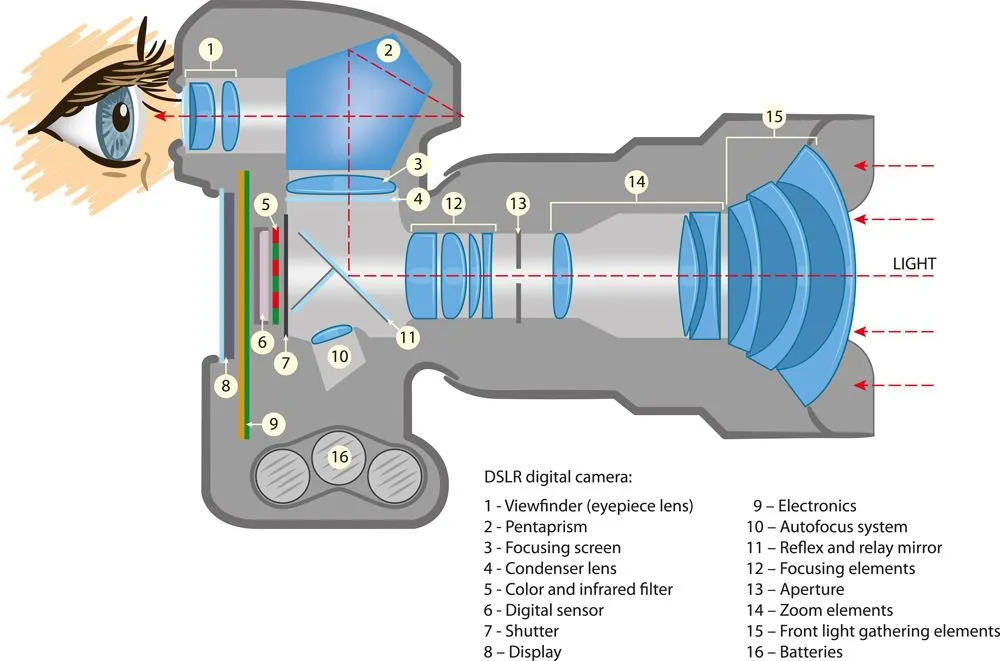
Thus, we went from daguerreotypes to being able to capture crystal-clear images of just about every variety. We can shoot wild animals (and celebrities) from a considerable distance with a telephoto lens or get the minutest details of a tiny bug with a macro lens.
Now, of course, we have progressed to smartphones with digital cameras built into them. They are so ubiquitous that we take them for granted. It’s easy to end up thinking that this is how it always was. Imagine if we had to take along an early camera obscura-sized box and silver-coated plates with us if we wanted to take selfies.
Conclusion
The camera obscura might not have much practical relevance in the world of smartphones and projectors, but it is still loved by artists and hobbyists. Artists like Abelardo Morell have used the camera obscura in their creations in various ways.
Camera obscuras as attractions can also still be found around the world. A large-scale camera obscura was installed in 1946 in San Francisco. It is still operational and maintained, and receives regular visitors!
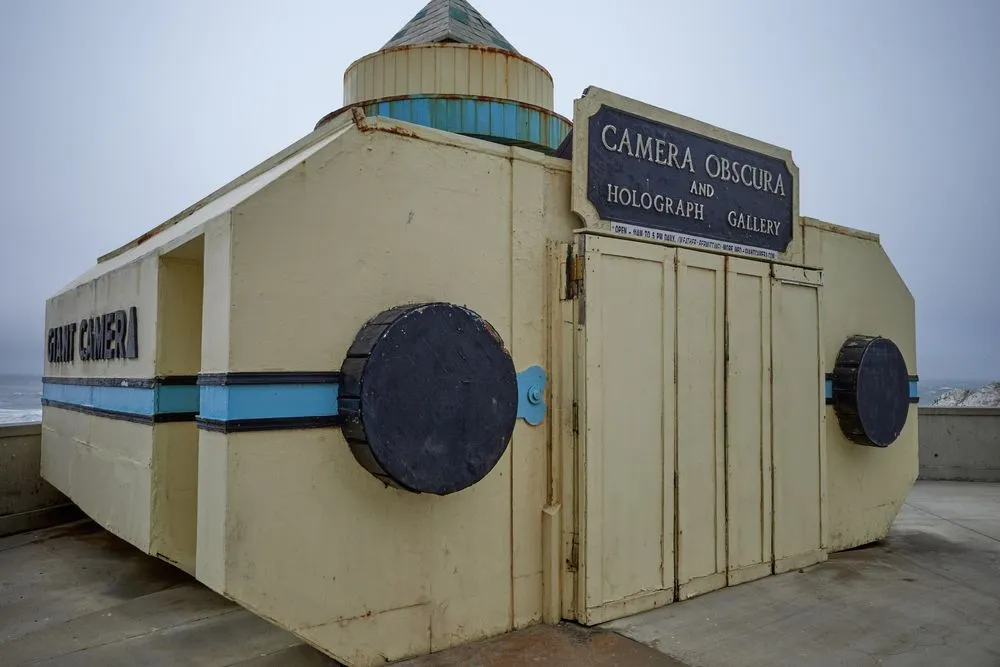
Although we have advanced far in camera technology, the fundamentals that govern modern cameras are still quite the same as that of the camera obscura. The camera obscura shows us how we can trace the roots of magical technological marvels of today to the ideas of brilliant people who lived centuries ago.
References (click to expand)
- Camera Obscura - Encyclopaedia Britannica
- Inside the Camera Obscura: Optics and Art under the Spell of the Projected Image - Max Planck Institute for the History of Science
- Baigrie, B. S. (2000). The Scientific Life of the Camera Obscura - Optics and Photonics News, The Optical Society
- The Daguerreian Era and Early American Photography on Paper - The Metropolitan Museum of Art
- The Niepce Heliograph (oldest surviving photograph, 1826) - Harry Ransom Center, University of Texas at Austin