Tap water is loaded with dissolved ions that conduct electricity, so a splash creates short-circuits and slowly corrodes the copper on a circuit board. Pure isopropyl alcohol has almost no free ions (conductivity around 6 µS/m), and it evaporates roughly three times faster than water, so it rarely lingers long enough to do damage.
Do you remember that one time when you were enjoying ScienceABC articles on your smartphone with a cup of tea for intellectual stimulation when the phone slipped and fell into the cup, effectively destroying both?
Conventional wisdom dictates that liquids and electronics don’t go together, but do you know what exactly the tea did to your phone? Also, if alcohol had replaced that tea, would the result have been the same?
The answer is explained by differences in the chemical and physical properties of water and alcohol.
Chemistry Of Water
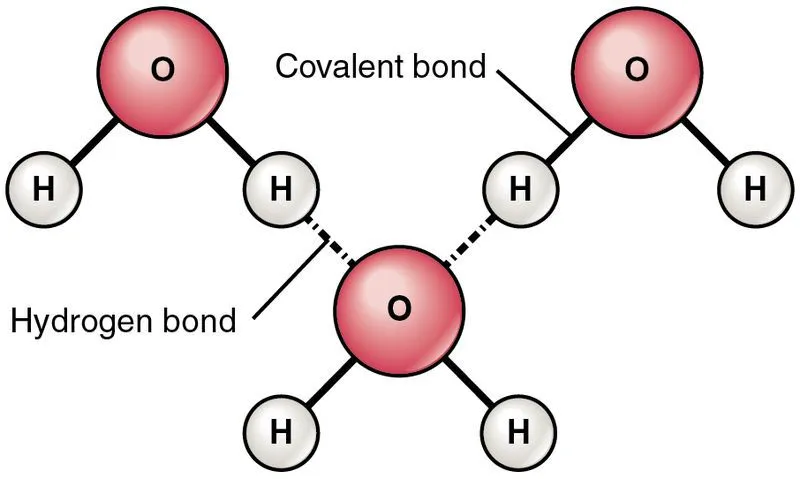
A water molecule has two hydrogen atoms bonded to one oxygen atom, denoted by the chemical formula H2O. Oxygen and Hydrogen form a bond by sharing an electron pair, with each electron in the pair being donated by Hydrogen and Oxygen, respectively. This is called a covalent bond. A consequence of sharing electrons is that there are no free electrons to conduct electricity. In fact, pure de-ionized water doesn’t conduct electricity.
Oxygen has an amazing property to attract electrons towards itself more than Hydrogen (electronegativity). In a water molecule, the shared electron pair is pulled more tightly toward Oxygen than toward Hydrogen. As a result, a partial negative charge develops on the O atom and a partial positive charge develops on each H atom. The geometry of water molecules is such that there is a separation of charges (centers of positive and negative charges don’t coincide).
A molecule may have elements with different electronegativities and yet be non-polar, such as methane, CH4. This makes water a polar (having poles of opposite charges) molecule. Due to this, minerals like Ca2+, Mg2+, Na+, Cl– etc. get dissolved (the negative pole of the water molecule attracts the positively charged mineral ions and vice-versa). These ions can conduct electricity in the presence of a potential difference.
Also, the intermolecular bonding is strong in water due to intermolecular Hydrogen bonding. This is the reason for the high boiling point of water, as compared to alcohols.
Chemistry Of Alcohol
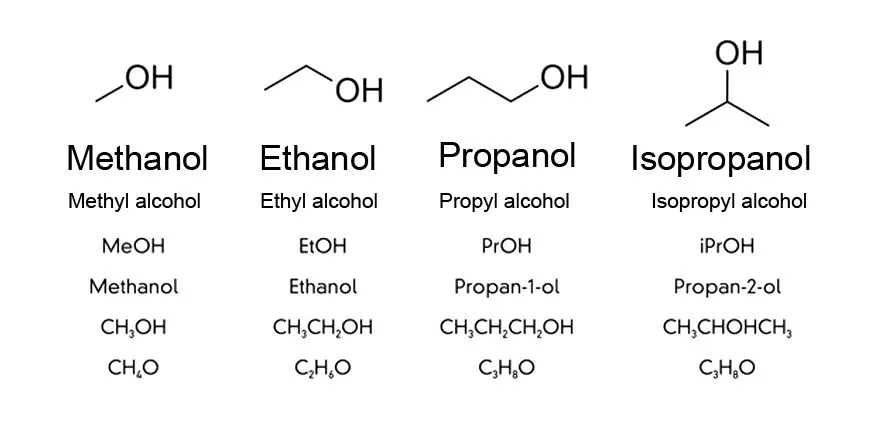
In common parlance, alcohol refers to either liquor or the liquid for medical purposes. However, in science, alcohol is not a single liquid, but a class of organic (i.e., carbon-containing) compounds that have the functional group (-OH). A functional group is a collection of atoms, such that some distinctive properties are associated with the organic compound bonded to it.
As was the case with water, the bonds formed between elements are covalent bonds (sharing of electrons). This translates to a lack of free electrons and ions to conduct electricity. Thus, pure alcohol is also an insulator.
Dissolving mineral ions in alcohol becomes more difficult than dissolving them in water, as there exists steric hindrance (difficulty accommodating new species due to repulsion from existing species) between the carbon chain and the mineral ions; the magnitude of charge is also less on alcohols.
Since the highly electronegative O is attached at one end, it pulls the shared electrons toward itself, gaining a partial negative charge and leaving a partial positive charge on the H of the hydroxyl group. Short alcohols like ethanol and isopropyl alcohol (IPA) are therefore polar overall, but they wear two faces: a polar head (-OH) and a non-polar tail (the carbon chain). This split personality makes them amphiphilic (comfortable around both polar and non-polar compounds), which is exactly why they show up in everything from cleaners to disinfectant wipes.
Also, the intermolecular attraction in alcohols is weaker than in water (steric hindrance caused by the presence of a bulky carbon chain). Thus, it is easier to vaporize alcohol than water.
Effect Of Water On Electronics
The consequences of water coming in contact with electronics can be divided into two parts, namely short-term and long-term effects.
Since water contains dissolved mineral ions, it is capable of conducting electricity. When a powered-on device comes in contact with water, multiple terminals inside the device come into contact with the same conductor, i.e., water. An alternate path for current flow is created and electricity starts flowing in directions where it shouldn’t. This is called a short-circuit. During a short-circuit, a huge amount of current flow occurs within a short time span, resulting in excessive heating and in the worst instances, fire!
Since most devices run on DC batteries, water bridging the anode and cathode of the battery can also electrolyze, releasing flammable H2 alongside O2 (which doesn’t burn on its own, but happily accelerates anything else that does).
Water also contains dissolved oxygen (O2) molecules. All electronics contain PCBs (printed circuit boards). PCBs have metals like Copper, Gold and Palladium as conductors. When exposed to water, a redox reaction occurs where the metal loses electrons and forms a metal-oxide layer. Over time, this eats away the conductive metal of the trace or terminal. In extreme cases the trace becomes structurally weak and breaks, leaving the circuit permanently open.
LED/LCD display screens contain a backlight panel that provides illumination. When water enters the backlight panel, the improper refraction of light occurs and the resulting display becomes distorted (hazy appearance, black spots, etc.).
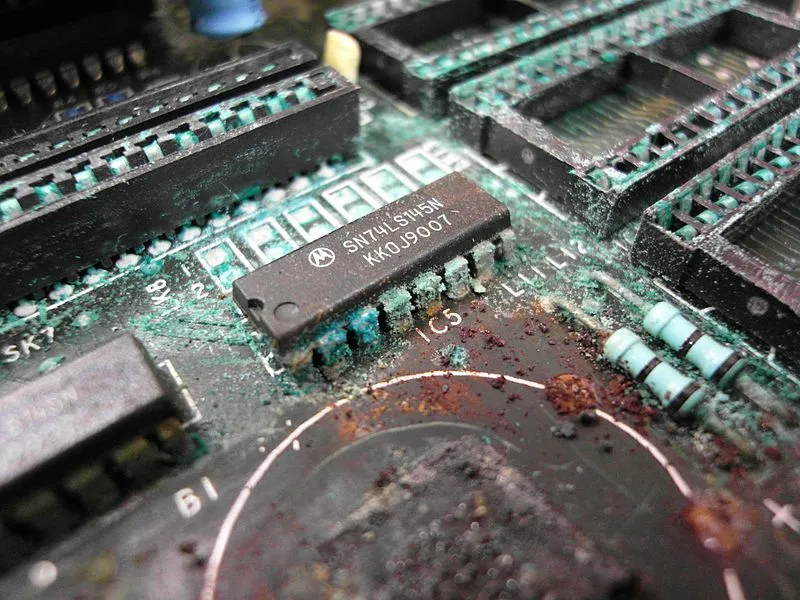
Moreover, water molecules can block speakers, resulting in a muffled output.
Effect Of Alcohol On Electronics
Alcohols don’t carry the kind of dissolved ionic baggage that ordinary water does. Pure isopropyl alcohol has a conductivity of only about 6 microsiemens per meter, compared with hundreds of microsiemens per centimeter for tap water, which is why the same droplet that would fry a powered circuit barely registers as alcohol. With so few free ions or electrons to ferry charge across pins and traces, short-circuits simply don’t get started.
Alcohol also evaporates faster than water (roughly three times as fast for IPA at room temperature), so it doesn’t hang around long enough to seep into a display or muffle a speaker. That’s also why repair guides specifically reach for the 99% bottle rather than the 70% drugstore variety: the 30% water in the latter is exactly the part of the mixture that can short-circuit or corrode the board, so the higher the alcohol content, the safer the cleanup.
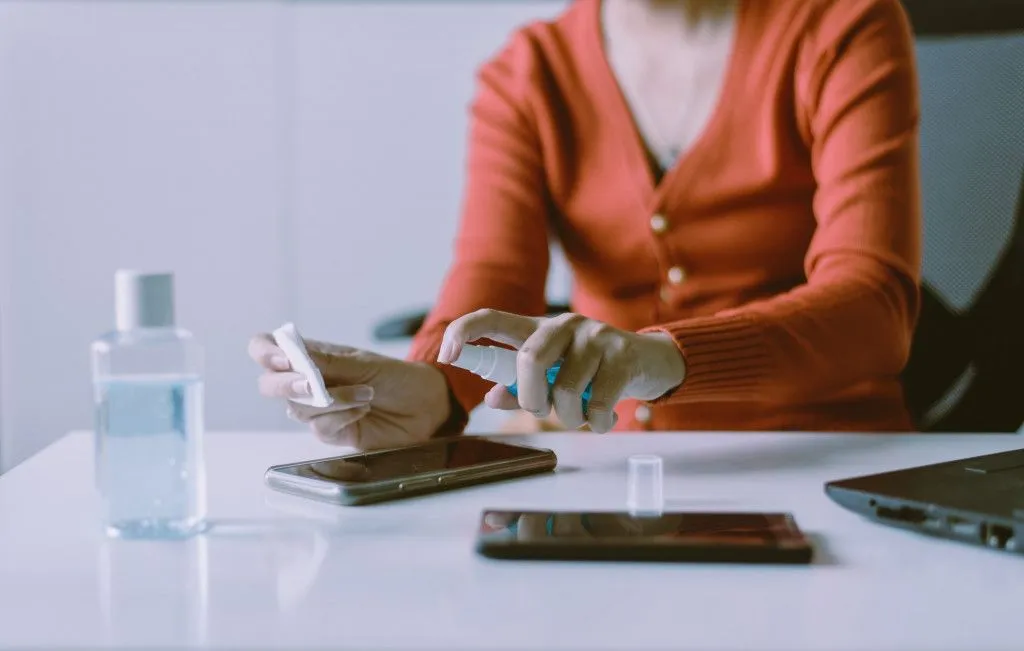
Moreover, since alcohol can bind to both polar and non-polar compounds, alcohol binds to fatty cell membranes of lipophilic germs and also denatures the proteins in microbes, effectively killing them. Thus, alcohols (especially isopropyl alcohol, IPA) are frequently used as cleaning agents.
When Alcohols Play Spoilsport
There are still cases of alcohols ruining electronics. The flash point (the lowest temperature at which a liquid gives off enough vapor to ignite when an ignition source (a spark, hot surface, or open flame) is present in air) governs the flammability risk. Pure isopropyl alcohol has a closed-cup flash point of around 12 °C (53 °F), which is well below typical room temperature. If a powered device is hot enough or sparks at a connector, those vapors can light up. Hence the standard advice: only clean with alcohol when the device is powered off, unplugged, and cool to the touch.
If alcohol bridges both the anode and the cathode of the battery, it can be electrolyzed too, releasing H2 gas, which is flammable in air at concentrations as low as 4% by volume.
Low molecular weight alcohols like ethanol and isopropyl alcohol (IPA) can dissolve very minute quantities of ionic impurities. If a sufficient volume of alcohol is present (e.g., dipping the device in an alcohol bath) then short-circuiting may occur.
A Final Word
The above discussion revolved mainly around drinking water and low molecular weight alcohol (ethanol, isopropyl alcohol, etc.). Pure water and pure alcohol rarely damage electronics, but dissolved impurities and intermolecular bonds are the main culprits when things do go wrong! Basically, since water can dissolve more impurities and evaporate slower than alcohols, it tends to ruin electronics more readily than alcohols.
References (click to expand)
- Electronegativity - Chemistry LibreTexts. LibreTexts
- Table - PMC - NCBI. The National Center for Biotechnology Information
- Hydrogen Bonding. Purdue University
- Functional Groups - Chemistry LibreTexts
- Covalent Bonds - Chemistry LibreTexts. LibreTexts
- Hydrogen Production: Electrolysis | Department of Energy. The United States Department of Energy
- Safe Use of Hydrogen and Hydrogen Systems. NASA Technical Reports Server
- Using Alcohol to Disinfect Electronics | Library and Information Services - lbis.kenyon.edu
- Flammable Liquids - 29 CFR 1910.106. OSHA Directorate of Training and Education