Table of Contents (click to expand)
Only a handful of animals pass the mirror self-recognition (MSR) test, devised by psychologist Gordon Gallup in 1970. The list includes great apes (chimpanzees, bonobos, orangutans), Asian elephants, bottlenose dolphins, Eurasian magpies, and one fish, the cleaner wrasse. Many intelligent animals, such as octopuses, fail it, though critics note the test relies heavily on vision.
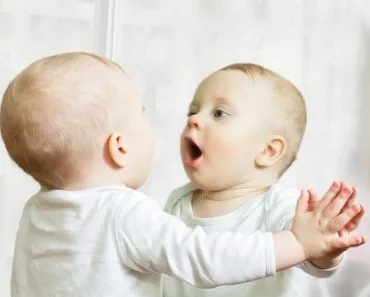
If you’ve ever taken a baby to a mirror, you might have observed that the baby gets quite fascinated with the “stranger” in the mirror. They eventually recognize that the mirror image is of themselves. This is a psychological stage called the mirror stage, when young children start to understand that the person staring back at them in the mirror is their own reflection. Such a moment of recognition is considered a level-up in development.
Given that, what would be the case with animals? When animals look at their mirror reflections, do they see a stranger, an identical rival, or do they genuinely identify themselves?
Scientists have actually declared this self-recognition capacity as a form of intelligence, and this metric has been used as a tool to compare the cognitive abilities of animals!
Gallup And His Mirror Test
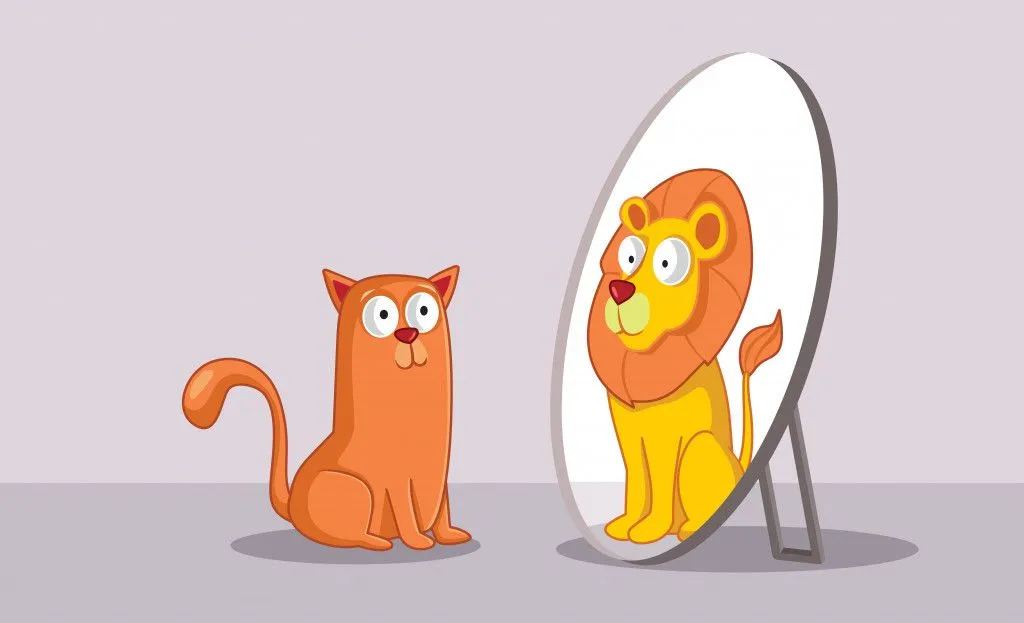
In 1970, an American psychologist named Gordon Gallup came up with the concept of mirror self-recognition or MSR (hence the name, the Gallup test). Gallup declared that self-recognition is a sign of self-awareness.
Self-awareness helps you understand and position yourself with respect to others, which in turn helps you frame and learn from experiences accordingly.
In the traditional MSR test, an animal is anesthetized and then marked with paint or a sticker on a part of its body that it can’t normally see. The animal is allowed access to a mirror once it has recovered from the sedation. If the animal touches or studies the mark, it is assumed that the test subject believes the reflection to be an image of itself, rather than that of another animal.
Mammals And The Mirror Test
We, Homo sapiens, pass the mirror test.
Evolutionarily, the great apes are our closest relatives, which makes them ideal first test candidates for the mirror tests.
Four chimpanzees were introduced to a mirror for a period of 10 days and their behaviors were observed. Initially, they started threatening the mirror images by blowing bubbles and making faces at them, but soon they started using the mirror for grooming, and even for picking their noses!
After 10 days, they were anesthetized and the mirror test was performed on them. The chimpanzees were able to recognize the new marks on them and analyzed them by touching them. Our other great ape cousins, bonobos and orangutans, have since passed too. Gorillas, on the other hand, usually fail (the famous sign-language gorilla Koko being a rare exception).
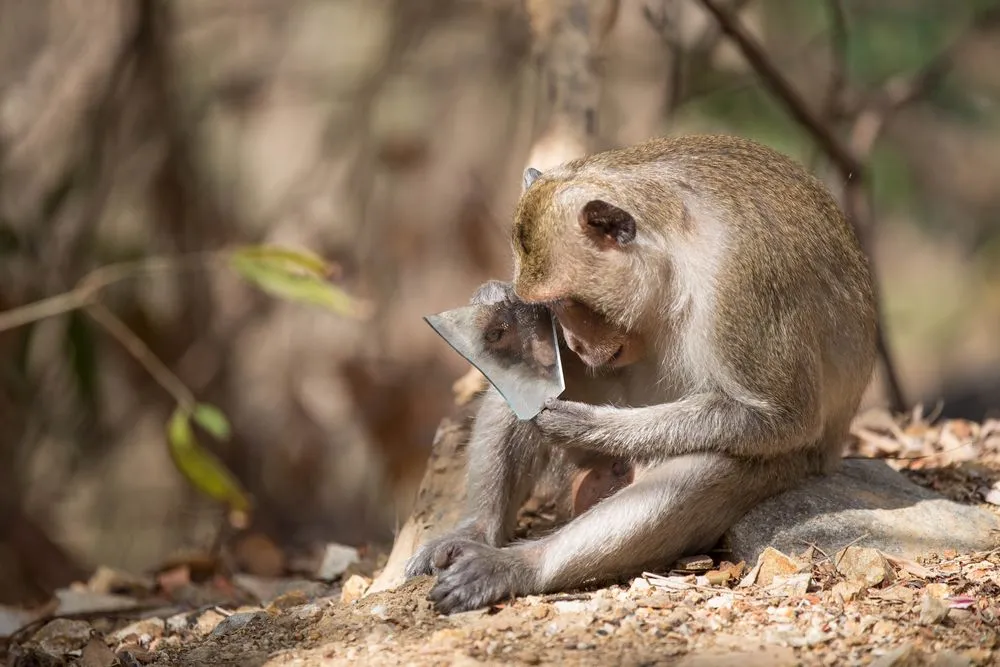
Next on the list are monkeys. In older studies, monkeys failed to perform well in the mirror test, but a 2015 study showed that rhesus macaques display self-recognition after undergoing some training. Whether the training reveals a hidden ability or simply teaches a new trick is still debated.
Primates aren’t the only vainglorious animals. The highly intelligent bottlenose dolphins, when exposed to reflective surfaces, used them to investigate marks on their body parts. Asian elephants can do it as well: of three tested in 2006, an elephant named Happy repeatedly touched a white cross painted above her eye, but only while facing the mirror. A single study even found that horses passed the test!
When Non-mammals Joined The League
European magpies, a songbird from the crow family, also recognized the marks on their body when presented with a mirror. Contradictorily, azure-winged magpies did not act as smart as their relatives. This variation makes it difficult to be conclusive about the MSR ability of the bird group.
Among fish (a challenging group to test self-recognition on), a species of fish called cleaner wrasse (named so because it removes parasites from other fish) passed the MSR test in 2019. The claim was controversial, since few expected a small reef fish to clear a bar that stumps most mammals, but a follow-up study in 2022 reported that the great majority of wrasse tested scraped at marks they could only see in the mirror. The debate it sparked is really about whether the mirror test measures self-awareness or just clever problem-solving.
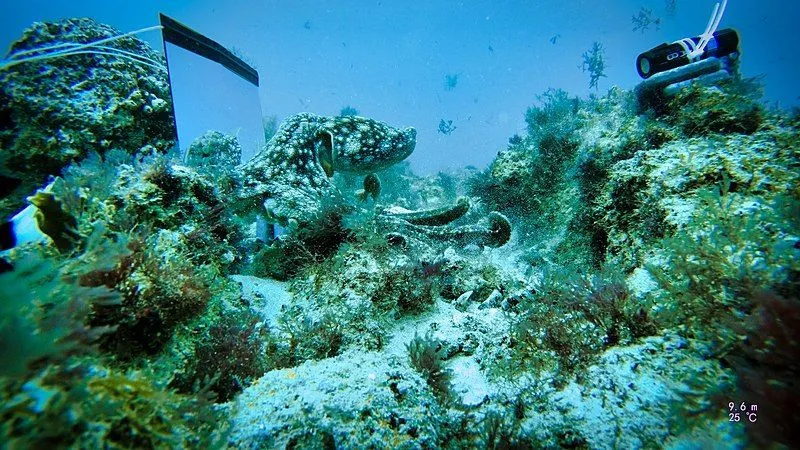
There are also octopuses, the 8-armed, 9-brained geniuses, but they have failed this test, to the surprise of many. In their case, the animals poked at marks whether or not a mirror was present, which suggests they were responding to touch rather than to their reflection.
Final “Reflections”
It is possible that some animals failed the test because the tests were not tailored to accommodate their evolutionary adaptations or visual spectrum. This supposition is based on the fact that the same groups of animals responded differently in different sets of experiments. Also, there are millions of organisms who have not yet seen a mirror, which makes it difficult to make generalized conclusions about animal groups.
Is it right to say that the mirror test is the final word in judging the intelligence of a species? Not so much. However, is the capacity for self-recognition an indicator of intelligence? Absolutely!
So, mirror mirror on the wall, am I the one who is doing it all?
References (click to expand)
- GG Gallup Jr. The Mirror Test Gordon G. Gallup, Jr., James R. Anderson .... The University of Washington
- Toda, K., & Platt, M. L. (2015, January). Animal Cognition: Monkeys Pass the Mirror Test. Current Biology. Elsevier BV.
- Gallup, G. G., Jr. (1970, January 2). Chimpanzees: Self-Recognition. Science. American Association for the Advancement of Science (AAAS).
- Mather, J. (2021, August 12). Octopus Consciousness: The Role of Perceptual Richness. NeuroSci. MDPI AG.
- Nobus, D. (2018, March 28). Life and Death in the Glass: A New Look at the Mirror Stage. Key Concepts of Lacanian Psychoanalysis. Routledge.
- Baragli, P., Scopa, C., Maglieri, V., & Palagi, E. (2021, March 13). If horses had toes: demonstrating mirror self recognition at group level in Equus caballus. Animal Cognition. Springer Science and Business Media LLC.
- Prior, H., Schwarz, A., & Güntürkün, O. (2008, August 19). Mirror-Induced Behavior in the Magpie (Pica pica): Evidence of Self-Recognition. (F. de Waal, Ed.), PLoS Biology. Public Library of Science (PLoS).
- Wang, L., Luo, Y., Wang, H., Zou, Y., Yao, H., Ullah, S., & Li, Z. (2020, August). Azure-winged magpies fail to understand the principle of mirror imaging. Behavioural Processes. Elsevier BV.
- Kohda, M., Hotta, T., Takeyama, T., Awata, S., Tanaka, H., Asai, J.-. ya ., & Jordan, A. L. (2019, February 7). If a fish can pass the mark test, what are the implications for consciousness and self-awareness testing in animals?. (F. B. M. de Waal, Ed.), PLOS Biology. Public Library of Science (PLoS).
- Reiss, D., & Marino, L. (2001, May). Mirror self-recognition in the bottlenose dolphin: A case of cognitive convergence. Proceedings of the National Academy of Sciences. Proceedings of the National Academy of Sciences.
- Plotnik, J. M., de Waal, F. B. M., & Reiss, D. (2006). Self-recognition in an Asian elephant. Proceedings of the National Academy of Sciences. National Academy of Sciences.
- Kohda, M., et al. (2022). Further evidence for the capacity of mirror self-recognition in cleaner fish and the significance of ecologically relevant marks. PLOS Biology. Public Library of Science (PLoS).
- Amodio, P., & Fiorito, G. (2022). A preliminary attempt to investigate mirror self-recognition in Octopus vulgaris. Frontiers in Physiology. Frontiers Media SA.