Table of Contents (click to expand)
Sort of, but not the way the headlines claim. In a 2021 study, dogs ignored a person’s misleading advice more often when that person knew the food had been moved than when they were honestly mistaken, hinting that dogs track whether a human is a reliable source. Scientists stop short of saying dogs grasp lying as deliberate deception.
Recall a time you told a lie. Do you have a secret chocolate stash in your room that your parents know nothing about? Or did you ever tell false stories about your achievements to your friends? Most of us have lied at some point in our lives. It could have been because we didn’t want to hurt someone’s feelings, or perhaps we just didn’t want to face the consequences of failing our exams.
It is impossible to get out of all those lies without being caught. People usually only consider this when doing it to other people, but what about animals? Have you ever wondered if your dogs could tell when you’re lying to them? Would this make you think twice next time before you fake-throw the ball to your dog?

Interestingly, there seems to be a way to test this out in animals.
What Is The Sally-Anne Test?
The Sally-Anne test involves a girl named Sally putting a marble inside a basket. Another girl named Anne then takes the marble and puts it inside a box when Sally isn’t there. We would assume that when Sally comes back, she will look into the basket, because she didn’t see what Anne did. This test is used to understand how children apply the concept of different perspectives and logic. Those who pass the test will expect Sally to look into her basket, even though they know the marble is in the box.
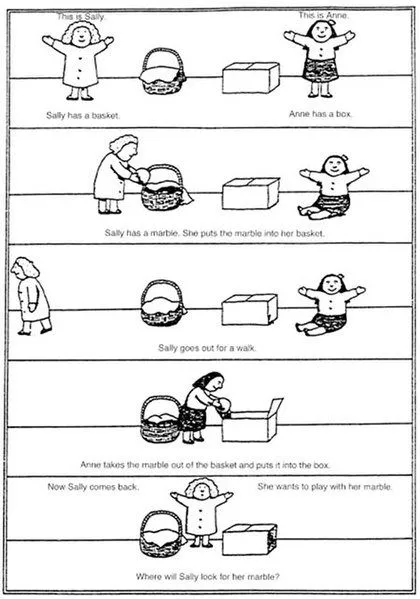
Researchers utilize this same concept in various ways to find out if animals can understand when someone is lying. One can only imagine that dogs might be good at this, as they seem to show a good understanding of human behavior. After all, a dog is “man’s best friend”.
To do this in dogs, scientists often use food as a motivator. They also change other parts of the test, since you can’t “ask” dogs to tell you what Sally thinks. In a 2021 study of 260 dogs published in Proceedings of the Royal Society B, researchers hid food inside one of two buckets and had person 1 (‘Sally’) point the dog toward the right one. They then changed things up by having person 2 (‘Anne’) move the food to the other bucket, either while Sally was watching or while Sally was out of the room, before Sally pointed again. Sally always pointed at the now-empty bucket.
The key result was a little counterintuitive: dogs followed Sally’s misleading point more often when Sally had not seen the food being moved than when she had. In other words, when Sally genuinely didn’t know the food had shifted, dogs tended to trust her; when she had watched the switch and still pointed at the empty bucket, more dogs ignored her and went to the food.
That pattern is what made the result interesting. As lead author Lucrezia Lonardo and her colleagues explained, because more dogs refused to follow an informant who knew where the food was (but still pointed to the empty cup) than one who didn’t know, the dogs may have read the knowing point as “deceptive.” The researchers stress that this is one possible interpretation rather than a settled conclusion.
This may hint that dogs are sensitive to whether a person is being straight with them, though it’s important to be careful here. The dogs could have been responding to subtle differences in how the two people behaved, rather than reasoning about what Sally did or didn’t know, and this line of research still needs much more work. Even so, there is a real possibility that dogs can pick out an unreliable human, a thought worth holding onto next time you shake an invisible treat in your hand.
What Other Factors Could Influence Dogs’ Behavior?
The same study also looked at whether breed type matters, comparing border collies with terriers. The border collies behaved like the wider group: they followed the human’s point toward the empty bucket more often when the person hadn’t seen the switch (and was therefore honestly mistaken), and were more likely to head straight for the food when the person had watched the switch and still pointed wrong. The terriers showed the opposite pattern, and they were the only group that lined up with how human infants and apes behave on similar tests: they followed the point more often when the person genuinely knew where the food was. One idea is that different breeds simply weigh human cues differently, perhaps because of how we bred them to work alongside us, though with just two breeds tested it’s too early to read much into the difference.
Also, if the dogs seemingly ‘trust’ complete strangers in these types of studies, we can only imagine what they would be like with their owners. It is believed that dogs not only love their owners unconditionally, but also trust their owners implicitly. They trust you to feed them every day and take care of them.
These dogs in the study might have trusted their owners’ suggestions even more than the experimenters.
It goes to show that these animals depend on you to love them, just like any child. Therefore, intentionally lying to them might not be the best way to go.
A Final Word
Having the ability to distinguish lies from the truth would be a big advantage for dogs attempting to survive among humans. If they can tell when you lie to them about where food is, they can quickly sniff around and get to their food. Otherwise, they would just be wasting time following useless and false human directions. It makes sense that the evolution of such behaviors might be present in non-humans too. We need a lot more research before settling on a definite answer, and detecting an unreliable human is not the same as understanding a deliberate lie. Still, the evidence so far suggests dogs are paying closer attention to our intentions than we might think.
So, the next time you try to fool your dog, just remember that they might be onto you, just like your mother knows about the hidden chocolate stash you have in your room!
References (click to expand)
- Young toddlers can tell when others hold false beliefs, study .... The University of Illinois Urbana-Champaign
- Lonardo, L., Völter, C. J., Lamm, C., & Huber, L. (2021, July 21). Dogs follow human misleading suggestions more often when the informant has a false belief. Proceedings of the Royal Society B: Biological Sciences. The Royal Society.
- Dogs know when humans are lying to them | Live Science. Live Science
- Does Your Dog Know When You're Lying? The American Kennel Club