Table of Contents (click to expand)
Yes, birds like the killdeer pretend to have a broken wing to lure predators away from their nest. The trick is called a broken-wing display (also "injury feigning" or "distraction display"), and a 2022 Proceedings of the Royal Society B study found it in roughly 285 species across the bird family tree, most often in ground-nesting birds at high latitudes where eggs are very exposed.
Of the more than 10,000 avian species known today, many are armed (or winged?) with a few tricks to defend themselves against predators. They can fly (or run or swim) away, attack a predator with their deadly talons and beak, or do as the nightjar does and camouflage themselves among their environment. However, recently, scientists have found that some birds go the extra mile to become masters of defensive deception.
This behavior is commonly referred to as injury-feigning, distraction display, or the broken-wing display.
Some birds employ strategies involving exaggerated displays of weakness in order to protect their young from predators. They ingeniously ploy a false ruse to lure the potential predator away from their young and towards themselves.
Which Species Show The Broken-wing Display?
At first, researchers had only seen this behavior in shore birds.
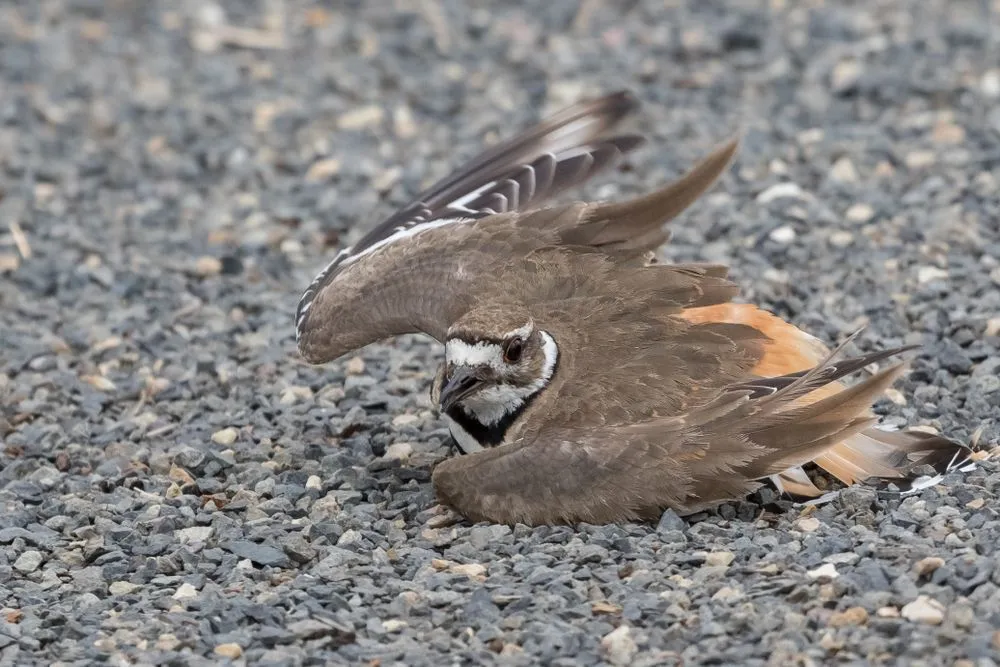
The killdeer probably displays the best “broken-wing” act. The killdeer is a shorebird that earned its name because of its unique call, “kill-deee, kill-deee!” Many bird species, such as hawks, owls, and falcons, as well as herring gulls and crows, view killdeer as an easy meal. Raccoons, skunks, and feral cats are also opportunistic hunters that regularly prey on killdeer.
To outsmart these predators, the killdeer pretends to have a broken wing. The killdeer lays camouflaged eggs nested in rocky crevices, areas that are not exactly inaccessible to predators.
By acting as bait, they distract the danger hovering over their offspring. The killdeer starts to inch away from the nest, loudly squawking, and dragging its tail and wings as if injured. This conspicuous behavior continues until the killdeer is satisfied that it has misled the predator. Subsequently, it “gets better,” and flies away unharmed.
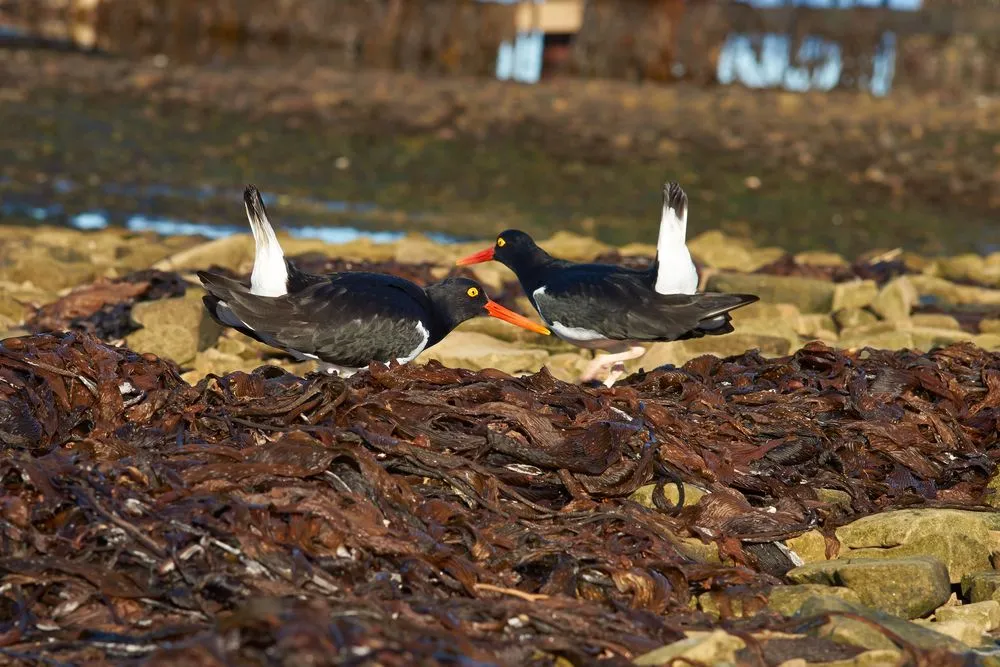
Oystercatchers are another species of birds that are known to fake injuries. They produce distress calls and move a far enough distance away from their nest site, luring the predator to follow the “injured bird.” However, eventually, the predator loses track of where its prey’s nest was, while the parent stops pretending to be hurt and simply flies away.
Studies report that 90% of the time, the predators fall prey to this elaborate pretense laid out by the oystercatcher.
Why Do So Few Birds Use This Technique?
For ornithologists and animal behaviorists, the scientists that study birds and animal behavior, respectively, this behavior was confusing. They wondered why these specific birds resorted to becoming Trojan horses (or birds)?
As it turns out, shorebirds aren’t the only deceivers of the avian realm. After more observing and broader research, scientists now report that about 300 species of birds display such deceptive tactics.
Researchers analyzed sixteen different features of those bird species that showed the “broken-wing display”, including body size, breeding latitude, and nest concealment strategies. From comparing these features, a pattern emerged. The species that nested at higher latitudes were more likely to display the broken-wing act than their tropical-dwelling counterparts. Similarly, species that laid their eggs on the ground or any other vulnerable places were more likely to demonstrate such behavior.
For example, birds such as woodpeckers, trogons and waterthrushes lay their eggs in predator-proof tree cavities. Deceptive behavior was hardly ever seen in those species.
Basically, it all boiled down to how much predation risk each species faced.
Do Birds Learn This Behavior Or Is It Genetic?
There’s no doubt that these birds pretend to have broken wings, but how intentional is this behavior? Is it an inherent response, or is it a thoroughly planned deception?
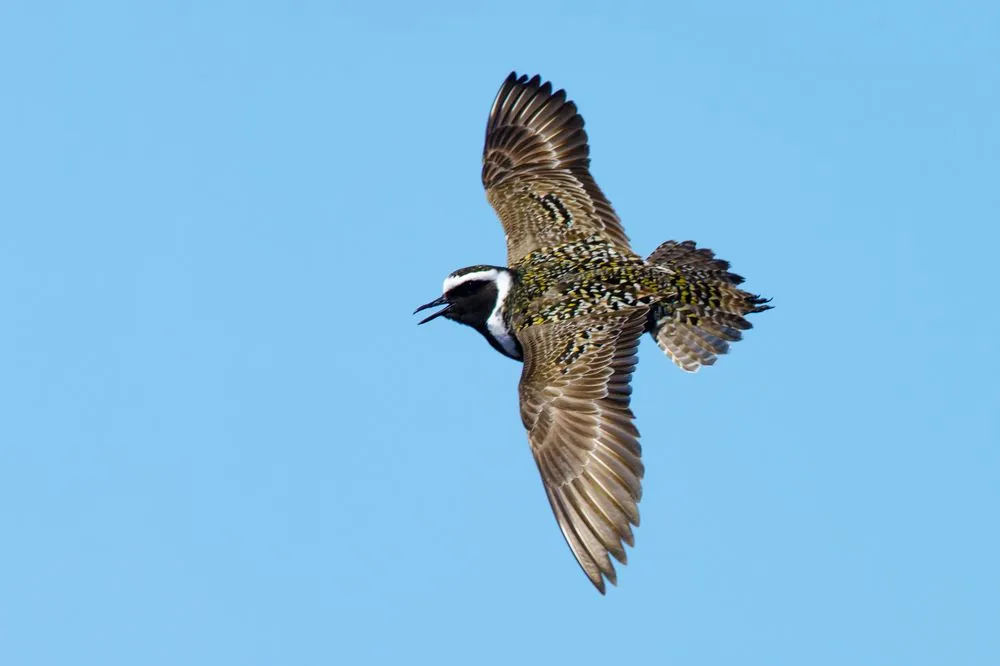
A study in 1993 conducted 45 trials where humans approached a plover’s nest. Of the trials performed, all but one case showed that the bird would successfully lead the predator away from its nest. What’s more, they made sure to stay at close proximity to the predator prior to their broken-wing display. When they moved, they would turn back to see if their little ploy was working! Since differences in predation pressure more dramatically influence the evolution of the broken-wing display, this behavior is also likely to be learned through exposure to various predators. Because the tactic leads to greater survival of the species, it was quickly adopted and integrated as a defense technique.
Is The Broken-wing Display Risky For The Parent?
It is tempting to picture the broken-wing display as a foolproof magic trick, but for the bird performing it the stakes are very real. By design, the act only works because the parent makes itself the most interesting thing in the predator's field of view. In their 2020 review in Ibis, behavioral ecologists Rosalind Humphreys and Graeme Ruxton describe distraction as one of the riskier forms of parental care, precisely because its success depends on the displaying parent becoming the focus of a predator's attention.
That risk occasionally turns into a real cost. The displaying bird stays close to the predator, fluttering and limping just out of reach, and a misjudged hop can be fatal. As Audubon notes in its coverage of the behavior, birds do sometimes get caught and eaten by the very predator they are trying to deceive, or snatched by a second opportunist that the commotion attracts. So why gamble? Because the math usually favors the parent. A clutch of eggs or a brood of flightless chicks represents a huge investment, and losing the whole nest is a far heavier blow to a bird's lifetime reproductive success than the smaller chance of getting hurt during a display. The behavior persists, in other words, because on average it saves more offspring than it costs parents.
What Other Distraction Tricks Do Birds Use?
The broken wing is the most famous routine, but it is really just one item on a wider menu of distraction displays, and the exact performance varies a lot from species to species. A killdeer aggressively calls and holds out a contorted wing, while a snowy plover may instead lie still with both wings spread flat, looking far more like a casualty than a frantic actor.
Then there is the rodent-run, a stranger variation. Instead of feigning a broken wing, the bird scurries away from the nest in a low, hunched crouch with its tail down and feathers fluffed, squealing as it goes. The illusion mimics a scampering mouse or vole, dangling an easy mammalian meal in front of the predator and drawing it away from the eggs. According to the field-guide essays compiled by Stanford ornithologists Paul Ehrlich, David Dobkin and Darryl Wheye, broken-wing and rodent-run displays are most easily provoked, and most convincing, in shorebirds, waterfowl and other birds that nest on open ground, exactly the species with the most to lose. Whichever script a bird uses, the goal is identical: become the more tempting target, then quietly slip away once the threat has been led far enough from the nest.
Do Animals Other Than Birds Fake Injury?
Faking injury to guard offspring is overwhelmingly a bird trick, but it is not exclusively avian. A handful of other animals have been documented pulling distraction displays of their own (much as some species play dead to throw off a threat), almost always when their young are at risk.

The most striking example comes from a small fish. In the three-spined stickleback (Gasterosteus aculeatus), the male guards a nest of eggs that hungry shoals of his own species would happily raid and cannibalize. Researchers Mark Ridgway and J. D. McPhail found that once a raiding shoal grows large enough, the parental male swims off and performs a spasmodic digging display away from the nest, leading the foragers toward an empty patch of lakebed and away from his eggs. Tellingly, the males only bothered with the display when there were actually offspring in the nest.
Mammals occasionally do it too. Naturalist Charles Long described a female North American red squirrel (Tamiasciurus hudsonicus) that, when her nest tree was approached, led the intruder away through the canopy using misdirected, ventriloquial calls, the rodent equivalent of a killdeer's limp. Cases like these are rare enough that biologists still regard injury-feigning as primarily a bird behavior, but they show that the underlying logic, sacrificing a little personal safety to save a clutch of young, is one that evolution has stumbled upon more than once.
Closing Thoughts
In the avian world, the broken-wing display is seen in some species, while even closely related species do not engage in the act. This suggests that, from an evolutionary perspective, birds that needed to defend their young more aggressively opted to adapt this type of defense.
So, next time you see a bird hopping about with a so-called broken wing, consider that it may just be a careful mum, and follow it for a while, so you don’t end up stepping on its nest!
References (click to expand)
- Barçante, L., M. Vale, M., & S. Alves, M. A. (2017, November 28). Altitudinal migration by birds: a review of the literature and a comprehensive list of species. Journal of Field Ornithology. Resilience Alliance, Inc.
- Cruickshank, A. D., Rutter, R. J., & Cottam, C. (1936, October). "Injury Feigning" by Birds. The Auk. Oxford University Press (OUP).
- Humphreys, R. K., & Ruxton, G. D. (2020, February 8). Avian distraction displays: a review. Ibis. Wiley.
- Carless, S. (2005). Effect of human disturbance on the foraging behaviour of the oystercatcher Haematopus ostralegus on the rocky shore. University of Plymouth.
- de Framond, L., Brumm, H., Thompson, W. I., Drabing, S. M., & Francis, C. D. (2022, March 30). The broken-wing display across birds and the conditions for its evolution. Proceedings of the Royal Society B: Biological Sciences. The Royal Society.
- McKee, J. (2022, April 28). Injury or Illusion? Why a Bird With a Broken Wing May Not Be What It Appears. Audubon.
- Ehrlich, P. R., Dobkin, D. S., & Wheye, D. Distraction Displays. The Birder's Handbook. Stanford University.
- Ridgway, M. S., & McPhail, J. D. (1988). Raiding shoal size and a distraction display in male sticklebacks (Gasterosteus). Canadian Journal of Zoology. NRC Research Press.
- Distraction display. Wikipedia. (Summarizing Long, C. A. (1993). Bivocal distraction nest-site display in the red squirrel, Tamiasciurus hudsonicus. Canadian Field-Naturalist.)