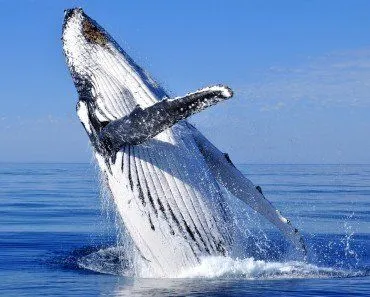
Orcas, or killer whales, are the largest members of the dolphin family (Delphinidae). They are sophisticated apex predators that hunt prey as large as the blue whale using coordinated pod strategies. Despite the name, there is no confirmed record of a wild orca killing a human, so killer whales are far less dangerous to people than their reputation suggests.
Imagine you’re surfing the waves, having the time of your life.
Suddenly, near the horizon, you see a group of fish the size of motorbikes moving through the water. Their dorsal fins cut through the waves like knives through butter, and you catch a glimpse of their shiny black heads with a spot of white. You’ve just spotted a pod of killer whales.
Chances are you’ll feel the urge to run away as quickly as possible. Many predators, from great white sharks, seals and dolphins to squid and blue whales, would run away as well!
Orcas are majestic, magical… and murderous!
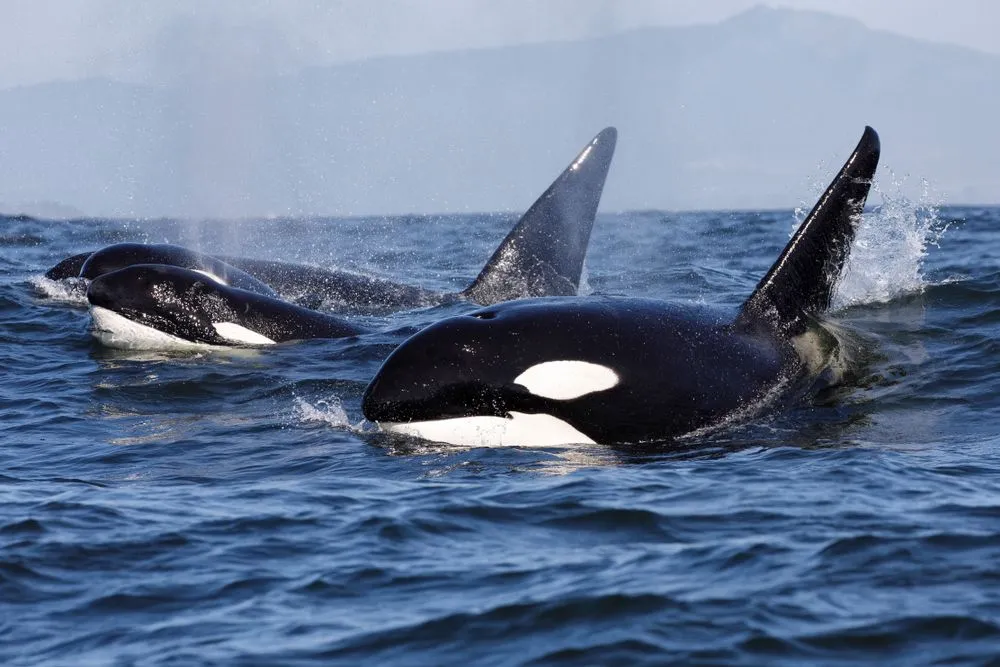
Orcas, commonly known as killer whales, are found in each of the world’s seven oceans.
They’re extremely revered in several cultures across the world. For example, The Haida people of the Haida Gwaii islands (in Canada) call Orcas Ska’na. Haida myth holds that orcas are the most powerful creatures of the underwater realm. It’s claimed that these Ska’na live in houses under the sea and rule over all other creatures.
Despite the magnitude of their distribution, there are many misconceptions about these creatures.
Where Did The Name “Killer Whale” Come From?
Orcas are top predators, but they aren’t exactly saints of the sea. From schools of fish to blue whales, pods of orcas hunt them all. That’s how they got their name. Ancient sailors once happened upon a pod hunting a whale. They called these hunters asesina ballenas, or ‘whale killer’.
The grim reputation is baked into their scientific name too. Their genus, Orcinus, means “belonging to Orcus”, the Roman god of the underworld, so the name roughly evokes “of the kingdom of the dead”. (The species name orca itself is more mundane, from a Latin word for a large-bellied pot.) They’re painted as the Grim Reaper of the seas, but is this reputation truly accurate?

Are Orcas Actually Dangerous?
To seals, sea lions, sharks and whales? Absolutely. To people? Not really.
Orcas are apex predators, but their reputation as human killers has always been overblown. As recently as 1973, a US Navy diving manual described orcas as “extremely ferocious”. It went so far as to claim that a killer whale would attack a human at every opportunity.
The reality is the opposite. There is no confirmed record of a wild orca ever killing a person, and the handful of documented wild encounters (such as a surfer off California in 1972 who was bitten once and then released) caused no deaths. To put that in scale, ordinary cattle kill roughly 20 people a year in the United States alone! Most researchers think the rare wild “attacks” are simply cases of mistaken identity, with the orca quickly realizing a human is not on its menu.
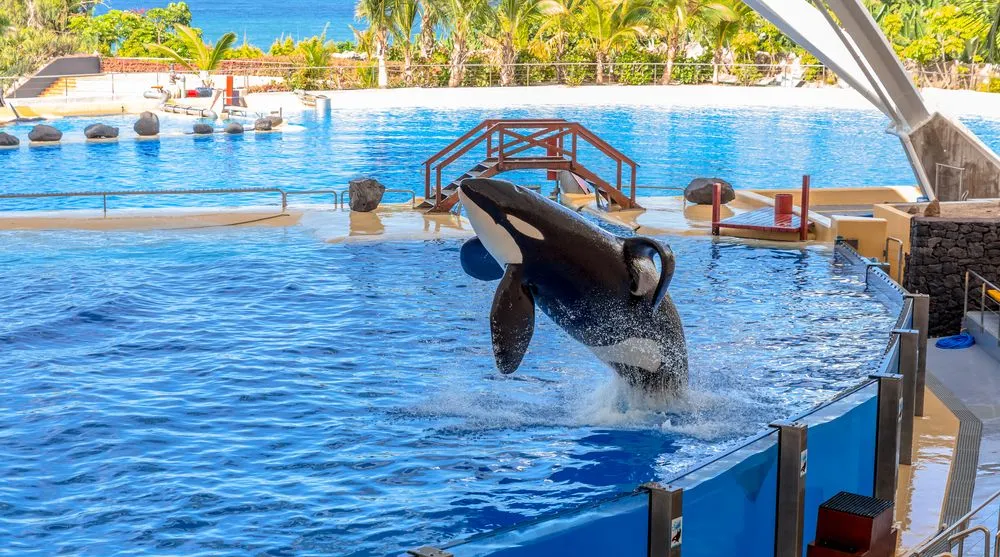
Captivity is a different story. Orcas, like several other aquatic giants (great whites, large whales), cope extremely poorly with life in a tank, and they can turn on their trainers under that stress. The most notorious example is Tilikum, a male orca linked to the deaths of three people across his decades in captivity, including SeaWorld trainer Dawn Brancheau in 2010. His story anchored the 2013 documentary Blackfish and helped push parks like SeaWorld to wind down their orca shows.
Why Are Orcas So Dangerous?
Orcas belong to the family Delphinidae. This family includes all oceanic dolphins, such as bottlenose dolphins.
Similar to most members of the dolphin family, orcas are incredibly smart. Scientists use a metric known as EQ to judge an animal’s intelligence.
The EQ or encephalization quotient measures the ratio of an animal’s actual brain size to the expected brain size for an animal of its mass. Orcas, like other members of the Delphinidae family, score very high on this metric.
Not only that, studies have shown that orca brains display a considerable amount of folding or convolutions. They also possess a high number of myelinated neurons in their brain. These two factors directly correlate to the increased processing power of the brain.
This processing power is reflected in orca intelligence. Orcas are the only species, apart from humans, who have evolved not just based on genotypes and phenotypes, but also due to culture!
There’s even an argument that the species (Orcinus orca) must be re-evaluated and reviewed, as it could be split into multiple different species. In fact, depending on location, diet, and culture (hunting strategies, whistles, and vocalizations, etc.) orcas can be differentiated into different races, sub-species, and ecotypes.
Let’s take, for example, the northeastern Pacific waters of the USA and Canada. This region of the Pacific alone houses three different ecotypes: residents, transients, and offshore orcas. Resident orcas are picky fish eaters that mostly hunt salmon. Transient orcas (now often called Bigg’s killer whales) prefer marine mammals like seals and sea lions, along with some squid. Offshore orcas roam farther out and eat fish, including sharks.
Apart from diet and location, orcas also differ in their culture.
This “culture” refers to the passage of hunting strategies and tricks from generation to generation. Offshore orcas herd and stun schools of fish, while transient orcas swim underwater and surprise their prey, namely whales.
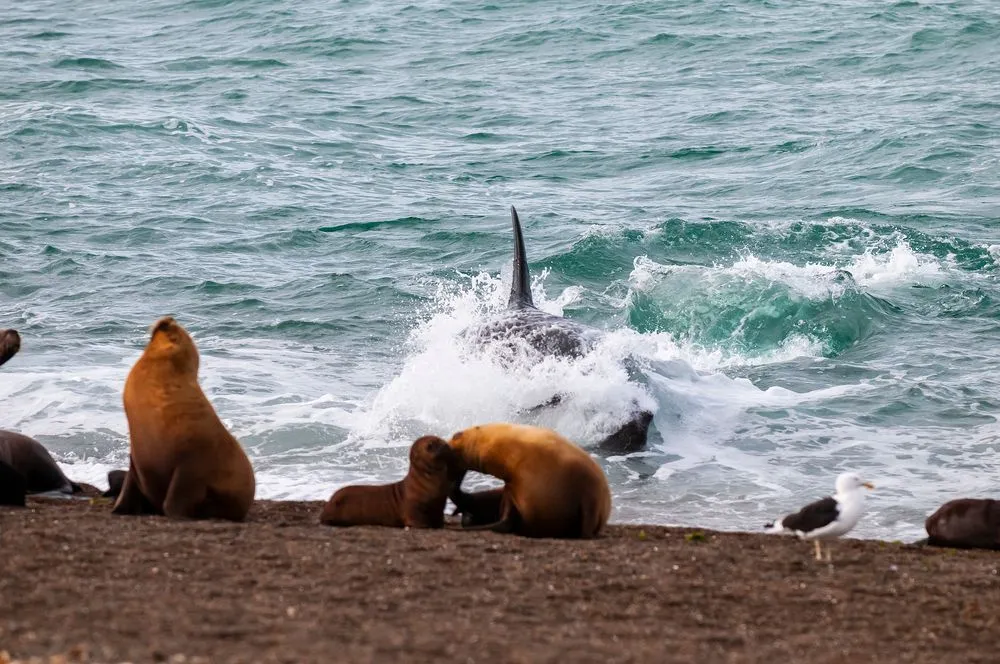
A few transient orcas have even been captured, on video, intentionally beaching themselves to attack sea lions.
They don’t just pass on old knowledge, they create it as well. Pods of orcas have been observed “testing” new hunting strategies. In fact, off Bremer Bay in Western Australia, scientists documented orca pods hunting and killing full-grown blue whales for the first time, in events recorded between 2019 and 2021. Once an orca breaches a blue whale’s defenses, it may even swim into the giant’s mouth to chomp on its nutrient-rich tongue!
Their “culture” doesn’t just end here; they also have a language. They talk to each other with distinctive calls and whistles. Most animals communicate with each other in some ways though, so how are orcas different? Let’s use an example.
Most people in the United Kingdom speak English. However, each region has its own accent or dialect. People in Scotland speak with a Scottish accent, while Englishmen in Newcastle speak a Geordie dialect.
Orcas do the same. The difference in their dialects comes downs to lineage. Groups of orcas follow a matrilineal descent. Mother orcas in each family pass down their own marked calls to sons and daughters. Each matriline (family of orcas) travels with other matrilines. Together, they form a pod.
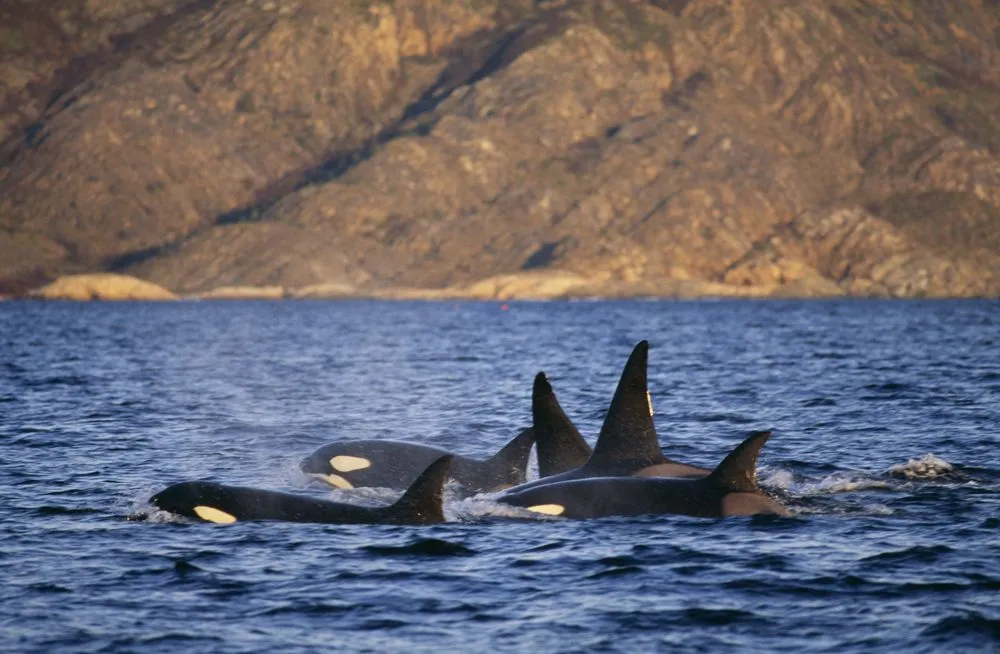
A hypothesis states that each family or matriline in a pod can be traced back to a single female ancestor.
Evidence of this was observed in resident orcas along the coastal waters of the Pacific Northwest. Four clans (multiple pods of orcas in the same region) of orcas observed in British Columbia and Washington State displayed variations in their vocalizations, clicks, and whistles.
What About Orcas Attacking Boats?
If orcas are so harmless to people, what about all those headlines of killer whales “attacking” yachts off Spain and Portugal? Since 2020, a small group of Iberian orcas has been making contact with sailing boats in the Strait of Gibraltar and along the Atlantic coast, usually by ramming and biting the rudder. Researchers have logged hundreds of these encounters, and a handful of boats have even been damaged badly enough to sink.
Scary as that sounds, the people on board have not been the target. In the entire run of interactions, no human has been killed or seriously hurt, and crews have been rescued each time a boat went down. Most scientists studying the population think this is not aggression at all, but a fad: a piece of playful, learned behavior, possibly started by a single young orca and copied by others, much like the cultural quirks we saw earlier. The encounters even peaked around 2023 and have since tapered off, which is exactly how a passing fad behaves. So once again, the “killer” reputation outpaces the reality.
A Final Word
While the threat orcas pose to humans is quite exaggerated, they are the undisputed killers of the oceans. Other predators, such as Great White Sharks, have been known to abandon their territories when pods of Orcas pass through. They don’t just abandon their post for a few days; they might not return for a whole year!
References (click to expand)
- Scientists Witness Orcas Kill Blue Whale for the First Time. Smithsonian
- Kaplan, M. (2007, December 14). Unique orca hunting technique documented. Nature. Springer Science and Business Media LLC.
- Orca | National Wildlife Federation. The National Wildlife Federation
- Southern Resident Killer Whale Research in the Pacific .... The National Oceanic and Atmospheric Administration
- Speciation in killer whales | KWAF10 Project | Results in brief. The Community Research and Development Information Service
- Understanding Orca Culture | Science| Smithsonian Magazine. Smithsonian
- Killer Whale. NOAA Fisheries
- How often do orcas attack humans? Live Science
- Orcas are ramming boats again, and scientists now think it’s a game. National Geographic