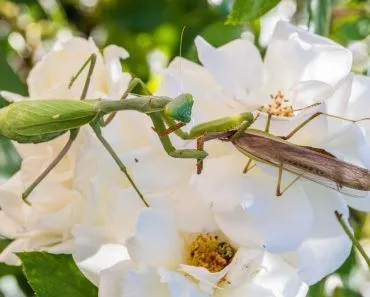
Mantises are classified as non-aggressive insects, and the vast majority of people who handle a mantis will never feel those mandible sink into their skin.
If you’ve ever done any gardening or forest-strolling, there’s a good chance that you’ve come across a praying mantis before. Hidden among the leaves and stems, these masters of disguise are some of the most striking and unique insects on the planet. Their unusual name is the result of their posture and the use of their front legs, but with their reputation as vicious hunters, some people who chance upon them in the wild end up saying a prayer of their own!
If creepy-crawly insects make you nervous, then the sight of a praying mantis slowly clambering up your shirt may be terrifying, leading you to ask the same question you ask every time you see a bug: do they bite??
The answer to that question is yes, but there is more to the story than that… as always.
Praying Mantis Facts
As mentioned above, these insects are masters of disguise, but they can actually be found all over the world, as there are many different species that have adapted to varying environments, from the densest jungles to the driest deserts.
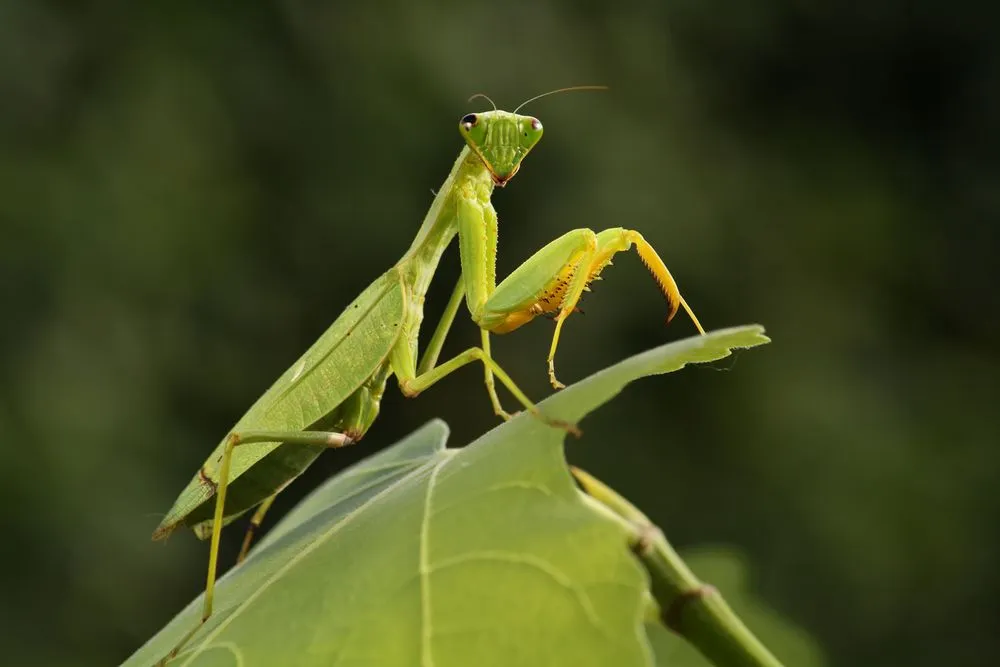
Typically ranging in color from brown or yellow to green, these insects are typically 2-6 inches in length, with three body parts (thorax, abdomen and head), like most insects.
These unique creatures have a rigid exoskeleton, six legs, two wings, two antennae, a triangle-shaped head and compound eyes that can contain about 10,000 smaller eyes (ommatidia)! One of the more interesting aspects of praying mantises is their ability to rotate their heads 180 degrees, something few other insects are capable of doing. This makes them extremely perceptive of their surroundings, thus adding to their hunting prowess.
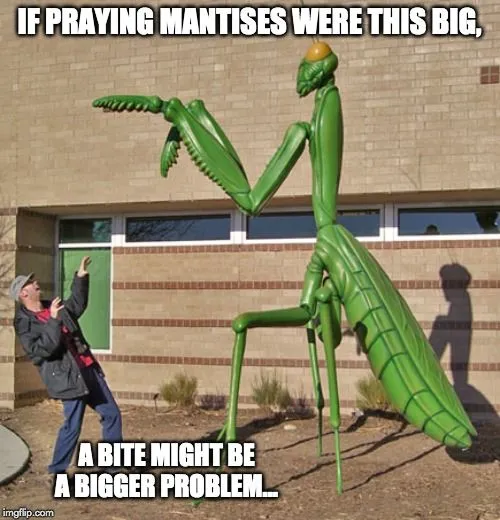
The front legs of a praying mantis are armed with barbed teeth, which can latch onto prey, making it difficult for them to escape as the praying mantis digs into dinner. Similar to a shark’s teeth being angled perfectly to lock on and hold prey, the front legs of a mantis are also deadly. They are called raptorial legs, and are used both for offense and defense. Their mouthparts also include a sharp mandible, so they can tear and rend the flesh of their prey, which includes other insects, small frogs and lizards, and even birds!
For such a small insect to have such an impressive dietary list of potential prey, it’s no wonder that people are worried about their bite. Furthermore, one of the most popular anecdotes about praying mantises is that the females will often bite off the head or legs of the males during the act of mating. While this typically only occurs in 30% of mating situations, it has given the praying mantis quite a fearsome reputation!
The Bite Of A Praying Mantis
Clearly, a praying mantis can bite its prey, but when it comes to humans, “common sense” seems to take over. In other words, a mantis is able to identify its typical food sources and preferred prey. Attacking something so much larger without provocation doesn’t make any logical sense, which is why bites are so rare. Mantises are therefore classified as non-aggressive insects, and the vast majority of people who handle a mantis will never feel those mandibles sink into their skin.
However, since they are such fierce hunters and fighters, a praying mantis is more than capable of fighting back and defending itself if provoked. In such a case, the raptorial legs and the sharp mouthparts will come into play, despite the massive size differential. This “provocation” could come in many forms, either unintentionally cramping their space in a bush or branch, or even extending a finger out to lure the insect onto your hand. In the former case, you might receive a small bite, but these insects aren’t venomous, and in most cases, their mouthparts won’t even be able to break your skin. In the latter case, the insect may latch onto your finger with its spiny front legs, but they won’t be able to “latch on” very effectively, and the small barbs cause a minimal amount of pain.
Even in the case of smaller pets, who may not have the good sense to avoid a moody praying mantis, a bite won’t do much harm, although it is possible that there could be some inflammation or indigestion if the leg-like barbs puncture your pet’s skin. In the case of a bite to yourself or a pet, you should simply wash the wound and sterilize it. There is no need to go to a doctor or make a big fuss, provided you have some modicum of a pain tolerance.
Do Praying Mantises Sting Or Have Venom?
This is probably the most common worry of all, so let’s clear it up: a praying mantis cannot sting you, because it simply has no stinger. Unlike bees, wasps and scorpions, mantises don’t carry a venom-injecting barb anywhere on their body. The University of Florida’s entomology program puts it plainly, noting that mantises “don’t carry venom or pose any health risks” to people. There is also no known venomous or poisonous species of mantis on record, so being “poisoned” by one (whether bitten by it or, oddly, eating one) is not something you need to lose sleep over.

So when people search for whether a mantis will “sting or bite,” the honest answer is that it can only do the latter, and even that is a last resort. A cornered mantis would much rather bluff than fight. It rears up, spreads its spiny front legs and wings, and may sway from side to side to look as large and intimidating as possible. That theatrical threat display is what most people mistake for aggression. If you keep crowding it after the warning, the worst it can muster is a defensive nip from its jaws or a grab with its barbed forelegs, with no venom involved at any stage. (If you’re fuzzy on why “venomous” and “poisonous” aren’t the same thing, we untangle that in our piece on the difference between venom and poison.)
Do Praying Mantises Have Teeth, And Does The Bite Hurt?
A mantis doesn’t have rows of teeth the way you or a dog does. What it has instead is a pair of mandibles, hardened jaws that open sideways and work like a tiny set of serrated shears to slice and grind up prey. A 2024 study in The Anatomical Record examined mantis mandibles under microscopy and found their cutting edges are reinforced and stiffened toward the tip, an adaptation that lets bigger, larger-prey species bite down hard without the jaw failing. Those edges are sharp enough to shred a cricket, which is why a forceful bite from a large mantis can occasionally feel like a sharp pinch rather than a gentle tickle.
That said, “does it hurt?” almost always has a reassuring answer. For the vast majority of encounters, a mantis bite lands somewhere between a pinch and a mosquito-bite level of discomfort, and the sensation fades within minutes. The mandibles of a typical garden mantis usually can’t break human skin at all, so most people feel a brief nip and nothing more. The barbed front legs are built to grip insect bodies, not human fingers, so when a mantis latches onto you they tend to scratch rather than puncture. A genuinely large species striking exposed skin (the back of the hand, a knuckle, the nose) can sometimes draw a pinprick of blood, but even then you’re looking at a minor, superficial nick, not a wound that needs stitches.
What Should You Do If A Praying Mantis Bites You?
Because a mantis has no venom and carries no disease that it transmits through a bite, the aftercare is refreshingly boring. Wash the spot with soap and warm water for a good 20 seconds, the same way you’d clean any small scrape. If the skin was actually broken, dab on a little antiseptic and cover it if you like; a cold compress will settle any mild swelling, and an over-the-counter painkiller is far more than you’ll usually need. There is no anti-venom to chase down and no reason to head to a clinic for a routine mantis nip.

The only thing worth watching for is the same thing you’d watch for after any minor cut: signs that the broken skin has become infected, such as spreading redness, warmth, swelling or pus over the following day or two. That’s a reaction to ordinary skin bacteria getting into a wound, not to anything the mantis injected, and it’s the one situation where a quick chat with a doctor makes sense. The smartest move, though, is to avoid the bite in the first place: don’t pin or squeeze the insect, let it walk onto an open palm rather than trapping it, and put it down gently if it starts flaring into a threat display. Treat it with a little respect and a mantis will almost always choose flight over a fight.
Do Some Praying Mantis Species Bite More Than Others?
People searching for whether a “green,” “brown,” “Carolina” or “Chinese” mantis bites are really asking the same thing in different costumes, because brown and green are usually just camouflage colors rather than separate species. What actually changes the picture is size. In North America you’re most likely to meet one of three: the native Carolina mantis (Stagmomantis carolina), which tops out around 5–6 cm (about 2–2.5 inches); the introduced European mantis (Mantis religiosa), roughly 7.5 cm (about 3 inches); and the much larger Chinese mantis (Tenodera sinensis), accidentally introduced near Philadelphia in 1896 and now the biggest mantis on the continent at up to about 11 cm (4.3 inches).

A bigger mantis means bigger jaws, so a hefty adult Chinese mantis is the one most able to deliver a nip you’d actually notice, and it’s no coincidence that the same species is large enough to occasionally take down small reptiles, amphibians and even the odd hummingbird. A small Carolina mantis or a delicate orchid mantis, by contrast, has jaws that are far less likely to make any impression on human skin at all. Across every species, though, the behavior is the same: none of them are out to bite you. The difference between a green garden mantis and a giant Chinese one isn’t aggression, it’s simply how much of a pinch you’d feel in the rare event that one does decide it’s had enough of being handled.
A Final Word
Considering that praying mantises are some of the most intriguing and oddly shaped insects around, there is a natural instinct in some people to interact with them, allowing them to go for a ride on your shirt, or even take them on as a pet! If you are deliberately engaging with a praying mantis on a regular basis, there is a decent chance of getting bitten once or twice, but generally speaking, these are non-aggressive insects who recognize and respect a much larger creature, and won’t attack unless they are provoked. In other words, stay out of their way, and they’ll stay out of yours!
References (click to expand)
- http://web.archive.org/web/20170126024833/https://wildlife.ohiodnr.gov/portals/wildlife/pdfs/wild%20ohio%20magazine%20archive/womagsummer2008.pdf
- Fukudome, M., & Yamawaki, Y. (2016, April 18). Behavioural interactions between the lizard Takydromus tachydromoides and the praying mantis Tenodera aridifolia suggest reciprocal predation between them. Journal of Ethology. Springer Science and Business Media LLC.
- Lelito, J. P., & Brown, W. D. (2008, October 8). Mate attraction by females in a sexually cannibalistic praying mantis. Behavioral Ecology and Sociobiology. Springer Science and Business Media LLC.
- Brannoch, S. K., Wieland, F., Rivera, J., Klass, K.-D., Béthoux, O., & Svenson, G. J. (2017, September 13). Manual of praying mantis morphology, nomenclature, and practices (Insecta, Mantodea). ZooKeys. Pensoft Publishers.
- What Is a Praying Mantis? Facts, Benefits and Environmental Role. Entomology and Nematology, University of Florida.
- Roze, M., Gorb, S. N., Zeimet, T., & Krings, W. (2024). Mandible composition and properties in two selected praying mantises (Insecta, Mantodea). The Anatomical Record. PubMed, NCBI.
- Chinese Mantis (Tenodera sinensis). Field Guide, Missouri Department of Conservation.
- Praying Mantids. Wisconsin Horticulture, Division of Extension, University of Wisconsin-Madison.