Table of Contents (click to expand)
The orchid mantis (Hymenopus coronatus) is a praying mantis whose pink-and-white body looks like a flower. It uses this floral disguise as a lure: pollinators such as bees mistake it for a blossom and become its prey. Research suggests it doesn’t copy one specific orchid, but resembles flowers in general.
What do criminals, celebrities and spies all have in common? They use disguises to evade the cops or the paparazzi or other fellow spies. You can add to that list the orchid mantis’ masterful deception.
The Orchid mantis, Hymenopus coronatus, is a kind of praying mantis. However, unlike the green Master Mantis in kung fu panda, and most other praying mantises, which are green or brown, an orchid mantis’ exoskeleton is colored with vibrant hues like those of the orchid flower.
A praying mantis has six legs: the front pair are spiky grabbers for seizing prey, while the middle and hind pairs are used for walking. On the orchid mantis, those four walking legs each carry a ‘femoral lobe’, a flap-like extension of the leg. When the mantis crouches and spreads its legs, the lobes fan out and look just like an orchid’s petals.
The disguise is convincing enough to fool people, too. In 1879, the Australian journalist James Hingsley returned from a trip to Indonesia with tales of a carnivorous orchid that snared and devoured insects whole. The “bloodthirsty flower” was, of course, an orchid mantis, an insect that naturalists had already formally described almost a century earlier. Hingsley simply hadn’t looked closely enough. Ever since, scientists have wondered why this praying mantis adopted a full-time floral garb.
Predatory Strategy
Praying mantises are carnivores. They prey on a variety of animals, from small birds, such as hummingbirds and sparrows, and lizards to other insects, including other praying mantises. Infamously, the female sometimes eats the male while they copulate, if she gets hungry enough, that is. Grim as it sounds, the meal isn’t entirely wasted: in at least one species, devouring the male means his body’s nutrients get invested into more eggs and offspring!
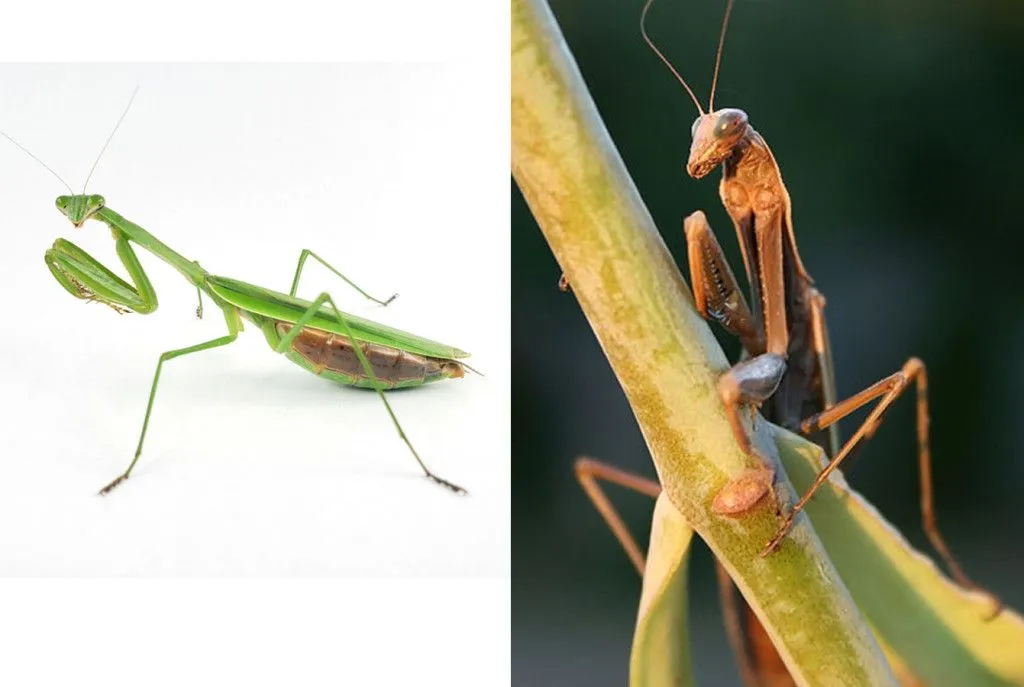
Most praying mantises are either green (like the Chinese mantis, Tenodera sinensis) or brown (like the large brown mantis, Archimantis latistyla), which helps them blend into the foliage as they hunt down their prey.
On the other hand, the orchid mantis’ appearance allows them to stand out, rather than blend in. The white with blushes of pink is promiscuous, tempting unsuspecting pollinators like bees with the hopes of bountiful pollen. Instead of taking home dinner, the pollinators end up as dinner themselves!
Remarkably, the mantis can do a flower’s job better than the flower itself. A landmark 2014 study by O’Hanlon and colleagues provided the first hard experimental evidence for this lure-and-ambush idea. Working with wild mantises and real flowers, the team found that isolated orchid mantises attracted pollinators at a rate even higher than the surrounding blooms, then captured those visitors as prey. To a bee’s eyes, the mantis’ color is essentially indistinguishable from a genuine flower.
Interestingly, orchids are innocent of deception. The bee orchid looks and smells like a female bee (Eucera spp). A male bee who’s looking for a mate will mistake the orchid for a female bee and try to mate with it. In this process, the orchid’s pollen will get deposited on the male, who will then get fooled by another orchid, where the male bee will deposit the pollen. The poor male bee gets no reward for his effort.
Now, despite the name, the evidence that orchid mantises actually copy orchids isn’t convincing. The same researchers found that the mantis doesn’t closely match any single orchid species. Nature offers plenty of pink and white blooms, so the insect appears to imitate a generalized flower rather than one particular model, a strategy biologists call generalized food deception.
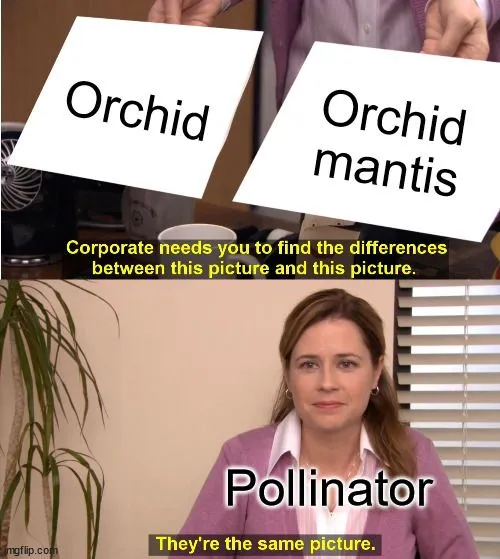
This may actually give the orchid mantis another advantage. Since it could look like any generic, bilaterally symmetrical flower, pollinators don’t associate the orchid mantis with danger. The orchid mantis can continue to allure and pollinators will continue to be allured. This is perhaps the most successful marketing strategy the natural world has to offer.
Because the mantis uses a flower-like look to draw in prey, scientists describe it as a case of aggressive mimicry, a predator disguising itself as something harmless or attractive to get close to its victims. Flower-like lures are common among plants, but luring animal prey this way is rare in the animal kingdom, which is why the orchid mantis is so often cited as a textbook example.
Hiding From Predatory Birds
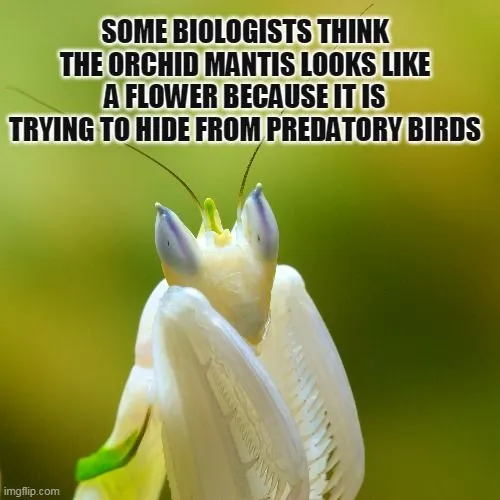
Some biologists think that the orchid mantis’ appearance could have evolved from a need to hide from avian predators, rather than to allure prey.
Some research suggests that the larger female’s patterns gave it a predatory edge, while the smaller male’s patterns evolved to hide from predators, such as birds. Others say that there isn’t enough evidence for the former claim.
If the orchid mantis was mimicking a flower as a predatory strategy, its success would depend on the flower. If you exposed bees to enough orchid mantises, they would eventually get the idea that they shouldn’t sit on any white and pink flowers. However, that hasn’t been shown experimentally.
A Final Word
Biologists are still debating over whether these mantids look like orchids or general flowers. Many argue that, based on technical grounds, the trait should merely be called food deception, as opposed to mimicry, if the orchid mantises aren’t actually mimicking a single orchid species. Furthermore, juvenile orchid mantises appear more flower-like than adults, which puts into question whether the insects are mimicking orchids.
Many other “flower mantises” use their floral traits to hide amongst flowers, in ambush, awaiting their unsuspecting victims. They resemble inflorescences not to attract, but rather to hide from their prey. Other insects, like flower crab spiders and assassin bugs, employ a similar strategy, using flowers to blend into their surroundings.
There may even be more to those petal-like leg lobes than disguise. A 2024 study in Current Biology found that the femoral lobes also act as tiny cambered airfoils, increasing the insect’s surface area by about a third and letting young orchid mantises glide gently to safety when they fall or leap from a perch. So a feature long assumed to be purely about looking like a flower may double as a built-in parachute.
One reason we’re still in the dark about orchid mantises is because they’re rarely spotted in the wild. Most of these studies were performed on lab-bred orchid mantises under laboratory conditions. And if there is one place that can’t capture the dynamism and mystery of nature, it is the controlled environment of a laboratory!
References (click to expand)
- O’Hanlon, J. C. (2016, February). Orchid mantis. Current Biology. Elsevier BV.
- O’Hanlon, J. C., Holwell, G. I., & Herberstein, M. E. (2014, February 1). Predatory pollinator deception: Does the orchid mantis resemble a model species?. Current Zoology. Oxford University Press (OUP).
- O’Hanlon, J. C., Holwell, G. I., & Herberstein, M. E. (2014, January). Pollinator Deception in the Orchid Mantis. The American Naturalist. University of Chicago Press.
- de Jager, M. L., & Anderson, B. (2019, May 11). When is resemblance mimicry?. (T. Houslay, Ed.), Functional Ecology. Wiley.
- Zhao, X., et al. (2024). Petal-shaped femoral lobes facilitate gliding in orchid mantises. Current Biology. Elsevier.
- Nyffeler, M., Maxwell, M. R., & Remsen, J. V. (2017). Bird Predation by Praying Mantises: A Global Perspective. The Wilson Journal of Ornithology.