Murder hornets, now officially called northern giant hornets (Vespa mandarinia), are the world's largest wasp. They rarely sting people and aren't usually deadly unless you provoke a nest or are allergic. Their real victims are honey bees, whose hives they can wipe out in hours. After turning up in Washington State, they were declared eradicated from the US in December 2024.
I’m sure that many of you remember the wave of alarming headlines about “murder hornets” (Vespa mandarinia Smith) a few years ago. Perhaps you came across those news articles but overlooked them and moved on to more pressing matters. Perhaps you glanced through them but didn’t fully understand what the fuss was about, or perhaps some of you have never even heard of these creatures to begin with.
A quick note before we dive in: in 2022, the Entomological Society of America gave this species a new official common name, the northern giant hornet, retiring “Asian giant hornet.” You will see both names below, since the old one is still what most people search for. Whatever you call it, we’re here to teach you a bit more about this unique and fearsome insect, and what happened after it showed up in North America.
What Are Asian Giant Hornets And What Do They Look Like?
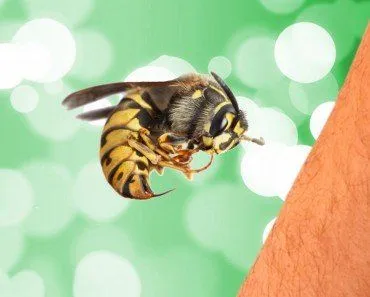
Hornets are basically wasps, and the northern giant hornet is the largest of all hornet species, in fact, the largest hornet on Earth. Adult workers usually grow to around 3.5 cm (1.4 in), while a queen can reach roughly 5 cm (2 in) long, with a wingspan close to 7.5 cm (3 in). They have a large orange-yellow head, with yellow and dark brown bands on the abdomen. Their distinctive coloration makes it easy to tell this species apart from other hornets.
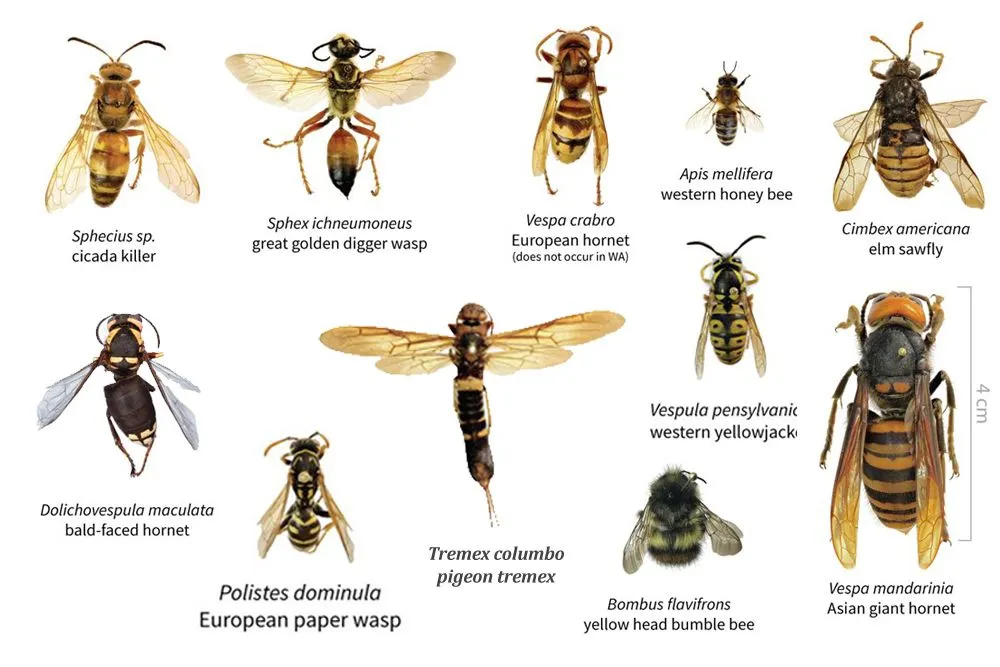
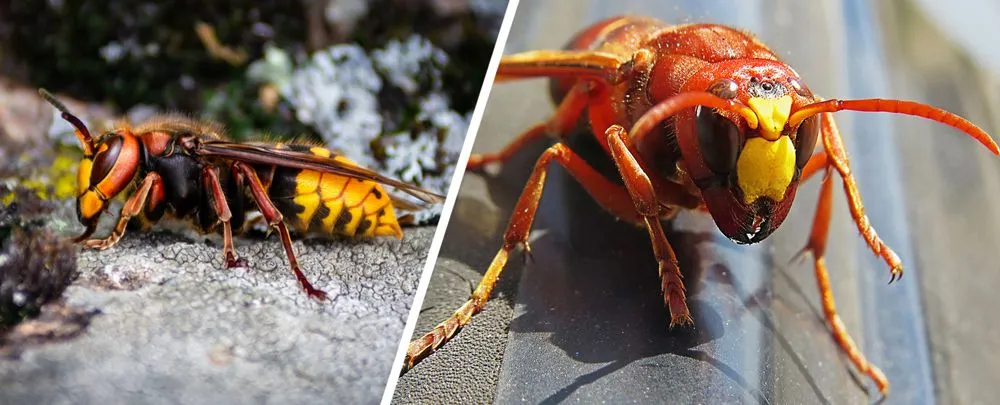
This hornet species has distinct cheeks or genae on either side of the head, which makes them look bigger than other hornet species. Their cheeks are one of their most important body parts, as the muscles required to move their large mandibles to subdue their prey are located there.
Northern giant hornets usually build their nests underground, often taking over abandoned rodent burrows or hollows at the base of rotting trees. That sets them apart from many familiar hornets and wasps, which build the papery aerial nests you see hanging from eaves and branches. Just like those species, however, they fiercely defend their homes.
Where Are Asian Giant Hornets Found?
Although this species prefers temperate regions, sightings have also been reported in subtropical areas. The northern part of its name refers to its home range: it is native to Asia, stretching from Russia, Japan and China to Nepal and Myanmar. Then, in December 2019, the hornet turned up far from home, near Blaine in Whatcom County, Washington State, the first confirmed sightings in the United States, along with detections just across the border in British Columbia, Canada.
How did it get there? Most hornets are workers, which can’t reproduce or start new colonies on their own, so a stray worker wouldn’t found a population. The leading explanation is that one or more fertilized queens hitchhiked across the Pacific in shipping or air cargo and established nests once they arrived.
The story has a happy ending for North American beekeepers. Washington and federal agencies trapped relentlessly and destroyed four nests in Whatcom County (one in 2020 and three in 2021). After three straight years with no confirmed detections, the Washington State Department of Agriculture and the USDA declared the northern giant hornet eradicated from the United States on December 18, 2024. For now, the murder hornet invasion of North America is over.
How Do Asian Giant Hornets Forage?
Northern giant hornets are known to forage up to 8 km (about 5 mi) from their nest for food. They feed mostly on other insects, such as bees and beetles. When it comes to foraging for resources, these hornets are quite competitive and aggressive. In fact, researchers have observed that this species gathers around tree sap and drives other insects away from it.
This hornet species hunts in interesting ways. Individual hornet workers have been observed attacking honey bees outside their beehives. These hornets kill the bee by decapitating it and then chewing on it until it becomes a paste. This paste is then transported back to the hornet’s nest so it can be fed to the larvae.
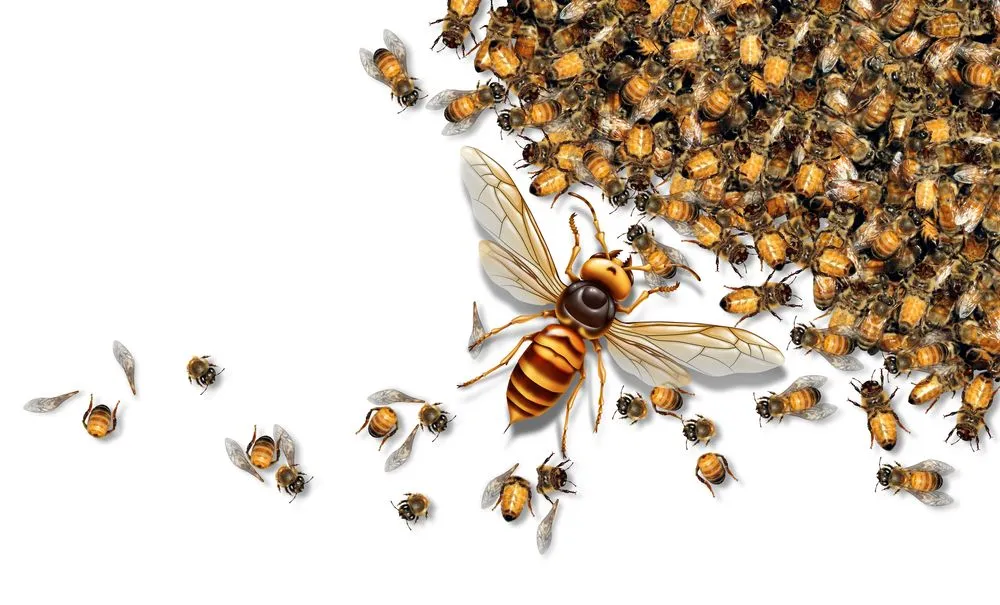
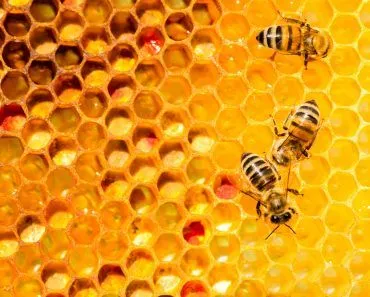
However, this is just one way by which these hornets predate. Their more famous mode of predation is commonly known as the slaughter phase. In this strategy, a group of hornets performs a coordinated attack on a colony of bees, wherein they rip apart the bees’ heads and continue their attack until there are no guard bees left to defend the nest. However, it doesn’t stop there. If any worker bees manage to survive until nightfall, the hornets come back the next day to finish the job, until the entire bee nest is completely emptied of adult occupants. Once all bees have been executed, the hornets enter the nest and recover the bee larvae, which they use to feed their own.
How And Why Did They Get The Nickname Murder Hornets?
These hornets were nicknamed murder hornets because of the brutal way they attack their prey, especially honey bees, to feed their young. Just 15 to 30 hornets are enough to wipe out, or “murder,” an entire colony of 30,000 to 50,000 honey bee workers, in a matter of hours.
It is still largely unclear who first dubbed this species the “murder hornet.” Some entomologists suspect the name came from Japan, where people describe the sting as so excruciating that it feels “like murder,” though no one has pinned down its exact origin.
It is unfortunate that people have dubbed this species with such a harsh and misleading name, when in reality, they aren’t a big threat to humans. What most people forget is that these wasps, like many other insects, are predators; just like other predators, they subdue their prey and bring it back to their nest for their young to feed. Hence, it is sad to see that this species, in particular, got stuck with the tag of “murder.”
Are Murder Hornets Deadly?
Northern giant hornets typically avoid humans and are not considered an imminent threat to us, unless and until we provoke them. Their sting is genuinely nasty (the venom is potent and the long stinger can pierce a beekeeper's suit), and people who are allergic can suffer a dangerous reaction, but for most healthy adults a single sting is painful rather than life-threatening. The real danger comes from a mass attack. In 2013, swarms of giant hornets killed 42 people and injured more than 1,600 in rural China, a reminder that there are exceptions to almost every rule.
This hornet species is, however, an incredibly huge threat to bees, which indirectly affects humanity in a major way. Bees are extremely vital for human beings, as most of the food we eat is pollinated by them. Without bees, we would not have many vegetables, fruits, or nuts on our table, meaning that we would be missing out on important vitamins that are required for our sustenance. Read more about the importance of bees here.
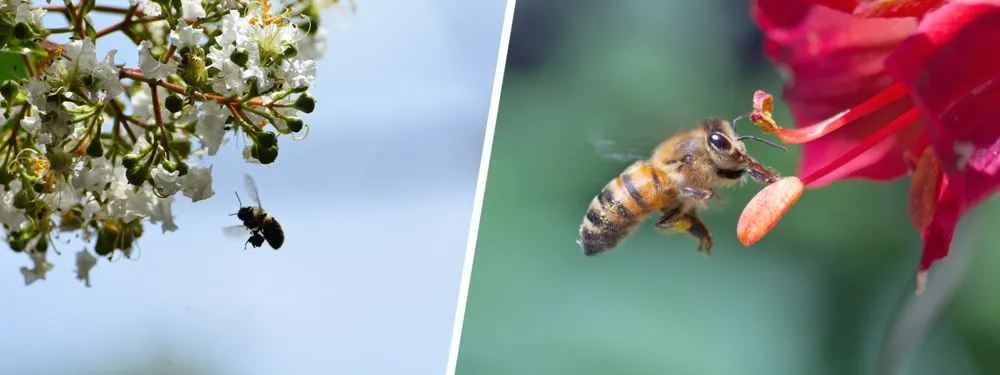
Giant hornets are a particularly dangerous threat to bees, as they can wipe out an entire colony within a few hours. Some bees, such as the Japanese honey bee, have evolved a remarkable way to protect their hives. When a scout hornet shows up, hundreds of bees pile onto it and form a tight “bee ball,” then vibrate their flight muscles. Inside the ball, the temperature climbs to about 46 °C (115 °F) while carbon dioxide builds up, a combination the bees can survive but the hornet cannot, and the intruder is effectively cooked alive within minutes. Unfortunately, not all bee species have this trick. European honey bees, the kind kept by most US beekeepers, have no such defense, so when a hornet targets their hive, they are easily overwhelmed.
I hope this article helped you get a better understanding of northern giant hornets, the insects the headlines called murder hornets. They are gone from the United States for now, but if you ever travel through their native range in Asia and spot one, don’t touch it and keep your distance. They may have been unfairly saddled with the title of “murderer,” but their stings can still cause a great deal of pain!
References (click to expand)
- Northern Giant Hornet, Vespa mandarinia. Entomology and Nematology Department, University of Florida
- Get to know the Asian giant hornet, or 'murder hornet'. Texas A&M University
- Takashi, A., Yoshiya, T., Hiromitsu, M., & Yasuko Y., K. (1991, January). Comparative study of the composition of hornet larval saliva, its effect on behaviour and role of trophallaxis. Comparative Biochemistry and Physiology Part C: Comparative Pharmacology. Elsevier BV.
- No, Americans Do Not Need to Panic About 'Murder Hornets'. Smithsonian
- Eight questions about the Asian Giant Hornet, aka the “Murder .... The Ohio State University
- ‘Northern Giant Hornet’ Adopted as Common Name for Vespa mandarinia. Entomological Society of America
- Hornets (northern giant hornet eradication). Washington State Department of Agriculture
- Sugahara, M., & Sakamoto, F. (2009). Heat and carbon dioxide generated by honeybees jointly act to kill hornets. Naturwissenschaften.