Table of Contents (click to expand)
Wildebeest migrate to follow the rains, which bring fresh, nutrient-rich grass and water. Each year more than a million loop between the Serengeti in Tanzania and the Masai Mara in Kenya, spending the wet months in the Serengeti (January to April) and the dry season in the Mara woodlands (July to October).
Every year, more than a million wildebeest embark on an epic journey of up to 1,000 km (around 600 miles), looping from the Serengeti in Tanzania to the Masai Mara in Kenya and back again. It is referred to as the Great Migration.
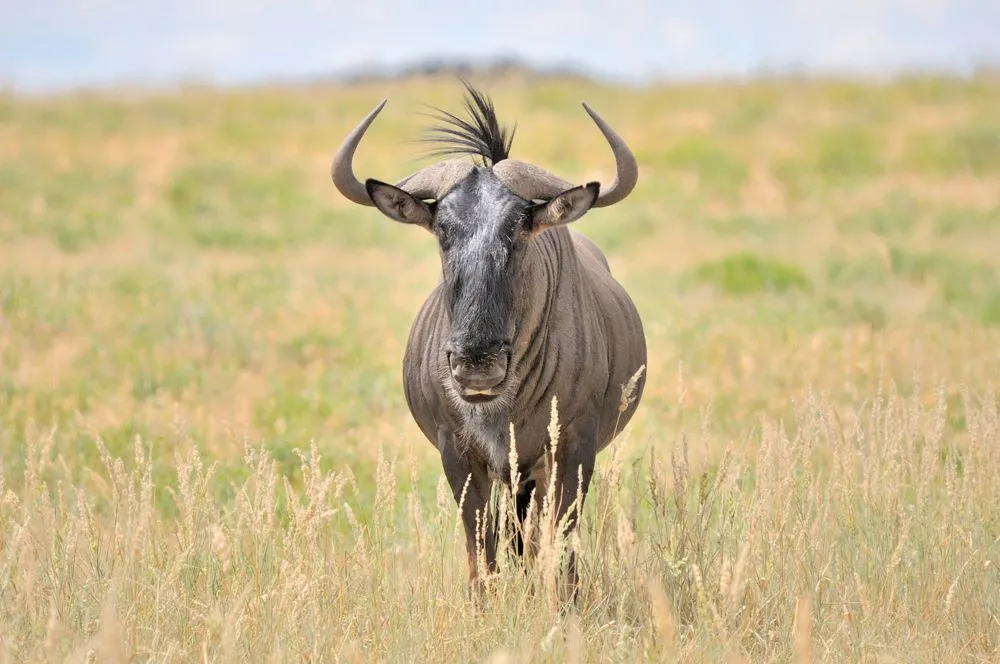
The journey is full of peril. At every turn, there are crocodiles hiding in the rivers, as well as hungry lionesses and hyenas stalking through the bush. However, others also share the rich African plains, including zebra, Grant’s gazelle, Thomson’s gazelle, elands and impalas, and accompany the wildebeest on their journey.
Why do the wildebeest brave such struggles, rather than remaining in one comfortable and familiar location?
The Great Wildebeest Migratory Route
Not all wildebeest migrate, but those that do are the blue wildebeest Connochaetes taurinus. They travel in a circle within the Serengeti and Masai Mara ecosystem, a migratory behavior that fossil and isotope evidence traces back to at least the Pleistocene.
The wildebeest are following the rains, which mean two things: food (mainly vegetation) and water.
The wildebeest and other migrating mammals follow the rains to the Serengeti in Tanzania, where they spend January to May, the peak rainy months.
Between January and March, the wildebeest inhabit the southeast of the Serengeti, around Ndutu. Here, the wildebeest give birth to their young.
All the pregnant females of the herd give birth during this short window of time. This synchrony in their birthing season is important for the young to survive. For the first few months, a young wildebeest calf is vulnerable to predators or getting left behind by the herd. By synchronizing the birthing period, the wildebeest calves remain secure within a large group. When it’s time to migrate once more, the calves are old enough to keep up with their herd.
They share this space with fellow migrators, primarily zebras and Thomson’s gazelles.
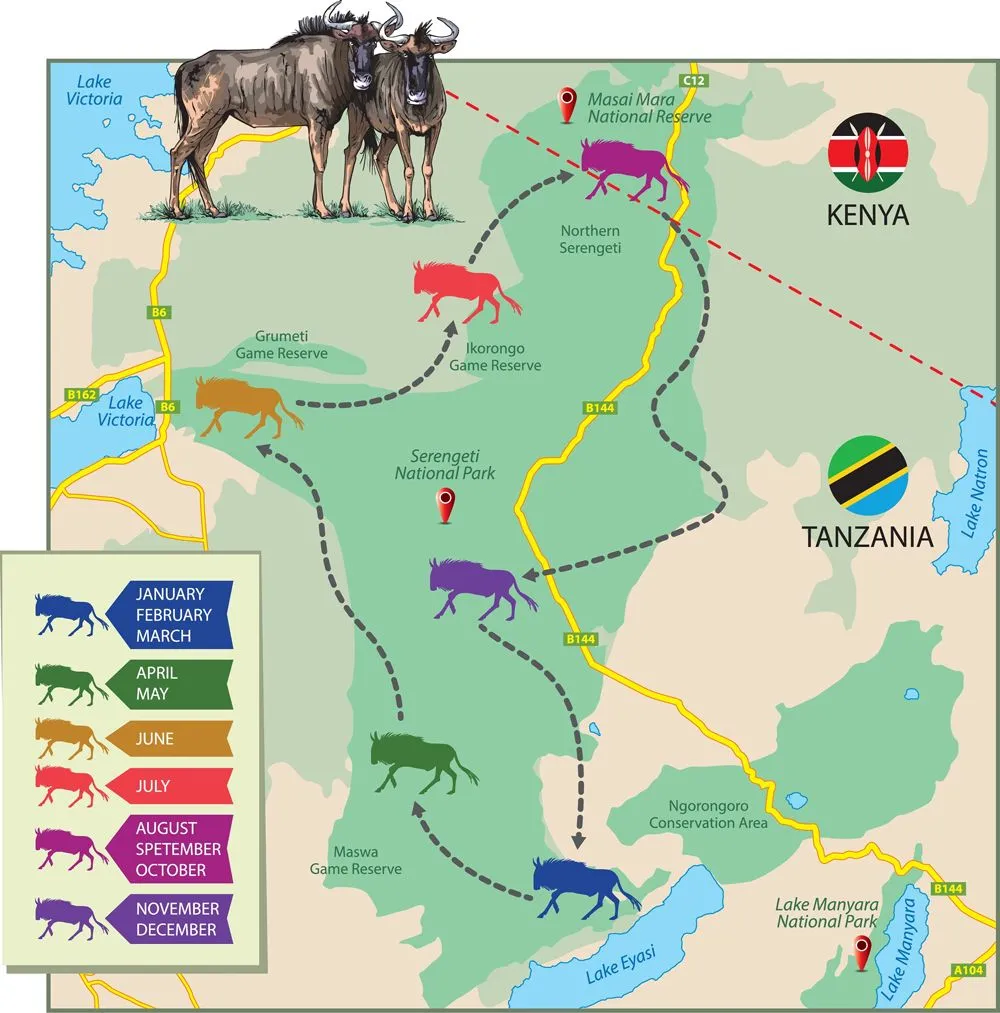
As the rains decrease and the herd diminishes across the Serengeti, in April, the wildebeest make their way north to the acacia woodlands of the Masai Mara in Kenya.
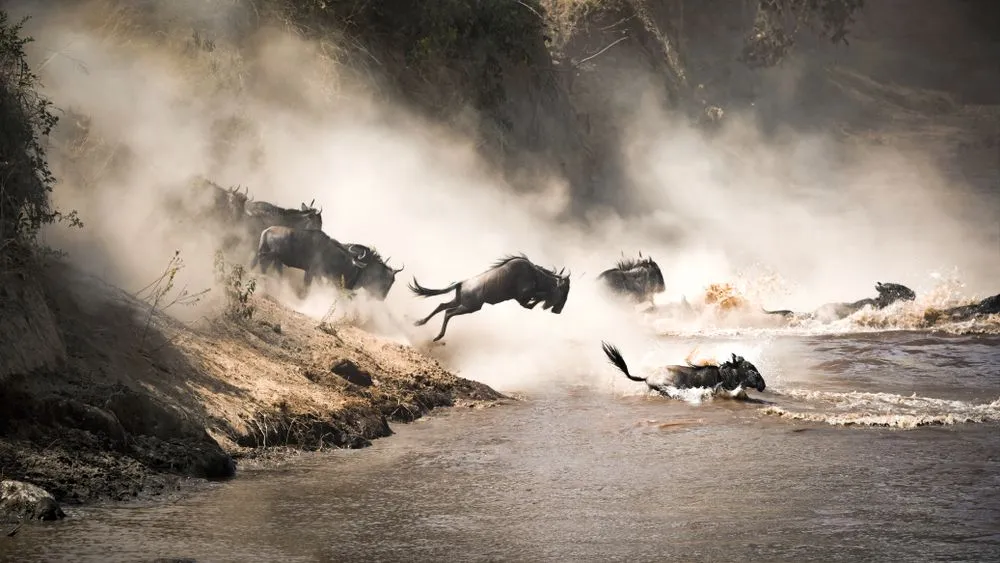
However, to reach the lush, green haven of the Mara, the wildebeest must cross rivers teeming with hungry crocodiles. The rush and the panic can also cause stampedes. When something like this happens, it’s every wildebeest for itself; even the calves must keep up or they will get left behind.
However, once they are past the rivers, the Masai Mara is their home until December, when the rains return to the Serengeti, and the cycle of migration begins once again.
How Does The Ecosystem Feed So Many Herbivores?
With so many herbivores munching on grass and leaves, how is it that there is enough for everyone? A team of researchers from Princeton University, the Smithsonian Institution in the USA, and the Mpala Research Centre in Kenya looked into this puzzle. Using DNA sequencing of plant material in animal dung, they found that grazing species each favor different suites of grasses, so they largely divide the menu rather than competing head-on for the same mouthfuls.
Why Do The Wildebeests Migrate?
Though researchers have extensively studied this magnificent migration, we still don’t fully understand why the animals undertake the arduous journey. The wildebeests follow the rainfall to the Serengeti, but throughout the year, the Masai Mara receives more rainfall. So why go through the journey every year?
Scientists have some guesses.
Some hypothesize that the Serengeti has higher forage capacity and better quality food. Others suggest that the wildebeest migrate to escape predators.
One research team suggested that the wildebeest migrated because of grass. Tree cover in the acacia woodlands doesn’t allow grasses to thrive, unlike the flat plains of the Serengeti. The grasses in the Serengeti are rich in nitrogen and phosphorus, two essential nutrients.
There are no conclusive answers, but nonetheless, the wildebeests charge ahead, as they have been doing for hundreds of thousands of years.
Why Is This Migration Important?
Wildebeest migrations keep the Serengeti healthy.
Wildebeests are a keystone species in the ecosystem. This means that they are a crucial species in an ecosystem, one that affects the ecosystem disproportionately compared to other species. In other words, taking the wildebeest out of this ecosystem or preventing them from migrating would have a massively negative impact on the ecosystem.
The wildebeest, along with their fellow migrators, graze the grass on the Serengeti plains, in effect trimming it to keep it healthy and curbing the buildup of dry fuel that feeds wildfires. Their dung and the trampling of millions of hooves enrich and aerate the soil, cycling nitrogen and phosphorus back into the ground.
They provide food for predators like lions, leopards, cheetahs, wild dogs, hyenas, vultures and numerous others that call this ecosystem home.
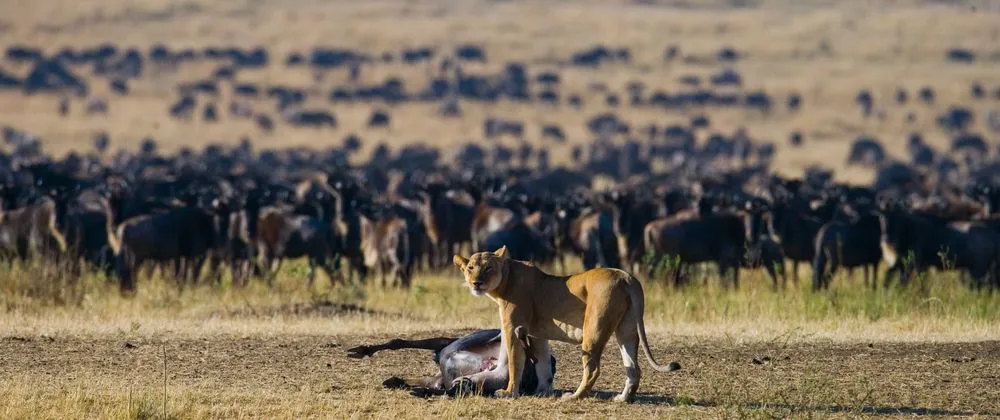
Their carcasses eventually feed the Earth, keeping the soil healthy.
A Final Word
Humans are encroaching on the lands of the Serengeti and Masai Mara. Roads, fences, the poorly planned expansion of agriculture and settlements, poaching, and increased competition for livestock are all threatening this annual migration.
The good news is that the population remains robust. A 2023 aerial census by the Tanzania Wildlife Research Institute counted roughly 1.37 million wildebeest in the Serengeti ecosystem, in line with the 1.3 million the herd has hovered around for decades. Even so, the share of animals that complete the full migration each year is shrinking.
Fortunately, efforts to protect the region are under way. Conservationists, ecologists and policy makers are trying to protect the reserves to ensure that one of the greatest migration events on the planet isn’t lost forever.
References (click to expand)
- Subalusky, A. L., Dutton, C. L., Rosi, E. J., & Post, D. M. (2017, June 19). Annual mass drownings of the Serengeti wildebeest migration influence nutrient cycling and storage in the Mara River. Proceedings of the National Academy of Sciences. Proceedings of the National Academy of Sciences.
- Eastern Africa: the Greater Serengeti grassland ecosystem in northern Tanzania | Ecoregions | WWF - www.worldwildlife.org
- Holdo, R. M., Holt, R. D., & Fryxell, J. M. (2009, April). Opposing Rainfall and Plant Nutritional Gradients Best Explain the Wildebeest Migration in the Serengeti. The American Naturalist. University of Chicago Press.
- Kartzinel, T. R., et al. (2015). DNA metabarcoding illuminates dietary niche partitioning by African large herbivores. Proceedings of the National Academy of Sciences.
- Aerial Point Survey of Wildebeest in the Greater Serengeti Ecosystem, Wet Season 2023. Tanzania Wildlife Research Institute (TAWIRI).