Horseshoe crabs are ancient marine arthropods often called “living fossils,” and despite their name they are not crabs at all but close relatives of spiders and scorpions (class Merostomata). Their copper-based blue blood contains amebocytes that clot around bacterial toxins, which is why humans harvest it to test the safety of vaccines and injectable drugs.
When someone says ‘prehistoric creatures,’ our minds tend to leap to dinosaurs that once roamed our planet millions of years ago. However, there are also species that were here long before dinosaurs appeared, and have survived to this day.
Take, for example, horseshoe crabs, which have been scuttling along beaches and cruising in and out of deep waters for over 450 million years. That is 100 million years before the dinosaurs even came onto the scene! What’s more amazing is that even though the dinosaurs were wiped out, horseshoe crabs have survived well into the 21st century.
What Are Horseshoe Crabs And Where Are They Found?
Horseshoe crabs are an ancient group of organisms commonly referred to as “living fossils”. They are marine arthropods and belong to the class Merostomata, which means that their legs are attached to their mouths.

Despite their name, horseshoe crabs are not actually crabs at all. Rather, they are closely related to trilobites, which first appeared around 521 million years ago, as well as spiders and scorpions.
There are four species of horseshoe crabs found on our planet.
While one species, the American horseshoe crab (Limulus polyphemus), is found in North and Central America, the other three, Tri-spine horseshoe crab (Tachypleus tridentatus), coastal horseshoe crab (Tachypleus gigas), and mangrove horseshoe crab (Carcinoscorpius rotundicauda) are found in the Indo-Pacific oceans.
We find these organisms across different habitats depending on what life stage they are in. For instance, eggs are laid on beaches, juveniles are found on sandy ocean floors, and adults can be found in the deeper ocean.
How Have They Survived For So Long?
Horseshoe crabs have survived three major extinction events that wiped out most species in the past. Three adaptations, in particular, have helped to keep these species safe. First, their ability to feed on any organic matter has ensured that these organisms can survive anywhere and on anything.
Second, these species can survive habitats with fluctuating salinity levels. Thus, when their environment changes (for example, because of climate change), these organisms can simply move to safety. Third, they can tolerate low-oxygen conditions that are normally fatal for marine organisms. On top of these, their blood gives them a built-in defense, coagulating around any bacteria they encounter.
What Do Horseshoe Crab Look Like?
Female horseshoe crabs grow up to 19 inches (48 cm) and are bigger than males, which only grow to about 15 inches (38 cm). Because of their clear differentiation in size, it is very easy to tell the sexes apart, particularly during the spawning season, when both sexes are present.
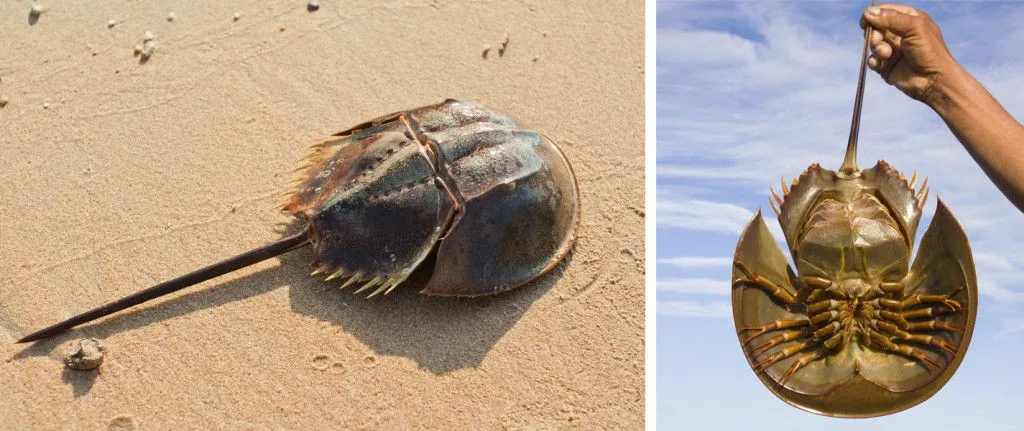
Overall, we can divide the body of horseshoe crabs into three sections: the prosoma (or head), opisthosoma (abdomen), and telson (tail).
Prosoma
We call these organisms ‘horseshoe crabs’ because of their heads, which are round and U-shaped and resemble a horseshoe.
The prosoma is the largest body part, and it contains the brain, mouth, heart, glands and nervous system, all of which are protected by a large plate.
The prosoma also protects the eyes… all ten of them!
Yes, you heard that right; horseshoe crabs have ten eyes. They use the two compound lateral eyes for finding mates, while the rest act as light receptors and help the organism determine changes in the moonlight, while also facilitating movement.
Opisthosoma
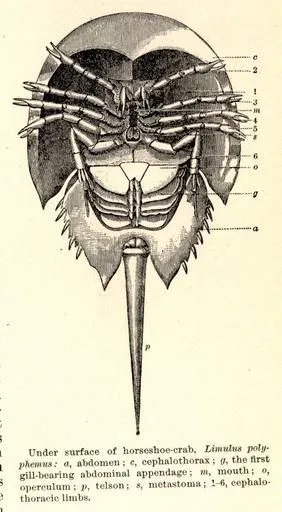
The abdomen is triangular in shape.
There are movable spines attached to the sides of the abdomen that help protect the organism. The underside of the opisthosoma is comprised of muscles and gills, which help with movement and breathing.
Horseshoe crabs can eat solid food because they have impressive digestive organs and systems. The mouth is found in the center of the body where the legs are attached. Because these organisms do not have teeth, they use their hind legs to crush food and then use the rest of their legs to bring the food to their mouth.
Telson
The tail or the telson is long and pointy. Unlike other animals, like the stingray, the tail of the horseshoe crab is not dangerous and is not used to sting other organisms. Rather, it helps the organism move in the water and also helps them flip over if they get stuck on their back.
Lifecycle Of Horseshoe Crab
The spawning season varies across regions, but usually peaks during May and June.
Adult horseshoe crabs patrol the shores waiting for females, and the females make their lives easier by announcing their arrival by emitting pheromones. By doing so, they ensure that there will be males on the shore to mate with. Males have special appendages that allow them to clasp on to females while mating.
Each female develops around 100,000 eggs during each spawning season and will lay 4-5 clutches of eggs containing 4,000 eggs each time she comes back to shore.
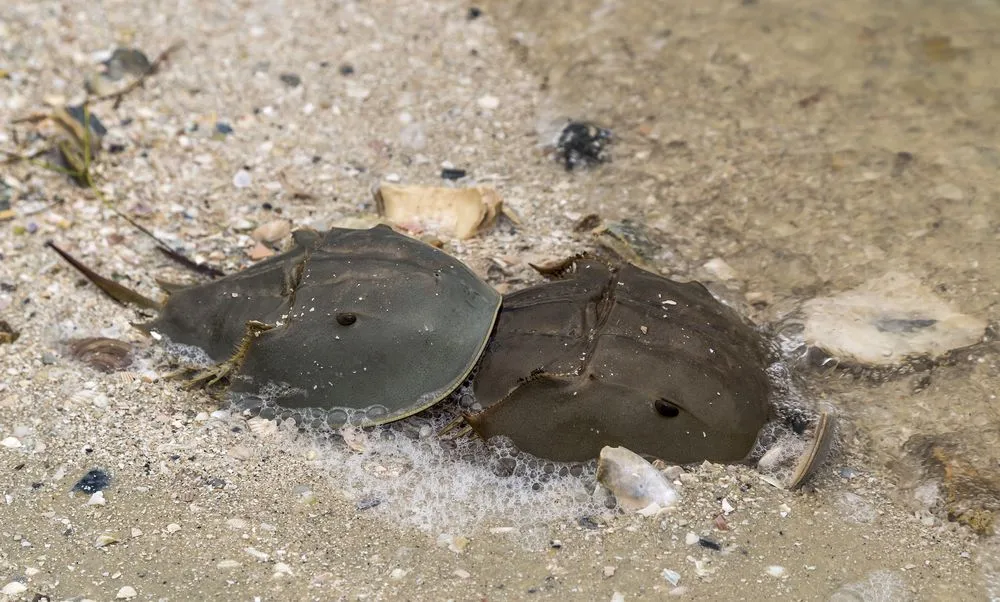
Horseshoe crabs live for over 20 years, during which they go through four stages of a life cycle– egg, larva, juvenile and adult. These species lay their eggs higher on the beach, where there is more warmth. The eggs hatch after two to four months, after which the larvae emerge. The larvae look a lot like miniature versions of adults, but without tails.
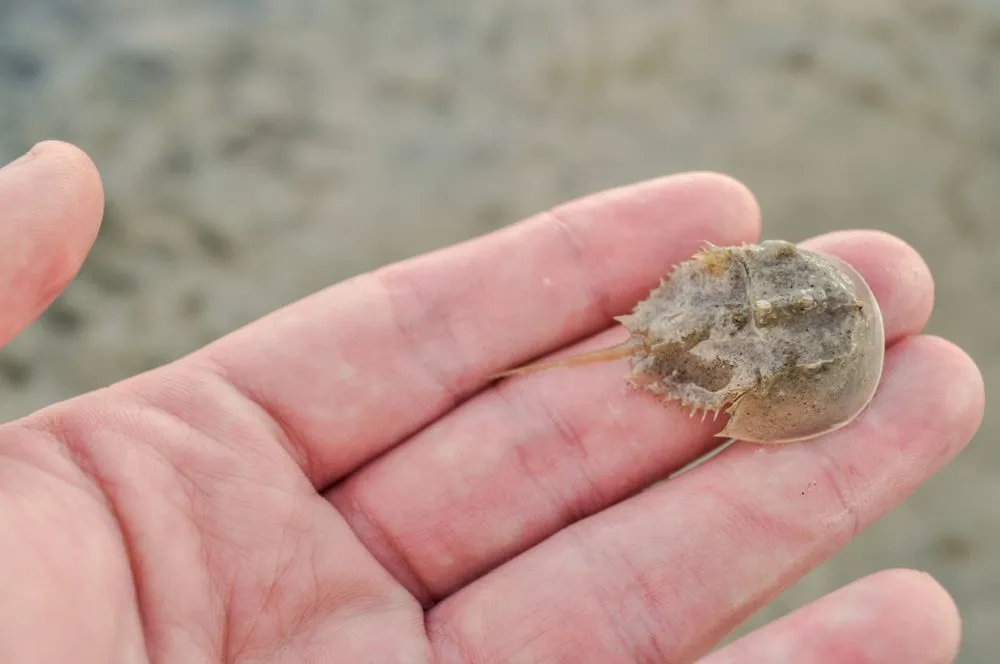
The larval crabs then swim into the ocean nearly a month later when there is a high tide. They rest on the sandy bottoms for a year. As they grow into juveniles, they move into deeper waters, where they feed on adult food. Juveniles molt over the next ten years, during which time they keep shedding small exoskeletons to make way for larger ones. They usually develop into full-grown adults after ten years.
Why Are Horseshoe Crab Important?
Horseshoe crabs play a vital role in our ecosystems.
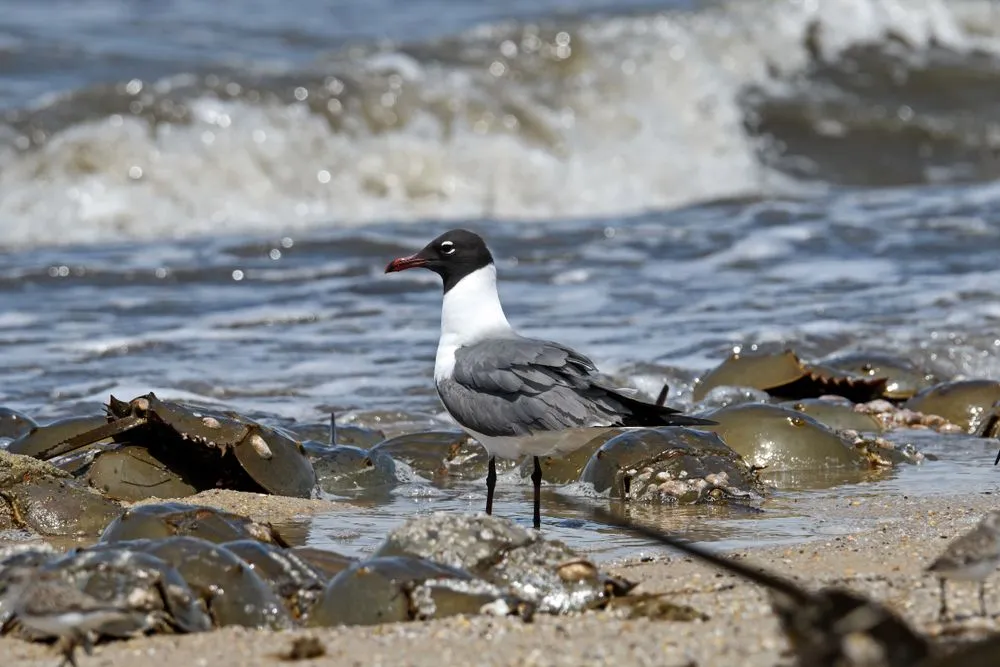
Their eggs are a source of food for many shorebirds, many of whom have actually adapted their migration patterns to coincide with the crab spawning season. Their shells also provide microhabitats for smaller species like snails and mussels, and their larvae are food sources for several fish and invertebrates, including crabs, fish and turtles.
They also share a symbiotic relationship with several organisms that live on and off of them. For instance, sponges attach themselves to their shells, flatworms lay their eggs on the gills and leg joints of horseshoe crabs, and snails lay their eggs on the backs of these crabs.
Despite the critical role they play, human activities threaten all four horseshoe crab species. The picture is sobering: the Tri-spine horseshoe crab is now listed as Endangered on the IUCN Red List, while the American horseshoe crab is classified as Vulnerable.
To begin with, their nesting sites are becoming more and more disturbed due to a higher human presence on beaches, forcing them to choose newer locations to nest.
The construction of seawalls or barriers to their nesting grounds further threaten these species.
Similarly, the removal of sand (for construction) or depositing sand (to replace erosion) alters their nesting sites. Sand brought in from other locations can affect their development, as they may vary in temperature and moisture content. In open waters, their populations are threatened by the use of mechanized trawlers and fishing nets, which can easily ensnare these creatures.
However, one of their most pronounced threats is the biomedical industry. If you’ve ever been vaccinated (like most of us) or have taken intravenous fluids, then you probably owe a huge thanks to horseshoe crabs!
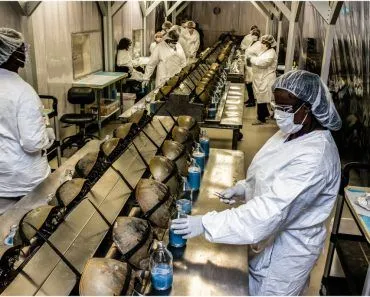
Most of us fall ill when we’re exposed to bacterial endotoxins, even more so when these toxins enter our bloodstream directly (e.g., when we receive injections). It is actually the blood of these horseshoe crab species that is used to check the safety of vaccines, injectable drugs, and medical equipment.
How is it done?
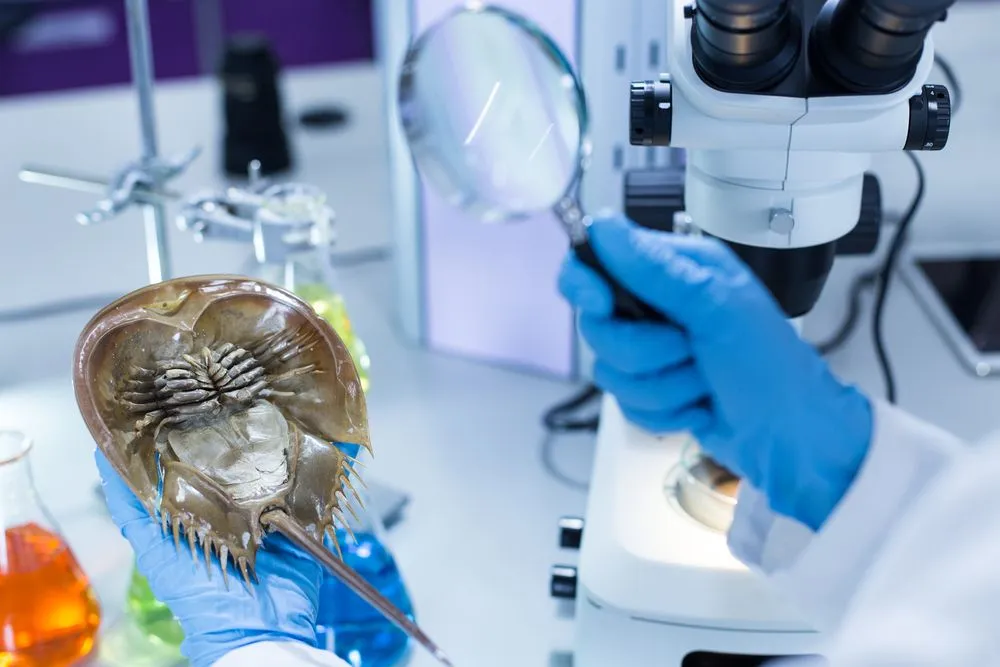
Well… horseshoe crabs have an open circulatory system, and their innate immunity is backed by amebocytes (their blood cells). When bacteria or other foreign substances enter the crab's bloodstream, these cells trigger a cascade of clotting proteins that gels around the intruder and walls it off, stopping it from spreading. Scientists realized they could harness this reaction: by harvesting amebocytes and bursting them open, they produce a reagent called Limulus Amebocyte Lysate (or LAL). Add a tiny amount of LAL to a drug or fluid, and if bacterial endotoxins are present, the mixture clots, revealing contamination.
Today, the LAL test is used to check the quality of vaccines, injectable drugs, and medical devices. As a result, horseshoe crabs are commercially harvested across the United States, with more than a million American horseshoe crabs bled each year. Even though most are returned to the water, an estimated 15–30% die in the process, which has contributed to declining populations.
There is, however, some good news. Researchers have developed a synthetic, animal-free substitute called recombinant Factor C (rFC) that copies the first endotoxin-sensing step of the crab's clotting cascade. In July 2024, the U.S. Pharmacopeia formally adopted a new chapter (<86>) endorsing rFC and related recombinant reagents for endotoxin testing, a change that could eventually spare hundreds of thousands of crabs every year.
After reading about these species, I’m sure you would agree that horseshoe crabs are quite amazing, and deserve our respect and protection!
References (click to expand)
- Horseshoe crabs are one of nature's great survivors. Phys.org.
- Horseshoe Crab.
- Horseshoe Crab.
- International Horseshoe Crab Day: a celebration of a flagship species. IUCN.
- http://web.archive.org/web/20220120195048/http://www.fws.gov/northeast/pdf/horseshoe.fs.pdf
- Spawning Habitat.
- Facts About Horseshoe Crabs and FAQ.
- Natural History: Spawning Behavior.
- Horseshoe crab: Conservation status. Encyclopaedia Britannica.
- Krisfalusi-Gannon, J., Ali, W., Dellinger, K., Robertson, L., Brady, T. E., Goddard, M. K. M., … Dellinger, A. L. (2018, June 5). The Role of Horseshoe Crabs in the Biomedical Industry and Recent Trends Impacting Species Sustainability. Frontiers in Marine Science. Frontiers Media SA.
- USP provides guidelines for Recombinant Factor C (rFC), a non-animal-derived reagent. U.S. Pharmacopeia.