The world’s largest butterfly is Queen Alexandra’s Birdwing (Ornithoptera alexandrae). Females are bigger than males, with wingspans up to about 28-30 cm (nearly a foot). The species is endangered and found only in Papua New Guinea, mainly on the Popondetta Plain.
Meet The Largest Butterfly In The World
When we think of butterflies, our mind often flits to the tiny common blue butterflies (3.5 cm in size) or the small copper butterflies (3.2 cm) fluttering around our gardens. Those living in tropical countries may think of the medium-sized monarch butterflies (9.5-10 cm) or pale-yellow swallowtails (8 -9 cm) that are so common in our environments.
Male Queen Alexandra’s Birdwings have a wingspan of 14-20 cm, whereas females have a much larger wingspan, between 18.7 and 30 cm. Both sexes have a yellow abdomen, but vary in their body colors. Females have a dark brown body with cream markings on the upper surface, while males have a black body and a yellow upper surface, in addition to pale green and blue markings.
Life Cycle
Queen Alexandra’s Birdwing has four life stages, which last between 5 and 7 months. The butterfly begins its life as an egg. Adult females lay large-sized eggs, around 0.41 cm in diameter. They usually lay their eggs on pipevine plants (Pararistolochia schlechteri), as the leaves of this plant act as a food source for the newly hatched caterpillars and, helpfully, load them with aristolochic acids that make them toxic to most predators.
In the next life stage, baby caterpillars hatch from the eggs. These tiny new life forms have a black body with long, fleshy and red tentacles all over. They also have a cream-colored spot in the middle of their black bodies. Once they hatch, they immediately begin feasting on the pipevine leaves where they were laid, and continue to do so until the end of this stage. As they grow, the caterpillars lose their old skin (molt) several times and slowly transform into a pupa.
All the magic happens in the pupa (or cocoon) stage. During this part of the cycle, the caterpillar’s body transforms into a butterfly. However, during this stage of the life cycle, the caterpillar does not eat or drink until it fully transforms into its final form.
During the last stage, the caterpillar emerges as an adult. Here, the butterfly feeds mainly on nectar, but does not grow any further. Its sole duty during this stage is to mate and reproduce so that its population can grow. Adult males usually have a short life span of around three months, while females live up to twice that long.
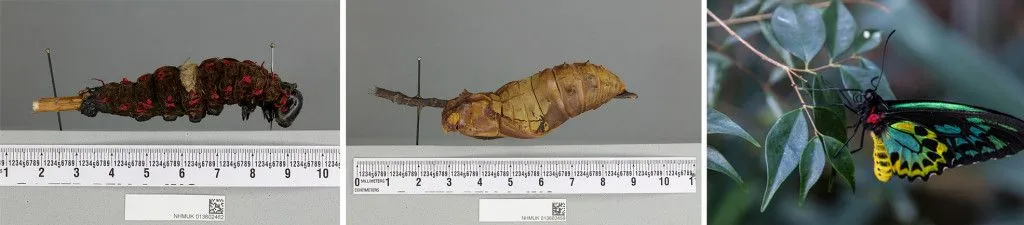
Their life cycle may seem pretty simple, but in every stage, the Queen Alexandra’s Birdwing faces danger. Right from the time they are eggs, ants are prone to attack them. Their larvae are further preyed upon by lizards, toads, and birds, and they are also susceptible to fungal infections. Once they reach the adult stage, they face little predation, but can be caught in spider webs or eaten by arboreal mammals.
What’s The Second-Largest Butterfly, And Isn’t The Atlas Moth Bigger?
If Queen Alexandra’s Birdwing takes the crown, who comes second? That title belongs to a close relative, the Goliath birdwing (Ornithoptera goliath), another giant from the rainforests of New Guinea. Females reach a wingspan of up to 28 cm (about 11 inches) and males up to 17 cm (about 6.7 inches), so it overlaps the smaller Queen Alexandra females but never quite matches the largest ones. Outside the birdwings, the biggest butterfly in Africa is the African giant swallowtail (Papilio antimachus), with a wingspan of roughly 18-23 cm (7-9 inches) and long, narrow, orange-brown wings.

Here’s where many people get tripped up. You may have read that the atlas moth (Attacus atlas) is bigger, and by one measure it is. The atlas moth’s wingspan can stretch to about 24-27 cm, and its broad wings carry one of the largest total wing areas of any insect. So why doesn’t it win our title? Because it is a moth, not a butterfly. The two belong to the same order (Lepidoptera), but they are different groups, and "largest butterfly" and "largest moth" are simply two separate records.
How do you tell them apart? The easiest tell is the antennae: butterflies have thin antennae that end in tiny clubs or knobs, while moths usually have feathery, comb-like antennae. Butterflies also tend to be active during the day and fold their wings up over their backs at rest, whereas most moths are night-fliers that hold their wings spread flat. So the atlas moth is the heavyweight of the moths, but Queen Alexandra’s Birdwing remains, unbeaten, the largest butterfly on Earth.
Just How Rare Is Queen Alexandra’s Birdwing? How Many Are Left?
Nobody can give you an exact headcount, and that uncertainty is part of the story. Queen Alexandra’s Birdwing survives in just two small, separate populations near Popondetta in Oro Province, Papua New Guinea: a lowland group on the Popondetta plains and a highland group on the harder-to-reach Managalas Plateau. Genetic work published in 2023 estimated that the butterfly actually occupies only about 128-140 square kilometers of suitable habitat (roughly 50-54 square miles), a sliver of forest for the world’s biggest butterfly to cling to.

The few field surveys that exist tell a worrying story. In 1992, researchers counted around 150 of the butterflies over a 10-day period. By the mid-2000s the numbers had slipped further, and in 2008 conservation biologist Tyler Hicks spent three full months searching and found only 21 adults, fewer than one butterfly per acre. That genetic study also found the species has remarkably low genetic diversity (a heterozygosity of about 0.08%, the lowest among the butterflies it compared), a sign of a population that has been small for a very long time; the same study estimated that its two populations split apart roughly 10,000 years ago.
The IUCN still lists the species as Endangered, and because the rainforest canopy makes the adults so hard to spot, scientists cannot even say for certain whether the population is stable, falling, or slowly recovering. What is clear is that there are only a handful left, which makes Queen Alexandra’s Birdwing not just the largest butterfly in the world, but also one of the rarest. That rarity is exactly what fuels the threats we turn to next.
Threats To The Species
The Queen Alexandra’s Birdwing has been legally protected in Papua New Guinea since the late 1960s. It is also listed in Appendix I of CITES (1987). However, this species is under severe threat. The biggest concerns facing Queen Alexandra’s Birdwing is that it is severely restricted to one region, Papua New Guinea. Even there, it faces many threats, both natural and human-induced.

The eruption of the volcanic Mt. Lamington in 1951 destroyed 150 sq. km of the species’ habitat and left its populations severely fragmented. The remaining habitats are being transformed rapidly for commercial logging and expanding crop plantations. Palm oil plantations, in particular, are rapidly altering landscapes in Papua New Guinea. Today, palm oil grows across thousands of acres right in the middle of the butterfly’s core habitat range, eradicating any chance of its extended survival. The species is also illegally captured and traded, particularly by collectors. People from all parts of the world pay handsome sums to own a specimen of the world’s largest butterfly, without even realizing that there are only a handful of them left in the world.
Even though most of us will never see this species in the wild, we can help in its conservation. The most important way we can do so is by boycotting items that contain palm oil. It might seem like a small thing, but it’s truly amazing how a simple change in our food habits could potentially help save an entire species!
References (click to expand)
- Butterflies with bullet holes | Natural History Museum. The Natural History Museum in London
- IUCN Red List of Threatened Species: Ornithoptera alexandrae - www.iucnredlist.org
- Queen Alexandra's Birdwing: Ornithoptera alexandrae - SBBT. sbbt.org.uk
- Mitchell, D. D. C. (2016). Queen Alexandra’s Birdwing Butterfly Ornithoptera alexandrae (Rothschild, 1907): a review and conservation proposals. Southdene
- Reboud, E. L., et al. (2023). Genomics, Population Divergence, and Historical Demography of the World’s Largest and Endangered Butterfly, The Queen Alexandra’s Birdwing. Genome Biology and Evolution.
- The Mysterious Fate of the World’s Largest Butterfly - Undark Magazine
- Spotlight: the atlas moth - Natural History Museum, London
- Ornithoptera goliath (Goliath birdwing) - Wikipedia
- Papilio antimachus (African giant swallowtail) - Wikipedia