Table of Contents (click to expand)
Flamingos are pink because of what they eat. Their diet of algae and brine shrimp is packed with carotenoid pigments (mainly canthaxanthin and beta-carotene), which the liver processes and deposits into growing feathers. Chicks actually hatch gray, and only develop their adult pink over two to three years of feeding on this carotenoid-rich diet.
The experience of seeing a flock of flamingos is not something you are likely to forget. After all, there are few birds more recognizable on the planet, with their unusually long legs, odd jerking movements, strange hooked bill, and of course their brilliant color!
Yes, pink is often the first sensorial flash when the word “flamingo” is mentioned, but this obvious display of color confuses many people. There are few animals that are naturally pink, and brightly colored creatures are often a signal that they are poisonous or dangerous, two words that don’t describe these gangly birds.
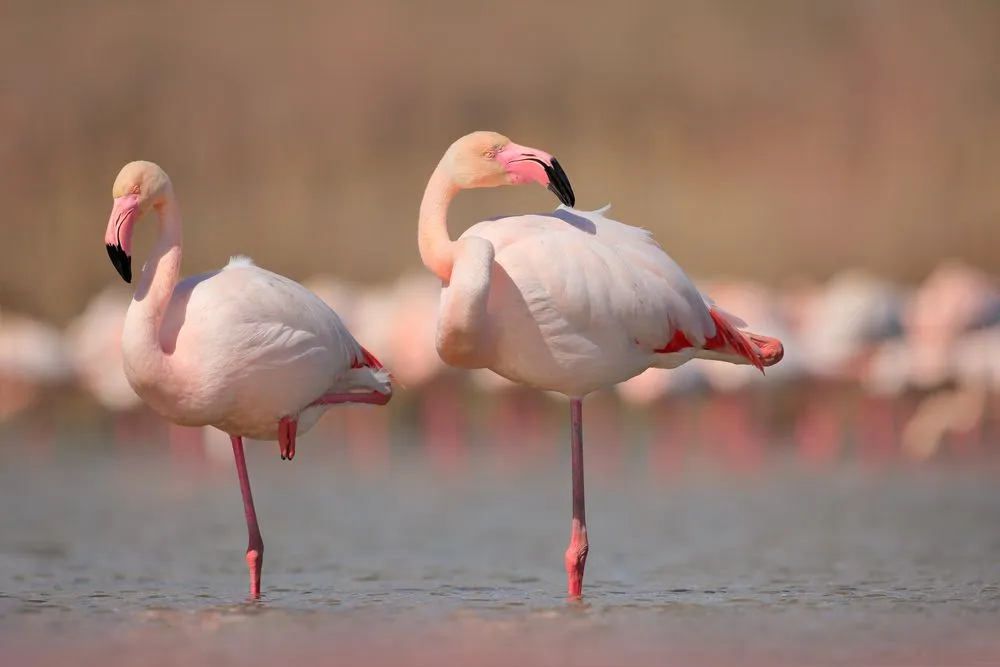
So, if we are to believe that everything in nature happens for a reason, or at least can be explained in some way, why are flamingos around the world such bright and outstanding colors?
What Do Flamingos Eat?
The common phrase that “you are what you eat” is certainly true for everyone’s favorite bright pink bird. Standing proudly in the sunlight in large flocks, a “pat” of flamingos is quite glorious to behold, but their unique coloring has a very simply explanation. All six flamingo species, from the salt flats of Curaçao to the mangrove forests of Mexico and the salt lagoons of the Camargue in southern France, get most of their nutrition from different species of algae, along with small crustaceans, shrimp and mollusks.
Both red and blue-green species of algae contain certain carotenoids, primarily canthaxanthin, a deep orange-red pigment, as well as beta-carotene, the orange-yellow pigment that also colors carrots and pumpkins. The other small creatures that flamingos consume on a daily basis (notably brine shrimp like Artemia) carry the same carotenoids, resulting in a distinctly colorful diet.
When these foods are eaten, the pigments are extracted by the bird’s digestive system, the liver converts much of the beta-carotene into canthaxanthin, and the pigments are stored in fat. From there, they are deposited into newly growing feathers, eventually leading to a pink-feathered adult! Yes, that’s correct, when flamingo chicks hatch, they are covered in dull gray down. Even the “crop milk” that flamingo parents regurgitate to feed their young is bright red from these very same carotenoids. The chicks don’t reach their full adult pink for roughly two to three years, as carotenoid-rich food slowly replaces the gray with feathers in every shade from pale salmon to deep crimson.
Depending on the variety and concentration of their diet, different species of flamingo can look dramatically different. The American flamingo (Phoenicopterus ruber) of the Caribbean feeds on carotenoid-loaded brine shrimp and is the deepest-colored of all flamingos, often shading into a dark orange or crimson. The greater flamingo (Phoenicopterus roseus), found from southern Europe across to South Asia, draws on a more carotenoid-thin diet and typically appears as little more than a pale pink with a brighter pink-and-red flush on the wings. There is also a clever twist: greater flamingos rub their pink uropygial-gland secretions onto their plumage as a kind of natural makeup during the breeding season, deepening their color to look more attractive to potential mates.
A dearth of pigment-containing foods will eventually cause the flamingo’s plumage to fade to white. In fact, flamingos kept in captivity (zoos) and fed unnatural diets began to lose their signature coloring until the dietary connection to their vibrant feathers was better understood.
Other Color-Changing Animals
Flamingos may be the most widely recognized species that changes color based on its selective diet, but they are far from the only animal whose appearance is affected by its palate.
Salmon
Similar to flamingos, salmon also eat small crustaceans as a staple part of their diet. Krill and shrimp are loaded with astaxanthin, a closely related carotenoid that the algae at the base of the ocean food chain produce, which is what gives wild salmon flesh its distinctive rich orange-pink color. Farmed salmon, raised on grain-based feed, would actually be a drab gray without astaxanthin added back into their diet.
Canaries
These common birds are typically yellow in color, but their color is quite variable, depending on the different pigments in their food. If their diet is supplemented with cayenne, paprika, or turmeric, it can begin to change their bright yellow color into darker orange hues!
Cedar Waxwings
Again, based on changes in a cedar waxwing’s diet, the bright yellow tip of their tail can be transformed into a vibrant orange. Ornithologists traced this to the spread of invasive Tartarian and Morrow’s honeysuckles across North America: when juvenile waxwings eat those berries during molt, a red carotenoid called rhodoxanthin mixes with their usual yellow pigments and the tail tip grows in orange instead of yellow. Tail color is a signal during courtship, so a diet-driven change in the “wrong” direction can confuse mate choice.
Humans
Yes, human beings are susceptible to changing colors based on the content of our diets. If you happen to love carrots, pumpkins, mangoes, sweet potatoes and tomatoes, don’t be surprised if your skin takes on a slightly more orange hue, especially on the palms and the soles of your feet. The condition even has a name: carotenemia. Those foods are high in carotenoids, such as beta-carotene, and the extra pigment ends up deposited in the fatty layer just under your skin. It is harmless and reversible the moment you cut back.
A Final Word
Next time you’re driving past a salt marsh in the Yucatan Peninsula and you see a flash of pink from the corner of your eye, don’t be surprised if it’s a flock of flamingos putzing around in a nearby pool. Their unusual color has a simple explanation, but it doesn’t make them any less impressive or inspiring to admire!
References (click to expand)
- Fox, D. L. (1962). Metabolic fractionation, storage and display of carotenoid pigments by flamingoes. Comparative Biochemistry and Physiology. Elsevier BV.
- Amat, J. A., Rendón, M. A., Garrido-Fernández, J., Garrido, A., Rendón-Martos, M., & Pérez-Gálvez, A. (2011). Greater Flamingos Phoenicopterus roseus use uropygial secretions as make-up. Behavioral Ecology and Sociobiology.
- The color of greater flamingo feathers fades when no cosmetics are applied. Ecology and Evolution. PMC.
- Why Are Flamingos Pink? And Other Flamingo Facts. Smithsonian’s National Zoo and Conservation Biology Institute.
- Why Are Flamingos Pink? Encyclopaedia Britannica.
- Plumages, Molts, and Structure: Greater Flamingo. Birds of the World, Cornell Lab of Ornithology.
- Mulvihill, R. S., Parkes, K. C., Leberman, R. C., & Wood, D. S. (1992). Evidence supporting a dietary basis for orange-tipped rectrices in the Cedar Waxwing. Journal of Field Ornithology.