Table of Contents (click to expand)
Red algae thrive deep in the ocean, where only blue and green light reach. They appear red because they carry pigments called phycoerythrins, which absorb the green and blue-green light that penetrates deep water and reflect red light back. These pigments let red algae photosynthesize far below the depths where ordinary green algae can survive.
It is a truth universally acknowledged that all plants are green… right?
After all, they need chlorophyll to help them perform photosynthesis to make that delectable and essential sugar. Chlorophyll pigment is green, so all the plants in the world have to be green…
Actually, that’s not the case!
Some of the very first photosynthetic life on Earth evolved in the ocean. These were the cyanobacteria, often called blue-green algae (though they are technically bacteria, not true plants). It was in the ocean that algae became so diverse and evolved in so many different directions: brown and red and purple and even fluorescent!
The question is, how do they photosynthesize if they’re red? What makes them red or brown?
What Gives Objects Their Color?
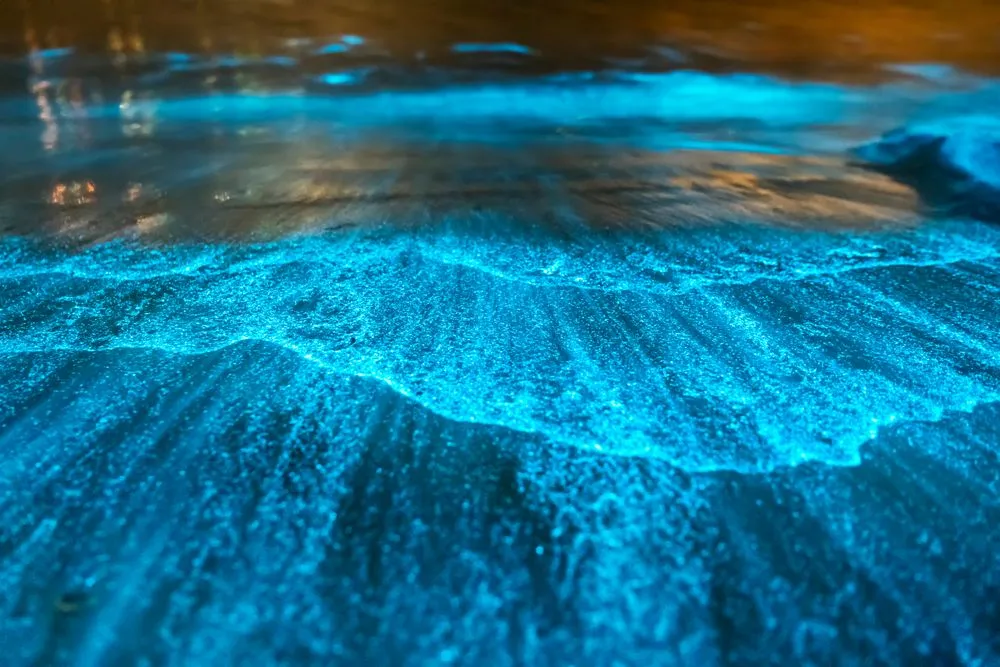
When light hits an object, it does one of two things: it is either reflected or absorbed. When light gets reflected, it gives off a certain color. Whatever color you see is the color that is reflected when light hits that object.
The color of an object also depends on what colors the object absorbs. I think this is explained best with an example. Consider the leaves on a tree. They’re green in color and everyone knows this is because of chlorophyll. White light (a mixture of all colors) hits the leaf. The chlorophyll in the leaf absorbs blue and red light, and reflects green light.
Thus, for an object to look red, like our deep-sea algae, it needs to absorb green and blue light and reflect red light. However, what exactly makes it necessary for them to absorb blue and green light? Water has its own peculiar behavior when light passes through it.
Why Does Red Algae Need Blue Light?
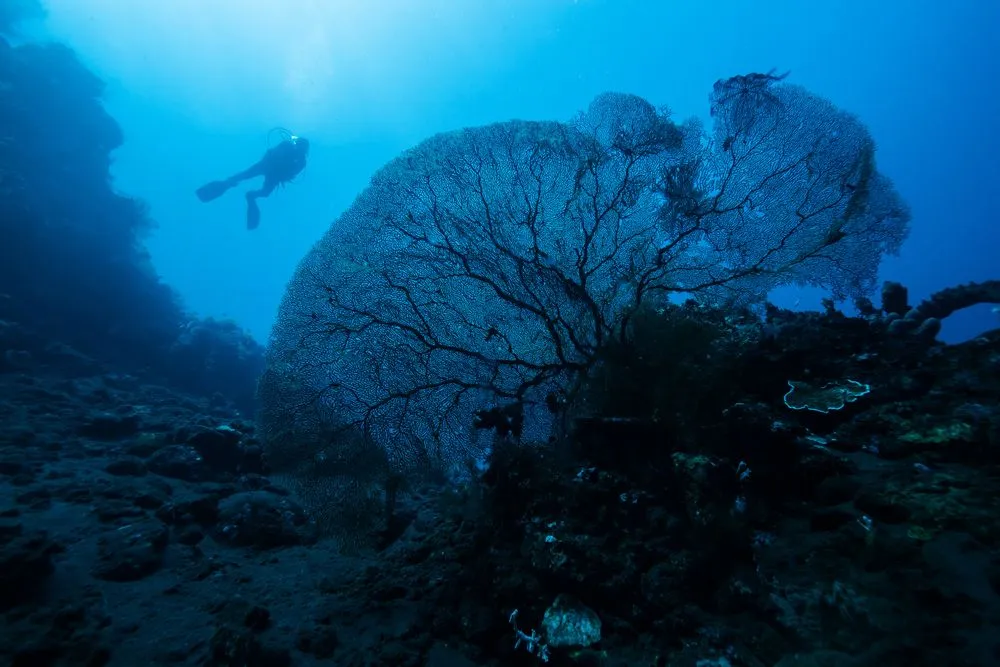
Water absorbs the longer wavelengths of light first. Red light is soaked up within the top 10 to 15 meters (33 to 49 ft), and orange and yellow disappear not long after. Only the shorter wavelengths, blue and green, penetrate deep into the water. The blue light that gets scattered back is also what makes oceans appear blue.
This means that the only light energy available to plants at these depths is blue and green light. They can’t rely on regular chlorophyll alone, so what else do they use?
Photosynthesis In Deep Waters
Green plants use two types of chlorophyll. Chlorophyll a absorbs blue-violet light (around 430 nm) and red light (around 662 nm). The second pigment, chlorophyll b, absorbs blue light (around 453 nm) and orange-red light (around 642 nm). If you look at the color spectrum, there’s only one color left over for both to reflect: green!
A surprising thing about red algae is that they do contain chlorophyll a. The trouble is that chlorophyll a mostly absorbs blue and red light, and at depth there is very little red light left, so the energy it captures isn’t enough for the algae to make food on its own.
Instead of chlorophyll-b, they have an interesting family of pigments called phycoerythrins.
Phycoerythrins are a group of red photosynthetic pigments. As you may guess, they appear red because they absorb green and blue-green light (with absorption peaks around 495, 545 and 565 nm) and reflect the red light back at us. Crucially, green and blue-green are exactly the wavelengths that survive deepest in the water, so phycoerythrins capture the light that chlorophyll alone would miss.
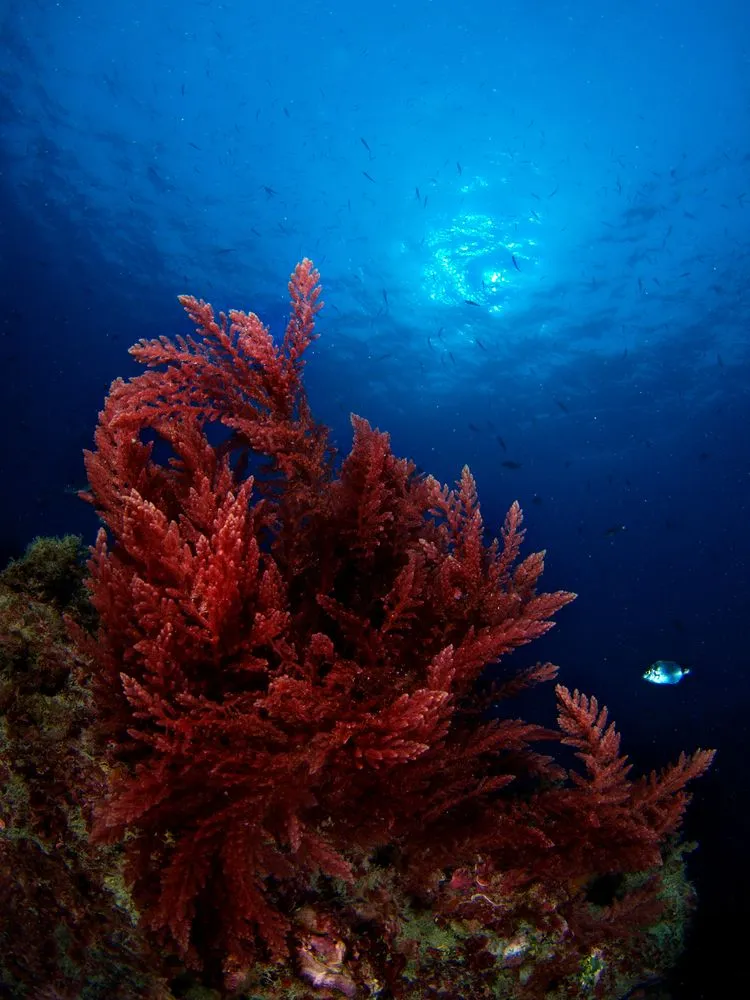
The fact that the pigments are red isn’t the most interesting bit. Unlike most plants that rely primarily on chlorophyll to harness the sun’s energy, red algae actually use phycoerythrins as their main photosynthetic pigments. In fact, according to this study, the amount of phycoerythrin found in these plants can be up to five times greater than chlorophyll.
This also has an interesting effect on the product of their photosynthesis.
Different Pigments, Different Products
Having different pigments even affects the type of food that red algae can make. In plants on the surface, food is stored in the form of starch. We’ve all heard of starch, which is famously known for being found in large quantities in potatoes. Many glucose molecules link themselves to each other in a very large chain to give us starch granules.
Red algae store their food as floridean starch. Despite how the name looks, it has nothing to do with Florida; it is named after the Florideae (now usually called the Florideophyceae), the large group of red algae in which this storage product was first described. Floridean starch is also a long chain of glucose molecules. The difference lies in the position of the bonds between those glucose molecules.
Why Does The Color Of Red Algae Change With Depth?
If you have ever gone diving, you may have noticed that red algae aren’t all the same shade. Some are a soft pink, others an almost blackish crimson. A lot of that comes down to how much light an alga has to work with. The deeper it grows, the dimmer and bluer its world becomes, and red algae respond by re-tuning their light-harvesting kit to match.
In low light, red algae build more of their phycoerythrin-packed antennae (bundles called phycobilisomes) and ease off on chlorophyll a. In one study of the coralline alga Lithothamnion glaciale, shifting the algae into dim light raised their phycoerythrin light-harvesting capacity by roughly 10% while dropping chlorophyll a by about 20%. Since phycoerythrin is the red pigment, loading up on it can leave deep-dwelling individuals looking a richer, darker red than their sunlit cousins.
It is worth saying that this is the alga acclimating to the light it actually gets, not a hard rule that color tracks depth. In some red algae, researchers find that this pigment-swapping stays fairly modest and the algae lean more on other tricks, like squeezing more out of every photon, to cope with the gloom.
Which Plants Actually Live At The Bottom Of The Ocean?
Here’s a fun twist: most of the “plants” at the bottom of the ocean aren’t really plants at all. The only true flowering plants (angiosperms) in the sea are the seagrasses, like eelgrass and turtle grass. They are the only flowering plants that live fully submerged in seawater and even flower and pollinate underwater. The catch is that seagrasses have some of the highest light requirements of any flowering plant, so they cling to shallow, sunlit coastal water and never reach the deep sea floor.

Go deeper and the greenery is really algae, or seaweed. Green algae drop out first because they depend so heavily on chlorophyll. Brown algae push a little further down, and red algae go deepest of all, thanks to phycoerythrin grabbing the blue-green light that survives at depth. If you want the full story of how anything makes a living down there, we get into it in how there is life in the deep ocean.
How deep can a photosynthetic organism actually go? The record holder is a crustose coralline alga (a red alga) that Mark and Diane Littler found on an uncharted seamount off San Salvador, Bahamas. A 1985 report in Science documented living coralline algae at 268 meters (879 ft), and Guinness World Records lists a later find at 295 meters (968 ft). At those depths, less than 0.001% of the sunlight hitting the surface is left, and yet these stubborn red crusts keep photosynthesizing.
Are Red Algae Actually Plants?
We have been loosely calling red algae “plants” this whole time, but botanists would raise an eyebrow at that. Strictly speaking, red algae (the phylum Rhodophyta) are not true plants. True plants, meaning land plants and their green-algae relatives, sit in a group called Viridiplantae, and red algae branch off on their own.
What red algae, green algae and land plants do share is membership in a much larger supergroup called Archaeplastida. Everything in it traces back to a single ancient event, when a hungry single-celled organism engulfed a cyanobacterium and, instead of digesting it, kept it as a live-in solar panel. That captured cyanobacterium became the chloroplast. So red algae are better thought of as very distant cousins of the plant on your windowsill than as plants themselves, which is why biologists usually file them among the “protists,” the catch-all bin for eukaryotes that aren’t animals, plants or fungi.
A Final Word
Life on this planet has adapted in many interesting and unique ways. Red algae are a great example of this. They manage to survive (and thrive) in places that no one would think possible.
In this effort to conquer impossible environments, they develop crazy adaptations. Our natural world is much more than what we see, and when we go explore it, we discover many interesting things, like red-colored plants!
References (click to expand)
- Introduction to the Rhodophyta - UCMP Berkeley. The University of California Museum of Paleontology
- Algae - Photosynthesis and light-absorbing pigments. Encyclopaedia Britannica.
- Marine Algae : Biodiversity, Taxonomy, Environmental .... Routledge
- Haxo, F. T., & Blinks, L. R. (1950, March 20). Photosynthetic Action Spectra Of Marine Algae. Journal of General Physiology. Rockefeller University Press.
- Yanshin, N., Kushnareva, A., Lemesheva, V., Birkemeyer, C., & Tarakhovskaya, E. (2021, April 24). Chemical Composition and Potential Practical Application of 15 Red Algal Species from the White Sea Coast (the Arctic Ocean). Molecules. MDPI AG.
- Deepest alga. Guinness World Records.
- Littler, M. M., Littler, D. S., et al. (1985). Deepest Known Plant Life Discovered on an Uncharted Seamount. Science.
- Red algae acclimate to low light by modifying phycobilisome composition to maintain efficient light harvesting. BMC Biology.
- Dominance of photo over chromatic acclimation strategies by habitat-forming mesophotic red algae. Proceedings of the Royal Society B.
- Seagrass. Wikipedia.
- Archaeplastida. Biology LibreTexts.