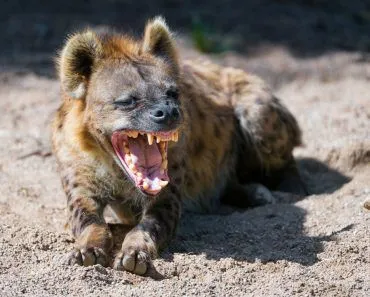
The otherwise laid-back hippos can be very aggressive when it comes to their territory. Male hippos will, as early as seven years old, start to learn and display aggressive shows of behavior. They are well known to open their mouths extremely wide and show off their massive tusks and teeth.
As relaxed as they may seem, when hippos in the wild come across humans in their territory, they get very mad, very quick. It doesn’t matter if they’re having a quick soak in the water or if they’re out lazing in the savannah, hippos will charge at a boat or a jeep with the same ferocity. This is especially terrifying when you consider that hippos are also deceptively quick. In fact, hippos can hit top speeds of around 30 kilometers per hour on land, and close to 10 kilometers per hour in the water.
Hippo charges after a speedboat.
Hippos attack a lot of people. According to an estimate quoted by the BBC, approximately 500 people lose their lives every year to hippo attacks in Africa. Although there aren’t any direct studies to support that number, there are many reported cases of people ending up in the hospital because of a hippo.
However, it is worthwhile to ask the question… what exactly provokes these hippos? After all, the humans that hippos generally come across do not pose any danger to them. In most cases, they aren’t poachers, hunters, or members of a crazed and angry mob; they are often just unassuming tourists who are exploring new lands or recreational hobbyists, like kayakers, who like being out in the wild, or local fishermen doing their job.
So, what is it about humans that rubs hippos the wrong way?
Why Do Hippos Hate Humans So Much?
As it turns out, it isn’t personal between hippos and humans! Yes, hippos do have a general dislike towards humans. And lions. And hyenas. And pretty much any other wild animal that intrudes on their territory. Hippos are intensely territorial and dominant animals. Male hippos will, as early as seven years old, start to learn and display aggressive shows of behavior. They are well known to open their mouths extremely wide and show off their massive tusks and teeth to deter predators or invaders.
Crocodiles And Hippos: An Unhappy Marriage In The Water
If there’s any animal that has gotten the stick end of dealing with hippos, it’s the crocodile. Poor crocodiles get into conflicts on an almost daily basis with hippos due to their overlapping habitat preferences. In fact, a video posted on National Geographic even captured a young bull seemingly playing with a crocodile and tossing it around in the water. To make matters worse for the poor croc, the hippo followed it onto land, where it continued to agitate it by apparently trying to “chomp” down on the croc for fun.
While hippos generally prefer to play with other hippos, it is not an uncommon sight to spot crocodiles and hippos lurking mere meters apart from one another. Both species show a strong preference for spending most of their time in the water, and when on land, both also relax and wind down in the same way, basking in the sun!
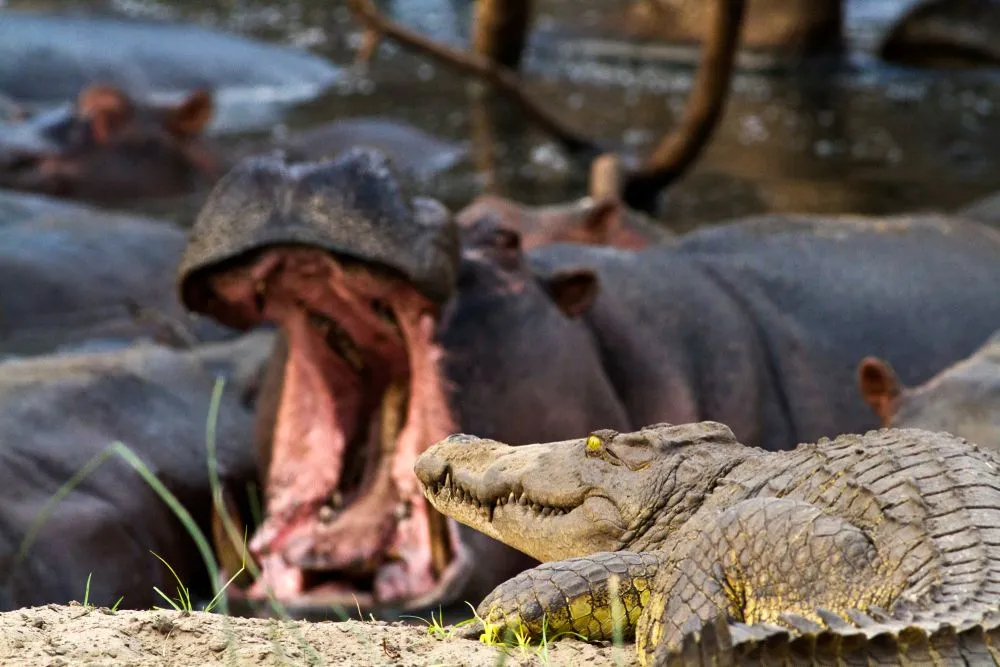
It’s uncommon to observe prey and predator side by side so often, and more importantly, for so long!
One would assume that crocs, being crocs, would be well within their rights to hunt down hippos, yet they can’t. Like Tantalus’ fruits, crocs can never hunt down a hippo. Despite having the strongest bite force in the entire terrestrial animal kingdom, crocs are often let down by their teeth. Hippos, on the other hand, have massive teeth that measure up to around half a meter (1.5 feet) in length!
In comparison, a crocodile’s teeth can only reach up to 0.1 meters (4 inches) in length. Yikes!
To make matters worse for crocs, hippos have a pretty decent bite force themselves. In fact, if we were to rank all the bite forces of extant terrestrial animals, number one billing would go to crocs, but can you guess who gets the number two spot? Hippos! So, unless it’s an abandoned calf or an already injured adult, crocs generally leave hippos alone.
Hippos are also generally better equipped to deal with crocodiles than crocodiles are equipped to deal with hippos. Hippos are heavier and bigger than crocodiles, and have thick skin to help defend themselves from ambush attacks from their long-snouted neighbors.
Is There Any Animal A Hippo Doesn’t Mess With?
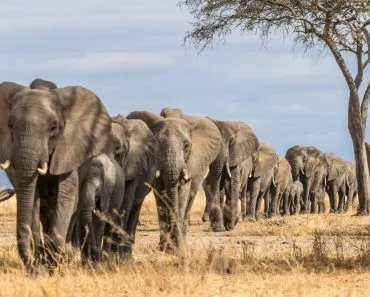
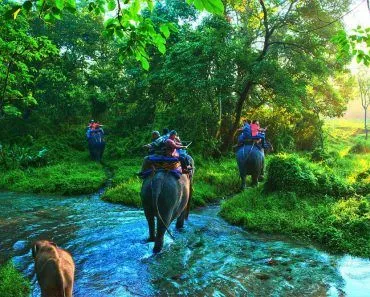
Don’t rush off to declare hippos as the kings and queens of the savannah and grassland just yet. While they are incredible beasts who can best be described as absolute units, there still is one animal to whom even hippos bow down. These animals are none other than the gentle giant elephants.
Elephants don’t even have to herd together to command hippos’ respect. Even an entire pod of hippos will let solitary elephants pass by undeterred. All of this comes down to the sheer size of elephants. Elephants are much larger and bigger than hippos, and can knock the living daylights out of them. Elephants have been previously filmed knocking over hippos. Especially when they threaten elephant calves, female elephants have been known to get incredibly aggressive and may even stomp on hippos once they have them immobilized.
What Actually Makes Hippos So Aggressive?
Here's the thing about hippo aggression: it's almost always about real estate, not appetite. According to the San Diego Zoo, a mature bull defends his patch of water for mating rights, not for food. In a lake, a single dominant male might control 250 to 500 meters (around 270 to 550 yards) of shoreline; along a river, he'll guard a tighter 50 to 100 meter (55 to 110 yard) stretch. Drift into that water and you've essentially trespassed on his entire dating pool.

That jaw-cracking "yawn" you've probably seen in wildlife clips isn't a sleepy hippo at all. It's a threat display. Rival bulls settle disputes with jaw-to-jaw sparring and wide open-mouth gaping contests, and a male will even fling dung around by rapidly flicking his tail to scent-mark his turf. The hostility peaks in the dry season, when shrinking rivers and pools cram more and more hippos into less and less water, and short tempers do the rest.
A lot of this behavior is defensive rather than predatory. Mother hippos are intensely protective of their calves and won't let anything get close, and because a full-grown hippo has almost no natural predators of its own (adults are largely left alone thanks to their size and ferocity), it has very little reason to ever back down. That same low tolerance is why hippos so readily charge boats: they have been widely reported ramming and capsizing small craft, and in one 2014 incident on the Niger River, a single capsized boat led to 13 deaths.
What Do Hippos Eat?
Given everything above, you'd be forgiven for assuming hippos are bloodthirsty carnivores. They're not. Hippos are herbivores, and surprisingly tidy eaters for animals that can weigh as much as a small truck. The San Diego Zoo notes that an adult hippo puts away an average of just 40 kilograms (about 88 pounds) of food a night, which works out to only 1 to 1.5 percent of its body weight, a famously small ration for such a massive grazer.

The menu is almost entirely short grass. Hippos crop neat, lawn-like patches near the water (rangers literally call them "hippo lawns"), and they do nearly all of it after dark. Once the harsh African sun has set and their sensitive skin is safe, they haul themselves out of the water and graze for roughly six hours, sometimes wandering several kilometers (a few miles) inland to find a good patch.
Their digestion is built for lean times, too. A hippo can stash about two days' worth of grass in its stomach and reportedly go up to three weeks without eating if it has to. So despite the tusks, the bellowing, and the boat-flipping reputation, the animal in front of you is essentially a very large, very territorial lawnmower that would much rather eat grass than bother you.
Conclusion
It all just comes down to territoriality and dominance displays with hippos. They are generally very defensive of their habitat and will be hostile to any foreign object (living or not) that encroaches on their territory. So next time you find yourself on safari in Africa, just be sure to keep your distance!
References (click to expand)
- Haddara, M. M., Haberisoni, J. B., Trelles, M., Gohou, J.-P., Christella, K., Dominguez, L., & Ali, E. (2020, August 1). Hippopotamus bite morbidity: a report of 11 cases from Burundi. Oxford Medical Case Reports. Oxford University Press (OUP).
- 9 of the World's Deadliest Mammals | Britannica. britannica.com
- Hippo | San Diego Zoo Animals & Plants. The San Diego Zoo
- Proof African Hippos Do What They Want - National Geographic. National Geographic
- Facts about hippos | Live Science. Live Science
- Hippopotamus Fact Sheet: Behavior & Ecology. San Diego Zoo Wildlife Alliance Library
- Hippopotamus. Wikipedia