Table of Contents (click to expand)
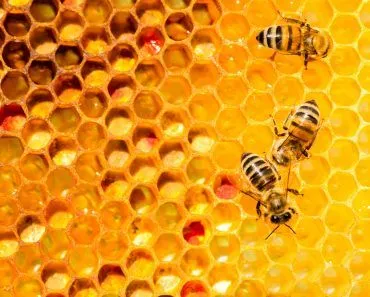
Bees build hexagonal honeycombs because the hexagon is the most efficient shape for packing cells side by side: it tiles a flat surface with no wasted space and encloses the most area per unit of perimeter, meaning the least beeswax used per unit of honey stored. Mathematician Thomas Hales proved this property (the Honeycomb Conjecture) in 1999.
If you’ve ever looked at a beehive (from a distance, that is), then you’ve probably noticed that there are small dark chambers on the surface of the beehive that form an almost identical pattern. Why are bees fond of making these shapes for their home and why are these hexagonal shapes the only ones that bees chose? Why didn’t they begin using some other shape for their beehive?
Who would have imagined that bees are so much more than buzzing insects with a nose for flowers, they’re also mathematical geniuses!
Why Do Bees Need The Honeycomb?
A honeycomb is both a nursery and a pantry. Worker bees use the hexagonal cells as cribs to raise the brood (egg → larva → pupa) and as jars to store food: ripened honey for winter carbohydrates and “bee bread” (fermented pollen packed into cells) for protein. Drone cells, worker cells and the larger queen cells all differ in size, but they share the same wax architecture.
The building material itself, beeswax, is expensive to make. Young workers aged roughly 12 to 18 days secrete it as tiny scales from four pairs of glands on the underside of the abdomen, and bees must burn a lot of honey to fuel that conversion. UN FAO figures put the cost at roughly 6 to 8 kg of honey per 1 kg of wax. That brutal energy budget is exactly why the geometry of the comb matters so much: every gram of wax saved is honey the colony gets to keep.
A Hexagon Makes Sense
Only three regular polygons can tile a flat surface without leaving gaps: the equilateral triangle, the square, and the regular hexagon. Anything else (pentagons, octagons, circles) either leaves wasted spaces or shares edges awkwardly. So if you’re a bee trying to pack cells side by side, you have just three options to choose from.
Among those three, the hexagon is the winner. For a given perimeter, a hexagon encloses more area than a triangle or a square, which means it uses the least wax per unit of honey it can hold. The Roman scholar Marcus Terentius Varro wrote about this intuition in his agricultural treatise Rerum Rusticarum around 36 BC, in what is now called the Honeycomb Conjecture: of all the ways to chop up a surface into equal-area cells, the hexagonal grid uses the least total boundary. Three centuries later, the Greek geometer Pappus of Alexandria offered a partial proof, restricted to the three regular tilings, and the hexagon won handily.
Why Only A Hexagon?
For nearly 2,000 years, mathematicians strongly suspected the conjecture was true for any partition of the plane, not just regular tilings, but a complete proof remained out of reach. It finally arrived in 1999, when University of Pittsburgh mathematician Thomas C. Hales showed that any partition of the plane into regions of equal area has perimeter at least that of the regular hexagonal tiling. Hexagons aren’t just locally clever, they are globally optimal. The bees, it turns out, beat us to a 21st-century proof by a few million years.
How the bees physically achieve this perfection is still being argued over. One school of thought argues that bees start by building cylindrical cells; their body heat softens the thermoplastic wax, and surface tension at the cell junctions pulls them into hexagons all by itself. A 2025 PLOS Biology study by Gharooni-Fard and colleagues pushed back, showing that bees actively merge, tilt and adjust cells as they go, suggesting it is a mix of behavior and physics rather than physics alone. And in case you wanted to know how close the bees actually get to perfection: László Fejes Tóth proved back in 1964 that a slightly different shape for the cell bottom would be about 0.35% more wax-efficient than the bees’ three-rhombus dome. Even after millions of years, the bees are off optimal by less than half a percent.
How Do Bees Know To Build Hexagons?
Here is the part that should give you pause: no single bee is in charge, and there is no blueprint pinned up anywhere in the hive. The individual chambers are simply called cells, and a colony will build thousands of them, all roughly identical, with nobody overseeing the project. So how does a swarm of insects with brains the size of a sesame seed end up with a near-perfect grid?

It starts with the wax itself. When a colony needs new comb, young worker bees gorge on honey and secrete tiny wax scales from glands on the underside of the abdomen. They often link their legs together into hanging chains, a behavior beekeepers call festooning, draped across the gap where the new comb will go. Festooning almost always coincides with comb-building, though its exact purpose is still debated. As the bee biologist Jürgen Tautz has put it, the function of these living chains is essentially unknown.
The leading scientific explanation is that the hexagons are not designed at all, but emerge. A 2018 model published in PLOS ONE treats comb-building as pure self-organization: some workers act as “attachers” that add wax, others as “excavators” that chew it away, and the tug-of-war between the two produces the structure. As the authors put it, because the workers follow such simple rules, the model “does not require them to have any prior knowledge of the complex shape that they build.” Each bee is just reacting to the wax right in front of it.
Not everyone is convinced it is only physics and reflex. A review of comb-building cognition points out that one bee will happily pick up where another left off, correctly continuing a half-built cell, and that bees seem to anticipate obstacles and adjust before they hit them. That flexibility looks less like a simple reflex and more like the colony working toward a shared goal. The 2025 PLOS Biology study mentioned above adds weight to this, showing that bees actively merge, tilt and re-size cells when their building space is awkward. The honest answer to “how do they know?” is that scientists are still arguing about it, and that open question is half the fun.
References (click to expand)
- Why do honeybees love hexagons? - Zack Patterson and Andy. TED Conferences, LLC
- Why do bees make hexagons? - Ask Dr. Universe. Washington State University
- What Is It About Bees And Hexagons? - NPR. National Public Radio
- Hales, T. C. (2001). The Honeycomb Conjecture. Discrete & Computational Geometry.
- Gharooni-Fard et al. (2025). Adaptive comb construction in honeybees. PLOS Biology.
- UN FAO. Production and Trade of Beeswax.
- Self-organization at the first stage of honeycomb construction. PLOS ONE (2018).
- Cognitive Aspects of Comb-Building in the Honeybee? PMC / NCBI.