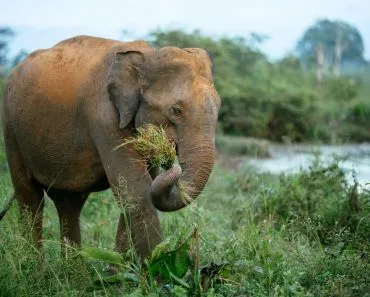
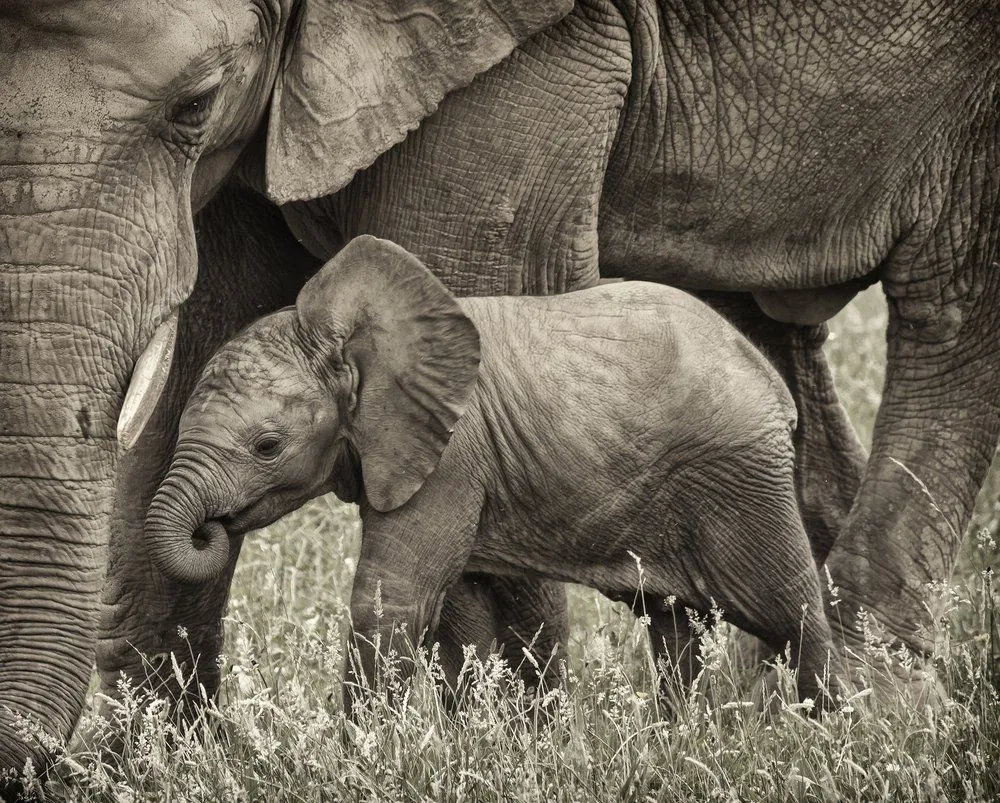
Elephants have such great memories because they own the largest brain of any land mammal, with an especially well-developed hippocampus (the brain’s key memory hub) and a deeply folded cerebral cortex tied to learning and problem-solving. This lets them remember the faces of dozens of herd members, the locations of watering holes and migration routes over decades, and even individual humans they last met 20 or more years ago.
One of the most well-behaved creatures of the wild, elephants, make a powerful impression on anyone that encounters one. Enormous in size and amusing in appearance, elephants have been loved by people from all walks of life for generations. And why shouldn’t they be? They are extremely smart animals, as we’ll explain shortly.
Elephant Memory
It is often said that elephants never forget a thing. Although this is not entirely true (it’s certainly not true for humans), it is true that elephants have superb memories. However, let me tell you, having a great memory is just one part of the many exciting attributes of elephants.

An elephant has a very large brain. In fact, out of all land mammals, an elephant’s brain is the biggest. To add to this, elephants have a great encephalization quotient. Encephalization is defined as the amount of brain mass related to an animal’s total body mass. In 335 B.C. Aristotle claimed that, “of all the animals, man has the largest brain in proportion to his size”, which is accurate. Humans have an EQ of 7.44, dolphins have 5.31 and elephants have an EQ of 1.87, which is pretty impressive.
An elephant’s EQ is in the same ballpark as that of chimpanzees, and since humans are close relatives of the latter, the brains of humans and elephants share more similarities than you might expect. Elephants have a highly developed hippocampus (the brain’s key hub for long-term memory and spatial navigation), along with a deeply folded cerebral cortex linked to learning, planning and problem-solving. It is these brain features that grant elephants their remarkable memories.
An Impressive Power Of Recollection
By using experiences that are stored in its brain as memories, an elephant is able to handle many dangerous situations that might appear in future. For instance, if they survived a drought in childhood, then they would be able to sense the danger of drought in a particular area (basically making a mental connection with the childhood memory ingrained in its brain). This is the reason why clans of elephants that have a high number of old members have higher survival rates.
Elephants are also able to recognize all the members of their own clan. This helps them avoid getting lost in unknown herds. They can recall important places (like potential sources of food and water), even if they had not been there for many years – even decades. Elephants not only remember their clan members, but also other creatures who have left a strong impression on them. For instance, a pair of elephants who had performed in a circus together were able to recognize each other when they met more than 20 years later! (Source). Their recognition skill is not only limited to other elephants; they are also found to bond with humans whom they had briefly met decades earlier!
Elephants Are Creative!
Apart from possessing a superb memory, elephants also boast some other amazing skills. Believe it or not, elephants are able to make sense out of basic arithmetic. For example, if you put a bunch of 10 bananas in front of an elephant and take out 2 bananas five minutes later, the elephant will sense that something mischievous has occurred.
Furthermore, elephants have astonishing means of communication. They use different body postures and vocalizations, as well as subsonic rumbles that can be heard kilometers away by other elephants.
Elephants have tremendous sensitivity to color and music. Elephants in captivity have been found to show special interest in certain types of art and painting. Therefore, the fact that there is actually an elephant band out there shouldn’t surprise you too much.
What Does “A Memory Like An Elephant” Mean?

If someone tells you that you have “a memory like an elephant,” they are paying you a compliment. The idiom simply means that you are able to remember things easily and rarely forget them, even small details from long ago. The closely related saying “an elephant never forgets” carries the same idea, while “elephantine memory” is just a more formal way of describing the same exceptional recall.
The phrase is a figure of speech, so it is not meant literally. People reach for the elephant because the animal has long been the popular symbol of a flawless memory. Interestingly, this reputation is fairly recent. The ancient Greeks actually praised the camel for its long memory, with a proverb that ran roughly “a camel never forgets an injury.” Over the centuries the elephant quietly took the camel’s place in the saying, and today it is the elephant’s name we attach to anyone with a sharp memory.
So when you hear the expression, the speaker is borrowing the elephant’s real talent, which we explore below, to flatter a human one. As you will see, the animal mostly lives up to its billing.
Do Elephants Have A Better Memory Than Humans?
This is one of the most common questions people ask, and the honest answer is that it depends on the kind of memory you mean. Elephants are not better than humans at everything. Their short-term and working memory is nothing remarkable, and humans comfortably win when it comes to abstract reasoning, language and flexible problem-solving. What elephants do possess is a specialized, exceptional long-term memory for a few survival-critical things: faces, voices, places and social relationships, held over decades.
Part of the explanation is raw hardware. An adult elephant has the largest brain of any land animal, averaging around 4,700 grams (about 10.4 lb), which is roughly 13 times the average brain mass of a chimpanzee. Their hippocampus and temporal lobe, the regions tied to long-term and spatial memory, are especially well developed. Of course, a bigger brain does not automatically mean a smarter animal, but in the specific niches that keep a herd alive, elephants are hard to beat.
So which animal has the best memory? There is no official winner, and researchers generally place elephants in the same league as dolphins and great apes rather than above them. But for sheer long-term recall of social and geographic information, the elephant remains the textbook example, and that is exactly why we say it never forgets.
How Do We Know Elephants Really Remember?

Saying elephants have great memories is one thing, but how do scientists actually measure it? The strongest evidence comes from long-running field studies, and it centers on the matriarch, the oldest female who leads the herd.
In a landmark study at Amboseli National Park in Kenya, Karen McComb and her colleagues played recorded contact calls to elephant families and found that adult females could recognize the voices of around 100 other adults from roughly 14 different families. Older matriarchs were better at telling friend from stranger, and crucially, families led by these older leaders enjoyed higher reproductive success. The herd’s survival, in other words, partly rides on what its eldest member remembers.
That memory can be a matter of life and death. During a severe drought in 1993 at Tanzania’s Tarangire National Park, families led by matriarchs aged 38 and 45 left the parched park in search of water, while a group led by a younger 33-year-old matriarch stayed put. The groups that left lost far fewer calves. Researchers concluded that the older females remembered an earlier drought from 1958 to 1961 and recalled the migration routes to greener land, knowledge the younger matriarch never had.
This long memory is also wired for navigation. A 2025 review in Veterinary Sciences documented elephants in Etosha National Park making targeted journeys to waterholes up to 50 km (about 31 mi) away, well beyond the reach of sight or smell, while Mali’s desert elephants undertake an annual migration of more than 600 km (about 370 mi). Older animals lead these treks, and the calves learn the routes by following. The elephant’s famous memory, then, is not a myth or a circus trick. It is a real, measurable survival tool.
Elephants are gentlemen (and ladies) among the animals of the wild. Unfortunately, we continue to make their lives difficult through deforestation and poaching. They definitely deserve better from us, and remember, they won’t forget the way we’ve treated them.
References (click to expand)
- Elephant Memory - Animals | HowStuffWorks. HowStuffWorks
- Fact or Fiction?: Elephants Never Forget - Scientific American. Scientific American
- Elephants Really Never Forget. Slate
- McComb, K. et al. (2001). Matriarchs as repositories of social knowledge in African elephants. Science, 292(5516), 491-494. PubMed
- McComb, K. et al. (2000). Unusually extensive networks of vocal recognition in African elephants. Animal Behaviour, 59(6), 1103-1109. PubMed
- Morel, M. et al. (2025). Memory-Based Navigation in Elephants: Implications for Survival Strategies and Conservation. Veterinary Sciences, 12(4), 312. PMC / NCBI
- An elephant never forgets - phrase meaning and origin. Phrases.org.uk