Plants do not have eyes, ears, noses, or a brain — but they do have functional analogues of all five "senses." They detect light direction and color through photoreceptors (phytochromes, cryptochromes, phototropins), pick up the vibrations of chewing insects, smell airborne chemicals released by neighbors, respond to touch via thigmotropism, and even "taste" soluble molecules to mount targeted chemical defenses. They just do it without a brain.
Many people talk to the trees, even at the risk of being called crazy, but some recent studies show us that plants might actually be listening in. Other than recognizing sounds, there are other basic senses that plants utilize. Plants fight for their territory, evade predators, seek out food and even trap prey. They are as alive as any animal and, just like animals, they exhibit behavior based on their perception of the environment. Movement in plants is quite sluggish for us to observe, but if we record their growth over a long period of time and then fast-forward the video, the similarities to animals become much more clear.
Hearing
Plants may not swing to the beats of your favorite song, but if they hear the munching sound of a caterpillar, that’s another story. A landmark 2014 study by Heidi Appel and Reginald Cocroft at the University of Missouri showed that Thale Cress (Arabidopsis thaliana) recognizes the vibration signature of a caterpillar chewing on its leaves — and in response, floods those leaves with chemical defenses including mustard oils that sicken or kill the unwary caterpillar. Crucially, the plants reacted to chewing vibrations but not to similar-frequency wind or insect-song vibrations: they were doing real signal discrimination, not just generic stress response.
And it turns out plants make sounds, too. In 2023, Lilach Hadany’s lab at Tel Aviv University reported in Cell that drought-stressed tomato and tobacco plants emit airborne ultrasonic clicks (in the 20-100 kHz range, well above human hearing) at a rate of about 30-50 clicks per hour — far more than healthy plants. Whether other plants or insects "listen in" on those clicks is the next big question.
Underground, the roots of many trees are also wired into a chemical conversation. Forest trees infested by hungry bugs release volatile signals that nearby intact trees pick up on and respond to by ramping up their own bug-repelling chemicals — a real-time alarm network.
Smell
If smell is the detection of airborne chemicals, plants are accomplished noseless sniffers. The volatile organic compounds (VOCs) released by injured plants — methyl jasmonate, methyl salicylate, green-leaf volatiles like cis-3-hexenal — drift through the air and bind to receptor proteins on the leaves of neighbors, which respond by priming or activating their own defenses. The parasitic vine Cuscuta (dodder) actually tracks down its hosts by smell: when given a choice between volatiles from a tomato plant and from wheat, dodder seedlings reliably grow toward the tomato volatiles (Runyon, Mescher & De Moraes, Science, 2006).
Sight
Plants don’t have eyes, but they do have at least three families of dedicated photoreceptors that let them "see" different parts of the spectrum: phytochromes read red and far-red light (and tell a plant whether it’s being shaded by a neighbor), cryptochromes and phototropins detect blue light (driving stem bending toward the Sun and positioning chloroplasts inside the leaf), and UVR8 senses UV-B light. Add them up and a typical plant can distinguish many more wavelength bands than the three our eyes use. It puts that information to work growing toward light (phototropism), timing flowering with the seasons, and deciding whether to invest in tall thin stems (in shade) or short bushy growth (in full sun).
One more provocative result: a 2021 study on Boquila trifoliolata, the Chilean "chameleon vine" famed for mimicking the leaf shape of whatever plant it climbs on, reported that the vine could even match the shape of plastic model leaves placed nearby — hinting at something that looks suspiciously like rudimentary plant vision. The result remains contested, but the underlying mimicry is real and the debate is active.
Touch
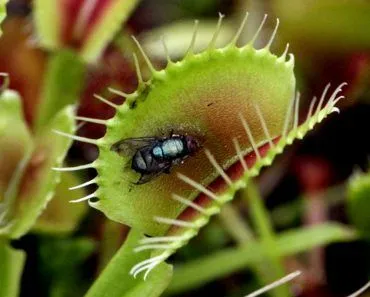
The Venus flytrap is the most famous touch-sensing plant, but it’s far from the only one. When a fly brushes against one of the trap’s trigger hairs, mechanoreceptors generate an electrical action potential — strikingly similar in shape to the ones running along animal nerves — that propagates across the leaf. Two touches within about 20 seconds activate calcium channels in the cell membranes, and the trap snaps shut in less than a tenth of a second. Mimosa pudica ("the sensitive plant") folds its leaves within seconds of being touched, using fast-acting motor cells that pump out water and lose turgor on cue. Climbing tendrils on peas and grapevines coil around any object they brush against (thigmotropism), and even ordinary Arabidopsis seedlings change their growth pattern when their leaves are repeatedly stroked.
Taste
Taste, biologically, is the detection of soluble molecules. Plants have plenty of receptors that fit that bill. When a hungry caterpillar starts chewing, its saliva drips onto the leaf surface, the molecules dissolve in surface water, and the plant’s receptors recognize specific caterpillar-saliva peptides as a "danger" signature, triggering a targeted defensive response. Roots taste, too: they detect dissolved nitrate, ammonium, and phosphate ions in the soil and grow preferentially toward the richer patches. Who knew plants could taste danger — and dinner?

Plants turn out to be far more similar to animals than we usually give them credit for. The illusion of their "lack of behavior" mostly comes down to timescale — they move slowly, and most of their signaling is chemical and invisible. Speed the footage up and the behavior is obvious: leaves track the Sun, tendrils coil around supports, defenses ramp up against attackers. None of this means plants are conscious the way animals are — they have no brain or central nervous system — but they are very much sensing, responding organisms, and the gap between us and them is narrower than it first appears.
References (click to expand)
- Osakabe, Y., Yamaguchi-Shinozaki, K., Shinozaki, K., & Tran, L.-S. P. (2013, January). Sensing the environment: key roles of membrane-localized kinases in plant perception and response to abiotic stress. Journal of Experimental Botany. Oxford University Press (OUP).
- GOMEZGOMEZ, L. (2004, November). Plant perception systems for pathogen recognition and defence. Molecular Immunology. Elsevier BV.
- Santamaria, M., Arnaiz, A., Gonzalez-Melendi, P., Martinez, M., & Diaz, I. (2018, May 3). Plant Perception and Short-Term Responses to Phytophagous Insects and Mites. International Journal of Molecular Sciences. MDPI AG.
- Plants respond to leaf vibrations caused by insect herbivore chewing (Appel & Cocroft, Oecologia, 2014)
- Sounds emitted by plants under stress are airborne and informative (Khait et al., Cell, 2023)
- Volatile chemical cues guide host location by a parasitic plant (Runyon, Mescher & De Moraes, Science, 2006)