Table of Contents (click to expand)
Insectivorous (carnivorous) plants trap and digest insects and other small animals to supplement scarce nutrients like nitrogen, since they grow in poor, boggy soils. They still photosynthesize for energy. Their trapping methods differ: pitcher plants use slippery pitfalls, sundews use sticky tentacles, and bladderworts use a lightning-fast suction trap.
Insectivorous plants, also known as carnivorous plants, have been a marvel for both scientists and common people for eons. Charles Darwin even went to the extent of calling one of the common insectivorous plants, the Venus Flytrap, “one of the most wonderful plants in the world.”
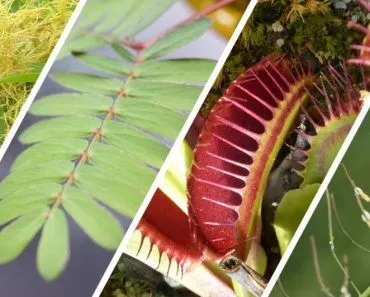
That flytrap, Dionaea muscipula, also shows off the trick most people picture when they hear “insectivorous plant.” Each trap lobe carries a few sensitive trigger hairs, and the plant essentially counts touches: brushing one hair fires a tiny electrical signal (an action potential), but the trap only snaps shut, in about a tenth of a second, if a second touch arrives within roughly 20 seconds. That two-touch rule keeps it from wasting energy on a stray raindrop or speck of debris.
A quick point that often confuses people: these plants haven’t given up on photosynthesis. Like any other green plant, they use chlorophyll to convert sunlight, water and carbon dioxide into energy. So why bother catching insects at all? Because they tend to grow in nutrient-poor, boggy soils that are starved of nitrogen and phosphorus. Trapping prey is simply how they top up those missing minerals, not how they get their energy.
But what makes them a subject of so much intrigue is their mechanisms, a few of which will be discussed in this article!

The Pitcher Plant: Nepenthes
The Structure
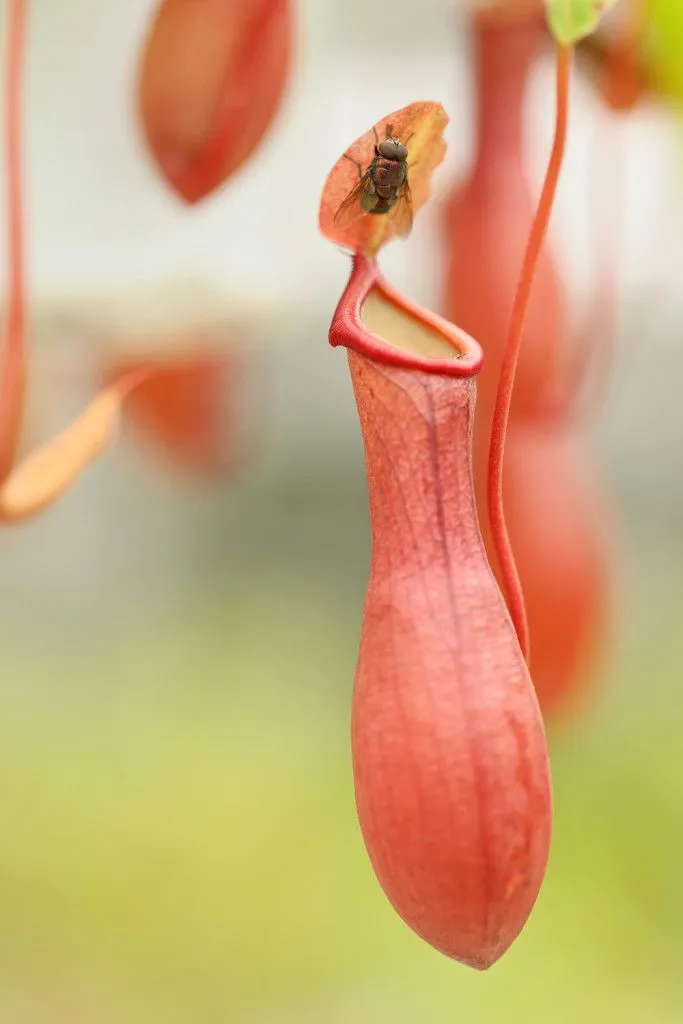
As the name suggests, this plant is in the shape of a cylindrical vase or container. The body of the pitcher plant (basically, the pitcher) is a modification of the leaf lamina. Like other containers, it also has a lid to cover the opening. The apex of the leaf modifies itself to form the lid of the plant.
The Mechanism
In most pitcher plants, the rim of the pitcher plant has a lot of ridges and nectar-producing tissues. This nectar is specialized to be slippery in texture. Now, when the insect lands on the rim of the pitcher, it gradually slips into the body of the pitcher. The hair on the lid of the pitcher and its body’s inner surface point downwards, causing the insect to slip.
However, there’s one pitcher plant whose mechanism I find particularly interesting and worth discussing. The name of our hero is Nepenthes gracilis. The capture of prey here comes from a rapid mechanism in the pitcher plant. The nectar is present on the outside surface of the plant, as well as on its lip (called peristome). It is also present on the underside of the lid. The nectar’s function is to attract insects and serve as an anti-friction coating, letting the insect slip further inside the pitcher.
What makes the mechanism interesting is that it is externally driven, meaning it does not require the expenditure of the metabolic energy by the plant. It is a middle ground between a rapid and a passive mechanism. The insect, in search of nectar, lands on the plant, and tries to extract nectar from the underside of the lid by walking upside down. The lid then acts as a catapult, throwing insects into the cavity of the pitcher.
This catapult-like action of the lid takes place due to an unexpected external force: a raindrop. Yes! Because pitcher plants are found in regions with incessant rainfall, one raindrop falling on the lid of the plant isn’t that big of a deal. Plus, the plant saves on the expenditure of its metabolic energy! What more would it want?
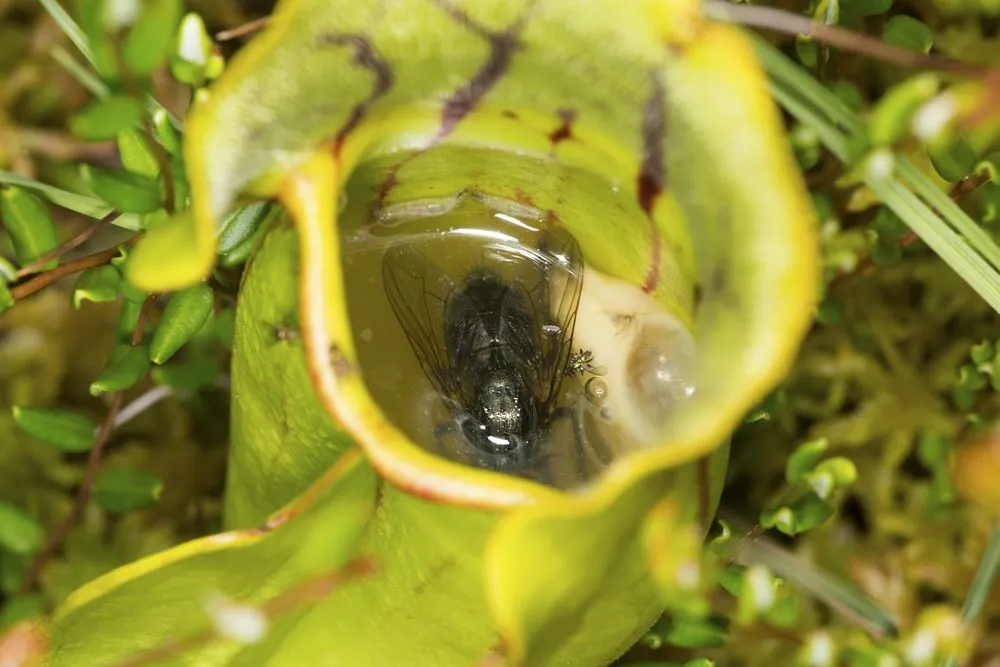
The inner surface of the pitcher has anti-adhesive wax crystals and is covered by downward-facing hair. These two, together, prevent the prey from escaping once it has fallen inside. The base of the pitcher is filled with fluid containing enzymes that digest the insect and absorb the nutrients!
The Bladderwort: Utricularia
The Structure
The Utricularia genus is primarily aquatic, and therefore commonly found in inland lakes, streams and rivers, although, some terrestrial forms also exist.
The plant possesses ‘bladders’ or small, hollow pouches that are present on the horizontal stems (hence the common name). These small pouches help trap the insects or their larvae.
The Mechanism
The trapping mechanism of the Utricularia is the fastest in all of the plant kingdom. The mechanism here is all about rapid action. The bladders of the bladderwort are as tiny as a millimeter, but have a door-like structure at the opening.
The door-like opening has a few (usually four) hair-like structures called trichomes attached to it. Here is the clever part: long before any insect shows up, special glands in the bladder wall actively pump water out of the trap. This leaves the inside at a lower pressure than the surrounding water, so the walls bow inward and the door stays sealed, like a loaded spring waiting to be released. When a nearby insect or protozoan brushes against the trichomes, those hairs act as levers and trip the door, which suddenly buckles open. The stored pressure difference does the rest: water rushes in to equalize, dragging the prey along with it. The whole capture takes only about half a millisecond, and the prey is yanked in at over 600 times the force of gravity, leaving it no chance of escape. Inside the tiny pouch, the insect is feasted upon by digestive enzymes and is thus assimilated.
Seems like biology and physics decided to function in synchrony with this one to help bladderworts get a fair share of nutrients!
The Sundew Plant: Drosera
The Structure
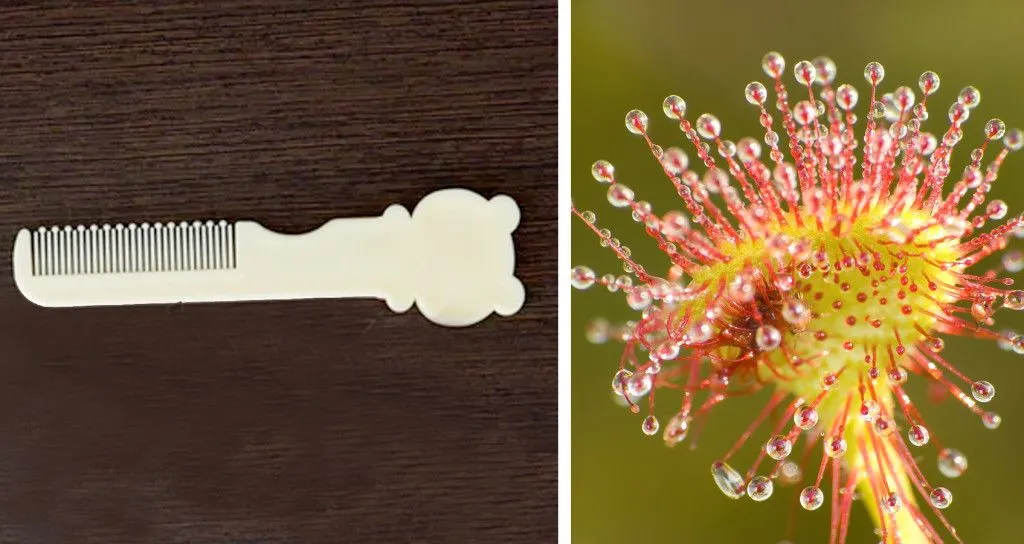
This plant has spike-like outgrowths called tentacles emanating from its leaves. At the end of the spikes is an almost spherical drop of fluid secreted by the plant.
This structure has many of these spikes protruding out and holding a drop of the fluid at their ends. To give you a better idea, it looks like the tips of the combs used for a baby. These drops of fluid shine or glisten under sunlight, giving the same effect as dewdrops, hence the name ‘Sundew’.
The Mechanism
These plants are passive hunters, using a slow but nonetheless effective strategy.
Sundew plants, under the sunlight, glisten and look incredibly attractive with spikes of red or any other bright color. When an insect sees this, it becomes prey to the plant. The insect alights onto these ‘dew drops’ to taste the fluid, which it assumes to be nectar.
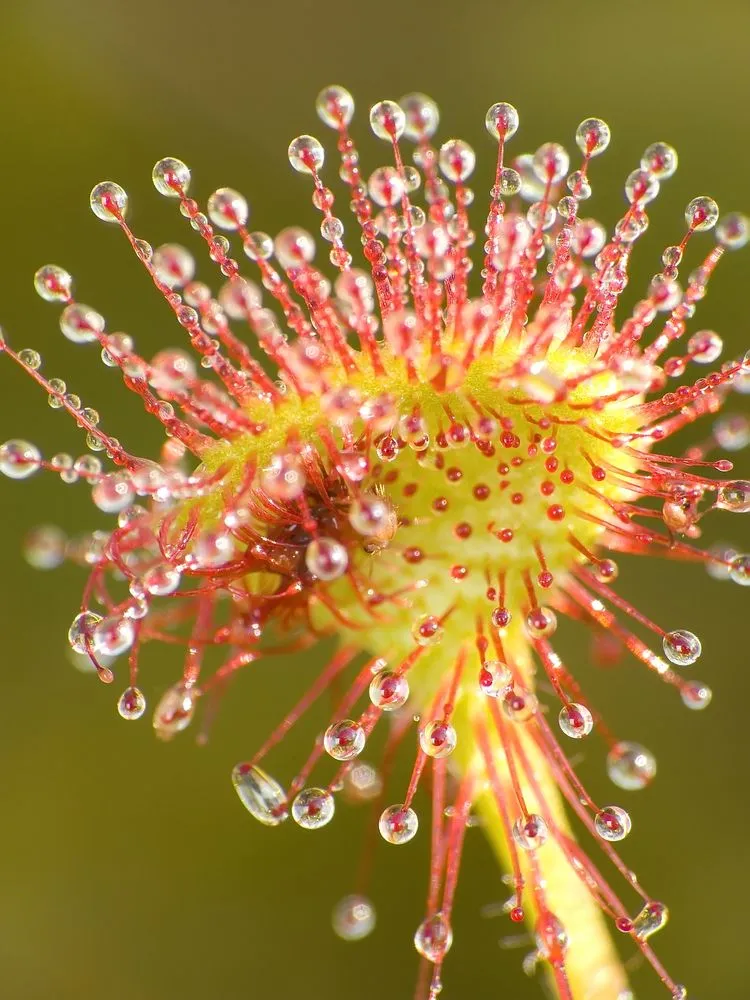
The fluid, however, isn’t any normal shiny fluid. The sticky gland, at the tip of the tentacles produces this fluid, which has strong adhesive properties. The insects get stuck to the tips of the tentacles. The tentacles then curl and wind around the body of the insect, making it impossible for the insect to escape. Thus, the unlucky prey is suffocated and killed by these beautiful appendages of the leaf.
To conclude, insectivorous plants are a marvel to look at and even more interesting to watch when they are capturing prey. It’s even more amazing to know how their genetic development occurred… You can continue reading about it here!
References (click to expand)
- Bauer, U., Paulin, M., Robert, D., & Sutton, G. P. (2015, October 5). Mechanism for rapid passive-dynamic prey capture in a pitcher plant. Proceedings of the National Academy of Sciences. Proceedings of the National Academy of Sciences.
- Vincent, O., & Marmottant, P. (2011, November). Carnivorous Utricularia: The buckling scenario. Plant Signaling & Behavior. Informa UK Limited.
- Płachno, B. J., Świątek, P., Adamec, L., Carvalho, S., & Miranda, V. F. O. (2019, March 26). The Trap Architecture of Utricularia multifida and Utricularia westonii (subg. Polypompholyx). Frontiers in Plant Science. Frontiers Media SA.
- Sundews | National Wildlife Federation. The National Wildlife Federation
- Drosera - an overview | ScienceDirect Topics. ScienceDirect
- Carnivorous plant. Encyclopaedia Britannica.
- Burri, J. T., et al. (2020). A single touch can provide sufficient mechanical stimulation to trigger Venus flytrap closure. PLoS Biology. PMC, NCBI.