Table of Contents (click to expand)
A spittlebug nymph builds its frothy cocoon from its own watery waste, not saliva, whipping air into it to make foam. The spittle mass hides the soft nymph from predators, keeps it from drying out, and (per a 2018 study) buffers its temperature, staying a few degrees cooler than the surrounding air.
Imagine living in a home made entirely of your own spit. Gross, right? Well, that’s the way the spittlebug chooses to exist.
Every spring, young and immature spittlebugs find shelter in bubbly cocoons made of their own saliva. Take a walk through a garden and you’ll notice the white frothy mass on many plants.
So, what’s the point of this odd behavior? Why does the spittlebug make its home out of saliva?
What Is A Spittlebug?
The spittlebug is a tiny insect (the common meadow species is only about 5 to 7 mm, under a third of an inch) that belongs to the order of true bugs (Hemiptera) and the superfamily Cercopoidea. These little guys are plant pests, like their relatives, the aphids and cicadas.
Like so many mysterious beings, the spittlebug has an alias. “Spittlebug” is only the name of the larvae, or nymphs, as entomologists might insist we call them, that encases itself in a foamy home. The adults are called froghoppers, because they look a bit like frogs and can jump as high as 70 cm (about 28 inches), which is very impressive considering these little fellows are only a few millimeters long. In fact, the froghopper is often described as the best jumper in the animal kingdom, out-leaping even the flea relative to its size.
However, just because the adult has the name froghopper doesn’t mean that the juvenile versions can’t hop. A spittlebug can actually jump over 100 times its own length!
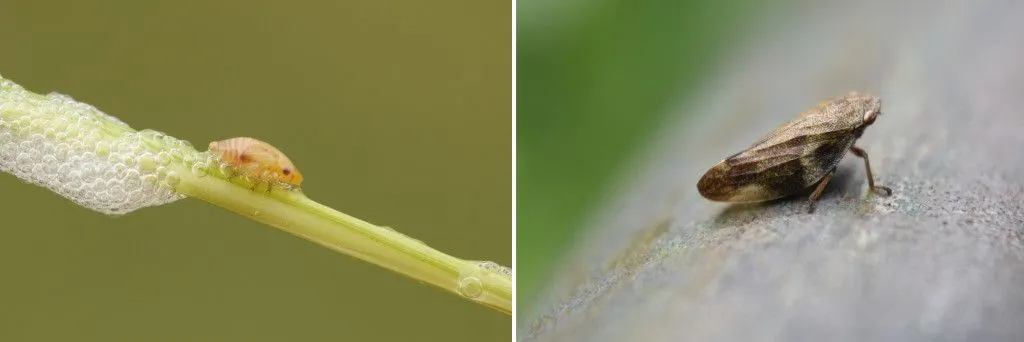
There are many species of spittlebugs with different plant hosts, lifestyles (the spittlebug is a huge fan of detox juices and clean eating), and appearance.
The adults lay their eggs in autumn, and by spring, the little nymph spittlebugs are ready to molt into froghoppers.
Spittlebugs feed on water running through the plant’s xylem vessels. The xylem vessels carry water absorbed by the roots to the rest of the plant. The other nutrient-carrying vessels in plants are called phloem tubes. Phloem transports the sugary food made by the leaves through photosynthesis to the rest of the plant.
It is the water from the xylem tubes that allows spittlebugs to make their homes.
What Is Spittle?
When I said that the nymphs live in their spittle, that wasn’t entirely true. They do live in white fizzy abodes, but that isn’t actually their spit, in the sense that it isn’t secreted from their mouth.
Instead, it’s the spittlebugs rear end that secretes their cocoon (i.e., a home made of poop).
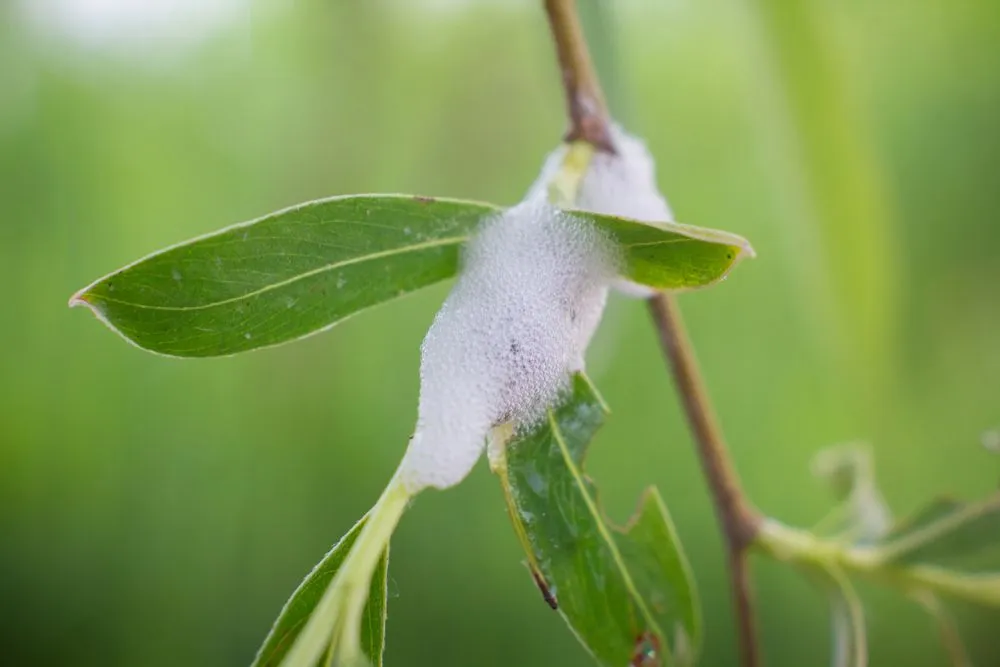
The spittlebug feeds with its head facing downwards and its butt pointing up.
The nymph’s main diet is the nutrient-rich water coursing through the plant’s xylem vessel. It sucks up the xylem juices by inserting stylets (mouth parts) into the xylem pipe and basically sipping the liquid as it flows by. Since it’s mainly water, the xylem juice (not a technical word) is quickly processed by the nymph, who can produce watery excreta that is approximately 280 times its own body weight!
Into this watery excreta, glands in the nymph’s abdomen secrete surfactants that reduce the surface tension of water and allow bubbles to form. Then, rather than exhaling through its breathing tubes, the nymph pumps its abdomen up and down, dipping the tip in and out of the fluid to scoop pockets of air into the surfactant mixture. Bubble by bubble, the spittle home is ready.
However, not all spittlebugs live in spittle. Those in the Machaerotidae family are called tube spittlebugs because, predictably, they live inside tubes that are calcareous (built from calcium carbonate they extract from the xylem) and decidedly not spittle (or poop!).
The Function Of The Spittle Mass
The actual function of spittle cocoons is surprisingly unclear, though it is believed that the spittle mass helps keep the nymphs moist and hides them from predators. In fact, many frogs adopt a similar strategy, encasing their own young in frothy surroundings to fend off predators and stop the eggs from drying out. The foam does not make spittlebugs invincible, though. They are hunted by birds, ants, predatory bugs, and parasitic wasps, and the shifting, sticky froth seems to work partly by denying these enemies a foothold rather than by hiding the nymph completely.
A 2018 study suggested that the spittle also helps the nymph keep cool. Insects are ectothermic, which means that their body temperature tracks that of their environment. The ancestor of the spittlebug was subterranean and comfortable in the cool temperatures of moist soil. The researchers proposed that the foam acts as an extension of that soil: in their field measurements, the spittle stayed roughly 4 °C (about 7 °F) cooler than the surrounding air on a hot day, holding the nymph at a steady, soil-like temperature.
A Final Word
Finally, after 1 to 3 months of feeding, the spittlebugs emerge as froghoppers. These froghoppers will then find a mate and lay their eggs during the autumn to winter period. In the spring, a new generation of spittlebugs will hatch, ready to suck the water from the xylem vessels of plants and create their own spittle masses.
Unfortunately for us, spittlebugs are plant pests. By continuously sucking out the plant’s water supply, the bug can wilt or even kill the plants. Rice, sugarcane, and even garden roses fall prey to these heartless suckers, and the meadow spittlebug alone has been recorded feeding on well over a thousand kinds of plant.
The bigger problem is what they can carry. The meadow spittlebug (Philaenus spumarius) is the main European carrier of Xylella fastidiosa, a bacterium it picks up while feeding on the xylem and passes to the next plant it sips from. In southern Italy, this bug-and-bacterium combination has driven Olive Quick Decline Syndrome, killing millions of olive trees across the Apulia region and putting Mediterranean olive groves on alert. The same bacterium attacks grapevines, citrus, and almonds elsewhere in the world, which is why an insect best known for its harmless-looking froth is now taken very seriously by farmers.
That being said, for us ordinary folks without agriculture problems, it is fascinating to see their frothy homes emerge every spring. Nature certainly does find the most bizarre ways to keep its creatures alive!
References (click to expand)
- Tonelli, M., Gomes, G., Silva, W. D., Magri, N. T. C., Vieira, D. M., Aguiar, C. L., & Bento, J. M. S. (2018, March 16). Spittlebugs produce foam as a thermoregulatory adaptation. Scientific Reports. Springer Science and Business Media LLC.
- YURTSEVER, SELÇUK (2000) "On the Polymorphic Meadow Spittlebug, Philaenus spumarius (L.) (Homoptera: Cercopidae)," Turkish Journal of Zoology: Vol. 24: No. 4, Article 13. Available at: https://journals.tubitak.gov.tr/zoology/vol24/iss4/13 - Scientific and Technological Research Council of Türkiye
- Spittlebugs in home gardens | UMN Extension. extension.umn.edu
- Burrows, M. (2003). Biomechanics: Froghopper insects leap to new heights. Nature, 424(6948), 509.
- Cornara, D., Saponari, M., Zeilinger, A. R., et al. (2017). Spittlebugs as vectors of Xylella fastidiosa in olive orchards in Italy. Journal of Pest Science. NCBI PMC.
- Spittlebugs. Wisconsin Horticulture, University of Wisconsin-Madison Extension.