Table of Contents (click to expand)
Mosquitoes circle over your head because the head is a strong source of the cues they hunt by: exhaled CO₂, body heat radiating from a well-vascularized scalp, and a cocktail of volatile odour molecules from sweat, skin microbes and hair. Recent research has shown that hair gels, oils and other personal-care products add their own scent compounds to that cocktail, often making the head even more attractive. Some of the swarms you see are also male mosquito mating swarms, which use any tall object (including a person’s head) as a visual marker.
In today’s world (or at any other time, for that matter), it is a surprise to find any human being who actually likes mosquitoes. It’s as if people inherently despise those tiny (and sometimes not-so-tiny) bugs that land on us and do irreparable and ‘bloody’ damage.
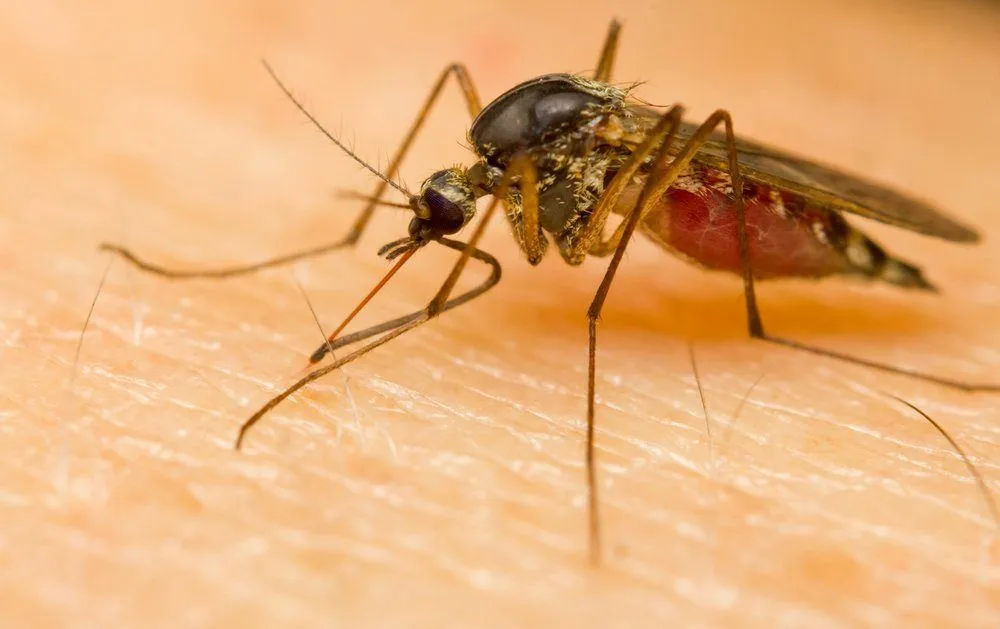
However, all prejudice aside, have you ever observed a rather queer thing about mosquitoes – that they tend to love some people more than others? Also, have you ever noticed how mosquitoes tend to hover over your head at times, especially at night, and more so if you have applied any gel or hair product?
Mosquitoes’ Interests
It’s not only mosquitoes that have this rather weird habit of hovering over your head; other flies and bugs also do that. There may be several reasons why an insect chooses to hover over your head; many of these reasons are the same as why mosquitoes bite some people more frequently than others.
If it’s a female mosquito, then it hovers over your head because it’s quite interested in you! More specifically, it’s interested in the carbon dioxide and other substances (including sweat, scent and heat) that you are constantly releasing. They have sensors on their antennae that detect these things and effectively help them locate a source of food.

You’re more prone to having circling mosquitoes above your head if you have just come back from the gym or have otherwise performed some rigorous physical activity that caused you to sweat a lot (perspiration). Mosquitoes are particularly fond of octenol (a chemical found in human sweat), so if you’re sweating a lot, by default, you become a ‘sweet’ target for them to hover over and then land upon.
How You Become The Best Target In A Group?
At times, you may have observed that while talking to your friends in a group at a park, a swarm of mosquitoes may circle above your head exclusively, seemingly ignoring all the other people; it’s as if the mosquitoes had something against you specifically. That doesn’t make much sense though, so what difference do mosquitoes see between you and your friends?

Barring other factors like carbon dioxide release, body odor and blood group, the one thing that’s making that swarm of mosquitoes hover over your head is that you have gelled your hair or applied various hair products, while others in your group haven’t.
Mosquitoes are strongly attracted to body heat, and the scalp is one of the warmest, most well-vascularized parts of the body. Hair traps that warm air against the skin and slows the evaporation of sweat, so the head ends up emitting a steady plume of warm, humid, odour-rich air. On top of that, recent research has shown that personal-care products (soaps, gels, oils, perfumed serums) add their own volatile compounds to your “smell signature”, and many of these compounds measurably alter mosquito attraction. So when you’ve just oiled or gelled your hair, you’re effectively running a heat-and-scent broadcaster on top of your head.
Mating Swarms
Mosquitoes (usually males) and some other types of flies often form ‘mating swarms’ over objects; these are usually inanimate things, like a tree or a boulder, but sometimes they use the head of a human being or some other animal. This swarm consists of many male mosquitoes, sometimes numbering even in the thousands! Whenever a female mosquito encounters such a swarm, the male that successfully courts her is usually the one whose wing-beat frequency best matches hers. Mosquito mating is largely an acoustic affair rather than a tournament of strength.

As mentioned earlier, the chances of such a huge number of mosquitoes hovering over a human’s head is extremely slim, because they will usually find much bigger, inanimate objects on which to perform this strange ritual. However, if it’s a small swarm of mosquitoes, it’s not uncommon to see it moving in alignment with the object. That’s the reason why jerking your head vigorously won’t make the mosquitoes go away!
Next time you see a swarm of mosquitoes hovering over your head, you’ll know that it’s either a group that has taken a keen interest in you, or a bunch of bugs trying to make sure that their individual lineage continues to flourish.
Can Mosquitoes Actually Bite Your Scalp?
So a mosquito is circling your head (and sometimes buzzing right in your ear), drawn in by all that warm, scented air. The obvious next question is whether it can actually land and feed up there, or whether your hair keeps it out. The first thing worth remembering is that only female mosquitoes bite. A male’s mouthparts simply aren’t built for the job; according to the CDC, “the male’s proboscis is not strong enough to pierce skin, and males do not feed on blood.” The female, on the other hand, needs your blood to mature her eggs, so when she lands it’s strictly business.

Whether she gets a meal out of your head depends largely on how much skin is on offer. According to the American Mosquito Control Association, biting is triggered by a combination of carbon dioxide, temperature, moisture, smell, color and movement. Your scalp ticks almost every one of those boxes, but a female still has to reach skin with that needle-thin proboscis. A thick head of hair acts like a hedge: it gets in the way, and most mosquitoes will give up and settle for easier-to-reach exposed skin. The feet are a notable favorite. A study in Scientific Reports found that volatiles collected from the feet were significantly more attractive to malaria mosquitoes than those from the armpits, which is consistent with how often bites land down around the ankles rather than on top of your head.
That said, your head is hardly off-limits. The forehead, the hairline, a center part, the temples and the patch of neck just below your hair are all exposed skin within easy reach, and a thinning or shaved scalp removes the barrier entirely. A bite there feels much like one anywhere else: a small itchy bump raised by your immune system reacting to the mosquito’s saliva. So the short answer is yes, a mosquito can absolutely bite your scalp and forehead. The hovering you notice is simply the prelude, the female lining up a landing on whatever bare skin your head is willing to offer.
References (click to expand)
- Why do mosquitoes bite me and not my friend?. The Library of Congress
- Fradin, M. S. (1998, June 1). Mosquitoes and Mosquito Repellents: A Clinician's Guide. Annals of Internal Medicine. American College of Physicians.
- Butail, S., Manoukis, N. C., Diallo, M., Ribeiro, J. M. C., & Paley, D. A. (2013, May 1). The Dance of MaleAnopheles gambiaein Wild Mating Swarms. Journal of Medical Entomology. Oxford University Press (OUP).
- About Mosquitoes. Centers for Disease Control and Prevention (CDC).
- Mosquito Biology. American Mosquito Control Association.
- Verhulst, N. O., et al. (2016). Attractiveness of volatiles from different body parts to the malaria mosquito Anopheles coluzzii is affected by deodorant compounds. Scientific Reports. NCBI / PMC.
- Mosquito Bites. Cleveland Clinic.