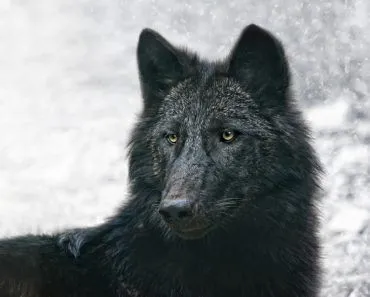
Wolves don’t actually howl at the moon. They tilt their muzzles upward when howling because it carries the sound further—a full-throated wolf call can travel up to 6 miles through forest and up to 10 miles over open ground. They howl to keep contact with their pack, defend their territory from rival packs, and signal availability to mates, mostly during their crepuscular dawn and dusk activity peaks.
If you’ve ever been out camping in the wilderness and hear the silence suddenly cracked by the howl of a wolf, then you understand the entrancing and hair-raising call of the wild. Ever since childhood, we have been told that wolves howl at the moon, and if you’ve ever seen a picture of a wolf with its muzzle turned towards the sky, bathed in moonlight, that explanation makes a lot of sense.
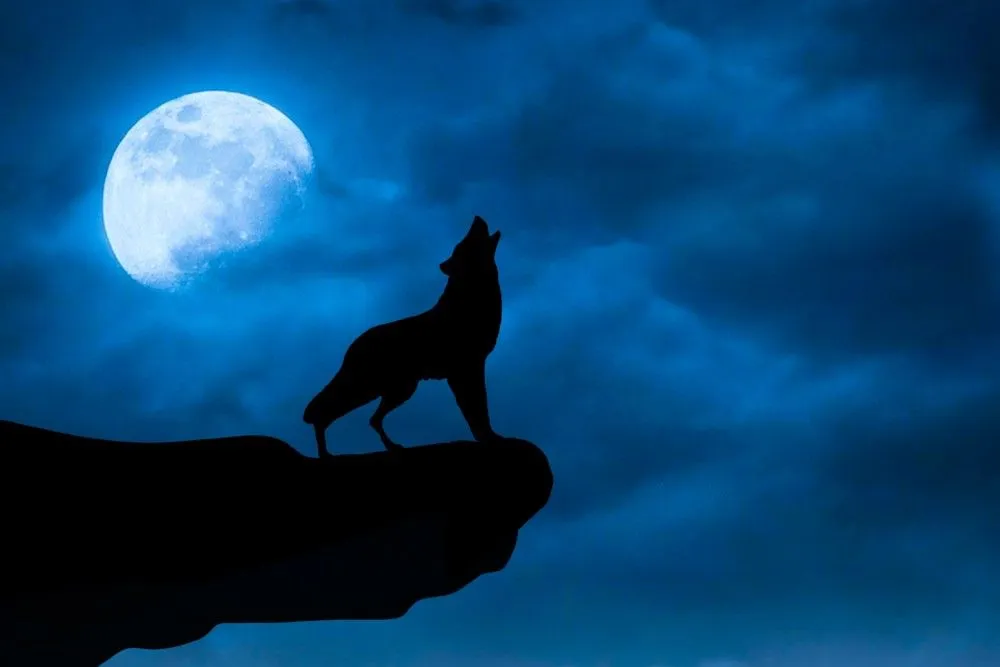
Are Wolves Calling To The Moon?
It may be a romantic notion, but the truth of the matter is that wolves aren’t howling at the moon; they have no more interest in our lunar companion than the rabbits they hunt and the fleas living in their fur. Before we get into the actual reason behind the howling of wolves, it is important to clear that question up.
Throughout human history, different cultures have created stories to explain things they don’t understand. Natural phenomena were often paired with such traditional stories, and passed down between generations. In Greek, Roman and Norse mythology, there was a strong connection between wolves and the moon, and Native American legends often saw wolves as the guardians of the moon, howling it into existence at night. Over the centuries, these legends faded into traditional, and even common knowledge, despite not having any real basis in science, merely in anecdotal experience.

Numerous research studies in modern times have shown that wolves do not howl in any sort of pattern in regards to the moon. In other words, whether it’s a full moon, a new moon, or anything in between, including a completely cloudy sky, or if the moon hasn’t even risen, wolves are still known to howl. There is no statistical significance to their frequency, duration or intensity in connection to the presence of the moon.
So…. why are they howling at all?
The Howls Of Wolves
Wolf howls may be some of the most dramatic and spine-chilling calls in nature, but they are similar to the calls of countless other animals, from primates and owls to whale songs and the croaking of toads. Communication in animal species is just as important as it is in humans, whether it is to warn others of danger, signal where food can be found, seek out a mate, or signal your location when lost. Human language may seem exponentially more complex, but there is a remarkable amount of nuance in the calls of wild animals. More importantly, when it comes to wolves, more research has been done on their distinctive howls than almost any other species.
While the most common argument behind the whole “wolf calling the moon” phenomenon is their upturned heads while howling, there is a very simple explanation for that—it helps the sound travel further. A full-throated wolf call can sometimes be heard up to 6 miles in any direction, and if they are on flat, unobstructed ground, their call can travel up to 10 miles. This allows wolves to remain in contact with one another even when a pack is spread thin.
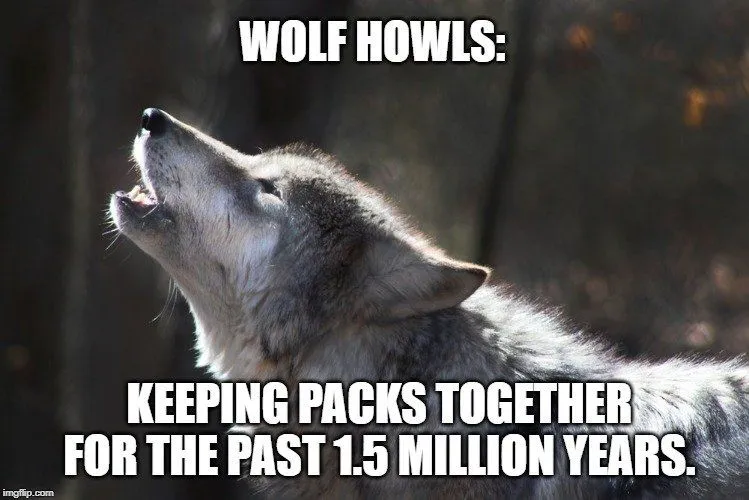
Secondly, wolves do most of their howling around dawn, dusk, and through the night because they are crepuscular—most active in the low-light hours rather than the middle of the day—so the night is when they most need to communicate with one another at distance. Wolves also bark, whimper and growl, all of which are sounds that humans are more used to, due to their close relationship with domesticated dogs. However, even your pet pooch will occasionally cry out like a wolf if they hear other dogs doing it in the neighborhood. They may be trained and have cute names like Fido and Princess, but don’t forget that dogs are still wild animals, and have some of those old wolf tendencies!
As you can imagine, wolves need to communicate with each other about some basic things—danger, location, mating and dominance being the major “topics of conversation”. The basic reasons that a wolf howls include signaling to the rest of the pack where they are located, which can help the pack unify if they’ve been split apart for some reason. Howling is also a warning for other packs or lone wolves to steer clear, since an established pack is holding the territory. This leads into the most interesting form of wolf howls, called “chorus howls”, in which multiple wolves howl together, making it difficult to tell how many wolves are in a given pack. This bit of trickery is used by packs to keep their size/strength hidden from rival packs, making those rivals less willing to fight for territory or mates.
There are other secondary reasons for wolf howls, which can often be delineated by the volume, pitch and duration of the howls. Lower-pitched and more frequent howls tend to come from dominant males, while higher-pitched howls, which can often be mistaken for whimpers, are signs of submission. These howls will also help to establish the pecking order for mating, with alpha males howling out more intensely to signal or attract potential mates.
Interestingly enough, for “lone wolves”, those who have lost their pack or been ostracized, howling can be a liability. Without a pack to support a wolf in their time of need or during a fight, howling could signal other predators or reveal their location. So, while howling is a way to confirm your place within a pack, it can have a decidedly negative effect for wolves without a group.
Why Do Wolves Howl At Night?
If wolves aren’t serenading the moon, why does almost every howl you’ve ever heard seem to come after dark? The short answer is timing. As we saw above, wolves are crepuscular, doing most of their moving, hunting, and socializing around dawn, dusk, and through the night, so those are simply the hours when they most need to communicate with one another. A howl is a long-distance message, and it pays to send it when the pack is awake and on the move.

There is also a neat bit of physics working in their favor. After sunset, the ground cools quickly while the air higher up stays warmer, creating what acousticians call a temperature inversion. Because sound travels faster in warmer air, a howl leaving the ground is bent, or refracted, gently back down toward the earth instead of escaping upward into the sky. The result is that low, drawn-out calls carry noticeably farther and more clearly on a still night than they would through the harsh, turbulent air of midday. So even though a wolf isn’t choosing the night for its acoustics, the night obligingly stretches its voice across the landscape.
Field research backs up how important this after-dark chatter is. In a classic Minnesota study, biologists Fred Harrington and L. David Mech found that wolves reply to howls to advertise their territory and keep rival packs at a distance, a kind of vocal fence-building that works best across the quiet of the night.
Wolves, Werewolves And The Moon
So why did our ancestors ever pair wolves with the moon in the first place? The likeliest answer is simple observation. Wolves are most vocal in the dark, which is also when the moon is on display, so people heard the howling, saw the moon overhead, and linked the two. It is a classic case of correlation being mistaken for causation, and it seeded a surprising amount of folklore.

That folklore runs deep. In Greek myth, King Lycaon of Arcadia served human flesh to Zeus and was punished by being turned into a wolf, and his name shares its Greek root, lykos (wolf), with the word lycanthropy, meaning “wolf-man”. Wolves prowl through Norse sagas and Native American legend alike, frequently tied to the night sky.
The werewolf is where the moon myth gets its firmest grip, and here history holds a surprise. In the oldest tales, the change from human to wolf was triggered by magic, a curse, or a wolfskin belt, not by the moon at all. The notion that a full moon forces the transformation is startlingly recent: it was a Hollywood addition. The Universal cycle that began with The Wolf Man (1941) shaped much of the modern template, and the full-moon trigger itself first reached the screen in Frankenstein Meets the Wolf Man (1943). So the next time a movie werewolf turns beneath a swollen moon, remember that you are watching a 20th-century screenwriter’s invention, not ancient lore. Whether the moon genuinely steers animal behavior at all is a question science has actually put to the test.
What Does It Mean To “Howl At The Moon”?
Given how firmly the picture is lodged in our imagination, it is no surprise that “howl at the moon” (and its close cousin “bay at the moon”) became an English idiom in its own right. Figuratively, to howl at the moon means to spend your time and energy on something hopeless, to complain or protest loudly with no real chance of changing the outcome. Picture a lone dog barking up at a distant, indifferent moon and you have the whole sentiment: plenty of noise, no result.
The expression leans on exactly the futility this article has been describing. The moon is not listening, it never was, and no amount of howling will draw it any closer. So when someone says a frustrated critic is “just howling at the moon”, they mean the effort is heartfelt but pointless. It is a fitting turn of phrase, because it quietly folds a piece of natural history into everyday language, reminding us that the loudest voice in the room is sometimes the one aimed at something that simply cannot be moved.
A Final Word
Next time you’re out in the woods and hear a wolf howl beneath a full moon, it isn’t the start of a werewolf horror movie, nor are the beasts of the forest communicating with celestial objects. They are simply using their voices to communicate over long distances to protect themselves and their pack, define their territory, or lure in potential mates to pass along their genes and keep the pack strong!
References (click to expand)
- Are Wolves Really Howling at the Moon? - Mental Floss. Mental Floss
- Do wolves really howl at the moon? - Animals | HowStuffWorks. HowStuffWorks
- Mech L. D.,& Boitani L. (2007). Wolves: Behavior, Ecology, and Conservation. University of Chicago Press
- SCOTT, J. P. (1967, May). The Evolution of Social Behavior in Dogs and Wolves. American Zoologist. Oxford University Press (OUP).
- (2000) Leadership in Wolf, Canis lupus, Packs - UNL Digital Commons. The University of Nebraska–Lincoln
- Harrington, F. H., & Mech, L. D. (1979). Wolf Howling and Its Role in Territory Maintenance. Behaviour - UNL Digital Commons
- Russell, D. A. Refraction of Sound Waves. Acoustics and Vibration Animations - Pennsylvania State University
- howl at the moon - Wiktionary, the free dictionary
- Werewolf - Wikipedia