Animals communicate through four main channels: visual signals (colors, displays, and dances), auditory signals (bird songs, roars, and chirps), touch (grooming and other contact that builds social bonds), and chemical signals such as pheromones. Each channel carries messages about mating, danger, territory, and food.
Why did one cow disagree with the other? Because it made a ‘moo’ point!
All jokes aside, do you think animals are actually saying something to each other when they utter that wide variety of cries, squawks, barks, and growls? Is there something behind the noises, or are they just meaningless sounds? A little digging on how animals communicate will tell you that uttering sounds, which is the dominant means of communication for humans, is only one of the many ways in which the members of animal and avian kingdoms communicate.
Visual Signals: Dances, Colors And Other Movements
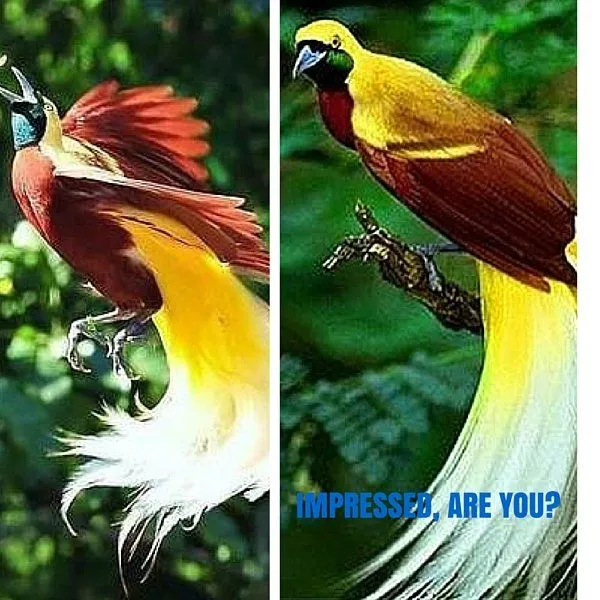
Unlike humans, visual communication in animals is the least effective, since it has prerequisites of proximity and adequate illumination, but birds and animals that conduct their activities during the day do utilize this form of communication. Amongst avian creatures, males usually have colorful plumage to attract the attention of females. Birds of paradise and peacocks are classic examples of this. The thickness and depth of color of a lion’s mane, for example, is a visual indicator for a female of his potency as a prospective mate.
Color in the animal kingdom conveys a lot of information, and is also used as a warning that signals predators to stay away. The bold colors of poison dart frogs, monarch butterflies, and wasps advertise that these creatures are toxic, foul-tasting, or armed with a sting, so a predator that has been stung or sickened once learns to leave them alone. Biologists call this honest advertising aposematism, and it acts as a built-in defense mechanism.
Movement is another characteristic visual cue. Research has shown that the "waggle dance" of forager bees is not random at all. A returning bee runs in a straight line while waggling her abdomen, then loops back to repeat it, and the dance encodes a surprisingly precise message: the longer the waggle run, the farther away the food, while the angle of the run relative to straight up tells the other bees the direction to fly relative to the sun. Karl von Frisch first decoded this "dance language" in work that earned him a share of the 1973 Nobel Prize. Not to mention, the whole exchange is quite entertaining to watch!
Auditory Signals: Bird Songs, Roars And Chirps
The cries that animals utter are limited to signals related to signifying danger, mating or foraging (food source) activities. Auditory signals are more advantageous for survival in the animal kingdom, since sound can travel much greater distances than visual recognition. Almost all animals and birds have some kind of cry that warns others of the presence of danger to members of their own species. The cuckoo sings and the frog croaks to communicate and attract potential sexual partners in their vicinity, as is true with millions of other species. Animals emit a very different cry to indicate pain, which is understood by members of the species, but perhaps not that different to human ears. This isn’t exclusive to land animals, but is also true of mammals living in the oceans, such as whales and dolphins, which “speak” to one another where visibility is greatly compromised. Baleen whales (blue, fin, and humpback whales) call at very low, often infrasonic frequencies, sometimes below 20 Hz, the same trait that lets their songs carry for tens or even hundreds of kilometers underwater. Dolphins, by contrast, rely on high-frequency, ultrasonic clicks and whistles that double as a kind of sonar.
Communicating By Touch:
Again, touch is a limiting aspect of communication, as it requires close proximity, but is nonetheless vital for social communication in the animal kingdom. Chimpanzees greet each other by holding hands, monkeys groom each other and, as pet owners should know very well, domestic animals commonly lick with their tongue to show affection.

Elephants, for example, are extremely tactile creatures and use their bodies to show many emotions, including affection, aggression, playfulness etc. Their trunks are generally used to caress, direct their young ones or hold other trunks as a sign of affection. Tusks are generally used to fight for herd dominance or protect the clan. Touching helps to strengthen bonds between animals both big and small, just like in humans!
Chemical Communication:
Chemical communication mainly involves pheromones, but it can also include bodily fluids, such as urine and, in certain animals, venom used for defense. This probably represents the strongest form of signal transmission among our four-legged brethren. Pheromones are a substance produced by an animal’s body that are released to convey information. Two different systems are required for chemical communication, classified based on whether it requires direct or indirect contact. In the case of indirect contact through airborne or aqueous mediums, chemical communication is perceived through the sense of smell and taste. For example, snakes can literally taste their enemies from a distance. They flick out their forked tongues to gather scent particles, then press the tongue tips against the Jacobson’s organ, a pair of chemical-sensing pits in the roof of the mouth, reading the chemical cues left by potential prey and predators before making their next slithering move!

Most big cats mark their territory by urinating, which warns other animals to stay away due to the pheromones in the smell. Dogs even sniff each other’s hindquarters to get valuable information about each other (gross!). Cats have a unique way of saying ‘you belong to me’. They rub their heads against a person or object to release the pheromones in glands located in their head and ear region, so that any other animal knows that they’ve claimed you already!
There are also alarm pheromones that the animal kingdom uses to rally defenders against predators. When a honeybee stings, she releases a chemical, isopentyl acetate (which smells faintly of bananas), from her sting apparatus to alert nearby bees. This recruits other workers to the same spot and can trigger a mass defensive attack on the intruder.
No wonder humans don’t understand what the rest of the animal world is saying! Unfortunately, we can’t blame it all on these more primitive forms of communication…. most of the time, we don’t understand what other humans are truly saying either!
References (click to expand)
- Animal communication - Encyclopaedia Britannica
- Low Frequency Sound Production and Reception in Mammals - Discovery of Sound in the Sea (University of Rhode Island)
- Chemical Communication in the Honey Bee Society - NCBI Bookshelf
- Wyatt, T. D. (2003). Pheromones and Animal Behaviour. Cambridge University Press. - Library of Congress