No, we cannot yet harness energy from tornadoes and hurricanes. A hurricane releases staggering power (its condensing water vapor alone equals about 200 times the world’s electricity-generating capacity), but that energy is spread out, chaotic, and mostly spent at sea. No existing technology can capture it.
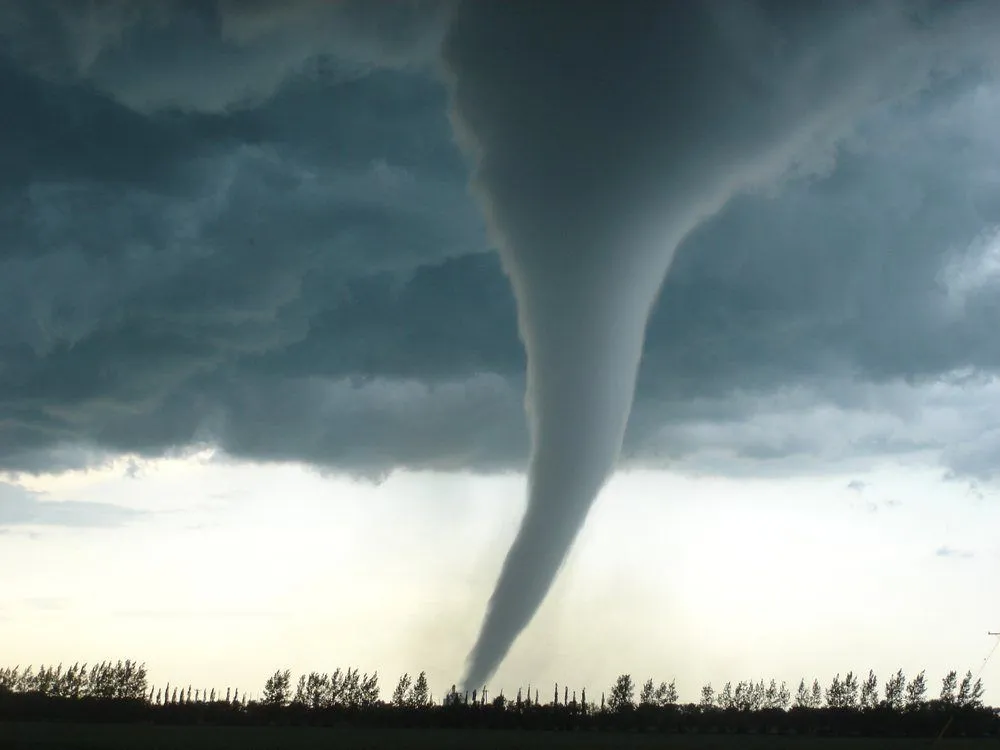
When you see a gigantic cone of swirling dust moving at a deadly pace and uprooting every structure in its path, you know that you’re looking at a tornado – preferably from a safe distance.
Tornadoes and hurricanes can leave massive amounts of damage in their wake. They are so powerful that anything that gets in their way, whether it is a car, a house or a building, is tossed like a rag doll (if the storm is strong enough). However, has this thought ever occurred to you… what if that power and that immense energy could somehow be captured and harnessed? What if we could actually generate electricity from the power of a tornado or a hurricane?

Power Of Tornadoes And Hurricanes
Needless to say, tornadoes and hurricanes are very powerful. This is evident from many unfortunate natural disasters in the past, when twisters and storms destroyed entire cities. According to the U.S. National Oceanic and Atmospheric Administration (NOAA), an average hurricane releases roughly 6.0 x 10¹⁴ watts simply by condensing its water vapor into clouds and rain. That figure is about 200 times the electricity-generating capacity of the entire world. Yes, the entire world! Obviously, there is some extraordinary power packed into a hurricane.
Unfortunately, that jaw-dropping number is not as useful as it sounds. The power a tornado or a hurricane wields is not released in a neat, uniform way. These storms are messy and constantly on the move, and most of that energy goes straight back into churning the air, water, and clouds that keep the storm alive, rather than sitting somewhere we could plug into.
Let’s Talk About Harnessing Energy
The mere idea of harnessing energy from such a dangerous and unpredictable storm is fascinating and terrifying at the same time. The concept is interesting because these storms carry immense energy that we would absolutely love to use, particularly in our energy-hungry modern age, but the idea is also terrifying because it won’t be easy to accomplish.
Hurricanes
According to Chris Landsea, the science and operations officer at the U.S. National Hurricane Center, how you harness the energy depends entirely on what you use to do it. Let’s consider the case of a hurricane. In terms of a hurricane, these storms release most of their energy and heat while condensing water vapor into droplets. With the current technology available, we have no way of harnessing that type of heat energy.

To make matters worse, a hurricane spends most of its energy while at sea, making it even harder to capture from a logistical perspective. When a hurricane hits land, it has already lost most of its energy and momentum, so it is not nearly as full of energy as it was while at sea.
Tornadoes
When we turn this energy-harnessing idea to tornadoes, one route is to chase the real thing. To survive a tornado, a turbine would have to withstand extreme pressures and wind speeds and be mobile enough to reach the storm’s path in the first place, so building a windmill tough and nimble enough is a tall order. A cleverer route is to skip the wild tornado entirely. Canadian engineer Louis Michaud has proposed an atmospheric vortex engine, a station that uses waste heat to spin up a controlled, tethered vortex (essentially a tame tornado) whose rising column drives turbines on the ground. It is a promising concept, but it remains experimental and has yet to be built at scale.
Why Can’t A Wind Turbine Just Sit In A Tornado’s Path?
If a tornado is basically a tower of fast-moving air, why not park a giant windmill where it will hit and let it spin? The trouble is baked into the physics of wind power. The energy a turbine can pull from moving air rises with the cube of the wind speed, so doubling the wind doesn’t double the power, it multiplies it roughly eightfold. A tornado’s winds are exactly what makes that idea so tempting, and exactly what makes it impossible.
Ordinary wind turbines are built for a gentle slice of that range. They start generating at a light breeze and reach full output at moderate wind, but once the wind climbs to around 25 metres per second (about 90 km/h or 56 mph), they deliberately feather their blades and shut down to avoid tearing themselves apart. That is the cut-out speed. Most commercial turbines are engineered to physically survive winds in the region of 60 metres per second (about 216 km/h or 134 mph). Now compare that to a top-tier twister: an EF5 tornado, the strongest rating on the U.S. National Weather Service’s Enhanced Fujita Scale, packs estimated winds of over 200 mph (322 km/h). A machine built to bow out at 56 mph would be obliterated long before the funnel arrived. Even setting survival aside, a German physicist named Albert Betz showed back in 1919 that no turbine can extract more than about 59.3% of the wind’s energy (the so-called Betz limit), and real turbines manage only 35 to 45%. So a tornado isn’t just a stronger version of a good wind site. It is so far outside the operating envelope that the honest answer is to not aim a fixed turbine at one at all.
Could A “Tame Tornado” Generate Power Instead?
If you can’t survive a real tornado, the clever workaround is to build a small, well-behaved one. That is the idea behind the atmospheric vortex engine (AVE), proposed by Canadian engineer Louis Michaud and his company AVEtec. Instead of chasing a storm, the AVE creates its own vortex: warm, low-grade waste heat (for example, the leftover heat a power station normally dumps) warms the air inside a circular arena, and that air is fed in at an angle so it begins to spin. The rising, twisting column behaves like a controlled tornado anchored over the site, and the air rushing in to feed it spins turbines at the base. The vortex itself does the job a tall chimney would otherwise do, without the chimney.
The appeal is that the heat is essentially free. Michaud has argued that tapping the waste heat from a typical 500-megawatt thermal power plant could yield on the order of 200 megawatts of extra electricity (a roughly 40% boost) at less than three cents per kilowatt-hour, with no extra fuel and no added greenhouse gases. The concept drew enough interest that Peter Thiel’s Breakout Labs put up $300,000 to fund a prototype, built with Lambton College in Sarnia, Ontario, where an 8-metre-wide arena spun up a 40-metre-tall test vortex. It is a genuinely promising route to harnessing tornado-like power, but it is still a research project rather than a working power plant, and a full-scale AVE has yet to be demonstrated.
Could Offshore Wind Farms Tame A Hurricane?
Capturing a hurricane’s energy head-on is off the table, but there is a subtler, well-studied possibility: using wind farms to blunt a hurricane and harvest some of its outer winds at the same time. In a 2014 study published in Nature Climate Change, researchers Mark Jacobson of Stanford University with Cristina Archer and Willett Kempton of the University of Delaware simulated huge arrays of offshore turbines placed in the path of real storms, including Hurricanes Katrina, Sandy, and Isaac.

The results were striking. Because each turbine pulls energy out of the wind passing through it, a dense wall of tens of thousands of turbines acts like a brake on the storm’s rotating outer edge. In the model, an array large enough reduced peak hurricane wind speeds by up to about 92 mph for Katrina and 87 mph for Sandy, and cut the storm surge by up to 79% for Katrina and 34% for Sandy. Two caveats keep this from being a magic bullet: the arrays modelled were enormous, far bigger than anything built today, and the turbines would still ride out the weakened storm rather than capturing its full fury. But it reframes the question. We may never plug a turbine straight into a hurricane, yet ordinary renewable energy infrastructure, scaled up enough, might one day both generate power and soften the blow when a storm reaches the coast.
As of today, it’s not possible to harness the energy from a tornado or a hurricane directly, but in the future, there’s no telling what sort of advancements we may discover. Once we have the required technology to achieve this unbelievable feat, we’ll harness as much of that overwhelming natural energy as we possibly can!
References (click to expand)
- Can We Really Make Tornadoes for Energy? This Man Wants .... National Geographic
- Can we harness energy from tornadoes and hurricanes?. HowStuffWorks
- How much energy does a hurricane release? Hurricane Research Division FAQ. NOAA AOML
- The Enhanced Fujita Scale (EF Scale). NOAA National Weather Service
- Betz limit. Energy Education, University of Calgary
- Controlled Tornadoes Create Renewable Energy. Discover Magazine
- Silicon Valley Funds Ontario Inventor’s Atmospheric Vortex Engine. POWER Magazine
- Offshore wind farms could tame hurricanes before they reach land. Stanford University School of Engineering
- Taming hurricanes with arrays of offshore wind turbines. Nature Climate Change