Technology inspired by nature is called biomimicry: copying nature’s tried-and-tested designs to solve human problems. Athletes’ swimsuits borrow from shark skin, breathable sports fabric from plant stomata, wind-turbine blades from humpback whale fins, and Japan’s bullet-train nose from the kingfisher’s beak.
Nature is perfectly imperfect, and it is constantly evolving and adapting. The parts that are beneficial remain, while the parts that are not will be discarded or adapted to the changing conditions on the planet. Nature, through constant tinkering, has found some truly unique design solutions, from the trunk of an elephant to the spiny nature of a cactus. Even termite mounds are built like natural chimneys that let air circulate in and out, keeping the colony comfortable. Architects have borrowed the idea: the Eastgate Centre in Harare, Zimbabwe, uses a termite-inspired passive cooling system that runs on a fraction of the energy a conventional building of its size would need.
So, the world’s smartest designers and engineers have based many of our man-made technologies on nature’s designs. Believe it or not, there is a whole field of biology that deals with mimicking strategies found in nature to invent and develop technology. This specialization is known as biomimicry, which literally means “the imitation of life”.
Together, let’s learn about some tips mankind has picked up from nature’s elegant solutions.
Wind Turbines And Whale Fins
The humpback whale is an incredibly large and magnificent creature. For something the size of a school bus, weighing up to about 36 tonnes (40 tons), it swims remarkably well. The agility and precision with which it cuts through the water is simply genius engineering. Its ability to do this is primarily due to the bumpy tubercles on its fins.
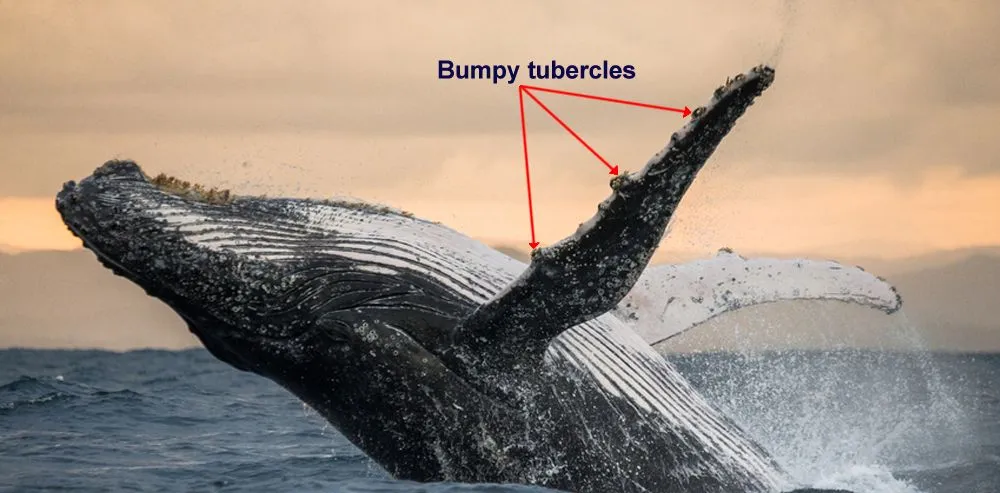
The tubercles allow the whale to cut through the water with speed and grace by reducing the drag and resistance that the whale feels while swimming through the ocean. These tubercles have inspired the design of more stable airplanes, windmills, and submarines. Oddly enough, Dr. Frank Fish discovered these projections and their beneficial effects. In 2005 he co-founded a company called WhalePower, which used the same bumpy leading edge to make wind-turbine blades that capture more energy at low wind speeds and stall less easily than smooth blades.
Breathable Sports Clothing Fabrics And Stomata
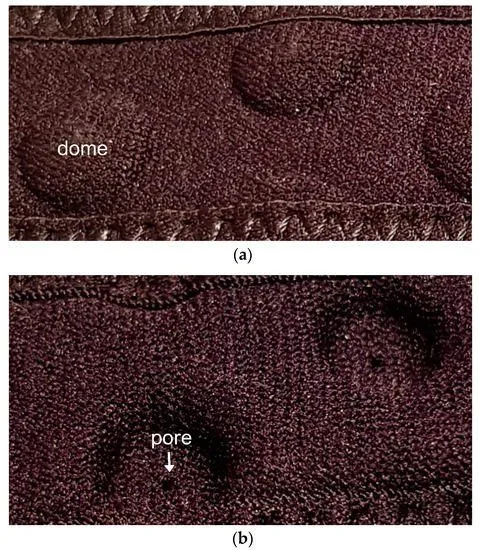
While working out, I like to wear sports clothes, those made of breathable material that doesn’t hold your sweat. Stomatex®, a company that designs such sports clothes, developed a fascinating material that has pores resembling plant stomata. Just like how plant stomata are responsible for gas exchange in plants, the pores in the fabric allow for better ventilation, making the fabric more breathable.
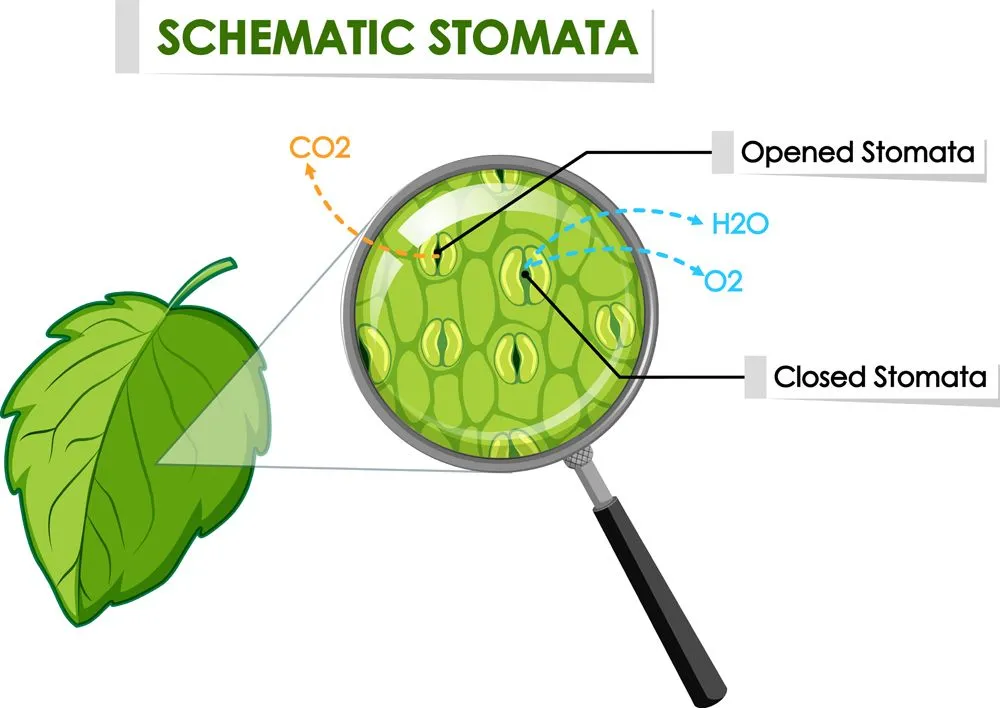
The trapped vapor molecules that arise when our sweat dries can escape through the pores, making space for cooler and drier air to enter. This technology allows our skin to stay free from perspiration and maintains a more comfortable skin temperature over long periods of time.
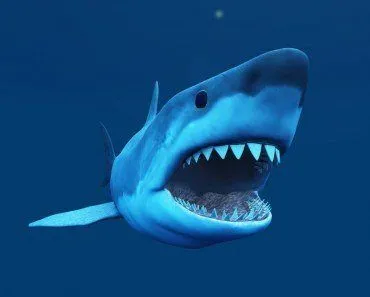
This isn’t the first instance where nature has been involved in our fashion. A swimsuit called the Fastskin suit by Speedo was patterned after the tiny tooth-like scales (called denticles) on a shark’s skin, which are thought to smooth the flow of water over the body. The suit became so closely linked to record-breaking swims that competitive swimming’s governing body banned full-body versions from 2010. (Tellingly, later lab tests by a Harvard biologist found the fabric’s surface doesn’t actually behave like real shark skin, so most of its speed likely came from compression and trapped air rather than the denticle pattern itself.) One catch with the suit is that it’s really tight! It takes about 20 minutes for a swimmer to put it on and must be cut off in order to remove it.
Velcro®, a common fastener for clothes and wallets, consists of two thin strips of plastic sheets. One sheet has tiny hooks on it, and the other has tiny hoops. George de Mestral, Velcro’s inventor, came up with the idea in 1941 after a walk in the Alps, when he noticed how burdock burrs hooked stubbornly onto his clothes and his dog’s fur. Under a microscope he saw that each burr was covered in tiny hooks, and he spent years turning that trick into the hook-and-loop fastener, finally patenting it in 1955.
The Kingfisher And The Bullet Train
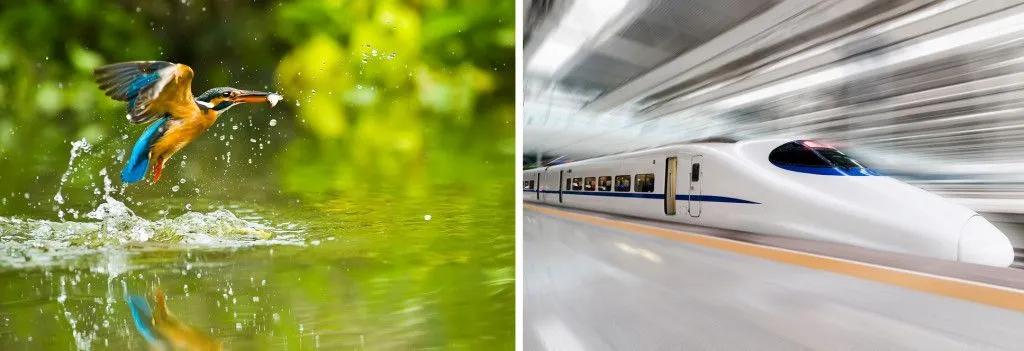
Japanese bullet trains are famous for their speed and ingenuity, but they didn’t start out this way. The earlier 300-series Shinkansen had a rounded nose, and every time it shot into a tunnel at around 300 km/h (about 185 mph) it pushed a wall of air ahead of it. That pressure wave burst out of the far end of the tunnel as a thunderclap known as a "tunnel boom," rattling residents up to 400 meters away.
The solution came from an unexpected place, the kingfisher’s beak. Eiji Nakatsu, the engineer who led development of the new 500-series train and a keen birdwatcher, had watched kingfishers dive from air into water (two media of very different density) while barely making a splash. The bird manages this thanks to its long, wedge-shaped beak. Inspired by that shape, Nakatsu’s team gave the 500-series, introduced in 1997, a long, pointed nose modeled on the beak. The redesign let the train slip through tunnels with far less air resistance, drastically cutting the boom while also trimming energy use, all at a top speed of 300 km/h (about 185 mph).
The Sticky Feet Of Geckos
There is a product design technique known as the biology-to-design approach. It starts by identifying a technological problem and then searching to see how nature has solved it. Once scientists figure out the secret to nature’s solution, they try to replicate it artificially. NASA’s space robots are a perfect example of this.
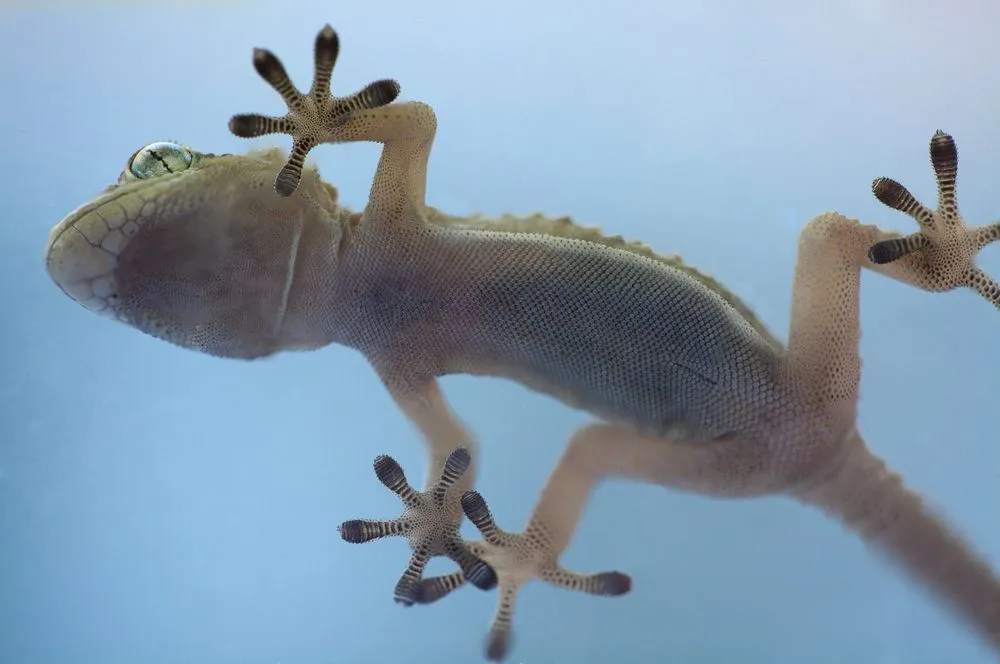
NASA developed robots that have a certain material on their little feet with teeny tiny hairs that help them stick to a surface. This material allows the robots to adhere to the spaceship while making repairs in outer space.
This invention came from observing the gravity-defying way that geckos walk on walls. Their toe pads are covered in millions of microscopic hairs called setae, and the sheer number of tiny contact points lets weak molecular attractions (van der Waals forces) add up to a grip strong enough to hold the lizard upside down on glass. No glue or suction is involved, which is exactly why the trick works in the vacuum of space.
The Proboscis Of Mosquitoes Inspired The Design Of Needles
Mosquitoes are the absolute worst! These disease-causing bloodsuckers stick their proboscis smoothly into our skin to suck out our blood, often before we even realize it’s happening! A proboscis is a sharp needle-like appendage on the mosquito that is used to pierce the skin. We rarely feel a mosquito “bite” us, which is the nifty part. The proboscis has a pair of saw-toothed blades called maxillae, and their serrated edges slip into the skin with very little force. (It helps that the mosquito also injects saliva laced with a mild numbing agent and an anticoagulant, so we barely notice the puncture.)
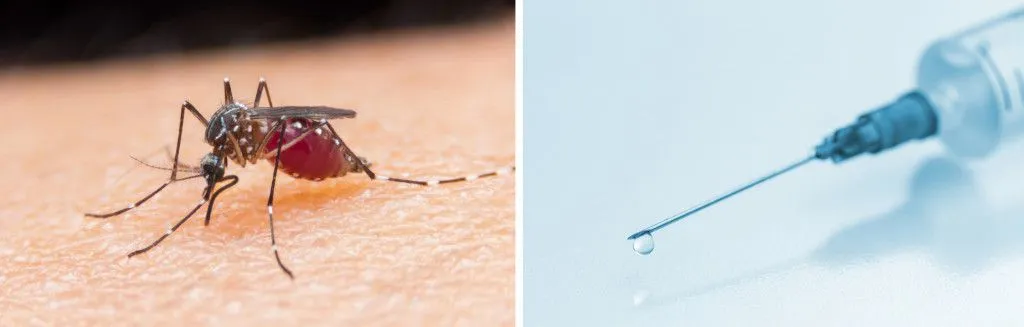
One study demonstrated the use of a specially designed injection needle that was similar to a mosquito’s proboscis. The needle is a combination of a few microneedles that are jagged like the maxillas, which improve the ease of insertion. These less painful and less invasive needles can be used for drug delivery or in lancets used by diabetics on a regular basis.
A Final Word
Biomimicry is incredibly useful, as it allows us to learn from nature’s 3.8 billion years of experience in expert design solutions. Everything that nature designs provides maximum returns with minimal effort and resources.
However, it is important to understand that nature is patient and didn’t force these results. If mankind could find more ways to copy nature’s actions, we wouldn’t have resource crunches and pollution problems. For example, consider the amount of effort that goes into making artificial pollinators (robotic bees), yet they still aren’t as good as real bees!
According to biomimicry practitioner Denise DeLuca, people should look at nature as a source of inspiration, rather than a source of raw materials.
In my opinion, the biggest takeaway for product designers and engineers should be the way that nature designs eco-friendly sustainable solutions. Mother Nature may not be perfect, but she does come up with clever and beautiful ways for life to continue without exploitation, resource waste, or pollutant byproducts.
References (click to expand)
- Ball, P. (2001, January). Life's lessons in design. Nature. Springer Science and Business Media LLC.
- Rinaldi, A. (2007, October 12). Naturally better. EMBO reports. EMBO.
- Reap, J., Baumeister, D., & Bras, B. (2005, January 1). Holism, Biomimicry and Sustainable Engineering. Energy Conversion and Resources. ASMEDC.
- Izumi, H., Suzuki, M., Aoyagi, S., & Kanzaki, T. (2011, January). Realistic imitation of mosquito's proboscis: Electrochemically etched sharp and jagged needles and their cooperative inserting motion. Sensors and Actuators A: Physical. Elsevier BV.
- Wood, J. (2019, February 12). Bioinspiration in Fashion—A Review. Biomimetics. MDPI AG.