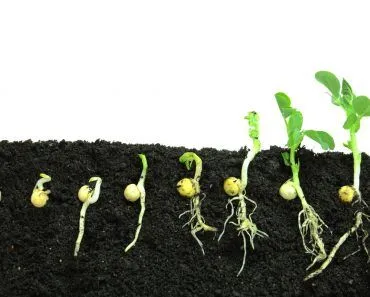
Seeds know which way to grow because of gravitropism, in which growth is steered by gravity. Dense starch grains called statoliths sink to the bottom of special root-tip cells, marking “down.” This shifts the hormone auxin, so roots grow downward toward the pull and shoots grow upward against it.
I once traveled to a friend’s village on vacation to spend a few days in an absolutely serene, pollution-free environment and have meals that were 100% organic. Some of his relatives were farmers and, incidentally, while I was there, the sowing season was beginning, so they were sowing seeds.
Watching them toss seeds into the soil, a thought struck me. The farmers weren’t carefully placing each seed “the right way up.” They simply scattered them and covered them over, yet every seed knew to send its root downward and its shoot upward. So how does a seed buried in the dark, with no eyes and no sense of which way is up, figure out which direction to grow?
How do seeds figure out the effect of gravity and grow in the right direction?
Short answer: Seeds can sense gravity and position themselves in accordance with it. This behavior is dictated by a physical phenomenon called gravitropism, wherein the growth of a plant is governed by the force of gravity acting on it. Roots grow in the direction of the gravitational pull, whereas stems grow in the opposite direction.
Let’s start with the basics.
What is gravitropism?
Gravitropism is simply a plant’s (or fungus’) growth movement in response to gravity. Also referred to as geotropism, it is commonly observed in most plants and other organisms. The roots of a plant show positive gravitropism (as they grow in towards the gravitational pull), while the stem displays negative gravitropism (as it shoots upwards, away from the gravitational pull).
Given below is a picture that clearly depicts the phenomenon:

This is a picture of an ancient cellar of a Roman villa in the Archaeological Park in Baia, Italy. If you observe carefully, you can see that the growing tips of the stems with leaves are curving upwards, even though the tree appears to be upside down. (Photo Credit : Kleuske / Wikipedia Commons)
Thomas Andrew Knight demonstrated gravitropism with an interesting experiment
Plants have been growing the same way since the dawn of civilization, and mankind has always been intrigued by their behavior. Around two centuries ago, in 1806, a botanist and horticulturist named Thomas Andrew Knight proved gravitropism with a rather fascinating experiment.
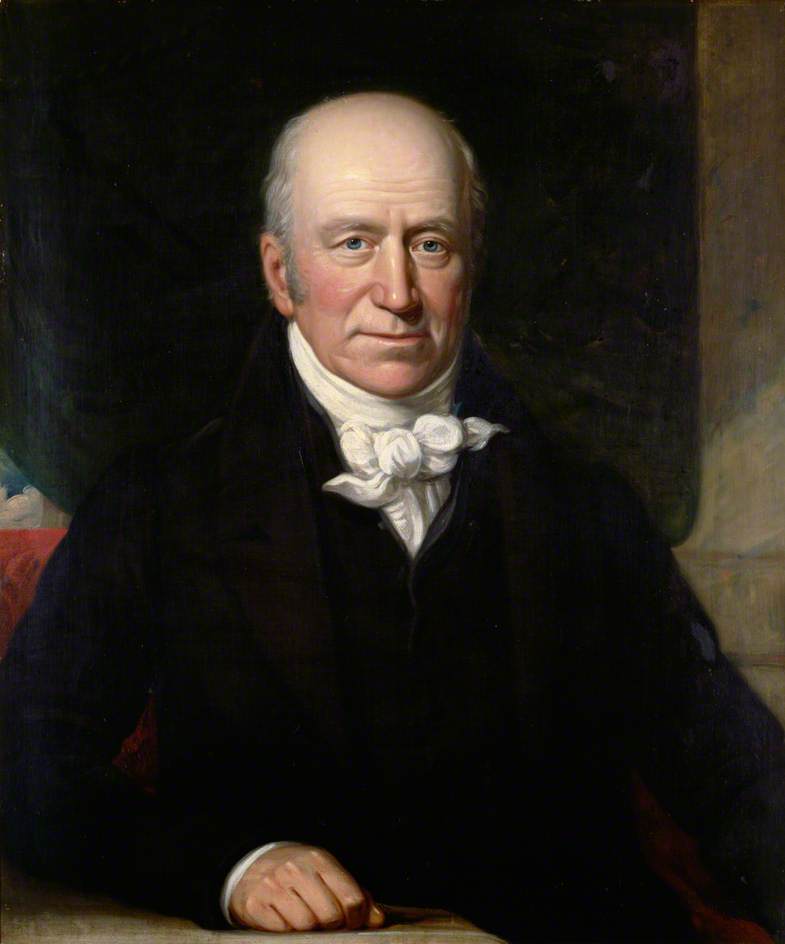
Thomas Andrew Knight, the man who elucidated the effects of gravity on seedlings around two centuries ago. (Photo Credit : Wikipedia Commons)
If you’ve ever taken a ride in a spinning tea cup at an amusement park, you know all too well that you get flung away from the center of the spinning object due to centrifugal force. To see whether seedlings would line up with this artificial pull instead of Earth’s gravity, Knight attached germinating seeds to the rim of a vertical wheel that a stream in his garden kept spinning at roughly 150 revolutions per minute for several days.
It turned out that the seedlings treated the centrifugal force exactly as they would gravity! After a few days, every plant on the wheel had its roots pointing outward (in the direction of the artificial pull) and its shoot pointing inward, toward the center.
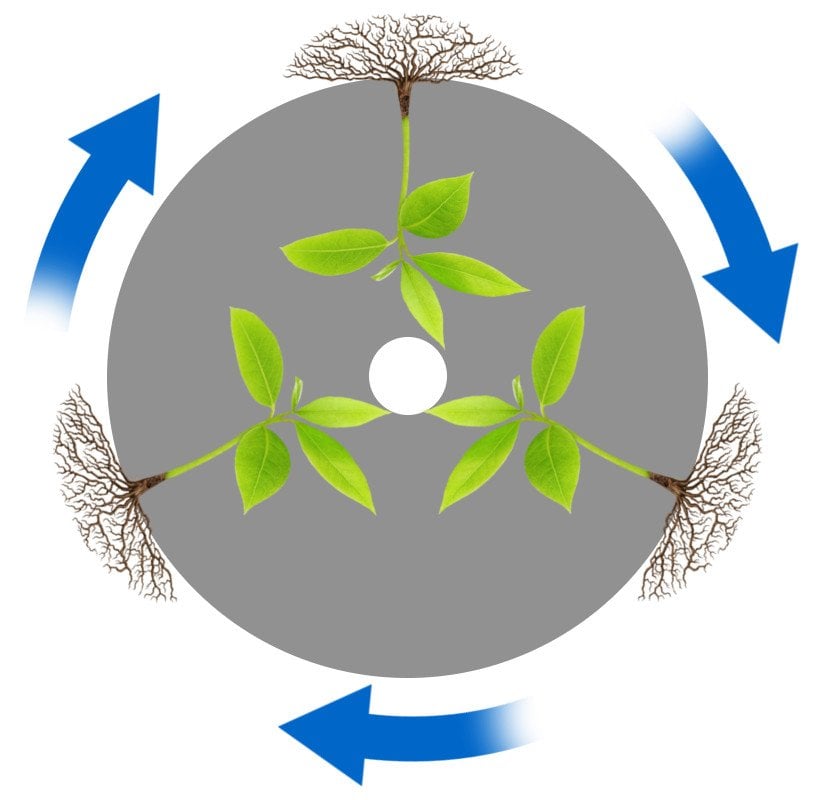
Roots of each plant pointed to the outside while their stems pointed inwards, proving that plants feel and respond to gravitational pull.
How Do Plants Sense Gravity?
Plants perceive gravity with the help of dense particles called statoliths. A statolith is simply a heavy, starch-packed amyloplast (an organelle that builds starch from glucose and stores it until the plant needs it). Because these starch grains are denser than the surrounding cytoplasm (the gel-like fluid inside the cell), they sink to the bottom of the cell. This settling happens inside specialized gravity-sensing cells called statocytes, which sit in the columella, a column of cells near the very tip of the root cap.
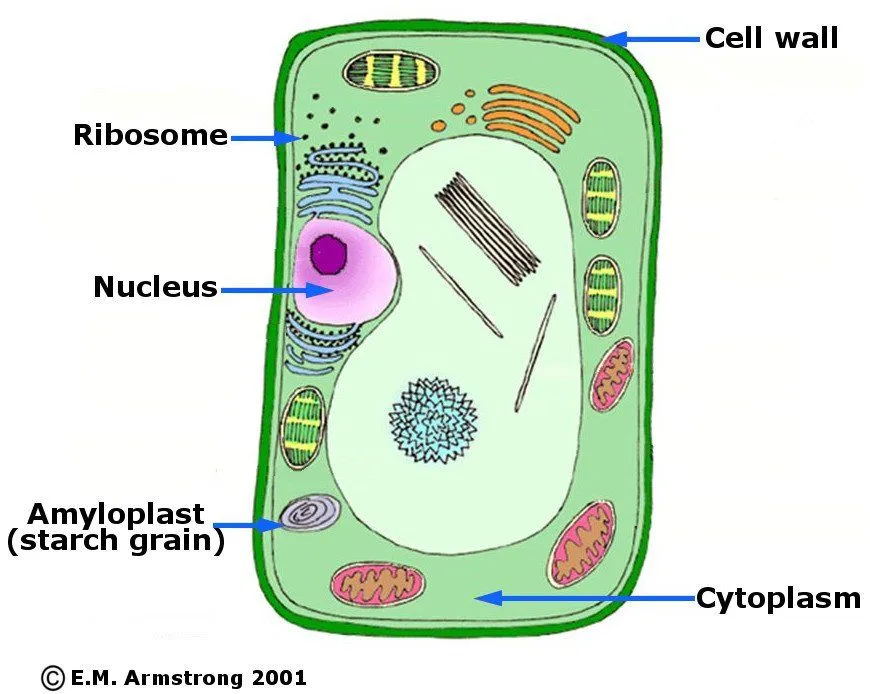
Once the statoliths pile up on the lower side, the cell reads that side as “down” and reshuffles a growth hormone called auxin accordingly. The sedimented statoliths prompt auxin-transport proteins in the cell membrane (the PIN proteins) to relocate toward the lower face of the cell, which steers more auxin to the underside of the root. This redistribution of auxin in response to gravity is the heart of the long-standing Cholodny–Went theory, first proposed in the 1920s. In roots, a higher auxin concentration actually slows cell elongation, so the lower side grows more slowly than the upper side and the root curves downward.
That’s why roots grow downwards!
Phototropism
Phototropism refers to the orientation of a plant in response to a light stimulus. In addition to gravitropism, which helps the roots go downwards, the stem demonstrates positive phototropism by growing in the direction of light.
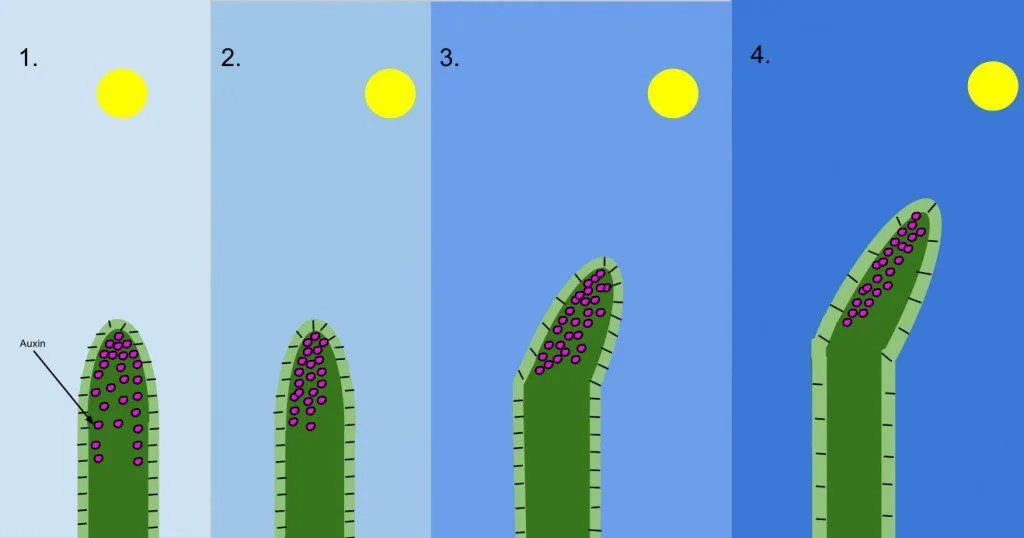
A plant hormone called auxin is present in the cells of the plant that are furthest from the light (in other words, auxin is concentrated on the opposite side of the light stimulus), which causes the plant to develop elongated cells in the opposite direction of the light stimulus. Consequently, the shoot grows/turns towards the direction of light!
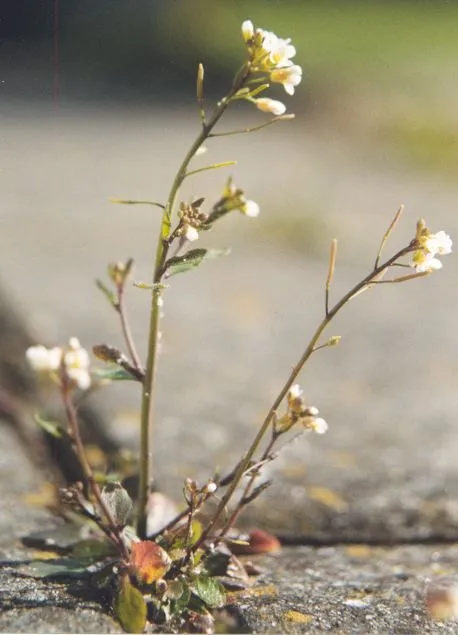
Note that roots usually show negative phototropism, which may contribute towards roots’ downward growth. However, gravitropism is much more dominant in roots, and explains the majority of their growth pattern.