Animals like the axolotl, hydra, planaria and starfish can regrow whole limbs or body parts if they lose them. They rely on a wound-site cluster of stem cells, called a blastema, plus developmental pathways that stay switched on for life. Most mammals, humans included, lack both features, so we heal a lost limb with scar tissue instead of regrowing it.
The critically endangered axolotl survives in the wild in just one place on Earth: the canals and wetlands of Lake Xochimilco, on the southern edge of Mexico City.
The axolotl drifts along in these freshwater canals, preying on small fish and mollusks. Its trademark smiling mouth opens wide and sucks water by vacuum into its mouth, drawing in prey. Close to the surface, a heron snaps at the axolotl, and the axolotl darts away leaving only an arm in the heron’s mouth.
A few months later, the arm is back, as if nothing ever happened.
All across the animal kingdom, from cockroaches to crickets, axolotls to anemones, regeneration is possible, and common. How do so many organisms heal so incredibly, and why does our healing pale in comparison?
How Are Regeneration And Healing Different?
Regeneration is essentially super-powered healing. Imagine you have a deep cut. In most scenarios, the gash will be bridged by scar tissue that is raised, tough, and not as good as the original. If any mammal loses a limb, all that will remain is a nub covered in scar tissue. Regeneration is a process of healing that mimics the original element of the body when something is lost, both in appearance and functionality.
How Does The Axolotl Grow Back An Entire Limb?
The axolotl is possibly the greatest of all regenerators. It can regenerate limbs, tails, large segments of its spinal cord, heart tissue, and even immensely complicated and interconnected neural tissue.
Imagine a single cell surrounded by other cells. Where is it? Your thumb. How does that single cell in your thumb know that it’s in your thumb, in your body, somewhere in the world, as you scroll through this article? It doesn’t! All it knows is the other cells that exist around it. This is an especially serious problem if you’re part of the blastema, which is responsible for growing back a limb. How do you know how to reform something that is already gone?
There is a sequence of events that needs to take place when an axolotl loses a limb. First, the axolotl needs to stop the blood loss. It does this by forming a little cap over the wound, composed of rapidly dividing cells, known as a blastema. This little clump of cells needs to regrow all the way to an entire limb. To do this, it needs to find its orientation again, an axis.
The axes work through chemicals known as morphogens. Specific cells are sources of different morphogens. The closer a cell is to the source of a particular morphogen, the more concentrated the morphogen is. Cells know how to recognize this concentration, known as a morphogen gradient. If there is more than one morphogen, that’s even better! Two morphogens are like x and y axes on a graph. The concentrations are the coordinates, and by knowing your coordinates, a single cell can situate itself within an entire limb.
When an axolotl is injured, the genes that code for morphogens are switched on.
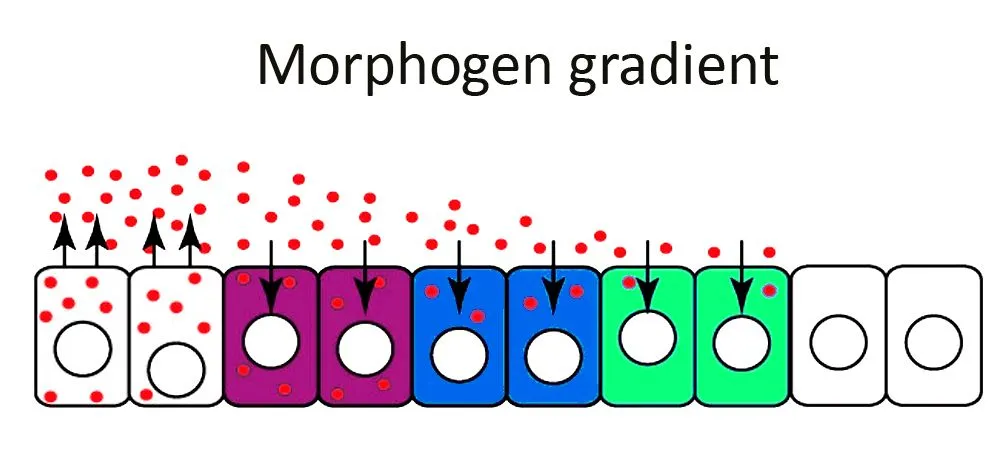
Caption: The concentration of a morphogen decreasing further away from the source. This is the morphogen gradient.
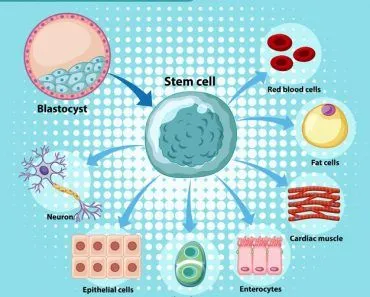
The third step is sending stem cells to the rescue. Cells that make up the heart or lungs or skin are as different as the organs themselves. Stem cells are undifferentiated, and have the potential to become anything. In the axolotl, stem cells migrate to the blastema, and with the help of morphogens, the undifferentiated stem cells slowly become bone, skin, nerve and muscle.
Axolotls are special because they exhibit a characteristic known as neoteny. The axolotl retains juvenile features, such as external gills, into adulthood. Unlike most other salamanders, it never undergoes metamorphosis from an aquatic larva into a land-dwelling adult, and it keeps growing throughout life. The trigger is hormonal: the axolotl’s thyroid system never fires the signal that drives metamorphosis, so the animal stays in its larval form (dose one with thyroid hormone in the lab and it will, in fact, transform into a terrestrial salamander). The upshot is that the developmental and growth pathways that normally “switch off” in an adult animal, and are hard to switch back on, simply never shut down in the axolotl. In other words, growing back a limb is easier if the axolotl never stopped running the machinery that grew it in the first place! In addition, axolotls retain a high population of stem cells, typically characteristic of youth.
How Does Hydra Grow Back Its Entire Body From A Single Cell?
As incredible as the macroscopic regrowth of a limb can be, the microscopic world has its own wonders of regeneration.
Hydra is a small freshwater organism. It has tentacles that drift in the water, ready to snap up prey. A small, tubular body then digests this prey.
Fascinatingly, you can mince a hydra into a soup of individual cells, and those scrambled cells will clump back together and rebuild a complete, feeding animal within about six days! The cell cluster first sorts itself into two layers: an internal one and an external one. Each of these layers possesses its own morphogen gradient, helping the cells sort themselves. In addition to morphogens, specialized cells known as organizers also help physically pull cells into the right place. These cells produce actin filaments, which act as mechanical arms, dragging cells into the right place and helping the hydra come back to its original pattern.
Hydra also has an incredible stem cell population that addresses injuries more minor than being reduced to a single cell.
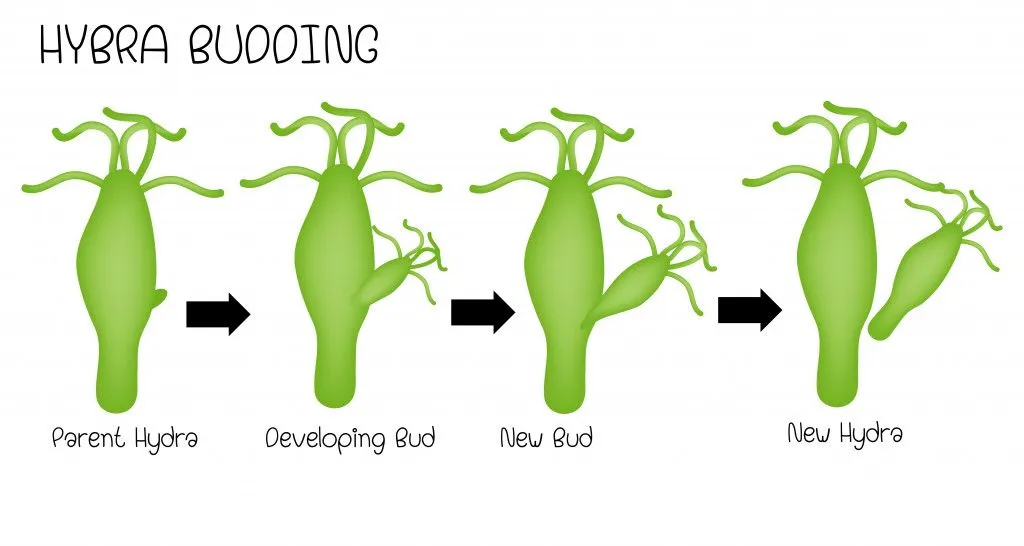
Like the axolotl, hydra grows throughout its lifespan. It also reproduces asexually, forming buds that eventually detach from the parent and become its offspring. Since the developmental pathways that perform both these functions are continually active, hydra can regenerate with ease.
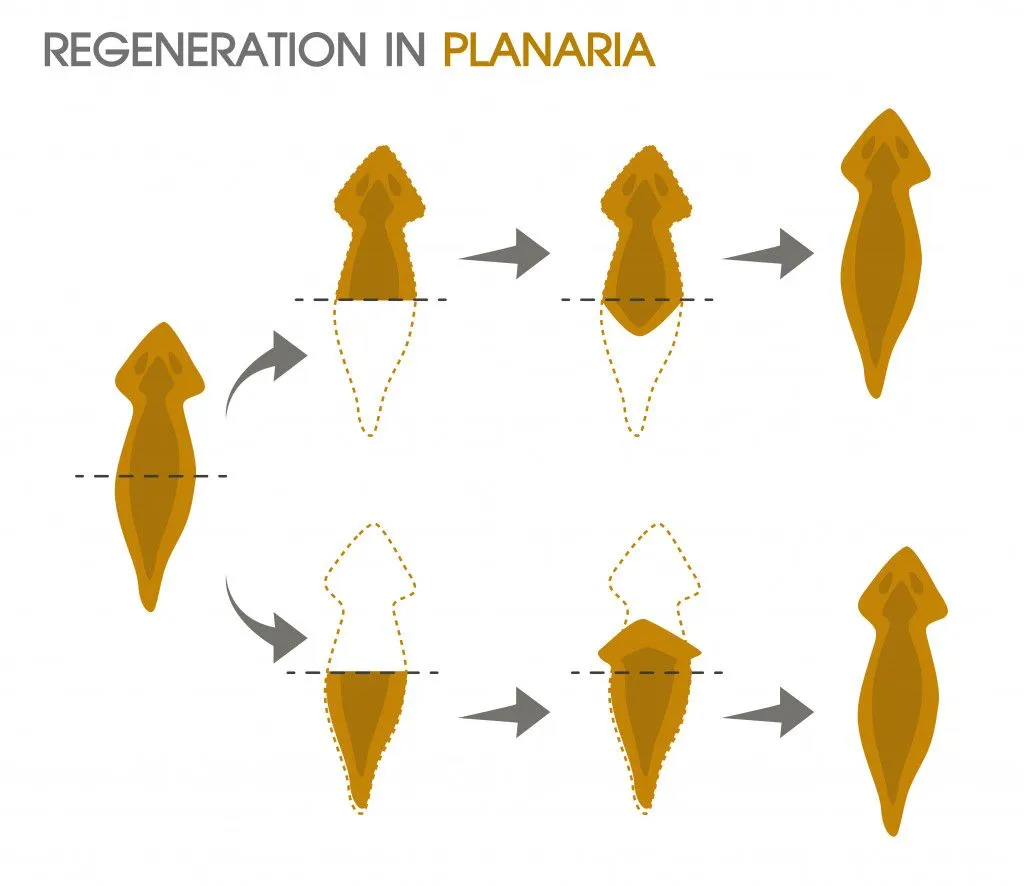
Planaria is a small, freshwater flatworm that follows a similar pathway to regeneration as the hydra. A planarian sliced into pieces can regrow a complete worm from a fragment as small as roughly 1/279th of its body, partly because adult stem cells called neoblasts make up around a quarter to a third of all its cells. Another feature of Planaria that might help it regenerate so easily is its plasticity. Even in adulthood, these worms manipulate their body size in response to nutrient availability in an ecosystem. A smaller body needs less food after all!
Why Can’t Humans Regenerate?
Humans actually can regenerate… but there’s a catch.
Children, especially before about age eleven, can regrow a fingertip lost beyond the last knuckle, complete with bone, nail and skin, as long as the wound is left open rather than stitched shut and enough of the nail bed remains. These regrown tips are fully functional too! The trick is that the developmental pathways responsible for growth are still humming along in the young. As we mature and stop growing, those pathways quiet down, making it far harder to grow back tissue. And it isn’t just us: all mammals are poor regenerators. Set against flatworms, reptiles and amphibians, our talent for regrowth is frankly pathetic!
Why do we scar instead of regrow? It isn’t that humans lack stem cells. We have them in skin, gut, muscle, bone marrow and more, but they are tissue-restricted, committed to topping up the one organ they live in rather than building a whole new limb. Blood-forming stem cells in the bone marrow make blood, muscle satellite cells repair muscle, and so on. What we lack is the coordinated program the axolotl has, one that recruits a blend of cell types into a blastema and rebuilds the missing structure from scratch. Faced with a serious wound, a mammal’s priority is to seal it fast against infection, and a quick patch of tough scar tissue wins out over slow, precise regrowth.
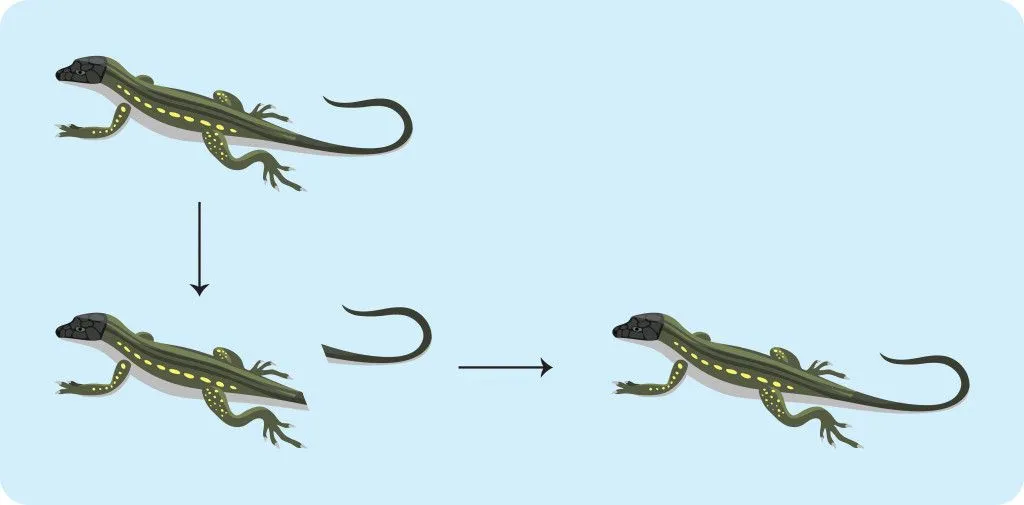
That may not be a permanent verdict. In 2022, researchers at Tufts University and Harvard’s Wyss Institute fitted amputated adult frogs (which normally cannot regrow legs) with a wearable cap they call a BioDome, loaded with a five-drug cocktail. A single 24-hour treatment was enough to kick off about 18 months of regrowth, yielding a working, touch-sensitive leg, and the team has since set its sights on mammals. Reptiles offer a parallel clue: a lizard’s self-amputated tail normally grows back only as an imperfect cartilage rod, but a 2021 USC study coaxed lizards to regrow properly patterned tails using engineered stem cells. Add in the promise of embryonic and induced stem cells, and the dream of regrowing a lost arm, or printing organs for transplant, no longer looks like pure science fiction. Matching the hydra or a planarian, mind you, still seems downright impossible for a mammal, no matter what the future holds!
References (click to expand)
- Shieh, S., & Cheng, T. (2015, August). Regeneration and repair of human digits and limbs: fact and fiction. Regeneration. Wiley.
- Bando, T., Mito, T., Hamada, Y., Ishimaru, Y., Noji, S., & Ohuchi, H. (2018). Molecular mechanisms of limb regeneration: insights from regenerating legs of the cricket Gryllus bimaculatus. The International Journal of Developmental Biology. UPV/EHU Press.
- Vogg, M. C., Galliot, B., & Tsiairis, C. D. (2019, November 1). Model systems for regeneration: Hydra. Development. The Company of Biologists.
- Ivankovic, M., Haneckova, R., Thommen, A., Grohme, M. A., Vila-Farré, M., Werner, S., & Rink, J. C. (2019, September 1). Model systems for regeneration: planarians. Development. The Company of Biologists.
- Rink, J. C. (2012, November 9). Stem cell systems and regeneration in planaria. Development Genes and Evolution. Springer Science and Business Media LLC.
- Rink, J. C. (2018). Stem Cells, Patterning and Regeneration in Planarians: Self-Organization at the Organismal Scale. Methods in Molecular Biology. Springer New York.
- Dolan, C. P., Dawson, L. A., & Muneoka, K. (2018, February 5). Digit Tip Regeneration: Merging Regeneration Biology with Regenerative Medicine. Stem Cells Translational Medicine. Oxford University Press (OUP).
- Murugan, N. J., et al. (2022). Acute multidrug delivery via a wearable bioreactor facilitates long-term limb regeneration and functional recovery in adult Xenopus laevis. Science Advances.
- Sun, A. X., Londono, R., Hudnall, M. L., Tuan, R. S., & Lozito, T. P. (2021). Introducing dorsoventral patterning in adult regenerating lizard tails with gene-edited embryonic neural stem cells. Nature Communications.