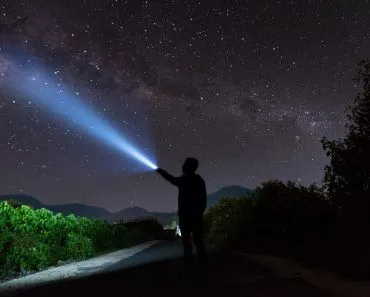
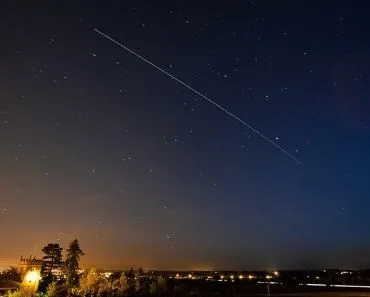
Stars twinkle because they are so far away that they reach Earth as point sources of light. As that light passes through different layers of our turbulent atmosphere, it is refracted in slightly different directions thousands of times a second, an effect astronomers call astronomical scintillation. The Sun and the planets present extended disks, not points, so the wobble averages out and they look steady. From above the atmosphere (the ISS, Hubble, James Webb), even the most distant stars sit perfectly still.
Stars twinkle because they are so far away from Earth that they appear as point sources even through powerful telescopes: the light rays emitted by them are refracted several times so that they look as if they are blinking. However, the sun and other planets are very close to us relative to stars and therefore appear like disks.
Twinkle twinkle, little star, how I wonder what you are!
Some rhyme, right?
Everyone must be familiar with that famous rhyme from Jane Taylor’s poem “The Star,” which was a big part of childhood for many.
Well, it’s not just a song for children; it actually refers to a certain scientific phenomenon that has fascinated observers of the Earth for millennia. Growing up, we were taught that stars couldn’t be like diamonds, but they do twinkle, right?
They certainly seem to do so, but what about our nearest star? The sun is a star, the heart of our solar system, but we do not see the sun twinkling. Why do all the other stars in the night sky seem to sparkle, but our sun does not?
Why Do Stars Twinkle, But The Sun And Planets Do Not?
Short answer: Stars twinkle because they are so far from Earth that when the light of the stars passes through the atmosphere, it is bent countless times by refraction, making it look as if they are blinking.
Earth’s Atmosphere
Astronomers have given a scientific name to the twinkling of stars: astronomical scintillation.
This also explains why astronomers do not write songs for young children; it would have been much more difficult to memorize songs about twinkling stars with words like scintillation thrown in there…”
Why The Sun Does Not Twinkle
The other stars we see in the sky are very far away from Earth. The Sun, our closest star, sits roughly 150 million km (93 million miles), or 0.0000158 light-years away. The next nearest star, Proxima Centauri, is about 4.22 light-years away, which works out to roughly 40 trillion km (25 trillion miles). The Sun is about 270,000 times closer than the next star, which gives you a sense of just how far the other dots in the night sky really are.
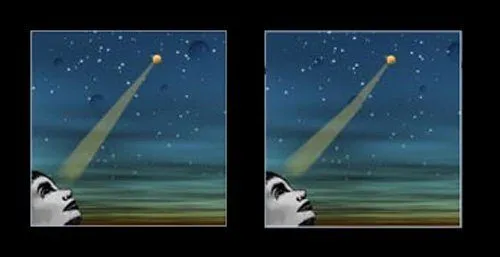
The Sun doesn’t twinkle because it is too close to Earth compared to other stars. Thus, unlike stars, the sun appears much larger than a small dot in the sky and therefore does not seem to twinkle. You see, the Earth’s atmosphere is so turbulent that images of all objects in the sky tend to “swim.” Consequently, a tiny dot in space is mapped to 2 or more points in space, giving the dot source this blinking effect. (Source)
In other words, the other stars are so far away that, after the atmosphere has bent their light in a dozen directions, the eye sees them as several flickering dots mashed into one. The Sun, by contrast, presents an extended disk: every little wobble from the atmosphere averages out across that disk, and the disk as a whole looks steady. So no, the Sun does not blink to a naked-eye observer (though if you safely watch its limb through a solar telescope on a hot afternoon, you can see the edge ripple from atmospheric heat haze).
Why Do Other Stars Twinkle?
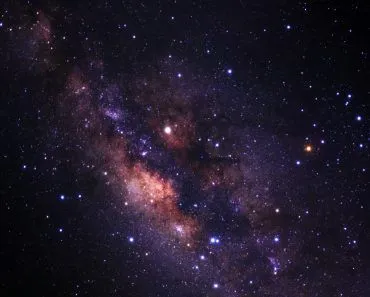
Light from other stars crosses a great distance to reach us and passes through areas of the Earth’s atmosphere that vary in temperature and density. Our atmosphere is very turbulent, with currents and eddies forming, swirling, and scattering. In each layer of the Earth’s atmosphere, air moves in different directions with varying intensities. As the light from stars passes through the atmosphere, it is bent due to refraction, which is why stars seem to twinkle when we stare at them.
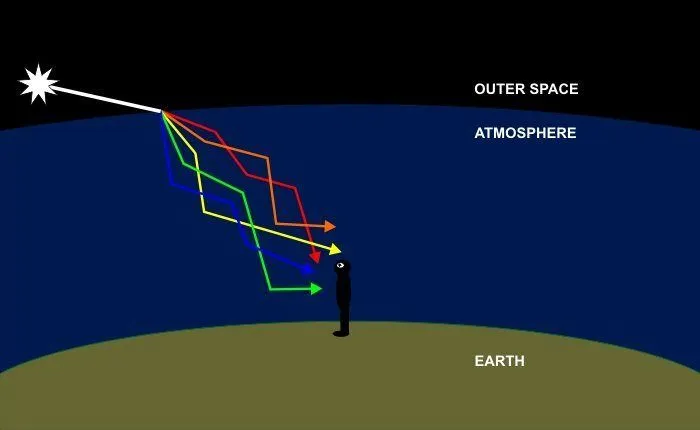
This process is similar to the sight of a coin dancing at the bottom of a swimming pool. The optical illusion occurs because the water bends the path of light coming from the coin.
This is also why astronauts on the International Space Station, and telescopes above the atmosphere like the Hubble and James Webb Space Telescopes, see stars as steady points of light rather than twinkling ones. Take the atmosphere out of the picture and the twinkling goes with it. Ground-based observatories like the Very Large Telescope and the Keck Observatory work around the problem with adaptive optics: a fast computer monitors how a guide star is distorted in real time and bends a deformable mirror hundreds of times per second to cancel out the wobble.
Why Planets Do Not Twinkle
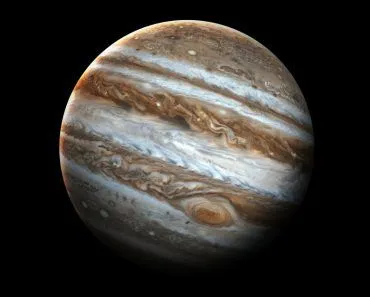
Planets, like the Sun, do not twinkle. Planets are also closer to Earth than distant stars, so planets appear larger in comparison. Due to the planets’ proximity to Earth, the light from these celestial bodies does not bend as strongly due to the Earth’s atmosphere. Therefore, the light coming from the planets of our solar system does not seem to twinkle like stars.
We should be very thankful for the Earth’s atmosphere; apart from protecting us from harmful UV rays that could fry us in an instant, the atmosphere is the reason why this sky full of stars seems to twinkle at night. Fortunately, this means that we can pass on the famous rhyme of Jane Taylor to future generations. It is a good poem… it would be a shame to waste it!
References (click to expand)
- Why Do Stars Twinkle? NASA Space Place.
- Hubble Space Telescope Optics: why imaging from above the atmosphere matters. NASA.
- Adaptive Optics. European Southern Observatory (ESO).
- Why Do Stars Twinkle Whereas Planets Do Not? University of California, Riverside.
- Why do stars twinkle? (Beginner). Curious About Astronomy?, Cornell University.
- Cosmic Distance Scales: The Nearest Stars. NASA Goddard.