Table of Contents (click to expand)
The moon does orbit the Sun—it just does it together with Earth, as part of the Earth–Moon system. The Sun actually pulls the Moon about twice as hard as Earth does, but because Earth and the Moon fall toward the Sun at the same rate, the Moon stays bound to Earth. The Moon’s orbital speed (~1 km/s) is below the escape velocity from Earth’s gravity at its distance (~1.4 km/s), so it remains trapped in Earth’s gravitational well.
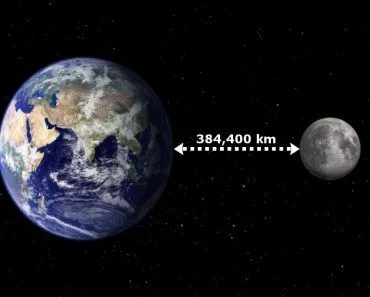
The force of gravity obeys the inverse-square law: its strength between two bodies decreases with an increase in the square of the distance between. Therefore, the decline in strength is one hundred-fold for a ten-fold increase in distance. The Sun, which accounts for 99.8% of the mass of the entire Solar System, however, is so massive that despite being almost 150 million kilometers away from Earth, it still pulls the moon, which is just 384,000 km away from Earth, with roughly twice as much gravitational force as Earth inflicts on our nearest celestial neighbor.
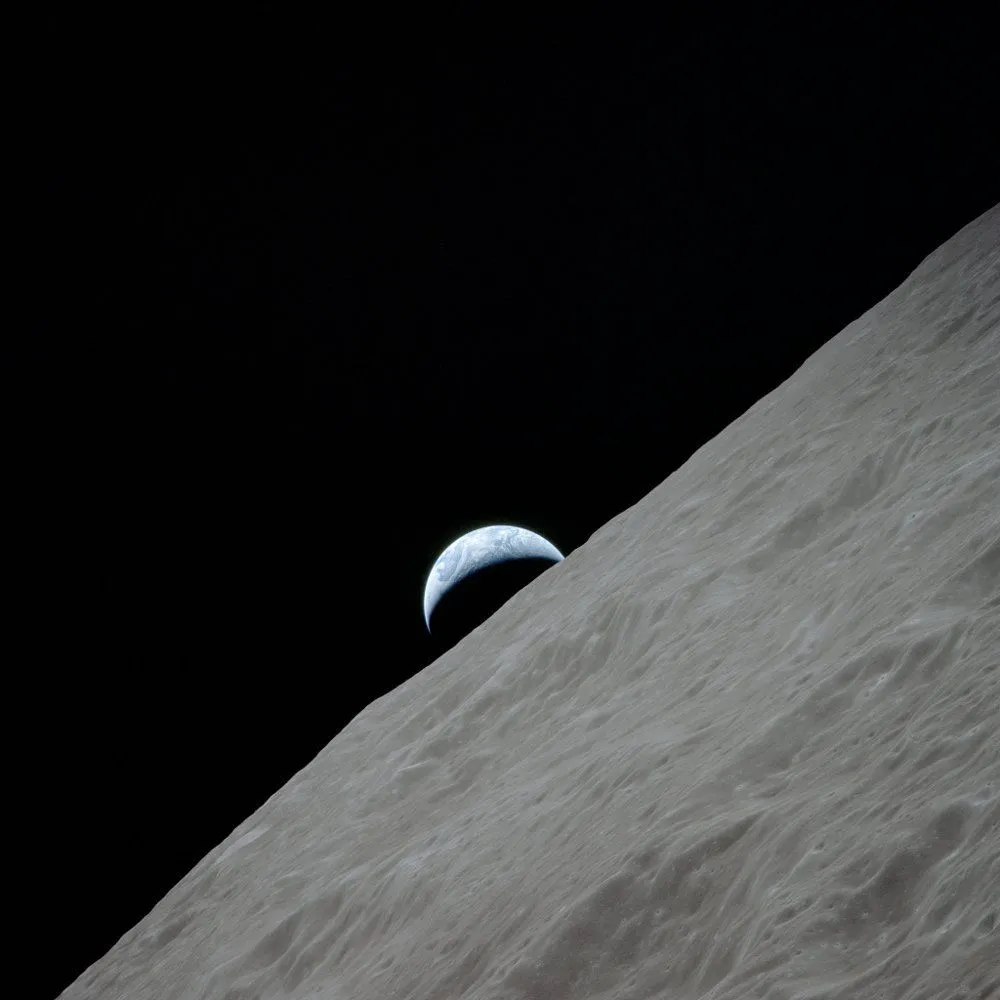
If this is the case, why hasn’t the Sun stolen the moon from us? Why doesn’t the moon revolve around the Sun instead of Earth?
The Skydiver Effect
The notion that Earth’s moon, and for that matter, every planet’s moons, simply chose not to orbit the Sun is obviously incorrect. It assumes that billions of years ago, the moons were presented with a binary choice, which is untrue. Of course, the moon does orbit the Sun, while simultaneously orbiting its home planet. The entire planet-moon system orbits the Sun. They are perpetually falling towards it together at the same rate.
At the same rate: this is the core of the argument. Someone on a forum I found answered this query beautifully. The submitted answer asked the reader to imagine two skydivers jumping from an aircraft towards the Earth’s surface at the same time. Neglecting air resistance, we know that the Earth pulls both the skydivers at the same rate: neither of the two falls any faster, the acceleration by gravity doesn’t discriminate on the basis of mass. The only mass on which it depends is the mass of the object towards which the bodies are falling.
Therefore, our Moon, plus the dozens of moons of Jupiter and the hundreds of moons of Saturn, all orbit (or fall towards) the Sun at the same rate as their corresponding planets. There is no reason why the skydivers would separate while they fall, unless, of course, they are acted upon by an external force, perhaps a third skydiver crashing into one of them.
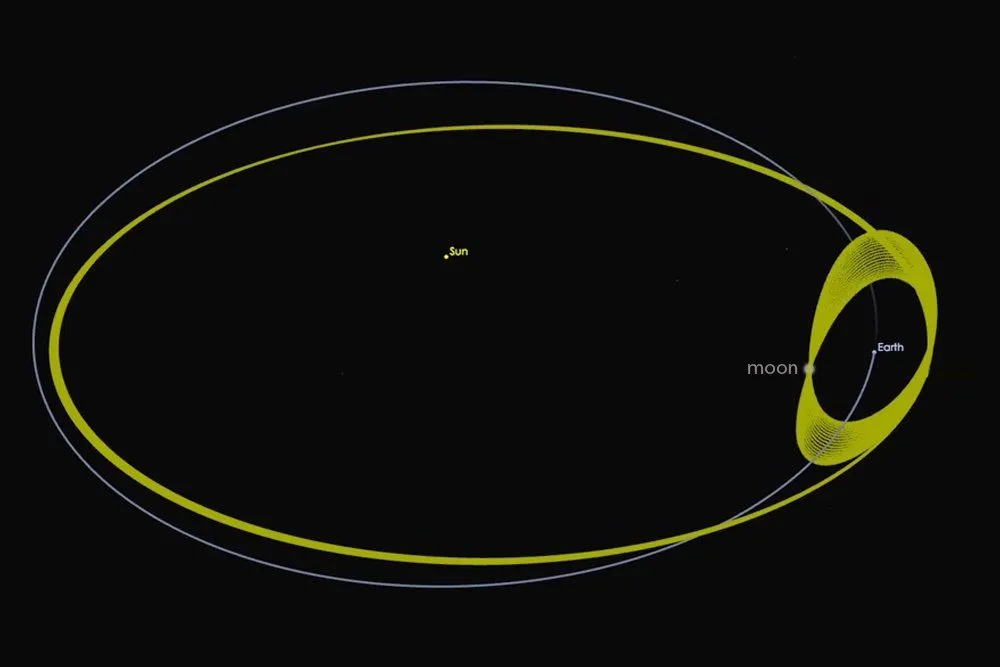
Granted, the above paragraphs don’t explain why the moon orbits the Earth, but the above explanation was included to make people realize that the moon does revolve around the Sun; in the question “Why does it revolve around the Earth instead of the Sun?”, the word “instead” reflects a dangerous misunderstanding of planetary systems.
To understand why the moon hasn’t escaped Earth’s grasp and crashed into the Sun, we only need to jump inside a well.
Gravity “Wells”
A small object traveling around a massive object behaves as though it is falling into a well or valley: the deeper it is, the steeper the slope, the faster it descends, and the harder it is to climb and escape. The Sun draws a well around itself that is so enormous that not only the giant planets like Jupiter and Saturn helplessly fall into it, but so does the Oort Cloud, whose inner edge lies roughly 186 billion miles away (and whose outer reaches extend out to several trillion miles).
However, the planets are also quite massive and draw considerably large wells around themselves too, albeit not as massive as the Sun. The moon orbits the Earth for the simple reason that it is stuck in the planet’s well. A “well-within-a-well” system is described by Hill spheres. In such a system, an object will revolve around another object or stay in its well, despite the presence of a more massive or steeper well. That being said, the moon hasn’t descended too deep into Earth’s clutches.
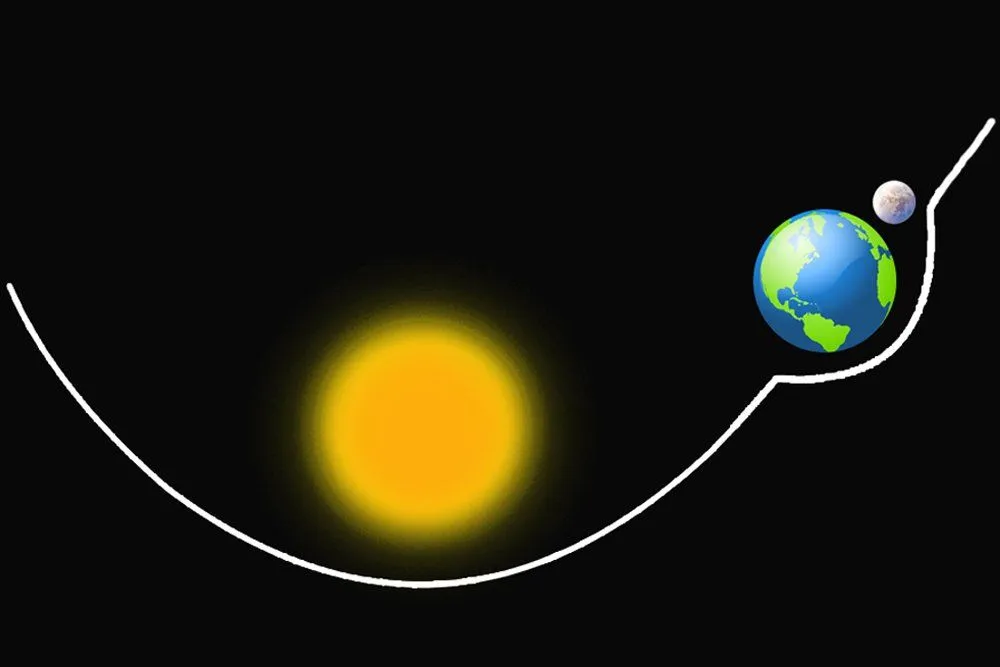
To escape Earth’s well, the moon must climb out at or past the well’s escape velocity. If the moon climbs with a velocity less than the well’s escape velocity, then it would be unable to escape. The moon currently orbits the Earth at around 1 km/s. The escape velocity from Earth’s gravity at the Moon’s distance, however, is about 1.4 km/s (Earth’s escape velocity at the surface is much higher, 11.2 km/s, because surface gravity is much stronger there). The moon doesn’t escape Earth’s grasp and orbit or crash into the Sun simply because it lacks the oomph.
It seems that the moon is revolving just below the well’s rim. A margin of about 0.4 km/s is comfortable enough to keep the Sun from stealing it.
What Does The Moon's Path Around The Sun Actually Look Like?
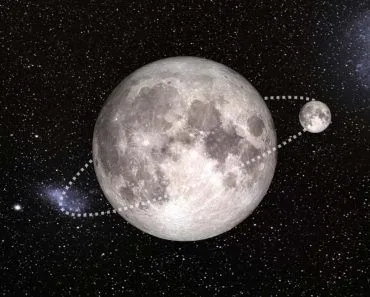
Here is where most of us picture the wrong thing. We imagine the Moon tracing tidy little circles around the Earth while the Earth sweeps a big circle around the Sun, so the Moon's true path through space ought to be a looping spring, curling back on itself once a month. Draw it out, though, and the loops vanish. The Moon's path around the Sun is a single, gently wavy curve that always bends toward the Sun and never bends away from it. It never loops backward over the Earth's track.

The reason is a mismatch in speeds. The Moon circles the Earth at roughly 1 km/s, but the whole Earth-Moon pair is barreling around the Sun at about 30 km/s, thirty times faster. The Moon's monthly sidestep is never enough to cancel that forward rush, so at every instant it is still moving forward along the orbit, just a touch faster or slower, a touch sunward or outward, than the Earth beside it. The physicists at the University of Illinois put it simply: because the solar orbital speed is always the bigger of the two, there are no actual backward loops. Astronomers describe the resulting curve as being concave toward the Sun everywhere, which is another way of saying the Sun's pull is always winning the tug-of-war we met earlier in this article. So in a very real sense the Moon orbits the Sun, with the Earth as a close dance partner it weaves around, rather than orbiting the Earth in isolation.
Is The Moon Slowly Drifting Away From Earth?
If the Moon is sitting just below the rim of Earth's gravity well, you might wonder whether it could ever climb out. It is, very slowly, edging in that direction. The Moon is receding from Earth at about 3.8 cm (1.5 inches) per year, roughly the rate your fingernails grow. We know this figure with remarkable precision thanks to mirrors left on the lunar surface.

Apollo 11 astronaut Buzz Aldrin set up a panel of corner-cube reflectors at Tranquility Base in July 1969, and Apollo 14 and 15 added more. Observatories on Earth still fire laser pulses at these arrays and time the round trip, pinning down the Earth-Moon distance to within a few millimeters. The drift itself comes from tides. The Moon's gravity raises bulges in Earth's oceans, Earth's rotation drags those bulges slightly ahead of the Moon, and their pull tugs the Moon forward. That forward nudge feeds it energy and lets it spiral very gradually outward, while Earth's spin slowly bleeds off, lengthening our day by a millisecond or two each century. So the answer to "does the Moon orbit the Earth" is yes, for now and for billions of years to come, but the leash is very slowly being let out.
References (click to expand)
- Why Doesn't The Sun Steal The Moon? - Universe Today. Universe Today
- Why Does the Moon Orbit the Earth and not the Sun? | UIUC. The University of Illinois Urbana-Champaign
- Moon Orbiting the Sun. Physics Van, University of Illinois Urbana-Champaign
- Orbit of the Moon. Wikipedia
- The Apollo Experiment That Keeps on Giving. NASA Jet Propulsion Laboratory