Table of Contents (click to expand)
Fusion inside a star stops at iron, so stars cannot fuse their way to gold. Gold instead forms through rapid neutron capture (the r-process) in extreme cosmic events. The dominant source is colliding neutron stars, confirmed by the 2017 GW170817 merger, with energetic supernovae and magnetar flares making up the rest.
If stars truly loved gold, then they would be star-crossed lovers! This is the most fitting explanation to the question of whether stars can fuse to form gold.
Actually, it gets even better… a star only makes gold and other heavy metals as it is dying. So, in quite a dramatic way, humans are fascinated with the ashes of some ancient star!

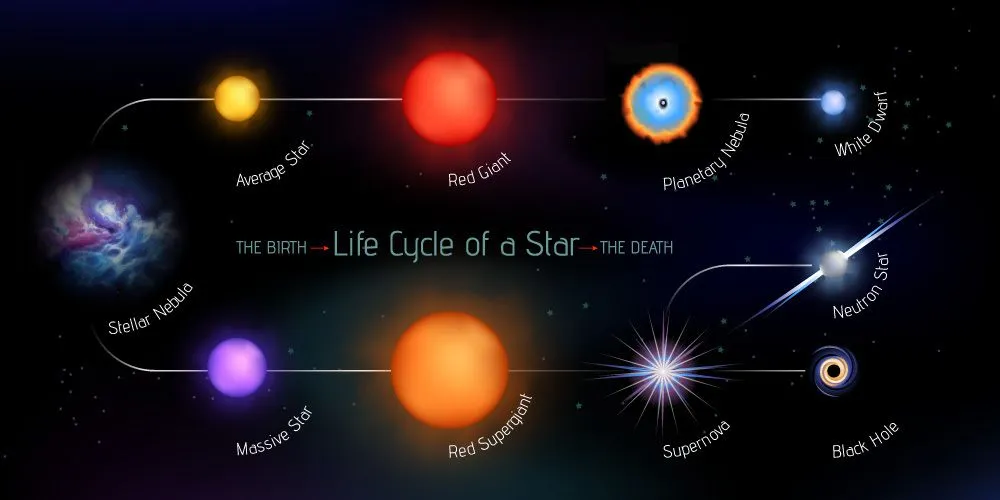
Stars are born, just like humans, and also eventually die. The tiny difference is that a star’s life can last millions to billions of years (the smallest, dimmest stars are predicted to last for trillions), and they can forge rather important elements when they die, or even collapse into black holes!
Stars Are Born, And Then They Die…
We know that stars are formed from stray gas and dust accumulations in space. Essentially, due to a momentary disturbance in a cloud of dust, the distribution of gases is compromised, which leads to gases collapsing due to their own gravitational force. This gives birth to a ‘protostar’, which has a heated center and a gaseous lump that will eventually become a star. The pressure, temperature and gravitational waves that happen to pass by create a force field that causes these gases (mostly hydrogen and helium) and the dust particles to continue collapsing until a star is formed. The star eventually develops into a main-sequence star, which has a higher mass and fuels itself by nuclear fusion. The gravity pulls the star inwards, while the fusion reactions push outwards. Hence, a star is almost always in precarious balance.
Stellar Nucleosynthesis: How Stars Form Different Elements
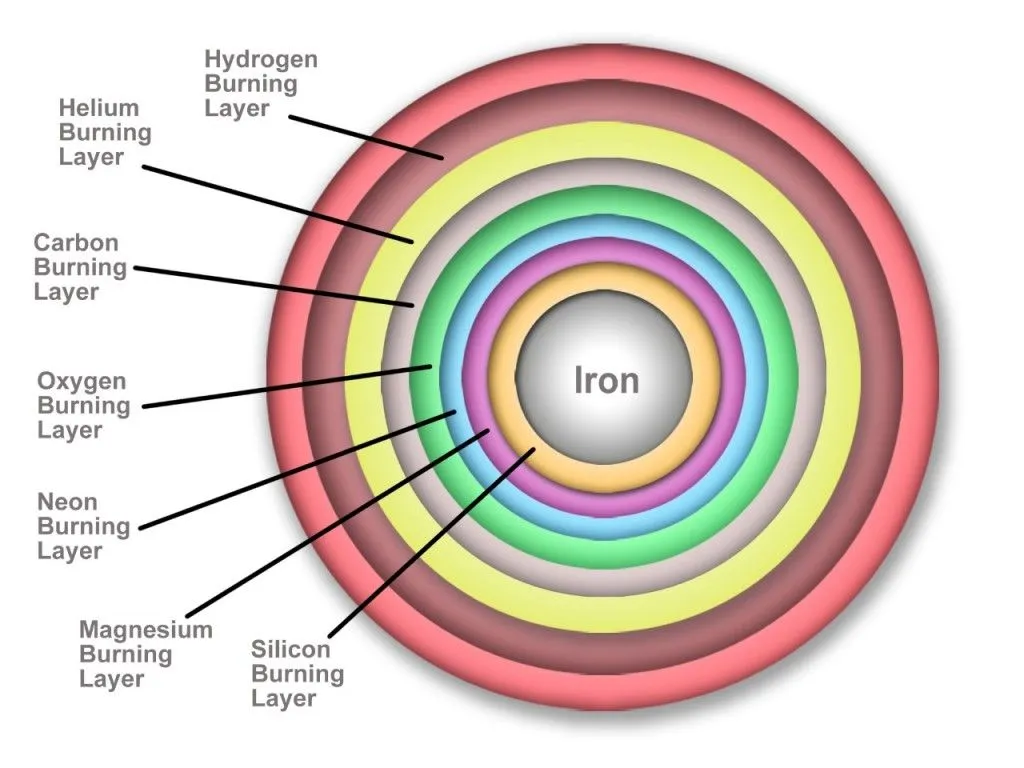
A star is fueled by the fusion of hydrogen into helium. After the hydrogen in the core is used up, a massive star fuses the helium to keep itself going. This process continues, building heavier and heavier elements, until the star reaches a stage where it has formed iron in its core. Each element that has been created forms a layer around the star, giving it the spherical shape that we are accustomed to imagining. The outer layer has the elements that were formed first, but as we near the core, we find heavier elements. Hydrogen gives way to helium, which helps prepare carbon and similarly oxygen, nitrogen, and silicon. All of these elements form a layer around the core, although these layers may sometimes blow out in space due to various cosmic effects like shockwaves or wind waves formed when two stars collide/interact.
The Death
The formation of iron at the core is the harbinger of doom for a star! After the formation of iron, there is no way a star can continue the process of nuclear fusion. As the end nears, the core compacts until there is simply no more space to cram in. This imbalance of energies causes the layers to compress towards the core. Big stars are able to handle this kind of strong energy, but sometimes the pressure and temperature rise is so massive that the star bursts with the force of 107 atomic bombs blasting at the same time! These mighty explosions are the source of various elements of the periodic table. During this explosion, the nuclei that have already formed are flooded with free neutrons. Because the supply is so intense, a nucleus captures neutron after neutron in a fraction of a second, a sequence astronomers call the rapid neutron-capture process, or r-process. Each overloaded nucleus is unstable, so it undergoes beta decay: a neutron turns into a proton (releasing an electron), nudging the atom up one place on the periodic table. Repeated over and over, this builds heavier elements such as gold and platinum. Note that this is neutron capture, not the energy-releasing fusion that powers the star, because fusing anything heavier than iron consumes energy rather than producing it. Supergiant stars more than about ten times the mass of our Sun end their lives in these supernova explosions.

Supernovae, though, are no longer thought to be the main gold factory. In 2017, astronomers watched two neutron stars spiral together and merge, an event named GW170817. The collision forged a fireball of heavy elements, and estimates suggest it minted several times Earth’s mass in gold alone. Crucially, the merger was detected both as gravitational waves (ripples in space-time) and as a flash of light, the first time a single event was seen in both, which confirmed neutron-star mergers as an r-process site. Today these mergers are considered the dominant origin of the gold in the universe. Even so, their numbers may not be enough to account for all of it, so energetic supernovae help fill the gap, and in 2025 astronomers found evidence that giant flares from magnetars (intensely magnetized neutron stars) can forge gold too.
So, exotically speaking, human beings celebrate the death of a star, since we’re so gold-hungry!
Many people talk about the flow of energy in the universe, but the stars seem to have taken that to the next level! Much of the gold we have today traces back to lighter elements that were reworked in dying stars and stellar collisions billions of years ago, and even now scientists are studying these neutron-capture reactions in the lab. In 2026, for example, nuclear physicists measured a key decay step in the r-process for the first time. They’ve successfully formed some radioactive metals with lifetimes of only microseconds, but the day can’t be far off that we begin fabricating gold on this planet, rather than waiting for any more stars to explode!
References (click to expand)
- Astronomers Strike Gravitational Gold In Colliding Neutron Stars. National Public Radio
- How to Make an Element | NOVA - PBS. The Public Broadcasting Service
- Stars | Science Mission Directorate. The National Aeronautics and Space Administration
- LIGO and Virgo Make First Detection of Gravitational Waves Produced by Colliding Neutron Stars. LIGO Caltech
- Flares From Magnetized Stars Can Forge Planets’ Worth of Gold, Other Heavy Elements. Simons Foundation
- Scientists crack a 20-year nuclear mystery behind the creation of gold. ScienceDaily