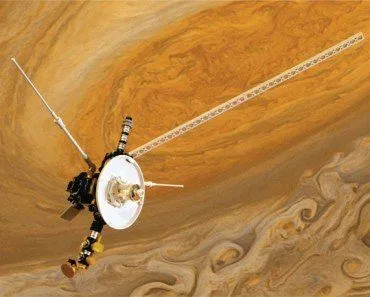
The farthest man-made object from the Earth is Voyager 1. It is a space probe that was launched by NASA on September 5, 1977 and has been in operation for nearly 49 years. It was the first space probe to cross into interstellar space, the region free from the influence of a particular star’s solar wind. At a distance of about 25.8 billion kilometers (172.6 AU) as of 2026, it is the farthest spacecraft from Earth, and is on track to reach one full light-day from us in November 2026.
We humans have come very far technologically, scientifically, and philosophically, and far surpassed the limits that early humans could have ever predicted. The presence and passion of men and women is too powerful to be bound by the limits of our planet. Have you ever wondered about those footprints on the moon and what they signified? About those numerous satellites revolving around the earth, feeding information to your phone, your computer, and your TV? The boundaries to our reach are slowly expanding, which brings us to this question, “How much do we really know?”
Voyager 1 is, at present, the farthest man-made object from the Earth. It’s farther away from our planet than any other human creation. It is whizzing past the outer reaches of our Solar System, making it the farthest human footprint out there in the vacuum of space.
About The Probe
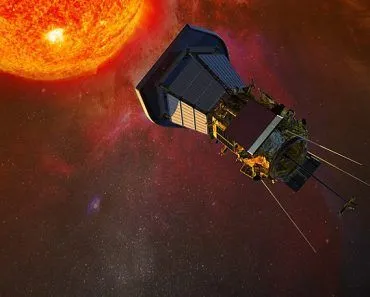
Voyager 1 is a NASA space probe built by the Jet Propulsion Laboratory and launched on September 5, 1977 atop a Titan IIIE rocket. The spacecraft weighed about 825 kg (1,820 lb) at launch and carried 11 scientific instruments dedicated to studying planetary systems, fields, and particles. Three radioisotope thermoelectric generators (RTGs), fueled by plutonium-238, supply the electricity that has kept the probe alive for nearly five decades, though their output has been decreasing steadily over time.
Voyager 1 communicates with Earth through NASA’s Deep Space Network, transmitting via a 3.7-metre high-gain antenna at signal powers of roughly 22 watts — by the time those signals arrive on Earth, they are around 1020 times weaker. The probe is the older sibling of Voyager 2, but its faster, more direct trajectory has made it the more famous of the pair.
The Planetary Missions
NASA began to work on missions to explore the outer planets in the 1970s. Their earlier mission, ‘Pioneer 10’, allowed them to redesign their probes to better suit the intense electromagnetic radiation in the outer Solar System. Out of this effort was born Voyager 1. Its primary mission objectives were to gather information about Jupiter, Saturn and Saturn’s largest moon, Titan. NASA had to choose between a Titan-priority trajectory and a possible Pluto path, and Titan won out because of its thick, complex atmosphere.
Jupiter: Voyager 1 began photographing Jupiter in January of 1979, and transmitted invaluable information about its moons, surrounding asteroids, rings, and other members of the Jupiter System. The Voyager space probe gave us information about Jupiter’s never-before-seen planetary rings.

Jupiter’s Big Red Spot

Volcanic Eruption on Jupiter’s moon ‘Loki’
Saturn: Voyager 1 made a gravity assist maneuver around Jupiter to encounter Saturn in 1980. The space probe’s cameras detected complex structures in Saturn’s rings. It also gave us sensitive information about Saturn’s atmosphere. The length of a day on Saturn was found to be 10 hours, 39 minutes, and 24 seconds (Cassini-era observations later revised this slightly downward to around 10 hours 33 minutes, but the Voyager figure stood as the accepted value for decades). The planet spins so quickly that Voyager measured equatorial winds of nearly 1,800 km/h (about 1,120 mph) — though Hubble observations have since shown those winds have slowed substantially in the years since.
Titan: Voyager 1’s mission included a flyby of Titan, Saturn’s largest moon, which had long been known to have an atmosphere. Earlier exploratory probes had already piqued the interest around Titan by finding its atmosphere developed and complex. Titan’s mass was calculated by observing its effect on Voyager 1’s trajectory. Although the surface wasn’t visible at the safe distance of 6,400 kilometers, the information discovered about the atmospheric composition and temperature led scientists to believe that liquid hydrocarbons could exist on its surface.

Titan’s blue hazy atmosphere
The Titan flyby took Voyager 1 out of the plane of the ecliptic (the plane of planetary revolution around the sun), thereby ending its planetary science mission. Still uninterrupted, the mission for Voyager 1 was extended to reach the end of the heliosphere (the region of space that is directly affected the Sun’s radiation and gravity) and into interstellar space.
Interstellar Travels
Voyager 1 took the first-ever portrait of the Solar System as seen from outside on February 14, 1990, which has become known as ‘the Family Portrait’. Soon afterwards, the cameras were deactivated to conserve power.
In 1998, Voyager 1 overtook Pioneer 10 as the most distant spacecraft from Earth, and continued traveling at about 17 kilometers per second. Its instruments continued to study the Solar System, namely directed to look for the ‘heliopause’, the boundary at which it would transition into interstellar space.
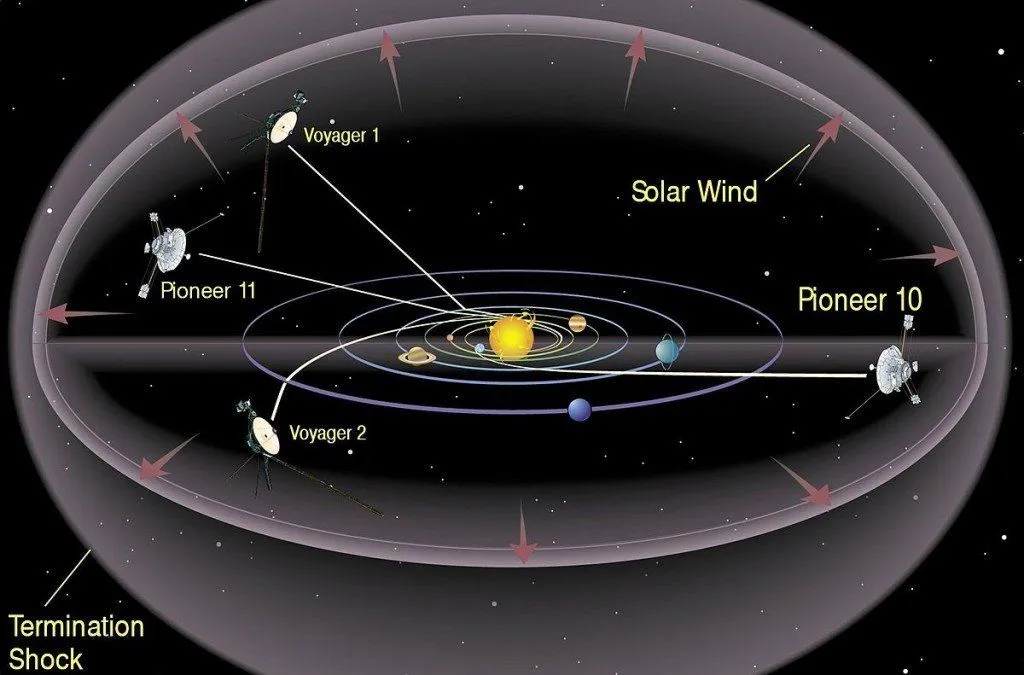
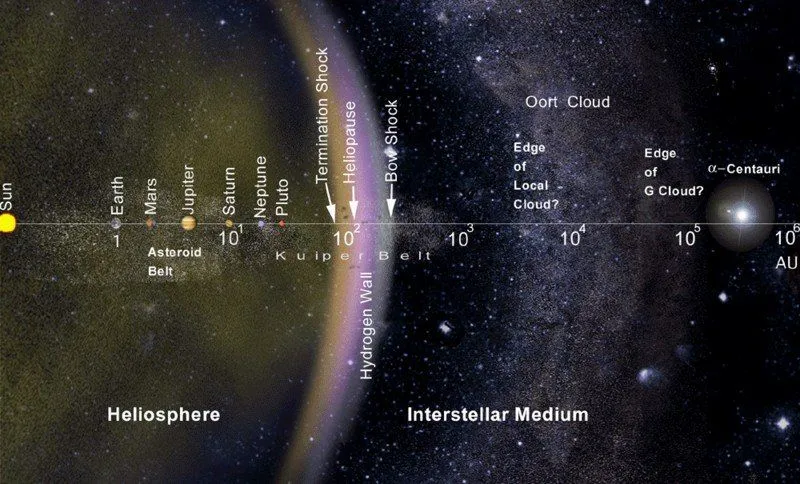
On September 12, 2013, NASA confirmed that the probe had crossed the heliopause into the interstellar medium on August 25, 2012. As of 2026, a one-way Voyager 1 transmission takes about 23.5 hours to reach Earth, and the spacecraft is expected to reach the symbolic one light-day distance (where a signal takes 24 hours to travel each way) on November 18, 2026, according to NASA. NASA has released audio recordings of the plasma waves encountered by the probe, which represented the first sounds ever captured in interstellar space.
You can check the current location and other mission updates of Voyager 1 here.
Most Interesting Thing Onboard Voyager 1
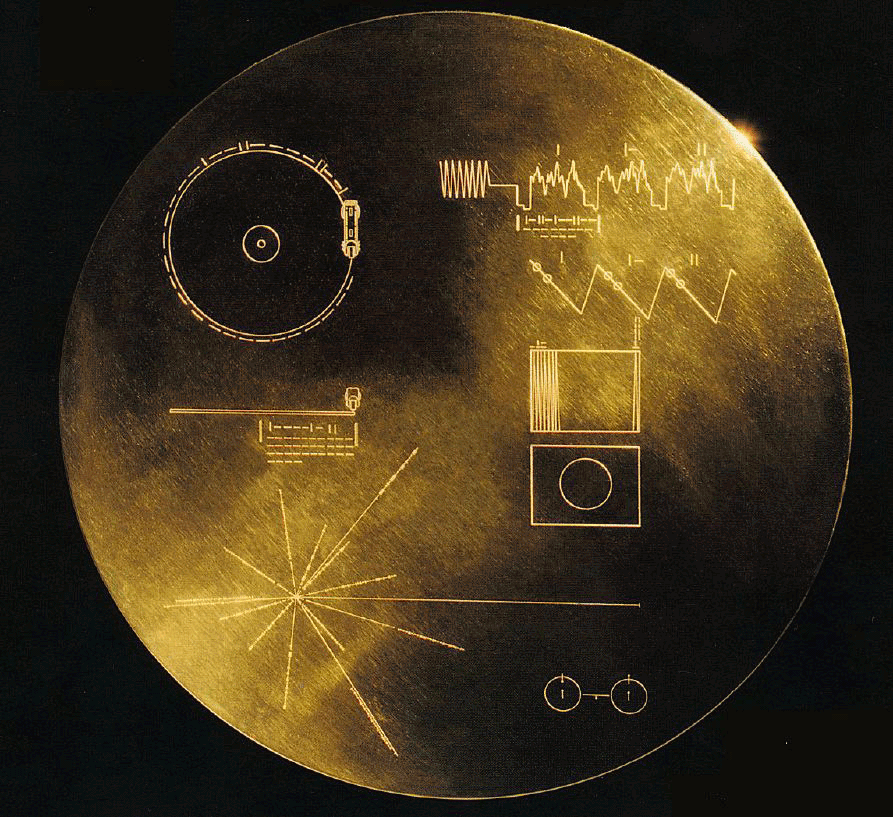
On board Voyager 1 is a gold-plated audio-visual disc meant to act as a ‘message in a bottle’. The disc carries photos of the Earth and its ecosystem, scientific information, spoken greetings from the Secretary-General of the United Nations and the President of the United States. Greetings in 55 different languages, works by Mozart and Chuck Berry, along with various performances of indigenous music from around the world, are also included. The contents of the record were made available by NASA as part of the public record.
The Twin Space Probe
Voyager 1 was launched 16 days after Voyager 2, but due to its shorter trajectory, it reached Saturn and Jupiter sooner than its counterpart. Voyager 2 crossed the heliopause into interstellar space on November 5, 2018, becoming the second spacecraft ever to do so, and is currently moving at a velocity slower than Voyager 1. It remains the only spacecraft ever to visit either of the two ice giants, Neptune and Uranus. Voyager 1’s plasma science instrument failed in 1980 and was switched off in 2007, so Voyager 2’s working plasma sensor produced the first direct measurements of interstellar plasma density and temperature after its 2018 crossing — that instrument was itself shut down in October 2024 to conserve power.
What Is The Farthest Object From Earth?
Voyager 1 holds the record for the farthest human-made object, but it is nowhere near the farthest object we can actually see. That title belongs to a galaxy. Using the James Webb Space Telescope, astronomers confirmed a faint galaxy called MoM-z14 as the most distant object ever observed, with a measured redshift of about 14.44. Its light set out when the universe was only around 280 million years old, and it has been travelling for roughly 13.5 billion years to reach our telescopes. Because space itself has stretched during that long journey, the galaxy now sits an estimated 33.8 billion light-years away. MoM-z14 edged past the previous record-holder, JADES-GS-z14-0, which Webb had confirmed only a year earlier.

So when people ask for the ‘farthest thing from Earth’, the answer depends on what they mean. Voyager 1 is only about one light-day away (roughly 0.0027 light-years), which makes it the farthest object we have built and sent out. A faint early galaxy tens of billions of light-years away is the farthest object we have ever detected. The two records are separated by an almost unimaginable gulf: everything humanity has physically launched still sits in our own cosmic backyard.
How Far Have Humans Themselves Travelled Into Space?
Voyager 1’s distance dwarfs anything a human being has managed in person. In April 1970, the three astronauts of Apollo 13 (Jim Lovell, Jack Swigert and Fred Haise) looped around the far side of the Moon and reached about 400,171 km (248,655 miles) from Earth, further than anyone had gone before. That record stood for 56 years. It finally fell on 6 April 2026, when the Artemis II crew (Reid Wiseman, Victor Glover, Christina Koch and Jeremy Hansen) swung around the Moon and reached roughly 406,773 km (252,757 miles) from home.

Even so, that is a rounding error next to Voyager 1. The farthest humans have physically travelled is a little over 400,000 km, while Voyager 1 is more than 25 billion km away, roughly 63,000 times farther. For a fuller account, see our piece on the farthest humans have gone in space.
The Future
Although Voyager 1 is not heading towards any particular system, the closest star it will approach is Gliese 445 in about 40,000 years. NASA says that “The Voyager is destined-perhaps eternally-to wander the Milky Way”. Another interesting fact is that it will remain the farthest spacecraft from Earth, given that it doesn’t collide with anything. The ‘New Horizons’ space probe will never overtake it, as it is travelling at about 14 kilometres per second — roughly 3 km/s slower than Voyager 1, and still decelerating. Power has been the bigger challenge than distance: Voyager 1’s radioisotope thermoelectric generators lose about 4 watts every year, and engineers have already switched off eight of the spacecraft’s ten science instruments, leaving just two operational (the magnetometer and plasma-wave subsystem). NASA shut down the Low-Energy Charged Particle (LECP) experiment on April 17, 2026 to keep those two alive. In mid-2026, engineers are also testing the “Big Bang” manoeuvre on Voyager 2 — not a thruster firing, but a swap of heater devices on the thruster fuel lines that saves about 10 watts. If it works, the same trick on Voyager 1 could buy the probe a few more years of operation. Once the power finally runs out, Voyager 1 will continue to drift silently through the Milky Way as a kind of message in a bottle — should any extraterrestrial civilization ever happen to find it.
References (click to expand)
- Where Are Voyager 1 and Voyager 2 Now? - NASA Science
- Voyager 1: Facts about Earth's farthest spacecraft - Space.com
- Voyager 1 to reach 1 light-day from Earth on November 18 - EarthSky
- MoM-z14 (most distant known galaxy) - Wikipedia
- NASA's Artemis II Astronauts Break Apollo's Distance Record - Scientific American