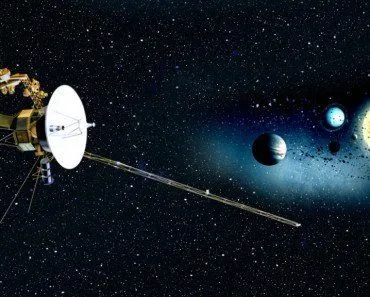
Pluto's distance from Earth varies from about 4.28 billion km (~28.6 AU) at closest approach to about 7.5 billion km (~50 AU) at maximum separation. Its average distance from the Sun is about 5.9 billion km (39.5 AU), with a perihelion of 4.4 billion km and an aphelion of 7.4 billion km. Sunlight takes roughly 5.5 hours to reach Pluto, and NASA's New Horizons spacecraft took 9 years and 5 months to fly past it in July 2015.
The most controversial celestial body in recent years has undoubtedly been the former planet of our solar system, Pluto. Albeit comically, Pluto was ousted as a ‘planet’ and was instead placed in the category of a ‘dwarf planet’ in IAU’s August 24, 2006 resolution. However, this did not deter people’s love for the planet, as NASA’s Administrator Jim Bridenstine came out and said, “Just so you know, in my view, Pluto is a planet”, further adding, “You can write that the NASA Administrator declared Pluto a planet once again. I’m sticking by that, it’s the way I learned it, and I’m committed to it.” Whoa!

Alas, it officially remains a dwarf, regardless of major popular sentiment wanting it to be a planet.

We now consider there to be 8 primary planets in our solar system, but this switch did not diminish the mystique surrounding this cold, icy dwarf planet, one of the most distant celestial objects in our solar system.
About Pluto
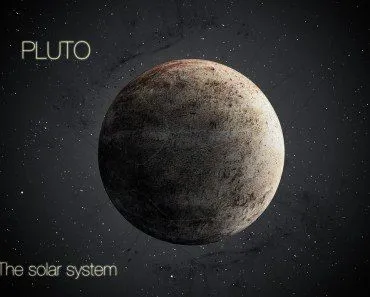
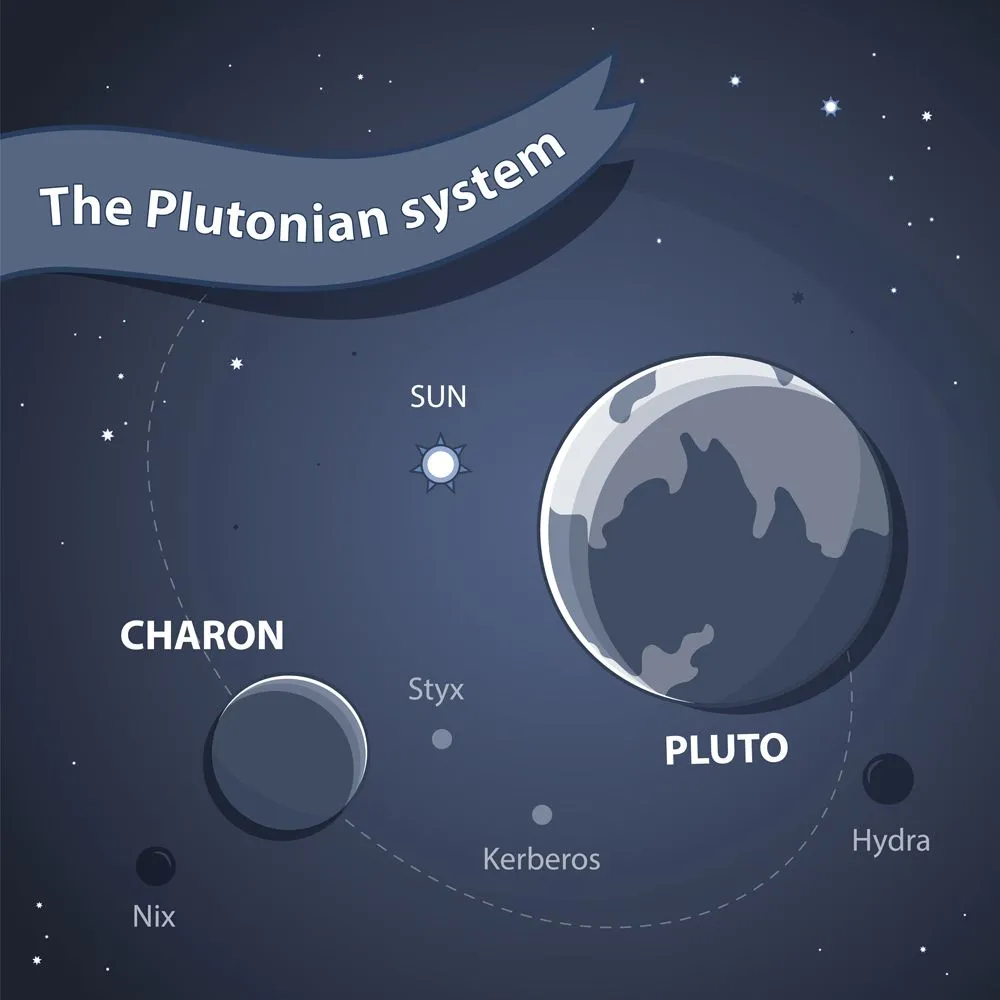
Pluto is the largest dwarf planet we have discovered with rocky mountain ranges and a multi-layered atmosphere composed of carbon monoxide, methane and nitrogen. It mostly contains frozen nitrogen ice, but a recent observation made by the New Horizons probe claims that it has liquid ocean beneath Sputnik Planitia, the western lobe of a heart-shaped region in its terrain, which is mostly frozen ice. Pluto also has five moons: Charon, Kerberos, Styx, Hydra and Nix.
Pluto has wide plains with varied topography that ranges from white and dark orange to charcoal black. It has no magnetic field and is located in the Kuiper Belt (the ring of celestial bodies starting after Neptune’s orbit). Although it is the 9th largest and the 10th most massive known celestial object in our solar system, it is about 1/6th the mass and 1/3rd the volume of our Moon.
The discovery of Pluto has been credited to the American astronomer Clyde Tombaugh in 1930. This was the first object to have been discovered in the Kuiper Belt. It was thought to be larger than Mercury and was considered a planet for about 75 years. However, after the discovery of Pluto’s moon Charon, its mass was more precisely calculated, at which point we realized that it was 20 times smaller than Mercury. After 1992, other celestial objects started being discovered in the Kuiper Belt that were similar to Pluto in terms of attributes, so its planetary status started coming into question.
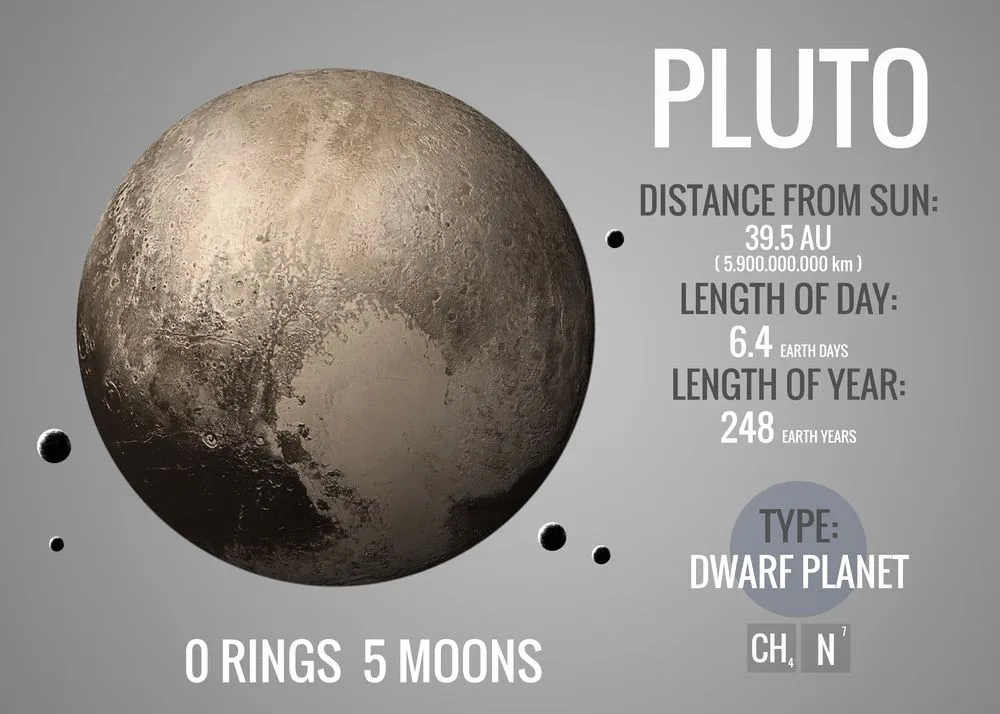
On 24 August 2006, the IAU introduced a new classification called ‘dwarf planets’, at which point Pluto was demoted into this class.
How Far Is Pluto From The Earth?
Pluto takes 248 Earth years to complete one orbit around the Sun and it is about 1,477 miles (2,377 km) wide. However, as far as numbers go, this is nothing compared to how far it is from Earth. The distance between any two celestial objects varies, and there is a time in their orbits when their distance is the least it could be, called perihelion, and a point when it is the furthest apart it can be, called aphelion.
Pluto is an astounding 4.78 billion kilometers at perihelion and 7.5 billion kilometers at aphelion from Earth, a distance so huge that it is incomprehensible for our minds. To give you a reference, Sun is 1.391 million km in diameter, meaning that you could easily fit 5,400 monstrous Suns between Earth and Pluto at their furthest distance apart. If that still doesn’t faze you, the distance between Earth and Pluto is 40 times greater than the distance between the Earth and the Sun (which is one astronomical unit (AU)). If you somehow still remain apathetic to such a gigantic distance, consider this… the last time Pluto was at perihelion with Earth was on September 5th, 1989 and it will reach its next aphelion with Earth on August 23, 2113!
Naturally, it is very far away from the Sun. It has an elliptical orbit around the Sun that is stretched and not completely flat, but rather about 17 degrees tipped from the plane. It is about 4.4 billion kilometers at perihelion (its closest approach to the Sun) and 7.4 billion kilometers at aphelion. Its time-averaged distance from the Sun is about 5.9 billion km (39.5 AU).
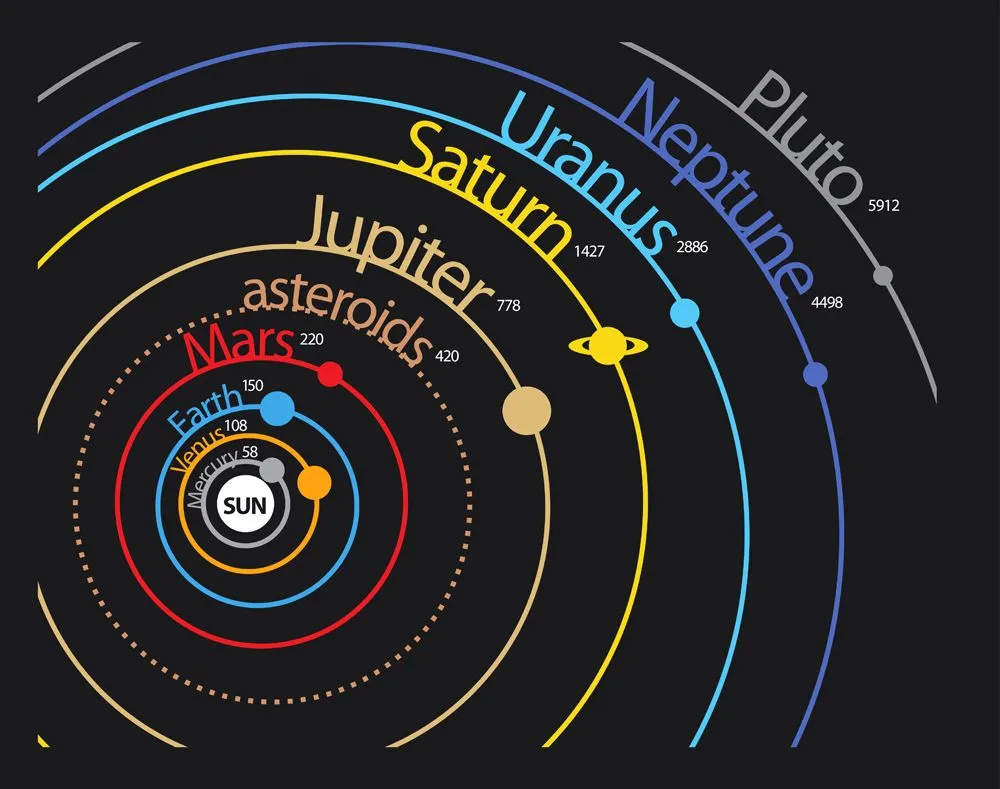
Yet, these vast distances are nothing for the fastest thing in the universe, right? Well, light from the Sun takes about 5.5 hours to travel to Pluto, and from Earth, it would take 4.6 hours to reach the icy planet. This doesn’t seem too much at first, but if you consider humans reaching Pluto someday, it would take 4.6 hours to send them a message from Earth and you would have to wait another 4.6 hours to receive a message back. Definitely not for the impatient!
How Far Is Pluto From Earth In Light-Years?
Because Pluto sits so far away, many people assume its distance is best measured in light-years, the same yardstick we use for stars. That instinct is understandable, but it overshoots the mark by an enormous margin. A light-year is the distance light travels in one year, which works out to about 9.46 trillion kilometers. Pluto simply is not that far.
At its average distance, Pluto is only about 0.0006 light-years from Earth, roughly six ten-thousandths of a single light-year. Depending on where the two bodies sit in their orbits, that figure drifts between about 0.0005 and 0.0008 light-years. Put another way, you would have to lay around 1,600 Earth-to-Pluto trips end to end just to equal one light-year.
This is exactly why astronomers reach for light-hours, not light-years, when talking about objects inside our own solar system. Light from Pluto takes only about 4 to 7 hours to reach us (averaging close to 4.6 hours), rather than years. For comparison, Proxima Centauri, the nearest star beyond the Sun, lies about 4.24 light-years away, which is more than 5,000 times farther than Pluto. Pluto may mark the far edge of our planetary neighborhood, but on the scale of the galaxy it is practically next door.
Why Is Pluto Sometimes Closer To The Sun Than Neptune?
Here is a fact that surprises most people: Pluto is not always the most distant major body from the Sun. Its orbit is unusually stretched, or eccentric (with an eccentricity of about 0.25), carrying it from roughly 30 AU at its closest to about 49 AU at its farthest. Neptune, by comparison, follows an almost perfectly circular path at about 30 AU. Because of this, part of Pluto's orbit actually dips inside Neptune's.

The last time this happened, Pluto was closer to the Sun than Neptune for a full 20 years, from 1979 to 1999. For that stretch, Neptune, not Pluto, was the outermost planet in the solar system.
So why don't the two ever crash into each other? They are locked in what astronomers call a 3:2 orbital resonance: Neptune completes exactly three trips around the Sun for every two that Pluto makes. This gravitational rhythm, combined with Pluto's steep 17-degree orbital tilt, guarantees the two never come closer than about 16 AU to each other. It is a cosmic dance that has kept them safely apart for billions of years.
How Long Will It Take To Reach Pluto?
Given the vast distance between the two planets, it’s quite difficult to consider the possibility of something from Earth reaching anywhere near Pluto, but these distances are nothing compared to the human will.
Nasa’s Pioneer spacecraft took 11 years to cross the distance and Voyager 1 took 12.5 years to cover the same amount of “ground”. Although neither of them flew past Pluto, they give a good estimate as to the time it would take to reach Pluto.
A better estimate can be taken from the New Horizons spacecraft, which was launched on January 19, 2006. It traveled at an average speed of about 50,000 km/h. It flew past Pluto on July 14, 2015, which makes the time it took to reach Pluto about 9 years, 5 months and 25 days. New Horizons also provided a better understanding of the icy planet, giving insights to Pluto’s terrain and a possible liquid ocean existing beneath Sputnik Planitia.
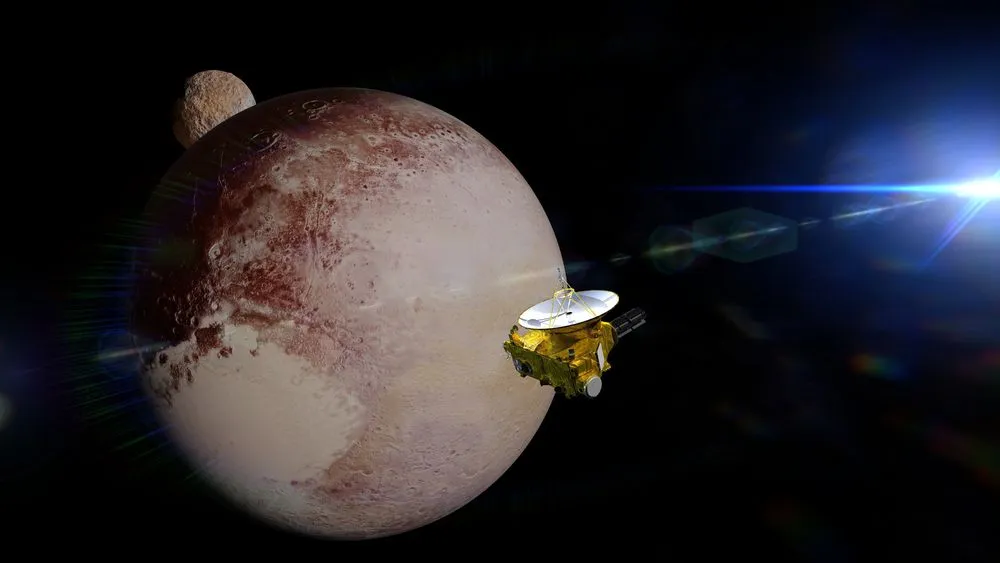
The time it takes to cross that distance may shrink, while faster and cheaper rockets will hopefully make it possible for humans to someday explore Pluto. Maybe then we can finally make up our minds over whether it is a planet or not!
How Long Is A Year And A Day On Pluto?
If you moved to Pluto, you would celebrate your birthday very rarely. Pluto takes about 248 Earth years to make one full lap around the Sun, so a single Plutonian year is longer than any human lifetime. Pluto was discovered in 1930 and has not yet completed even one orbit since then; it will not finish its first observed year until 2178.

A Plutonian day, on the other hand, is far more manageable. Pluto spins once on its axis roughly every 6.4 Earth days (about 153 hours), so a day there lasts a little under a week of our time. Curiously, Pluto rotates in the opposite direction to Earth, a motion astronomers call retrograde, and it is tipped over on its side, with an axial tilt of about 120 degrees. That means the Sun would appear to rise in the west and set in the east, and the poles endure extreme, decades-long seasons as the dwarf planet trundles along its stretched orbit.
References (click to expand)
- Pluto - NASA Science.
- Changes in a scientific concept: what is a planet?.
- How far is Pluto from the Sun?.
- How far is each planet from Earth? (Intermediate) - curious.astro.cornell.edu
- Pluto Facts - NASA Science.
- What Is a Light-Year? - NASA Science.
- The Nearest Neighbor Star - Imagine the Universe!, NASA.
- Ask Astro: Will Pluto and Neptune ever collide? - Astronomy Magazine.