A gravitational slingshot (or gravity assist) lets a spacecraft borrow some of a planet’s orbital motion to gain speed without burning fuel. In the planet’s own frame the probe just curves around it; in the Sun’s frame, by approaching from behind the planet’s direction of motion, the probe steals a tiny sliver of the planet’s kinetic energy. Voyager 1 picked up about 10 km/s at Jupiter and another ~5 km/s at Saturn this way, enough to escape the solar system.
The planets are separated by massive distances. Despite NASA’s most powerful engine at its disposal, calculations showed that Cassini would still be incapable of crossing the ocean of dark space and complete its journey to Saturn. Burning more fuel is not exactly a nifty solution, as rocket fuel is terribly expensive. Behind their glorious qualifications, NASA’s engineers are essentially human beings; they are frugal when it comes to buying a Venti from Starbucks, paying delivery charges or expending rocket fuel. They try to save fuel whenever they can; to achieve this, they often devise idiosyncratic techniques.
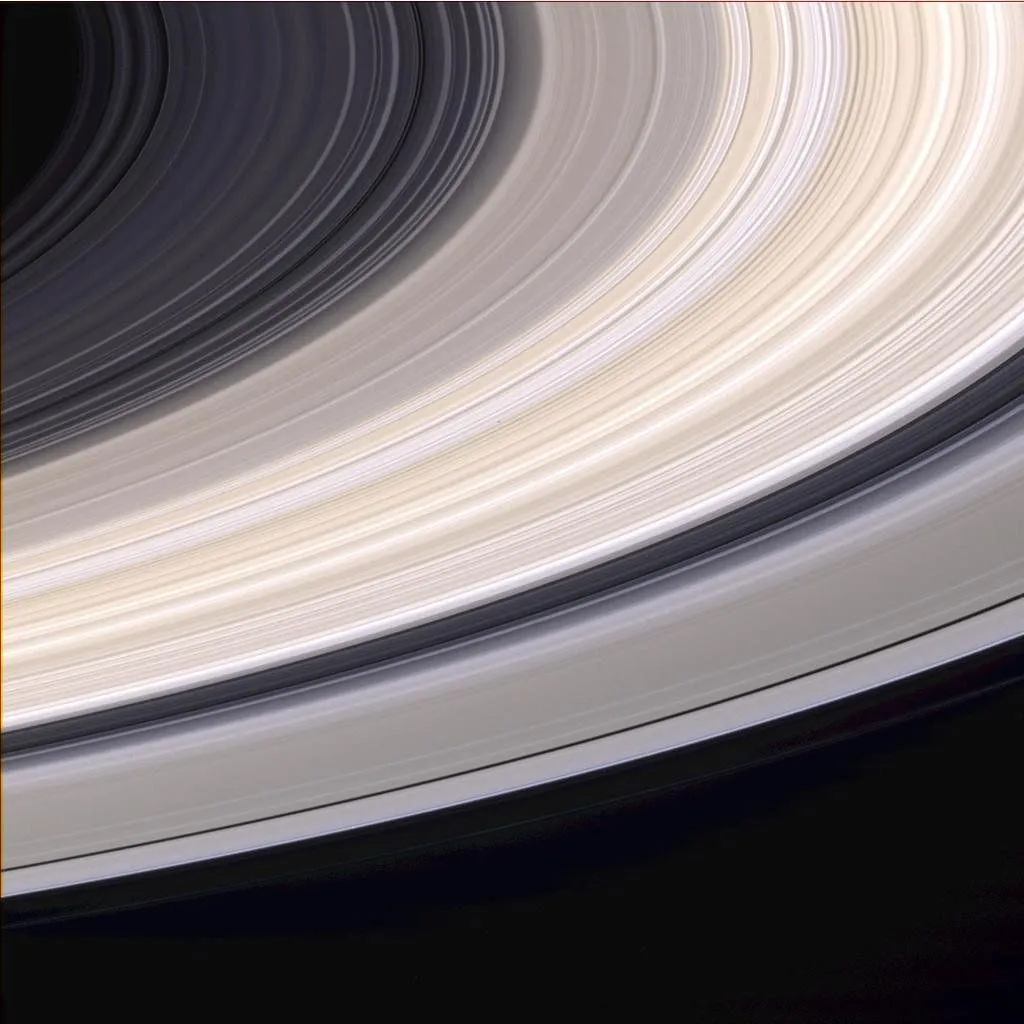
For instance, Cassini did reach Saturn, despite the shortage of firepower. If it weren’t for Cassini, we would be oblivious to the gorgeous rings that hug the gas giant. It was one of those strange techniques, mentioned above, that gave Cassini the extra push. The maneuver is called a gravitational slingshot.
What Is A Slingshot Or Swing-By?
The Sun accounts for roughly 99% of the mass in the entire Solar System. This makes for an exorbitant amount of gravitational pull. This gravitational pull, like terrestrial friction, decelerates probes that travel against it to explore the outer gas giants. However, these probes can be reaccelerated by the same force that bogs them down: the gravity of planets in between can be exploited to “slingshot” these probes and reinvigorate them to finish their set course.
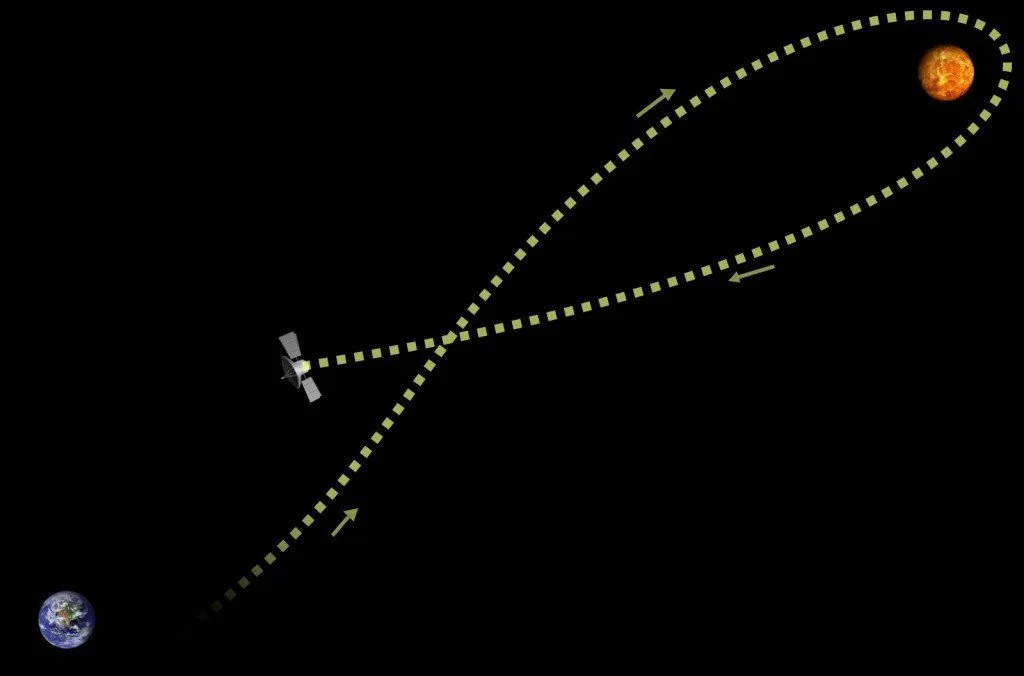
The probes can be flung in the direction of their destination or towards other planets to undergo another or a series of slingshots. The first spacecraft to use a gravity assist of any kind was the Soviet Luna 3 (1959), which used the Moon’s gravity to swing back toward Earth after photographing the far side of the Moon (the side that always faces away from Earth, often colloquially but inaccurately called the “dark side”). The first true interplanetary gravity assist came later, with Mariner 10 swinging past Venus in 1974 on the way to Mercury. In fact, when one of the oxygen tanks on Apollo 13 exploded, the captain aborted the landing and decided to slingshot his way around the moon towards Earth. Despite the rapidly diminishing fuel and the insurmountable odds, the slingshot generated enough energy to bring the crew back home safely.
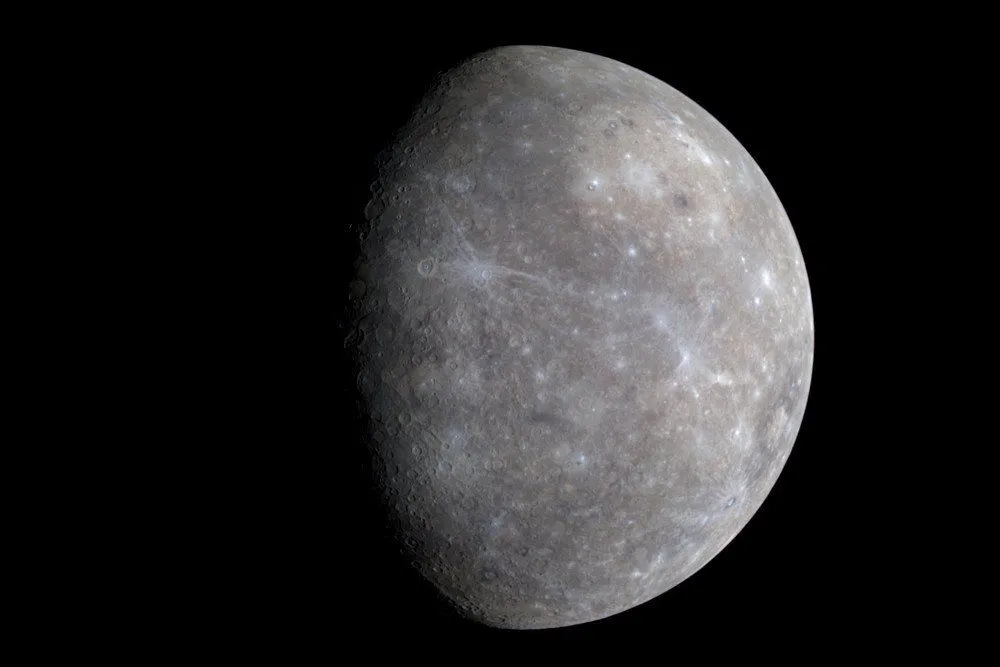
A few decades later, Cassini flew around Venus, Earth and Jupiter before reaching Saturn. Gravity can also be used to decelerate probes that are progressively accelerated by the Sun’s pull as they travel towards the inner, terrestrial planets. It would have been impossible for the MESSENGER to settle in Mercury’s orbit without a couple of swing-bys around Venus, Earth and Mercury itself to lose some of its augmented momentum.
However, there seems to be a slight inconsistency: the maneuver seems to defy the very first commandment of science, the law of conservation of energy. A planet’s gravity digs a steep valley around it, so when a ball enters and rolls down this valley, it gains momentum. That being said, it uses this very same momentum to climb the valley on the other side and escape. The product is sold at the same price it was bought, and the trade produces no profit.
However, the probe does accrue a profit because after exiting the valley, it is accelerated! The system of bodies produces energy out of essentially nothing. The probe accelerates when it travels in the direction of the planet’s motion. The probe cuts in from behind the planet and, as it departs, we observe an abrupt increase in its velocity.

How is this possible?
‘The Probe Steals Some Of The Planet’s Kinetic Energy’
While the planets are stationary from their perspective, they are running in circles from the perspective of the Sun. From the perspective of the planet, or what is formally called its frame of reference, the probe merely changes direction. However, it is from the perspective of the Sun that the probe appears to accelerate or decelerate.
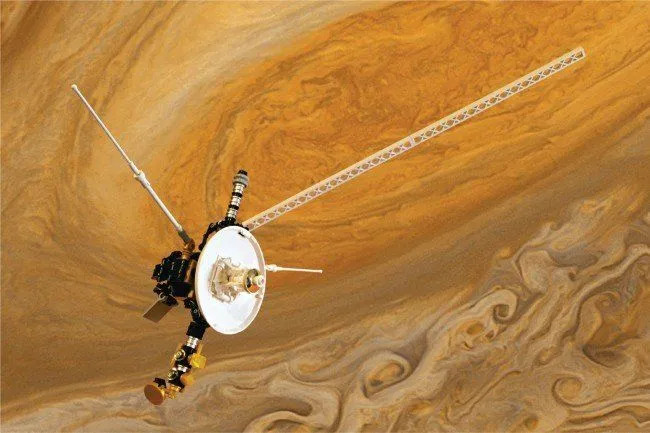
In the Sun’s reference frame, the resulting gain in energy comes at the cost of the planet’s orbital motion. The probe steals some of the planet’s kinetic energy, rendering it immeasurably slowed down. Due to the difference in masses, the retardation is negligible, but even this paltry proportion represents a huge change in the spacecraft’s momentum. In 1979, Voyager 1 slowed down Jupiter’s orbital velocity by roughly 10 to the power of negative 24 kilometers per second. At the same time, the vehicle gained 10 kilometers per second, a dramatic increase in speed!
This finding has a profound implication: if one were to send an enormous army of probes to swing-by a planet, the loss in its orbital energy would be so great that it would eventually collapse into the Sun. Similarly, a probe transfers its energy to a planet when it contacts a planet from the opposite direction. In this case, again, the gain in the planet’s orbital energy is negligible, but the tiny proportion translates to a drastic decrease in the probe’s velocity. This loss allows it to, for example, settle into a planet’s orbit.
Interplanetary Snooker
The procession of events makes it seem like planets and probes are just balls in a game of space snooker. While the planets are the red balls, the probe represents the distinctive cue ball. The cue ball cleverly alters is trajectory by bouncing or deflecting off a few red balls scattered in its path.
However, the efficacy of the shot doesn’t necessarily hinge on the dexterity of the player, which are NASA’s engineers. As the shot can only be played once in a century, its efficacy also comes down to patience – the patience to wait for the right time. The planets do not revolve around the Sun at the same velocity, which renders them misaligned with respect to each other. Now, NASA could either burn excess fuel to cover a larger distance or wait until the planets are conveniently aligned for an economical voyage.
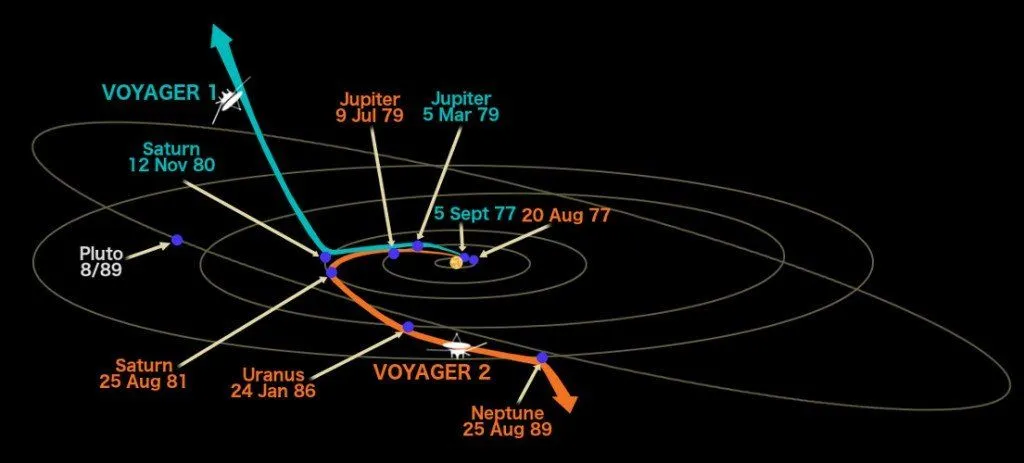
Such an alignment is also liable for gravitational assistance. Voyager 1 and 2 exploited what is called the Grand Tour alignment, an alignment of the outer four planets that occurs only once every 175 years; it will occur next, around 2150. The Voyagers were assisted by every single one of the last four giants to propel further into outer space. However, the right alignment would have been ineffectual if it weren’t for the unprecedented genius of NASA’s engineers, who discerned the angles to the highest degree of precision.
Gravity’s assistance doesn’t just save fuel, but also reduces the duration of a mission. A spacecraft can carry only a limited amount of fuel on its journey; with gravity’s assistance, it achieves extra maneuvering capabilities and course enhancements without expending any extra fuel. Furthermore, the simplicity of the maneuver allows even cheaper, less dynamic rockets to explore celestial bodies or deep space.
Before it became acquainted with Jupiter, Voyager 1 lacked sufficient energy to escape our Solar System. It gained, as mentioned, 10 km/s at Jupiter and an additional 5 km/s at Saturn. If it weren’t for this idiosyncratic technique, Voyager 1 wouldn’t have made it nearly as far – it is the farthest human-made object ever propelled into space. As of 2026 it is roughly 25.8 billion km (about 173 astronomical units) from the Sun, while Voyager 2, which embarked on a slightly different path, is about 21.4 billion km out. Both are now in interstellar space. (For the record, Voyager 1 is no longer the fastest object we have built: in December 2024, NASA’s Parker Solar Probe swept past the Sun at about 192 km/s at perihelion, comfortably more than ten times Voyager 1’s cruise speed.)
Why Is Jupiter The Solar System’s Favorite Slingshot?
If you scan the roll call of famous slingshot missions, one planet keeps showing up: Jupiter. That is no coincidence. Jupiter is by far the most massive planet, weighing in at roughly 318 times the mass of Earth, which is more than twice the mass of every other planet combined. The strength of a gravity assist depends on how deep the planet’s gravity well is and how quickly the planet is barreling along its own orbit, and on both counts Jupiter is unrivalled. It carves the deepest gravitational valley of any planet, and it sweeps around the Sun at about 13 km/s, so a probe that dives in from behind can steal a generous helping of that orbital motion.

So if you were handed the four outer giants (Jupiter, Saturn, Uranus and Neptune) and asked which one hands out the biggest free boost, the answer is Jupiter, and it is not close, because it packs the most mass and the strongest pull. That is why the planet has served as a springboard for a remarkable roster of spacecraft. Pioneer 10 became the first probe to use Jupiter’s gravity to reach solar escape velocity in 1973, and Pioneer 11 swung past a year later on its way to Saturn. Voyager 1 and 2 took their celebrated kicks in 1979. Ulysses used a 1992 Jupiter flyby to fling itself clean out of the flat plane in which the planets orbit, so that it could fly over the Sun’s poles; here the assist changed direction rather than simply adding speed. Cassini borrowed a boost in 2000 en route to Saturn, and New Horizons picked up about 4 km/s at Jupiter in 2007, a shove that trimmed roughly three years off its journey to Pluto.
How Fast Is Voyager 1 Traveling Now?
Once those Jupiter and Saturn assists had pushed Voyager 1 safely past the Sun’s escape velocity, the probe settled into a long, quiet coast. Today it is receding from the Sun at about 17 km/s, which works out to roughly 61,000 km/h (about 38,000 mph). That makes it the fastest-departing spacecraft ever built; Voyager 2, which took a gentler route past Uranus and Neptune, trails a little behind at about 15 km/s. The Sun’s gravity still tugs faintly on both probes, bleeding away a tiny fraction of their speed, but neither will ever be pulled back.

It is worth being precise about the record. Voyager 1 is not the fastest object humanity has ever launched (as noted above, the Parker Solar Probe whips past the Sun far faster), but nothing else is leaving the solar system as quickly. That steady 17 km/s has carried Voyager 1 more than 25 billion km from home. In November 2026 it is set to become the first human-made object a full light-day from Earth, meaning a radio signal from the probe, travelling at the speed of light, now takes the better part of a day, around 23 hours, to reach us.
References (click to expand)
- Voyager Mission. NASA Jet Propulsion Laboratory.
- Gravity Assist. The Planetary Society.
- Gravity assist (overview, history, examples). Wikipedia.
- Grand Tour program (175-year outer-planet alignment). Wikipedia.
- NASA’s Parker Solar Probe Makes History With Closest Pass to Sun (24 Dec 2024). NASA.
- Jupiter Fact Sheet (mass ~318 Earth masses, mean orbital velocity 13.1 km/s). NASA NSSDCA.
- Voyager 1 (heliocentric recession speed ~17 km/s). Wikipedia.
- New Horizons (Jupiter gravity assist, Feb 2007, +4 km/s). Wikipedia.
- Ulysses (1992 Jupiter flyby out of the ecliptic to study the Sun's poles). NASA.