Table of Contents (click to expand)
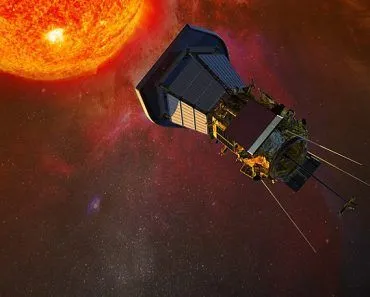
A space probe is an unmanned, robotic spacecraft sent to explore other planets or interstellar space. Distant probes like Voyager 1 are guided by ground teams using NASA’s Deep Space Network. Commands sent by radio take almost a day each way, so navigators rely on pre-planned trajectories and small thruster firings called trajectory correction maneuvers (TCMs) to keep a probe on course.
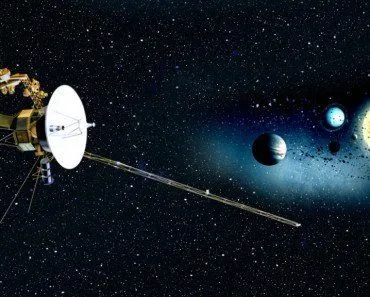
You might already know that the man-made object that has gone farthest in space is Voyager 1. Launched by NASA in 1977, it crossed the heliopause in 2012 to become the first space probe to enter the interstellar medium. It has now been flying for nearly 49 years (you can check its current location and instrument status on NASA’s Voyager “Where Are They Now?” page). Its twin, Voyager 2, was also launched in 1977 and remains the only spacecraft to have visited either of the ice giants, Uranus (in 1986) and Neptune (in 1989).
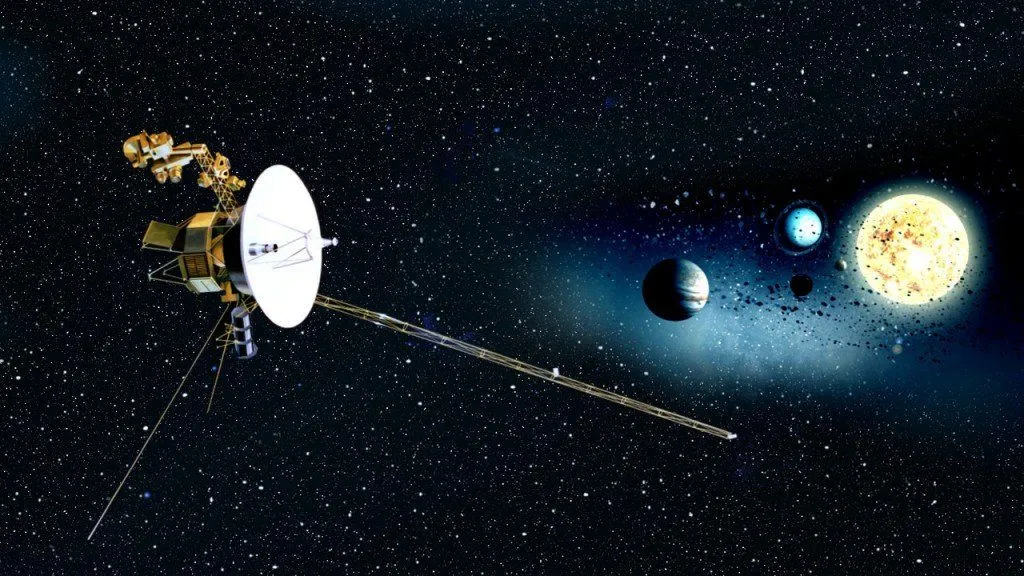
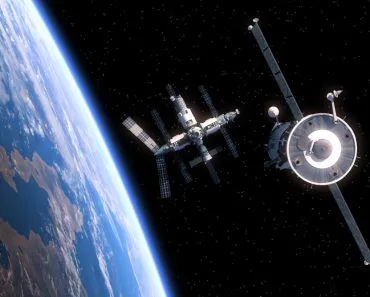
There are a few other space probes that have reached, or are about to reach, the ‘boundary’ of our solar system, which is extremely far away, as you can imagine. Now, space probes, by definition, are robotic spacecraft, meaning that they don’t have humans onboard. Therefore, naturally, such space probes are guided by dedicated units of trained ‘space’ personnel on the ground.
Communication With Distant Space Probes
As mentioned earlier, these space probes keep flying away from Earth and are now millions and millions of miles away. Even so, we are able communicate with these space probes through radio waves, which are a type of electromagnetic radiation, and therefore travel at the speed of light. (Read more about communication with space probes here: How Do Space Probes Send Signals To Earth?)
That being said, just as light from the sun takes 8 minutes to reach the Earth, radio signals from space probes also take time… a lot of it! For instance, Voyager 1 is now roughly 15.7 billion miles (25.3 billion km) away, and a one-way signal from it takes about 23 hours and 33 minutes to reach Earth. Late in 2026 it will become the first spacecraft to put a full light-day between itself and us, meaning a command sent today would not arrive for a full 24 hours.
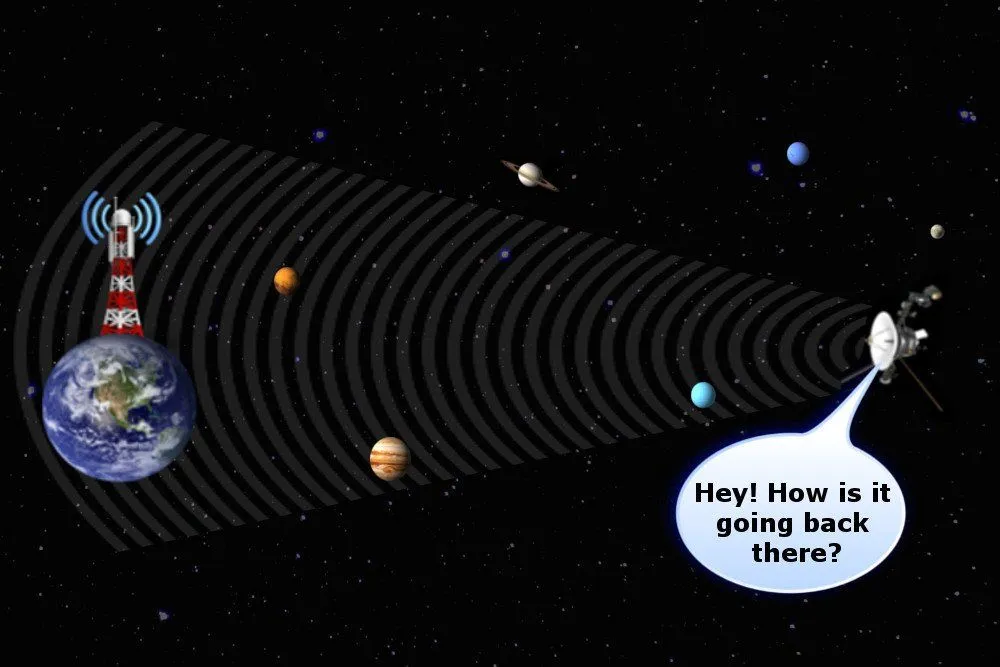
Now, we know that space probes are controlled by ground units back on Earth, and we also know that it takes almost a day for a signal sent by us to reach those probes. With that in mind, how are space probes guided or course-corrected if there is such a huge input lag?
Space Is Mostly Empty
No matter what movies and TV shows have led you to believe about spacecraft dodging a dense network of asteroids and other clusters of dangerous, tightly-packed celestial bodies, one unmistakable truth of life is that space is mostly empty (Source).

It’s not like space probes have to navigate tight spaces between adjacent celestial bodies; they also never run too close to any celestial object to be able to be affected by its gravity.
Routes Of Space Probes Are Predictable
Astronomers and space personnel put in a huge amount of effort (months or even years or work) to design the course that a space probe takes. Since they know the relative positions of many members of our solar system, they do tons of calculations to determine routes for a space probe where it will encounter little or no surprises.
Astronomers know exactly what path their space probe follows, so they can predict the probe’s future encounters with other objects well in advance. Suppose that astronomers observe that a comet is approaching their probe. Since such comets and other celestial objects are usually detected when they’re still thousands of miles away from the probe, ground personnel have ample time to readjust the probe’s course so that the object flies by without impacting the probe in any way.
That’s why an input lag of nearly a day is not a problem for guiding space probes like Voyager 1 and Voyager 2. If, however, a probe did encounter an object that suddenly appeared in its path out of thin air, a nearly day-long input lag would certainly be cause for concern!
How Are Course Corrections Actually Made?
So how does a command actually reach the probe, and how does the probe nudge itself onto a slightly different path? The trick is a piece of hardware on the ground and a piece of hardware on the spacecraft.
The ground side is NASA’s Deep Space Network (DSN), a trio of giant radio-antenna complexes spaced roughly 120 degrees apart around the planet (in Goldstone, California; near Madrid, Spain; and outside Canberra, Australia). Because they’re spread around the globe, at least one of them is always pointed at a given probe as the Earth turns. The DSN sends commands up, receives the probe’s downlink, and (importantly) measures the probe’s position. By looking at the Doppler shift of the carrier signal, navigators can pin down the probe’s line-of-sight velocity to a fraction of a millimeter per second; by timing how long a special ranging tone takes to bounce back, they can pin down its distance to roughly a meter. That is how we know where Voyager 1 is, down to a hair, even though it’s 15 billion miles away.
The spacecraft side is a set of small hydrazine thrusters. When the navigators decide the probe has drifted a touch, they schedule a short burn called a Trajectory Correction Maneuver, or TCM. These are not the dramatic, full-throttle burns you see in movies. A typical TCM changes the probe’s velocity by a few meters per second (NASA’s OSIRIS-REx asteroid mission once made a course tweak of just 1.1 mph using a 12-second burn and about 18 ounces of fuel). The command travels up at the speed of light, the probe fires the thrusters for a precisely timed interval, and the new trajectory bends gently onto the desired path.
For long interplanetary trips, the cleverest course corrections aren’t made by the probe at all. They’re made by other planets. A gravity assist (or “slingshot”) lets a probe steal a sliver of a planet’s orbital momentum during a close flyby, gaining speed and a new heading without burning any extra fuel. Voyager 1 used Jupiter in 1979 to slingshot toward Saturn, and another assist at Saturn in 1980 flung it out of the solar system entirely. Voyager 2 daisy-chained four such assists (Jupiter, Saturn, Uranus, Neptune), thanks to a once-in-175-years alignment of the outer planets. Most of the “guiding”, in other words, was baked into the launch trajectory; the TCMs just keep the probe honest.
References (click to expand)
- NASA NSSDC - Voyager 1 Trajectory Details. nssdc.gsfc.nasa.gov
- The Voyager Spacecraft. NASA Science.
- Where Are They Now? Voyager Mission Status. NASA Science.
- Chapter 18: Deep Space Network. NASA Basics of Space Flight.
- Chapter 13: Navigation (Doppler tracking, ranging, and trajectory correction maneuvers). NASA Basics of Space Flight.
- UI instrument aboard Voyager 1 spacecraft marks 40 years of discovery. The University of Iowa.
- The Voyager Probes: A 35 Year Galactic Road Trip. Harvard University.
- Voyager 1 Spotted from Earth with NRAO's VLBA and GBT. nrao.edu.